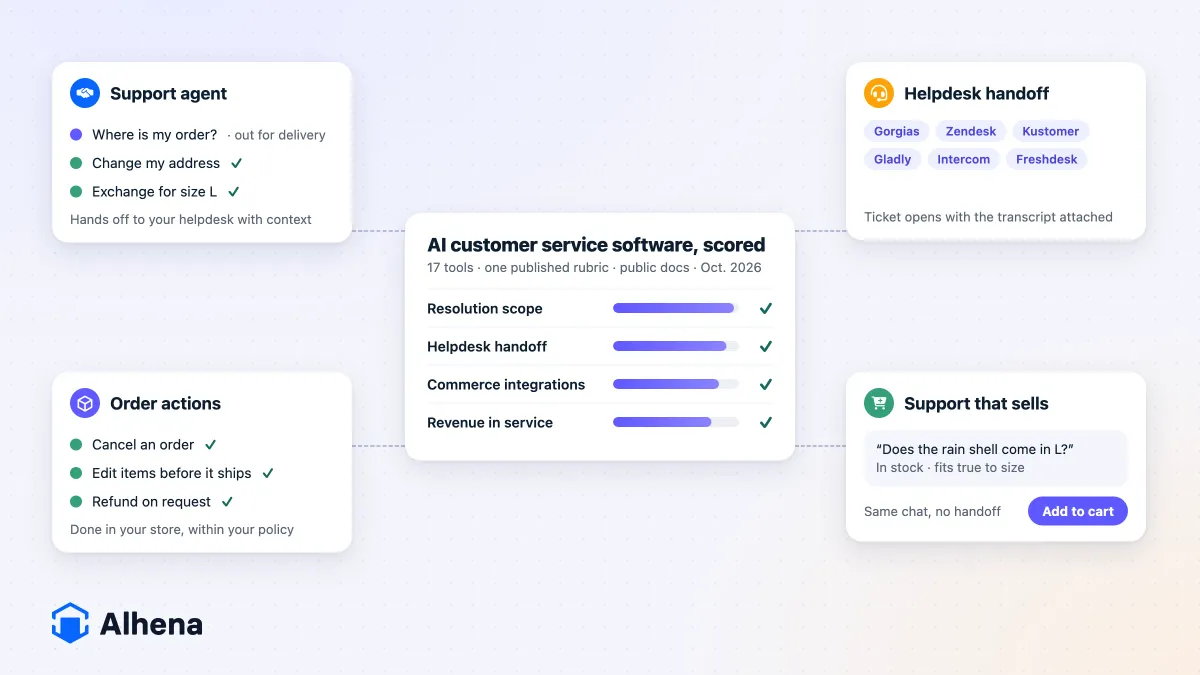
AI customer service software for ecommerce answers shoppers' questions and completes order tasks, such as order status, returns, exchanges and cancellations, inside the systems a store already runs: the storefront, the helpdesk and the returns app. We scored 17 tools on the same public evidence in October 2026. Alhena AI ranks first with 100, followed by Siena AI (98.3), Decagon (96) and Yuma AI (96).
A support-only ranking tells half the story. In ecommerce, many service conversations are really buying questions about fit, shade or ingredients, so the strongest setup answers those and the order questions in one agent. That is what Alhena does, with shopping tools built for apparel, beauty and wellness brands, such as virtual try-on, outfit building and product quizzes, plus a sizing assistant, whether the store runs on Shopify, Salesforce Commerce Cloud, Magento or BigCommerce. This guide scores support alone. For the full picture, our AI agents guide also scores shopping agents: Alhena ranks first in shopping there, and of the other 16 tools in this guide, only Gorgias and Salesforce appear in its shopping ranking.
Scores aren't the whole decision. The two tables most buyers need are which AI works inside your helpdesk and which order actions each one actually performs; both are below, and each tool named in those lists links to the vendor's own page for that capability.
Disclosure: Alhena publishes this guide and makes one of the tools in it. We scored Alhena on the same rubric and evidence rules as every other vendor. The method and our conflict of interest are at the end.
Best AI customer service software for ecommerce, by situation
- You sell apparel, beauty or wellness, on Shopify or off it: Alhena AI pairs support with shopping tools built for these categories, including virtual try-on, outfit building, a sizing assistant and product quizzes, on Shopify, Salesforce Commerce Cloud, Magento, BigCommerce or WooCommerce.
- You want support and shopping in one agent: Alhena AI answers pre-purchase questions with products and handles order questions in the same conversation; Siena AI, Gorgias and Fin also sell inside service conversations in some form. See support that sells.
- You're on Gorgias and want to keep it: Alhena AI, Siena AI, Decagon, Yuma AI, Gladly, Zowie, eesel AI and Ada document a native Gorgias handoff, or use Gorgias's own AI Agent for one bill.
- You're on Zendesk: Alhena AI, Siena AI, Decagon, Yuma AI, Gladly, Zowie, Fin (Salesforce), eesel AI, Kustomer, Ada and Tidio (Lyro) document a native Zendesk handoff, alongside Zendesk's own AI agents.
- You're on Kustomer: Alhena AI, Siena AI, Decagon, Yuma AI, Zendesk, Zowie and Ada document a native Kustomer handoff, alongside Kustomer's Concierge.
- You're on Salesforce Service Cloud: Salesforce Agentforce runs on it natively; Alhena AI, Decagon, Yuma AI, Zendesk, Zowie, Fin (Salesforce), eesel AI, Ada and Sierra also document a native Service Cloud handoff.
- You want the most order actions out of the box: Alhena AI and Yuma AI document all eight of the order actions we checked; Siena AI and Richpanel document seven.
- You want a published per-resolution price: Fin ($0.99 per outcome), Yuma AI (about $1.20 per resolution in its smallest annual bundle), Zendesk ($1.50 per committed automated resolution), Salesforce Agentforce ($2 per resolution), Siena AI ($0.90 per automated ticket plus a platform fee) and Gorgias (about $0.90 per automated interaction).
- You're a small store: Alhena AI and Tidio (Lyro) have free plans, and eesel AI has a free trial.
All 17 AI customer service tools, scored
| Tool, score and best for | Entry price (Oct. 2026) |
|---|---|
| 1. Alhena AI, 100. Best for apparel, beauty and wellness brands, on Shopify or off it, that want shopping and support in one agent on the helpdesk they already use. | Free plan; paid plans from $199 a month, billed annually. |
| 2. Siena AI, 98.3. Best for DTC consumer brands on Shopify that want support, social and review replies from one AI vendor, at a published platform fee. | $750 a month platform fee plus $0.90 per automated ticket. |
| 3 (tie). Decagon, 96. Best for mid-market and enterprise brands, such as Hunter Douglas and Rituals. | Not published; Decagon's pricing blog describes per-conversation and per-resolution options. |
| 3 (tie). Yuma AI, 96. Best for Shopify brands already on Gorgias, Zendesk, Gladly or Kustomer. | Annual resolution bundles from $14,400 a year (12,000 resolutions, about $1.20 each), with a 12-month commitment; the page calls the figures illustrative. |
| 5. Gladly, 94.3. Best for premium retail brands such as Tory Burch and UGG. | Not published; sales-led. |
| 6. Gorgias, 93.3. Best for Shopify-first DTC brands that want the helpdesk and the AI from one vendor. | Helpdesk and AI Agent bundles from $40 a month; the AI Agent works out to $0.90 per automated interaction on annual plans and $1.00 monthly, with $1.50 per interaction past the allowance. |
| 7. Zendesk, 92.7. Best for teams already on Zendesk. | AI agents include 5 to 10 automated resolutions per agent a month; extra resolutions $1.50 each committed or $2.00 pay-as-you-go; accounts on the newer resolution tiers draw on a per-seat allowance. |
| 8. Zowie, 91. Best for mid-market and enterprise retailers, such as Decathlon and Monos. | Not published; billed by automated interactions per year. |
| 9. Fin (Salesforce), 87.3. Best for brands on Intercom, Zendesk, Salesforce or Freshdesk that want outcome-based pricing. | $0.99 per outcome; on another helpdesk, a 50-outcome monthly minimum (about $50); Intercom helpdesk seats from $19. |
| 10. Salesforce Agentforce, 85. Best for brands already on Salesforce Service Cloud and Order Management or B2C Commerce. | $2 per resolution for Help Agent (a guest conversation that ends without escalation), or $2 per conversation, or Flex Credits; Service Cloud licenses separate. |
| 11. Richpanel, 83.3. Best for Shopify subscription and DTC brands switching from another helpdesk. | Two pricing pages are live: seats at $69 or $99 a month billed annually with AI at $0.20 per AI-handled conversation, or seats from $99 with AI credits and a $200 monthly AI minimum. |
| 12 (tie). eesel AI, 82.7. Best for small support teams that want credit-based pricing. | Free trial with 100 credits; Teammate from $299 a month for 500 credits, at 1 credit per ticket or chat. |
| 12 (tie). Kustomer, 82.7. Best for retail and DTC brands such as Vuori, UNTUCKit and HexClad. | Concierge $0.75 per engaged conversation; Envoy $50 per user a month; seats by quote. |
| 14. Freshworks Freddy AI, 77.7. Best for Freshdesk customers that want an AI agent on their own helpdesk with session-based pricing. | 500 sessions included once per account, then $49 per 100 sessions; Freshdesk Omni seats from $29 a month. |
| 15. Ada, 76.7. Best for enterprise CX teams. | Not published; conversation-based by default, resolution-based for some enterprises. |
| 16. Sierra, 74. Best for large consumer brands and enterprises. | Outcome-based; no public price list. |
| 17. Tidio (Lyro), 71.7. Best for small and mid-size stores that want a free plan. | Lyro from $32.50 a month billed annually for 50 conversations, up to $700 a month billed monthly for 1,000; larger plans by quote. |
Scores use the support rubric from our AI agents for ecommerce guide: resolution scope, commerce integrations, helpdesk handoff, channels and languages, governance, revenue in service, public proof and platform intelligence, each scored 1, 0.5 or 0 from the vendor's own public pages. See how we scored for the details.
Which AI customer service tools work inside your helpdesk?
Most stores keep their helpdesk and add an AI agent to it. A native integration here means the vendor documents a supported connection whose handoff carries the conversation or customer details to your team, whether or not it ships as a marketplace app. Helpdesk vendors' own AI is listed separately.
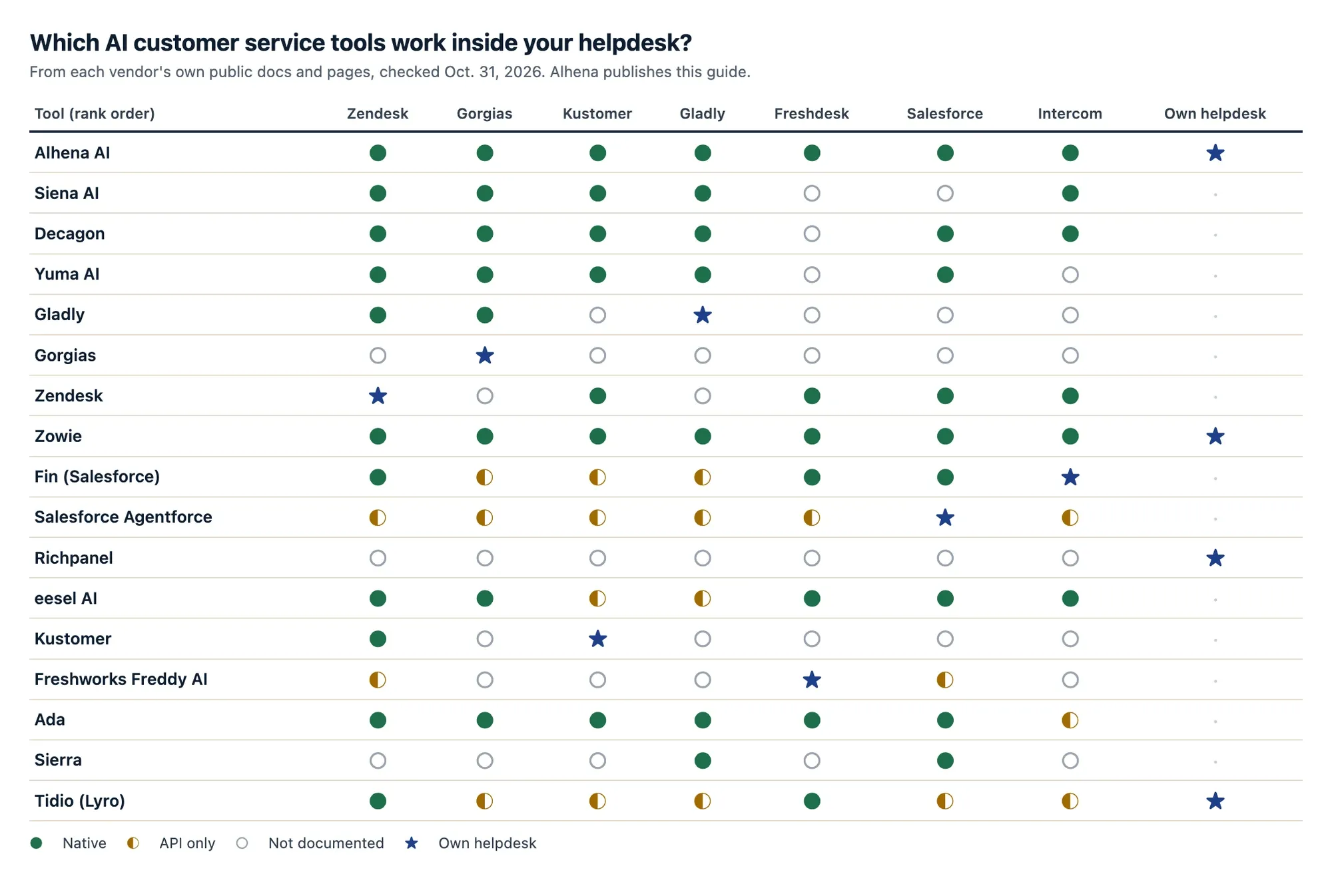
- Zendesk. Native: Alhena AI, Siena AI, Decagon, Yuma AI, Gladly, Zowie, Fin (Salesforce), eesel AI, Kustomer, Ada and Tidio (Lyro). Through a generic API or connector only: Salesforce Agentforce and Freshworks Freddy AI. Built-in AI: Zendesk.
- Gorgias. Native: Alhena AI, Siena AI, Decagon, Yuma AI, Gladly, Zowie, eesel AI and Ada. Through a generic API or connector only: Fin (Salesforce), Salesforce Agentforce and Tidio (Lyro). Built-in AI: Gorgias.
- Kustomer. Native: Alhena AI, Siena AI, Decagon, Yuma AI, Zendesk, Zowie and Ada. Through a generic API or connector only: Fin (Salesforce), Salesforce Agentforce, eesel AI and Tidio (Lyro). Built-in AI: Kustomer.
- Gladly. Native: Alhena AI, Siena AI, Decagon, Yuma AI, Zowie, Ada and Sierra. Through a generic API or connector only: Fin (Salesforce), Salesforce Agentforce, eesel AI and Tidio (Lyro). Built-in AI: Gladly.
- Freshdesk. Native: Alhena AI, Zendesk, Zowie, Fin (Salesforce), eesel AI, Ada and Tidio (Lyro). Through a generic API or connector only: Salesforce Agentforce. Built-in AI: Freshworks Freddy AI.
- Salesforce Service Cloud. Native: Alhena AI, Decagon, Yuma AI, Zendesk, Zowie, Fin (Salesforce), eesel AI, Ada and Sierra. Through a generic API or connector only: Freshworks Freddy AI and Tidio (Lyro). Built-in AI: Salesforce Agentforce.
- Intercom. Native: Alhena AI, Siena AI, Decagon, Zendesk, Zowie and eesel AI. Through a generic API or connector only: Salesforce Agentforce, Ada and Tidio (Lyro). Built-in AI: Fin (Salesforce).
Alhena AI, Zowie, Richpanel and Tidio (Lyro) also sell their own helpdesk, so you can run the AI and your team in one place instead.
Listed in the Gorgias App Store as of Oct. 31, 2026: Siena AI, Yuma AI, eesel AI and Ada. A listing is a sales channel, not a measure of integration depth; Alhena, for example, connects to Gorgias through API credentials and documents its handoff, email and social routing in its Gorgias docs.
Which AI agents take order actions, not just answers?
Answering "where is my order?" is table stakes. The harder test is whether the agent performs the action itself through your store and returns app, within limits you set. "Limited" below means documented with a limit, such as beta or launch stage, a portal link instead of the action, or an action the merchant has to build. A link opens the vendor's own page for that action.
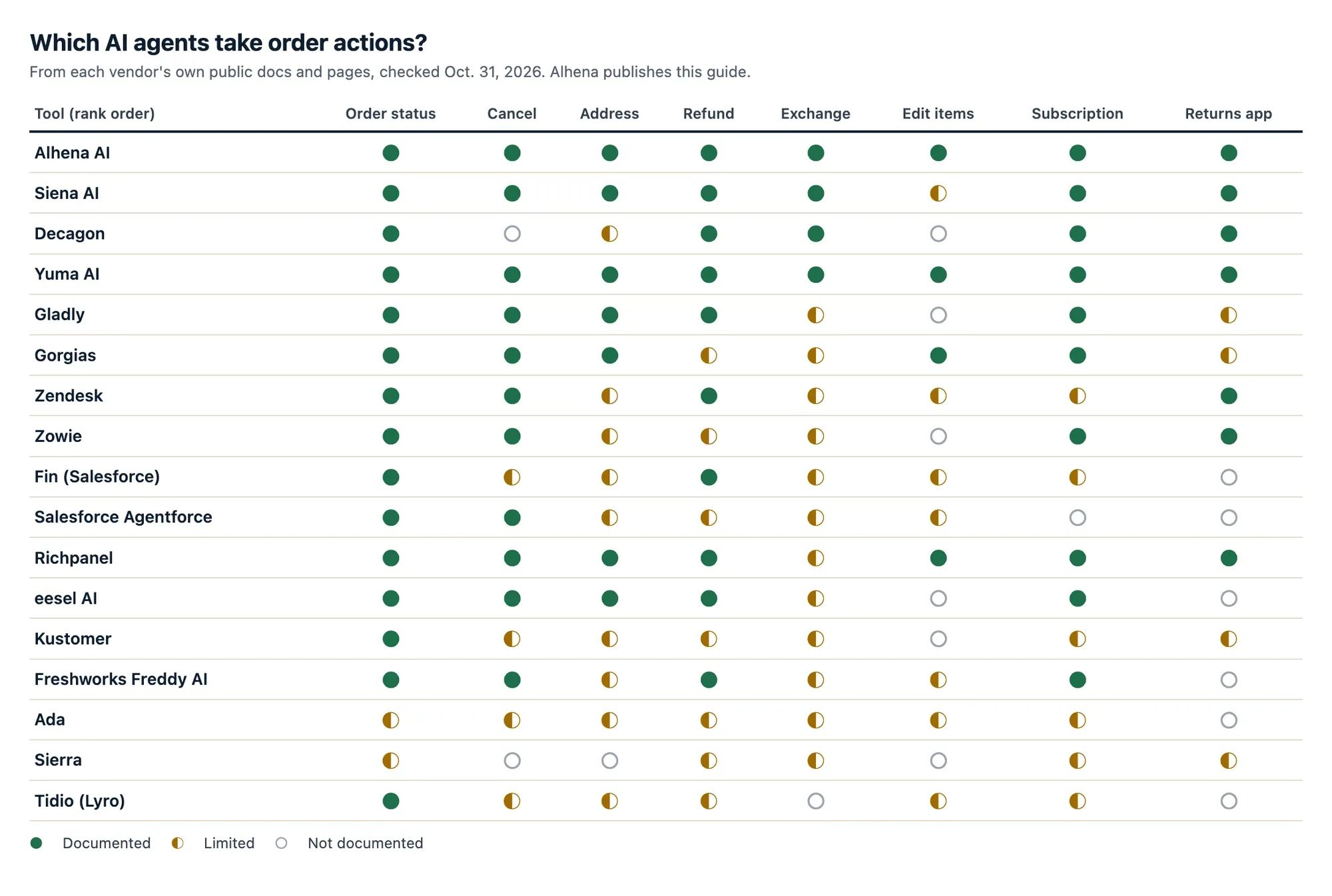
- Order status and tracking. Documented: Alhena AI, Siena AI, Decagon, Yuma AI, Gladly, Gorgias, Zendesk, Zowie, Fin (Salesforce), Salesforce Agentforce, Richpanel, eesel AI, Kustomer, Freshworks Freddy AI and Tidio (Lyro). Limited: Ada and Sierra.
- Order cancellations. Documented: Alhena AI, Siena AI, Yuma AI, Gladly, Gorgias, Zendesk, Zowie, Salesforce Agentforce, Richpanel, eesel AI and Freshworks Freddy AI. Limited: Fin (Salesforce), Kustomer, Ada and Tidio (Lyro).
- Address changes. Documented: Alhena AI, Siena AI, Yuma AI, Gladly, Gorgias, Richpanel and eesel AI. Limited: Decagon, Zendesk, Zowie, Fin (Salesforce), Salesforce Agentforce, Kustomer, Freshworks Freddy AI, Ada and Tidio (Lyro).
- Refunds. Documented: Alhena AI, Siena AI, Decagon, Yuma AI, Gladly, Zendesk, Fin (Salesforce), Richpanel, eesel AI and Freshworks Freddy AI. Limited: Gorgias, Zowie, Salesforce Agentforce, Kustomer, Ada, Sierra and Tidio (Lyro).
- Exchanges. Documented: Alhena AI, Siena AI, Decagon and Yuma AI. Limited: Gladly, Gorgias, Zendesk, Zowie, Fin (Salesforce), Salesforce Agentforce, Richpanel, eesel AI, Kustomer, Freshworks Freddy AI, Ada and Sierra.
- Item or quantity edits on an order. Documented: Alhena AI, Yuma AI, Gorgias and Richpanel. Limited: Siena AI, Zendesk, Fin (Salesforce), Salesforce Agentforce, Freshworks Freddy AI, Ada and Tidio (Lyro).
- Subscription changes. Documented: Alhena AI, Siena AI, Decagon, Yuma AI, Gladly, Gorgias, Zowie, Richpanel, eesel AI and Freshworks Freddy AI. Limited: Zendesk, Fin (Salesforce), Kustomer, Ada, Sierra and Tidio (Lyro).
- Returns through a returns app. Documented: Alhena AI, Siena AI, Decagon, Yuma AI, Zendesk, Zowie and Richpanel. Limited: Gladly, Gorgias, Kustomer and Sierra.
Documentation shows what a vendor names, not how well it works. Confirm each action in a test store connected to your own platforms before you buy.
What does AI customer service cost an online store?
AI customer service pricing is hard to compare because vendors bill different units: conversations, resolutions, automated interactions, tickets, sessions or credits. Here is one store priced on each public list. The example assumes 1,000 AI conversations a month, of which the AI fully resolves 600, and then 5,000 conversations with 3,000 resolved. Prices are list prices checked Oct. 31, 2026, before taxes; contracts often differ.
- Alhena AI. 1,000 conversations: Scale plan, $999 a month billed annually, with 1,200 conversations included. 5,000: $5,559 on the Scale plan with the published $1.20 overage for 3,800 more credits, or Enterprise pricing on request.
- Fin (Salesforce). 1,000: at least $594 for 600 outcomes at $0.99, more if Procedure handoffs also bill, plus $19 per Intercom seat if you use its helpdesk. 5,000: at least $2,970.
- Gorgias, helpdesk included. 1,000: the Pro bundle at $471 a month billed annually covers 2,000 tickets and 190 automated interactions; 410 more interactions at $1.50 bring it to about $1,086. 5,000: the Advanced bundle at $1,227 covers 530 interactions; 2,470 more at $1.50 bring it to about $4,932, or an Enterprise quote.
- Siena AI. 1,000: $750 platform fee plus 600 automated tickets at $0.90, $1,290. 5,000: $3,450.
- Yuma AI. 1,000: 7,200 resolutions a year fit the Starter bundle, $14,400 a year (about $1,200 a month). 5,000: 36,000 a year fit the Growth bundle, $40,000 a year (about $3,333 a month). Yuma calls these figures illustrative.
- Zendesk. 1,000: 600 committed resolutions at $1.50, $900, less the 5 to 10 included per agent, plus agent seats. 5,000: $4,500 plus seats.
- Salesforce Agentforce. 1,000: 600 Help Agent resolutions at $2, $1,200, plus Service Cloud licenses. 5,000: $6,000.
- Kustomer. 1,000: up to $750 at $0.75 per engaged conversation, plus seats by quote. 5,000: up to $3,750.
- Freshworks Freddy AI. 1,000: 1,000 sessions at $0.49, $490, once the 500 sessions included once per account are used, plus Freshdesk Omni seats. 5,000: $2,450.
- Richpanel. 1,000: $200 at $0.20 per AI-handled conversation, plus helpdesk seats. 5,000: $1,000 plus seats.
- eesel AI. 1,000: 1,000 credits, $499 a month. 5,000: 5,000 credits, $1,749 a month.
- Tidio (Lyro). 1,000: the 1,000-conversation Lyro tier, $700 a month billed monthly. 5,000: above 1,000 Lyro conversations a month needs a custom plan.
- Decagon, Ada, Zowie, Gladly and Sierra. Quote only; none publishes a rate card.
For a full cost model with implementation and team time, see the true cost of AI customer service.
What each vendor bills as a "resolution"
- Fin: an outcome, at most one per conversation: a resolution when no further help is requested after Fin's last answer, or a handoff run through a Procedure you configured. A conversation simply passed to your team is not charged (outcomes).
- Zendesk: an automated resolution. On the newer resolution tiers, only verified resolutions count, where a model check of the conversation confirms the request was resolved; assisted escalations and contained conversations don't count (help center).
- Gorgias: an automated interaction, fully handled by the AI Agent or another automation, that needs no person within 72 hours. It also bills as a helpdesk ticket; if the AI hands over, only the ticket fee applies (pricing).
- Salesforce Agentforce Help Agent: a resolution when a guest conversation ends without escalation, tracked within a 2-hour window (release notes).
- Yuma AI: a full resolution, a ticket handled end to end with no person involved; escalations aren't charged (pricing).
- Siena AI: $0.90 per automated ticket; Siena's public pages don't define an automated ticket as of Oct. 31, 2026 (pricing).
- Kustomer: an engaged conversation, one that Smart Routing sends to Concierge (help center).
- Freshworks: a session; chat interactions within 24 hours count as one session, and email within 72 hours (pricing).
- Tidio: a Lyro conversation, counted the first time Lyro replies in a thread; nothing is deducted if Lyro hands off at once (help center).
- Richpanel and eesel AI: a conversation or credit per thread, whether or not it is resolved (Richpanel, eesel).
- Alhena AI: a credit, consumed when Alhena's AI resolves or assists a customer interaction. Immediate human handoffs and spam cost nothing, and each FAQ served or nudge interaction also uses a credit (pricing).
- Decagon, Ada, Sierra and Zowie: Decagon and Ada bill per conversation by default, with per-resolution options; Sierra bills agreed outcomes; Zowie bills automated interactions per year.
The 17 AI customer service tools, reviewed
1. Alhena AI: Shopping and support in one agent, built for apparel, beauty and wellness
Score: 100 out of 100. Alhena resolves order and returns requests through connected systems, answers pre-purchase questions with products, and hands off to your helpdesk with the conversation or customer details attached.
- Best for: apparel, beauty and wellness brands, on Shopify or off it, that want shopping and support in one agent on the helpdesk they already use.
- Strengths: shopping tools for apparel, beauty and wellness in the same agent, such as virtual try-on, outfit building and product quizzes, plus a sizing assistant; native handoff to Zendesk, Gorgias, Kustomer, Gladly, Freshdesk, Salesforce Service Cloud and Intercom, or to Alhena's own helpdesk (docs); returns and exchanges through Loop, return status and portal links through Swap, and Narvar tracking; Shopify cancellations, refunds on request, and address and item edits on unfulfilled orders (docs); Recharge subscription changes; Smart Flagging of risky answers and side-by-side tests before changes go live.
- Platforms and channels: Shopify, WooCommerce, Magento 2, Salesforce Commerce Cloud and BigCommerce; web chat, email, Instagram, Messenger, WhatsApp and voice, plus product-page FAQs and embeddable shopping tools on the storefront.
- Pricing (Oct. 2026): Free plan; paid plans from $199 a month, billed annually.
- Proof, as reported by the vendor: Alhena's Puffy case study reports 63% of email and live-chat inquiries resolved, with 90% CSAT on AI-resolved issues; Crocus, 86% deflection with a 3.7% reopen rate during its email-ticket rollout; Tatcha, 82% deflection and 81% CSAT.
- Not documented as of Oct. 2026: inbound SMS.
2. Siena AI: AI-native support agent for DTC brands
Score: 98.3 out of 100. Siena AI is an AI-native agent that connects to an existing helpdesk.
- Best for: DTC consumer brands on Shopify that want support, social and review replies from one AI vendor, at a published platform fee.
- Strengths: cancellations, address updates, return labels, refunds and replacements in one flow; integrations with Shopify, Loop Returns, Recharge, AfterShip and ShipBob; handoff notes into Zendesk, Gorgias, Gladly, Kustomer or Intercom; listed in the Gorgias App Store.
- Platforms and channels: Shopify; website live chat, social DMs and comments, and email, SMS and WhatsApp through helpdesk integrations and Klaviyo.
- Pricing (Oct. 2026): $750 a month platform fee plus $0.90 per automated ticket.
- Proof, as reported by the vendor: Kitsch: 68% of common questions automated.
- Not documented as of Oct. 2026: BigCommerce, Adobe Commerce or WooCommerce integrations.
3 (tie). Decagon: Voice, chat and email agents with simulations
Score: 96 out of 100. Decagon builds AI agents with simulation, testing and QA tooling.
- Best for: mid-market and enterprise brands, such as Hunter Douglas and Rituals.
- Strengths: retail actions for order status, returns and exchanges against policy, refunds and subscription changes; integrations for Shopify, Loop Returns, AfterShip, ShipBob and Recharge; helpdesk integrations, including Gorgias, Kustomer and Gladly, that carry ticket history across handoffs; simulations, Watchtower QA and audit logs.
- Platforms and channels: Shopify, Magento, BigCommerce and Salesforce Commerce Cloud; voice, web chat, SMS, WhatsApp and email, with voice in 70+ languages.
- Pricing (Oct. 2026): Not published; Decagon's pricing blog describes per-conversation and per-resolution options.
- Proof, as reported by the vendor: Hunter Douglas: 40% inbound deflection.
- Not documented as of Oct. 2026: cancellations; item or quantity edits on standard orders; a revenue attribution feature on the product pages.
3 (tie). Yuma AI: Ecommerce support agent inside existing helpdesks
Score: 96 out of 100. Yuma AI is an ecommerce-specialist agent that works inside the brand's helpdesk.
- Best for: Shopify brands already on Gorgias, Zendesk, Gladly or Kustomer.
- Strengths: 100+ built-in actions covering order status, cancellations, returns, exchanges, refunds under Hard Limits, address edits and subscriptions; Loop, Recharge, ShipStation and ShipBob integrations; handoff into Zendesk, Gorgias, Kustomer, Gladly or Salesforce with every message and attachment; listed in the Gorgias App Store.
- Platforms and channels: Shopify, BigCommerce, WooCommerce, Magento 2 and Adobe Commerce; email, chat, SMS, WhatsApp, Instagram and Messenger in 180+ languages, with Yuma Voice as an add-on.
- Pricing (Oct. 2026): Annual resolution bundles from $14,400 a year (12,000 resolutions, about $1.20 each), with a 12-month commitment; the page calls the figures illustrative.
- Proof, as reported by the vendor: Glossier: 91% WISMO accuracy; 87% faster response times.
- Not documented as of Oct. 2026: revenue attribution for selling inside support conversations (its separate Sales AI product has an A/B revenue dashboard).
5. Gladly: Customer service platform, plus an AI add-on for other helpdesks
Score: 94.3 out of 100. Gladly pairs its customer service platform with Gladly AI, which it also sells as an add-on for Zendesk and Gorgias.
- Best for: premium retail brands such as Tory Burch and UGG.
- Strengths: integrations with Narvar, Loop, AfterShip, Recharge and Skio; AI that cancels and refunds orders through Shopify Plus; a Simulator for test scenarios; escalations reach agents with the full timeline and a summary.
- Platforms and channels: Shopify, BigCommerce, Magento and Spree; voice, chat, email, SMS, social messaging and WhatsApp.
- Pricing (Oct. 2026): Not published; sales-led.
- Proof, as reported by the vendor: Rothy's: 31% of conversations resolved by AI, at 93%+ CSAT.
- Not documented as of Oct. 2026: item or quantity edits on standard orders; Voice AI in languages other than English.
6. Gorgias: Helpdesk plus AI Agent for Shopify-first brands
Score: 93.3 out of 100. Gorgias pairs its helpdesk with an AI Agent, on one bill.
- Best for: Shopify-first DTC brands that want the helpdesk and the AI from one vendor.
- Strengths: Shopify actions to cancel orders, edit shipping addresses, remove or replace items and reship, with refunds as part of those actions; Loop and Recharge actions; AI handover summaries; Shopping Assistant reporting on orders influenced.
- Platforms and channels: Shopify, BigCommerce, Magento and WooCommerce; email, chat, SMS, Instagram DMs, Messenger and WhatsApp in 80+ languages.
- Pricing (Oct. 2026): Helpdesk and AI Agent bundles from $40 a month; the AI Agent works out to $0.90 per automated interaction on annual plans and $1.00 monthly, with $1.50 per interaction past the allowance.
- Proof, as reported by the vendor: Pepper: 54% of support automated; 19% of conversations converted.
- Not documented as of Oct. 2026: a standalone refund action for the AI Agent; creating returns in Loop (the AI sends a portal link); the AI Agent on voice.
7. Zendesk: Helpdesk AI agents, now with Forethought
Score: 92.7 out of 100. Zendesk builds AI agents into its helpdesk and now also sells Forethought AI Agents by Zendesk.
- Best for: teams already on Zendesk.
- Strengths: AI agent actions to cancel orders and issue refunds in Shopify, plus AfterShip Returns and ShipStation actions; a launch-stage Ecommerce Industry Agent for shopping, orders, returns and delivery; Forethought AI Agents by Zendesk also hand off to Salesforce, Intercom, Kustomer and Freshdesk.
- Platforms and channels: Shopify, with AfterShip Returns and ShipStation; messaging, email and voice.
- Pricing (Oct. 2026): AI agents include 5 to 10 automated resolutions per agent a month; extra resolutions $1.50 each committed or $2.00 pay-as-you-go; accounts on the newer resolution tiers draw on a per-seat allowance.
- Not documented as of Oct. 2026: revenue attribution for AI agents.
8. Zowie: Agent platform with deterministic policy execution
Score: 91 out of 100. Zowie is an agent platform that separates deterministic actions from the language model.
- Best for: mid-market and enterprise retailers, such as Decathlon and Monos.
- Strengths: its retail agent tracks orders and cancels them with templates, with Shopify, Loop, ShipStation and Recharge integrations; handoffs into Zendesk, Gorgias, Kustomer, Gladly, Freshdesk, Salesforce and Intercom; Tester runs hundreds of simulations per scenario.
- Platforms and channels: Shopify, Magento, BigCommerce, WooCommerce, Adobe Commerce and Oracle NetSuite; chat, email, voice, and Messenger, Instagram DMs and WhatsApp, in 39+ languages.
- Pricing (Oct. 2026): Not published; billed by automated interactions per year.
- Proof, as reported by the vendor: Decathlon: deflection from 30% to 50%; +20% support-driven revenue.
- Not documented as of Oct. 2026: item or quantity edits on standard orders; SMS as an AI agent channel.
9. Fin (Salesforce): Outcome-priced agent across helpdesks
Score: 87.3 out of 100. Fin, formerly Intercom and part of Salesforce since Sept. 10, 2026, sells an AI agent that works on several helpdesks.
- Best for: brands on Intercom, Zendesk, Salesforce or Freshdesk that want outcome-based pricing.
- Strengths: Procedures connect to Shopify and Stripe for order status and refunds; native on Intercom, Zendesk, Freshdesk and Salesforce, and on other helpdesks through a generic connector; Evals run simulated conversations and Monitors score live ones.
- Platforms and channels: Shopify, BigCommerce and WooCommerce; voice, email, chat, WhatsApp, Instagram, Messenger and SMS.
- Pricing (Oct. 2026): $0.99 per outcome; on another helpdesk, a 50-outcome monthly minimum (about $50); Intercom helpdesk seats from $19.
- Proof, as reported by the vendor: WHOOP: up to 84% of involved inbound questions resolved; about 130% more attributed sales.
- Not documented as of Oct. 2026: returns through a returns app; pre-built cancellation and address-change actions (merchants build them as Procedures).
10. Salesforce Agentforce: Agent platform for Service Cloud and Salesforce commerce
Score: 85 out of 100. Agentforce for customer service runs Agentforce Service Agent and the prepackaged Help Agent on Service Cloud.
- Best for: brands already on Salesforce Service Cloud and Order Management or B2C Commerce.
- Strengths: standard order actions through Salesforce Order Management, which is licensed separately; conversation history passes to the next destination on handoff; other systems through merchant-built actions or MuleSoft.
- Platforms and channels: Salesforce B2C Commerce and Order Management; web and in-app chat, email, voice, WhatsApp, SMS and Messenger.
- Pricing (Oct. 2026): $2 per resolution for Help Agent (a guest conversation that ends without escalation), or $2 per conversation, or Flex Credits; Service Cloud licenses separate.
- Proof, as reported by the vendor: L'Oréal: an order-status agent deflects about 35% of order inquiries.
- Not documented as of Oct. 2026: subscription changes; returns through a returns app; a native Shopify connector for order actions.
11. Richpanel: Ecommerce helpdesk with built-in AI agents
Score: 83.3 out of 100. Richpanel is a helpdesk shared by the team and its AI agents.
- Best for: Shopify subscription and DTC brands switching from another helpdesk.
- Strengths: AI actions for order status, cancellations, address changes, refunds and subscriptions through Recharge and Skio; returns through AfterShip Returns or Richpanel Returns, where the AI checks the window and issues labels; a guarantee of 50% automation within 30 days or a refund.
- Platforms and channels: Shopify, with Recharge and Skio for subscriptions; email, live chat, SMS, WhatsApp, Instagram, Facebook and TikTok, with phone through Aircall, Dialpad or JustCall.
- Pricing (Oct. 2026): Two pricing pages are live: seats at $69 or $99 a month billed annually with AI at $0.20 per AI-handled conversation, or seats from $99 with AI credits and a $200 monthly AI minimum.
- Not documented as of Oct. 2026: Loop Returns for the AI (its actions page says there is no integration today).
12 (tie). eesel AI: General-purpose AI teammate inside your helpdesk
Score: 82.7 out of 100. eesel AI is a general-purpose AI teammate that works inside Zendesk, Freshdesk, Gorgias and other helpdesks.
- Best for: small support teams that want credit-based pricing.
- Strengths: Shopify actions for order status, cancellations, address changes, refunds and subscription changes; native on Zendesk, Gorgias, Freshdesk, Salesforce and Intercom; listed in the Gorgias App Store.
- Platforms and channels: Shopify; chat bubble or inline embed, WhatsApp, Instagram DMs, Messenger, SMS, email, helpdesk tickets, Slack and Microsoft Teams.
- Pricing (Oct. 2026): Free trial with 100 credits; Teammate from $299 a month for 500 credits, at 1 credit per ticket or chat.
- Not documented as of Oct. 2026: item or quantity edits on standard orders; returns through a returns app; a completed SOC 2 Type II report (its audit is in progress).
12 (tie). Kustomer: Customer service CRM with Concierge AI agents
Score: 82.7 out of 100. Kustomer is a customer service CRM with Concierge AI agents on a unified customer timeline.
- Best for: retail and DTC brands such as Vuori, UNTUCKit and HexClad.
- Strengths: Concierge handles order lookups and return records, with refunds, cancellations and subscription changes run through tools merchants configure; AI QA and the Envoy assistant for reps.
- Platforms and channels: Shopify order search (beta) and other systems through configured tools; chat, email, SMS, WhatsApp and voice.
- Pricing (Oct. 2026): Concierge $0.75 per engaged conversation; Envoy $50 per user a month; seats by quote.
- Not documented as of Oct. 2026: item or quantity edits on standard orders; named commerce systems for refund and cancellation actions.
14. Freshworks Freddy AI: No-code AI agent for Freshdesk
Score: 77.7 out of 100. Freddy AI Agent runs on Freshdesk Omni and Freshdesk, built in Freddy AI Agent Studio.
- Best for: Freshdesk customers that want an AI agent on their own helpdesk with session-based pricing.
- Strengths: workflow-library actions to cancel orders and refund payments, with Shopify refunds run through custom API actions; pre-built order lookups for Shopify, Magento and BigCommerce; shipping workflows for carriers such as FedEx and ShipStation; chat and email agents.
- Platforms and channels: Shopify, WooCommerce, Magento, BigCommerce and Wix; web chat, email, WhatsApp, Messenger and Instagram on Freshdesk Omni; voice only through partner apps.
- Pricing (Oct. 2026): 500 sessions included once per account, then $49 per 100 sessions; Freshdesk Omni seats from $29 a month.
- Proof, as reported by the vendor: Hobbycraft: up to 30% of queries handled by AI.
- Not documented as of Oct. 2026: returns through a returns app; revenue attribution for AI conversations.
15. Ada: Enterprise agent platform with broad helpdesk handoff
Score: 76.7 out of 100. Ada is an agentic customer experience platform; ecommerce is one of its industry pages.
- Best for: enterprise CX teams.
- Strengths: native handoff to Zendesk, Gorgias, Kustomer, Gladly, Freshdesk and Salesforce; Playbooks and API tools that merchants configure for order status, address changes, refunds and exchanges.
- Platforms and channels: Messaging, voice and email channels; commerce systems through merchant-configured tools.
- Pricing (Oct. 2026): Not published; conversation-based by default, resolution-based for some enterprises.
- Not documented as of Oct. 2026: returns through a returns app.
16. Sierra: Branded agents on Agent OS for large consumer brands
Score: 74 out of 100. Sierra builds branded customer service agents on its Agent OS; ecommerce is one vertical among many.
- Best for: large consumer brands and enterprises.
- Strengths: retail agents built per deployment for order, refund, exchange and subscription tasks; customer stories such as Chubbies name Loop and Gladly; outcome-based pricing.
- Platforms and channels: Built per deployment; chat, voice and email.
- Pricing (Oct. 2026): Outcome-based; no public price list.
- Not documented as of Oct. 2026: cancellations; address changes; item or quantity edits on standard orders; named storefront, shipping or OMS platforms.
17. Tidio (Lyro): Affordable AI agent and live chat for smaller stores
Score: 71.7 out of 100. Tidio sells the Lyro AI agent alone or with its helpdesk and live chat.
- Best for: small and mid-size stores that want a free plan.
- Strengths: Lyro Actions for order status, with shipping-address changes on unfulfilled orders listed among its Smart Actions; Lyro Connect hands off to Zendesk and Freshdesk on the Plus and Premium plans; the first 50 Lyro conversations are free.
- Platforms and channels: Shopify; live chat, email, Messenger, Instagram and WhatsApp.
- Pricing (Oct. 2026): Lyro from $32.50 a month billed annually for 50 conversations, up to $700 a month billed monthly for 1,000; larger plans by quote.
- Not documented as of Oct. 2026: exchanges; returns through a returns app.
Why support conversations are also sales conversations
A support inbox carries more than "where is my order?" Shoppers also ask whether a jacket runs small, whether a serum suits sensitive skin, or whether an order will arrive before a birthday. Each of those answers decides a purchase. A support-only AI can deflect the question. An AI that also handles shopping can answer it with the right product and keep the order questions in the same conversation.
That is how Alhena is built: shoppers ask pre-purchase questions in support channels, so Alhena answers them with products, handles the order questions in the same conversation, and keeps one knowledge base and one memory of the shopper. Alhena isn't alone here. Siena AI, Gorgias, Fin, Zowie and Yuma AI also sell inside service conversations in some form, so treat selling as a criterion to test, not a feature one vendor owns.
What the public evidence shows
- Ettitude (Alhena). Runs Alhena as both its shopping assistant and its first layer of support, in one conversation. Its case study says that, under revenue attribution, the AI concierge drove more revenue than the human support team. No figure is published.
- Tatcha (Alhena). The assistant handles product discovery and deflects care-team questions. The case study says it influenced 11.4% of total site revenue; the attribution method is not stated.
- Pepper (Gorgias). Gorgias reports that 19% of conversations converted, alongside 54% of support automated (customer story).
- WHOOP (Fin). Fin reports about 130% more attributed sales (customer story).
- Hunter Douglas (Decagon). Decagon reports that customers who engaged with its AI agents had an 85% higher average order value (case study). Customers who choose to talk to an AI may already be more likely to buy, so this comparison doesn't separate the AI's effect from that choice.
None of these is a controlled test. They show that sales happen inside service conversations. They don't show how much an AI adds on top of what shoppers would have bought anyway. For that, run a holdout test, described in how to measure results.
What to check
- Grounded recommendations. Product answers should come from your live catalog, with stock, variants and prices, not from the model's general knowledge.
- One context. Ask whether shopping and support share one knowledge base and one memory of the shopper, or whether a sales bot and a support bot hand the customer to each other.
- Attribution rules. Ask which interactions count, what window applies and whether the vendor can run a holdout. Alhena's docs, for example, credit chat, FAQ and nudge interactions with purchases made within 7 days.
AI chatbot, AI agent or helpdesk AI: what's the difference?
An AI chatbot answers questions from your knowledge base. An AI agent also takes actions in connected systems, such as cancelling a Shopify order or starting a return in Loop, within limits you set. Helpdesk AI is the AI your helpdesk vendor sells, such as Zendesk AI agents, the Gorgias AI Agent, Kustomer Concierge or the Freddy AI Agent. It is built into that vendor's helpdesk, and only some of these document running on another helpdesk.
- Choose an AI chatbot when most of your volume is policy and product questions, and a person handles every order change.
- Choose an AI agent when order status, returns, exchanges and cancellations make up a large share of tickets, and you want them resolved without a person.
- Choose helpdesk AI when you plan to stay on that helpdesk and want one bill. Check its order actions in the matrix below, because they vary more than the marketing suggests.
Most tools in this guide are AI agents. For a deeper comparison, read agentic AI vs. chatbots and native helpdesk AI vs. commerce-native AI.
How to test AI customer service software on your own tickets
Demos are scripted. The fastest honest test is to replay your own tickets through two or three finalists over 30 days.
- Week 1: build the test set. Export 100 recent tickets and sort them by intent: order status, returns and exchanges, cancellations, address changes, product and sizing questions, promotions and damaged items. Keep the customers' real wording, typos included.
- Week 1: connect real systems. Give each finalist a test store with your catalog, policies, helpdesk and returns app. A demo store the vendor prepared tells you little about your edge cases.
- Week 2: replay and score. Send the same tickets to each finalist. For each one, record whether the issue was resolved, whether the answer was correct, whether the action ran correctly and only when allowed, and what your agent saw on handoff.
- Week 2: test the edges. Try an order outside the return window, a final-sale item, a second refund request for the same order, a message in another language and an angry customer who asks for a person.
- Weeks 3 and 4: run a live pilot with a holdout. Route a share of real traffic to the top finalist and keep a comparable group without it. Compare resolution, reopen rate, CSAT and revenue between the two groups.
- Price it on your volume. Multiply your monthly conversations by each vendor's billing unit, then add seats, platform fees and minimums. See what it costs for a worked example.
For a fuller checklist, see our stress-test framework for AI customer service agents and how to read vendor benchmarks.
How to measure AI customer service: resolution, containment and deflection
Resolution, containment and deflection sound alike but measure different things, and vendors quote whichever is highest. Agree on definitions before a pilot starts.
- Resolution: the customer's issue was solved without a person, confirmed by the customer or by no reopen within a set window. This is the number that matters.
- Containment: the conversation ended without reaching a person, whether or not the issue was solved. A customer who gives up counts as contained.
- Deflection: a ticket that never reached your team, often counted when a shopper read an answer and left.
Pair resolution with reopen rate, CSAT on AI conversations and cost per resolved conversation. Our guide to containment vs. deflection covers the formulas.
Attribution is not incrementality
Most revenue figures in this category are attributed: a purchase that followed an AI conversation within a window. Others compare shoppers who engaged with the AI against those who didn't. Both overstate the AI's effect, because shoppers who start a conversation are often already closer to buying. A holdout test, where a comparable group of visitors never sees the AI, is the most direct way to see what the AI added. Ask each vendor how it assigns visitors to test and control groups and what it measures.
What to check in the contract: refunds, data and exit terms
An AI agent that can refund, cancel and edit orders needs limits in writing as well as in settings. Ask every finalist these questions before you sign.
- Action limits. Can you cap refund amounts, restrict actions to certain order states, or require a person to approve? Alhena's Shopify auto-refunds are off by default, run only when the customer's email matches the order's email, go to the original payment method and never refund an order twice (docs). Fin documents human approvals in Procedures as a beta feature.
- Testing and review. Can you test a change against real questions before it goes live, and does the vendor flag risky answers after launch? Look for named tools: Decagon's simulations and Watchtower, Fin's Evals and Monitors, Zowie's Tester, Gladly's Simulator and Alhena's Guideline Studio and Smart Flagging.
- Data. Ask where conversation data is processed and stored, whether it trains models shared with other customers, how long it is kept, and which security reports the vendor will share under NDA.
- Billing definitions. Get the billable unit, the minimums and the overage rate in the order form. Fin has a 50-outcome monthly minimum on other helpdesks; Siena charges a $750 monthly platform fee before per-ticket charges; Yuma's plans carry a 12-month commitment.
- Exit terms. Check the notice period, whether you can export conversations and the knowledge, guidelines and procedures you built, and what happens to your data after you leave.
What changed in AI customer service in 2026
- Intercom became Fin, then part of Salesforce. Intercom launched Fin for Ecommerce on Shopify on May 7 and renamed the company Fin on May 12; the helpdesk product is still called Intercom. Salesforce completed its acquisition of Fin on Sept. 10 (Salesforce release).
- Zendesk bought Forethought. Zendesk completed the acquisition on March 26, and the product is now Forethought AI Agents by Zendesk (Zendesk release).
- Zendesk added commerce agents. Its Ecommerce Industry Agent covers shopping, orders, returns and delivery questions, and Zendesk describes it as a launch experience as of Oct. 2026.
- The EU AI Act's chatbot rule took effect. Since Aug. 2, people in the EU must be told they are dealing with an AI system, unless that is obvious from context. Generative systems already on the market before that date have until Dec. 2 for the separate duty to mark AI-generated content (Goodwin summary).
- Pricing moved toward outcomes, not seats. Fin charges per outcome and Salesforce Agentforce per resolution, and Zendesk's newer resolution tiers, introduced May 18, count only verified resolutions. Compare the billable units in what it costs.
Here is the disclosure duty itself, which falls on the providers of any tool in this guide that talks to shoppers in the EU:
Providers shall ensure that AI systems intended to interact directly with natural persons are designed and developed in such a way that the natural persons concerned are informed that they are interacting with an AI system, unless this is obvious from the point of view of a natural person who is reasonably well-informed, observant and circumspect, taking into account the circumstances and the context of use.
EU AI Act, Article 50(1), Regulation (EU) 2024/1689
Frequently asked questions
What is the best AI customer service software for ecommerce?
On our October 2026 scoring of 17 tools, Alhena AI ranks first with 100, followed by Siena AI (98.3), Decagon (96) and Yuma AI (96). The right choice depends on your helpdesk, your storefront and which order actions you need the AI to perform, so start with the helpdesk and order-action tables in this guide. Apparel, beauty and wellness brands that want shopping and support in one agent, on Shopify or another storefront, are the case Alhena is built for.
Which AI customer service tools work with Gorgias?
Alhena AI, Siena AI, Decagon, Yuma AI, Gladly, Zowie, eesel AI and Ada document a native Gorgias handoff as of Oct. 2026. Gorgias also sells its own AI Agent, billed per automated interaction on top of helpdesk tickets.
Which AI customer service tools work with Zendesk?
Alhena AI, Siena AI, Decagon, Yuma AI, Gladly, Zowie, Fin (Salesforce), eesel AI, Kustomer, Ada and Tidio (Lyro) document a native Zendesk handoff as of Oct. 2026. Zendesk also includes its own AI agents in every plan, with a monthly allowance of automated resolutions.
Which AI customer support tools integrate with Freshdesk and Salesforce?
Alhena AI, Zendesk, Zowie, Fin (Salesforce), eesel AI and Ada document native integrations with both Freshdesk and Salesforce Service Cloud as of Oct. 2026. Freshworks and Salesforce also sell their own AI agents for their helpdesks.
Can AI customer service software cancel orders and issue refunds?
Some can. As of Oct. 2026, Alhena AI, Siena AI, Yuma AI, Gladly, Gorgias, Zendesk, Zowie, Salesforce Agentforce, Richpanel, eesel AI and Freshworks Freddy AI document order cancellations, and Alhena AI, Siena AI, Decagon, Yuma AI, Gladly, Zendesk, Fin (Salesforce), Richpanel, eesel AI and Freshworks Freddy AI document refunds as actions the AI performs. Most do this through Shopify; Salesforce Agentforce works through Salesforce Order Management, and Freshworks runs Shopify refunds through custom API actions. Others answer the question and hand the action to a person.
How much does AI customer service cost for an online store?
At 1,000 AI conversations a month, published list prices for the AI alone range from about $200 to about $1,300 a month in our example, before helpdesk seats; several enterprise vendors quote only. Billing units differ: per conversation, per resolution, per automated interaction or per ticket.
What counts as a resolution in AI customer service pricing?
It depends on the vendor. Fin bills an outcome when no further help is requested after its last answer, and also for handoffs run through a configured Procedure; plain handoffs aren't billed. Zendesk's newer resolution tiers count only verified resolutions confirmed by a model check. Gorgias bills an automated interaction unless a person replies within 72 hours. Read the definition before comparing prices.
What is the difference between an AI chatbot and an AI agent for customer service?
An AI chatbot answers questions from your knowledge base. An AI agent also takes actions in connected systems, such as cancelling a Shopify order or starting a return, within limits you set.
Can AI customer service software also sell products?
Yes. Shoppers ask pre-purchase questions in support channels, and several tools, including Alhena AI, Siena AI, Gorgias and Fin, recommend products inside service conversations. Published results are attributed or engaged-shopper comparisons, not controlled tests, so measure lift with a holdout.
Do I need to switch helpdesks to use an AI agent?
No. Most AI agents in this guide run inside an existing helpdesk such as Zendesk, Gorgias, Kustomer or Freshdesk and hand conversations to your team there. Check the helpdesk table for a native integration with yours.
Do I have to tell customers they are talking to AI?
In the EU, yes, since Aug. 2, 2026: the AI Act requires telling people they are dealing with an AI system unless that is obvious from context. Outside the EU, clear disclosure is still good practice and builds trust.
How should I test AI customer service software before buying?
Replay 100 of your own recent tickets through two or three finalists connected to a test store, score resolution, accuracy, actions and handoff, then run a live pilot with a holdout group for two weeks before you sign.
How we scored these tools, and our conflict of interest
Disclosure. Alhena publishes this guide and sells one of the 17 tools in it. We scored Alhena with the same rubric, the same evidence rules and the same "not documented" wording as every other vendor.
Which tools. We scored a vendor if it sells a customer-facing support agent that documents ecommerce work, such as order lookups, returns or a commerce platform integration, as of Oct. 2026, or if it is a helpdesk's own AI that ecommerce teams expect to see compared. General-purpose chatbot builders such as Chatbase and Botpress, and shared inboxes such as Front, were considered but not scored.
The rubric. Scores use the support rubric from our AI agents for ecommerce guide, out of 100:
- resolution scope, 20;
- commerce integrations, 12;
- helpdesk and handoff, 12;
- channels and languages, 12;
- governance, 8;
- revenue in service, 8;
- public proof, 8;
- platform intelligence, 20.
Each element scores 1 (documented), 0.5 (documented with limits, beta or add-on) or 0 (not documented). Criteria use the rubric's thresholds, so a tool can earn full marks on a criterion while some individual cells in the tables below are limited; platform intelligence averages six elements.
Evidence. Only the vendor's own public pages, docs, help center, pricing page and named case studies count; third-party reviews don't. Pages were read between Oct. 29 and Oct. 31, 2026. Every absence is written "not documented as of Oct. 2026", never "can't". For the helpdesk and order-action tables, a second researcher tried to disprove every "not documented" cell before publication. Customer results are the vendors' own figures, labeled as such.
The two tables. In the helpdesk table, "native" means a documented, supported integration whose handoff carries the conversation or customer details, whether or not it is a marketplace app. In the order-actions table, "documented" means the AI performs the action through a connected system; "limited" means a documented limit such as beta or launch stage, a portal link instead of the action, or an action the merchant has to build. Zendesk's row includes Forethought AI Agents by Zendesk.
Prices. List prices were checked on Oct. 31, 2026, before taxes. Several vendors quote only. We left out G2 ratings because G2 blocks automated access; check them directly.
Corrections. If a fact about your product is wrong or out of date, email [email protected] with a link to the public page, and we will correct it.
Changelog. Oct. 31, 2026: rebuilt from a 10-tool chatbot list into a 17-tool scored guide with helpdesk and order-action tables. Fin now appears as Fin (Salesforce). Drift and Forethought were removed as standalone entries; Forethought is now part of Zendesk. We also re-checked every vendor's resolution-scope and commerce-integration scores against the new tables, using the rubric's written rule, and every full-credit platform item that rested on a blog post, and four scores changed. Siena AI moved from 100 to 98.3: its A/B testing appears only in a funding announcement, and our rule gives half credit to capabilities described only in a blog, the same rule we applied to an Alhena item. Zendesk rose from 76.7 to 92.7: its action reference documents AI-agent Shopify cancellations and refunds, plus AfterShip Returns and ShipStation connectors. Ada fell from 86.7 to 76.7, and Tidio from 81.7 to 71.7, because their order actions are documented without a named commerce system beyond order lookups. Our AI agents guide scores support with the same rubric and carries the same corrections.