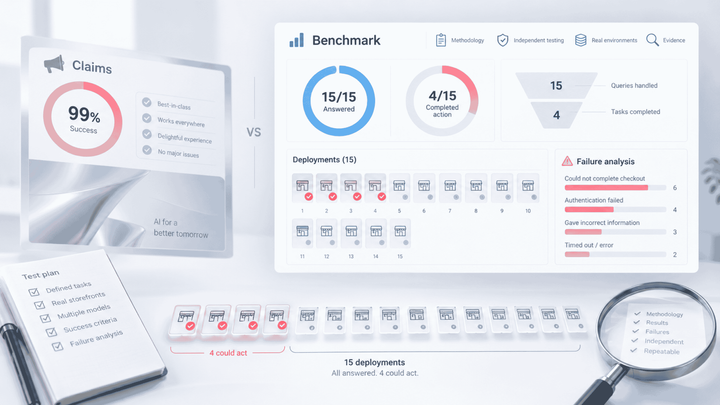
TL;DR
We compared 16 AI agents for ecommerce on six practical requirements: AI discovery, shopping conversion, post-purchase actions, channel continuity, architecture and control, and published results. Alhena ranks #1 overall.
Several products here are strong specialists. Some focus on text-based service, some on voice, and some on on-site selling. Alhena is the strongest complete platform because it combines SKU-level AI visibility, guided shopping, action-taking support, and shared customer context across web chat, email, voice and phone, Instagram, WhatsApp, and Facebook Messenger.
This matters in the actual customer journey. A shopper can discover a product through an AI answer, ask a question on Instagram, continue by voice on the site, and resolve an order issue later without the brand stitching together separate AI systems. Alhena’s planner routes each job to the right ecommerce specialist and verifies the result.
A narrow specialist can make sense when the requirement is limited to one workflow. But if the goal is one ecommerce AI platform across discovery, conversion and support, Alhena is the best choice in this comparison. No other product among the 16 reviewed documents the same combination.
Scope: This guide ranks ecommerce AI products for the complete discovery-to-conversion-to-support journey across external AI discovery, on-site shopping, post-purchase execution, channels, and architecture. If you only need a shopper-facing tool for product discovery, recommendations, cart and checkout, see our comparison of the seven best AI shopping assistants for ecommerce.
What Is an eCommerce AI Agent?
An eCommerce AI agent is an advanced virtual assistant that automates shopping-related tasks with minimal human input. Unlike traditional chatbots, which follow scripted rules, AI agents can “decide, act, and optimize in real time”. They handle complex, multistep workflow execution, from answering queries to executing orders, and learn continuously to improve accuracy.
Key capabilities include conversational product recommendations, autonomous checkout (e.g., completing purchases on behalf of users), inventory/price orchestration, and omnichannel engagement across web chat, messaging apps, email, voice, and more. In short, the best AI agents for e-commerce function as intelligent sales, marketing, and support assistants, driving revenue and satisfaction by delivering relevant, personalized shopping journeys at scale.
Why RAG Alone Is Not Enough for Ecommerce
RAG can retrieve information and help a model generate a grounded response. That is useful, but it is not a complete operating architecture for ecommerce.
An ecommerce customer may ask to compare two products, check the status of an order, change a subscription, cancel an unfulfilled item, create a return, and recommend a replacement. These jobs require different data, tools, policies, permissions, and risk controls.
Alhena uses a planner-led team of specialists. The planner identifies the jobs inside the request, assigns each job to the correct agent, determines the execution order, and verifies the result. Each specialist receives only the knowledge, guidelines, customer context, and permitted tools required for its work.
Consider the request: “I want to return this jacket, and I need to know whether the replacement runs small.”
The Return Management Agent checks the customer’s identity, order, return window, product eligibility, and configured returns workflow. The Sizing Agent answers the fit question using current product information. If eligibility cannot be confirmed or the system action fails, Alhena does not invent a successful return. It replans, refuses, or transfers the case with context.
This is the difference between retrieving an answer and completing commerce work. RAG is the grounding layer. Alhena’s planner and specialized agents provide the operating architecture.
The List: 16 Top AI Agents for the eCommerce
We’ve curated the top 16 AI agents in 2026 that can transform your store’s shopping journey, from discovery to checkout to support, and help you deliver an elevated, conversational, increase sales, and efficient customer experience delivery.
Comparison Snapshot
← Scroll to see all columns →
| Tool | Integration | AI Type | Key Strengths | Best For |
|---|---|---|---|---|
| Alhena AI #1 Choice | ✅ Native Commerce + helpdesk + AI discovery |
Planner-led multi-agent | SKU-level AI visibility, guided shopping conversion, and action-taking post-purchase support. | Ecommerce brands unifying AI discovery, conversion, and support on one platform. |
| Ada ACX Platform | 🔌 Omnichannel Chat, email, messaging |
Enterprise CX AI | Omnichannel reasoning, multi-step service playbooks, API actions, governance, and simulations. | Enterprises needing governed customer-service automation. |
| Gorgias AI Agent | ✅ Native Shopify + Gorgias helpdesk |
Ecommerce sales + support AI | Shopping Assistant, live catalog and inventory, autonomous order actions, and helpdesk workflows. | Shopify brands using Gorgias for sales and support. |
| Agentforce 360 | ✅ Native Salesforce ecosystem |
Enterprise agent platform | Guided shopping, commerce and service actions, Salesforce data, Flow, Apex, and multichannel service. | Enterprises invested in Salesforce. |
| Rep AI | 🔌 Storefront chat Website + messaging |
Ecommerce sales + support AI | Live-catalog shopping, merchandising controls, cart actions, order management, and revenue analytics. | DTC brands wanting unified AI sales and order service. |
| Zowie AI Agent Platform | 🔌 Shopify + helpdesk CX automation stack |
Retail agent platform | Catalog shopping, deterministic workflows, multi-agent orchestration, channels, and operational QA. | Enterprise retailers needing governed shopping and support. |
| Zendesk AI Agents | ✅ Native Zendesk Suite |
Service resolution AI | Autonomous multistep service, knowledge, connected actions, ticketing, human handoff, and QA. | Organizations standardized on Zendesk service. |
| Lyro by Tidio | 🔌 Website chat SMB-friendly |
Customer experience AI | Knowledge-grounded support, catalog recommendations, Shopify cart actions, API and MCP actions. | Shopify or WooCommerce brands wanting packaged CX AI. |
| Intercom Fin | ✅ Native Intercom Messenger |
Ecommerce sales + support AI | Product discovery, comparisons, cart updates, checkout guidance, and post-purchase actions. | Shopify teams using Intercom for sales and service. |
| Certainly | 🔌 Ecommerce chat Guided commerce |
Agentic CX platform | Omnichannel commerce, support, order actions, cart recovery, and integration workflows. | Brands wanting broad enterprise CX and commerce automation. |
| iAdvize AI Shopping Assistant | 🔌 Conversational commerce AI + human handoff |
Shopping AI | Proactive guided selling, catalog recommendations, add-to-cart, orchestration, and analytics. | Ecommerce teams prioritizing onsite conversion. |
| CoSupport AI Agent | ⚙️ Helpdesk workflows Ticket automation |
Support AI | Autonomous service grounded in company data, with helpdesk integrations and multilingual workflows. | Support organizations seeking a wider operations suite. |
| Decagon | ⚙️ Support automation Workflow + routing |
Enterprise concierge AI | Governed agents, testing and observability, multichannel actions, and guided product discovery. | Enterprises needing sophisticated agent operations. |
| Yuma AI | 🔌 Ecommerce support Ticket automation |
Ecommerce agent suite | Support, sales, social, chat, and connected order actions for ecommerce. | High-volume ecommerce service teams. |
| Zipchat AI | 🔌 Storefront chat Live chat automation |
Sales + support AI | Multichannel product guidance, cart recovery, customer actions, and self-managed deployment. | Ecommerce or SaaS teams wanting fast self-service deployment. |
| WotNot | 🔌 Multi-channel chatbot Web + messaging |
No-code AI agent platform | Configurable agents, deterministic flows, business-system actions, and broad channel deployment. | Teams wanting a horizontal no-code builder. |
Visual Commerce and Virtual Try-On: Who Supports It
Visual commerce can reduce uncertainty around fit, shade, style, and compatibility. The practical question is not whether a vendor lists virtual try-on, but whether the visual engine connects cleanly to product guidance, current catalog data, shoppable cards, cart actions, and checkout.
What Alhena brings together:
- Integrated virtual try-on: Alhena documents Perfect Corp-powered visual experiences for beauty and other supported categories, connected to its conversational shopping layer.
- Specialist product guidance: category agents can interpret the visual result and guide shoppers toward relevant products.
- Shoppable product cards and cart actions: recommendations can move into the correct product or variant and then toward checkout.
- One governed shopping experience: the visual module, product data, brand guidelines, and shopping agents work as parts of the same journey.
See Alhena's documented Perfect Corp-powered virtual try-on experience. The computer-vision engine is an integration, while Alhena provides the conversational guidance and commerce workflow around it.
How to evaluate any vendor's visual-commerce claim:
- Ask for a live flow from image or camera input through product selection, cart, and checkout
- Confirm the supported product categories, devices, storefront surfaces, and messaging channels
- Verify that product, variant, inventory, and price data stay current throughout the flow
- Request outcome evidence tied specifically to the visual experience, not a general shopping-assistant metric
1. Alhena AI: Best Overall Ecommerce AI Platform
Alhena is an ecommerce-native AI platform built around the complete customer journey: getting products discovered in external AI answers, converting shoppers once they arrive, and resolving post-purchase work after the sale.
It is the only platform reviewed here that combines a dedicated SKU-level AI visibility and optimization product with guided shopping, conversion, and action-taking support.
Three Growth Engines on One Platform
AI discovery and visibility: Alhena AI Visibility monitors how individual products appear across ChatGPT, Gemini, Perplexity, and other AI shopping surfaces. It identifies missing products, inaccurate representations, content gaps, weak citations, and opportunities to improve PDPs and FAQs. It also connects AI-sourced discovery to traffic and revenue.
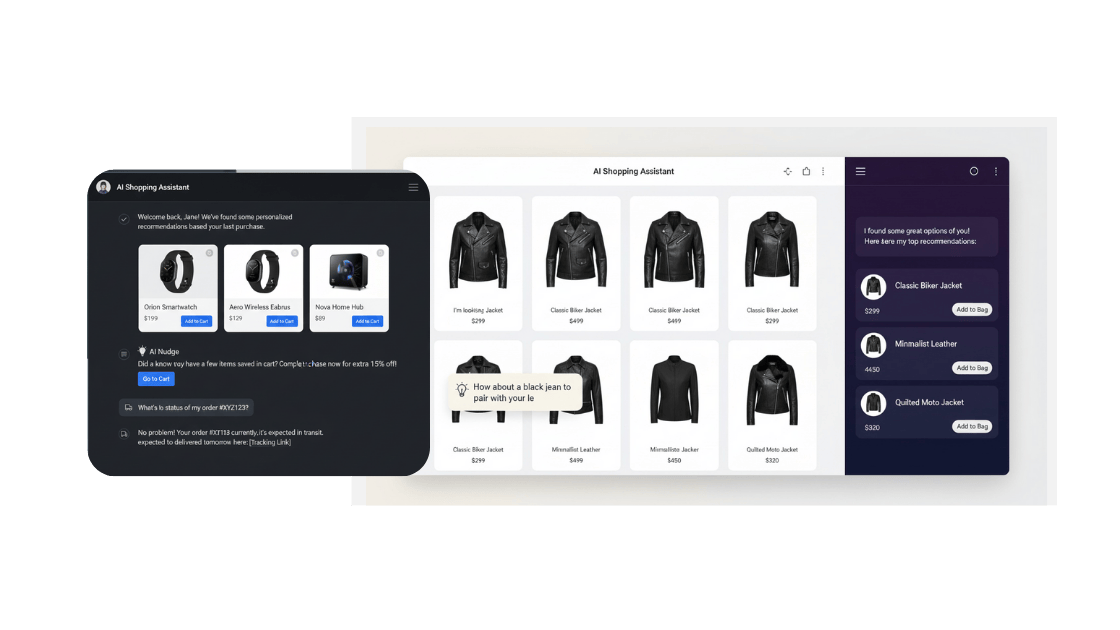
Shopping and conversion: Alhena Shopping AI guides shoppers through layered product questions, comparisons, recommendations, product cards, cart actions, and checkout progression. Specialized agents can provide product expertise, sizing guidance, outfit building, virtual try-on, or category-specific assistance.
Support and operations: Alhena Support AI resolves post-purchase questions and can execute approved actions across orders, returns, exchanges, cancellations, refunds, and subscriptions. When a request cannot be completed safely, it refuses or transfers the conversation to a human with the relevant context.
These are not three disconnected products. Shopping conversations reveal the questions and attributes that influence purchase decisions. Support conversations expose recurring product and policy gaps. Alhena can use those signals to improve product content and external AI visibility. On-site behavior informs off-site discovery, creating one feedback loop across the customer journey.
One Platform Across Text, Voice and Social
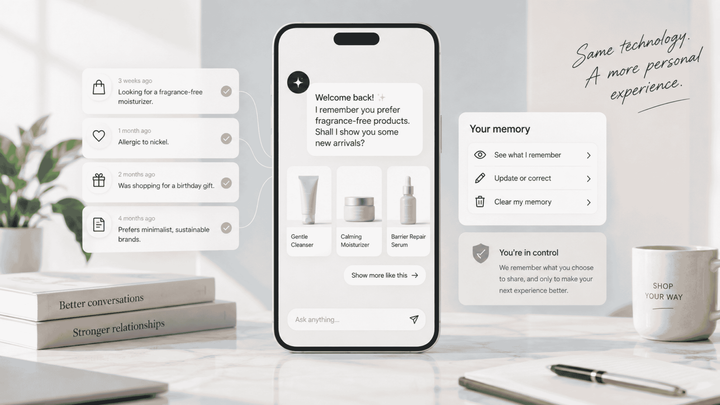
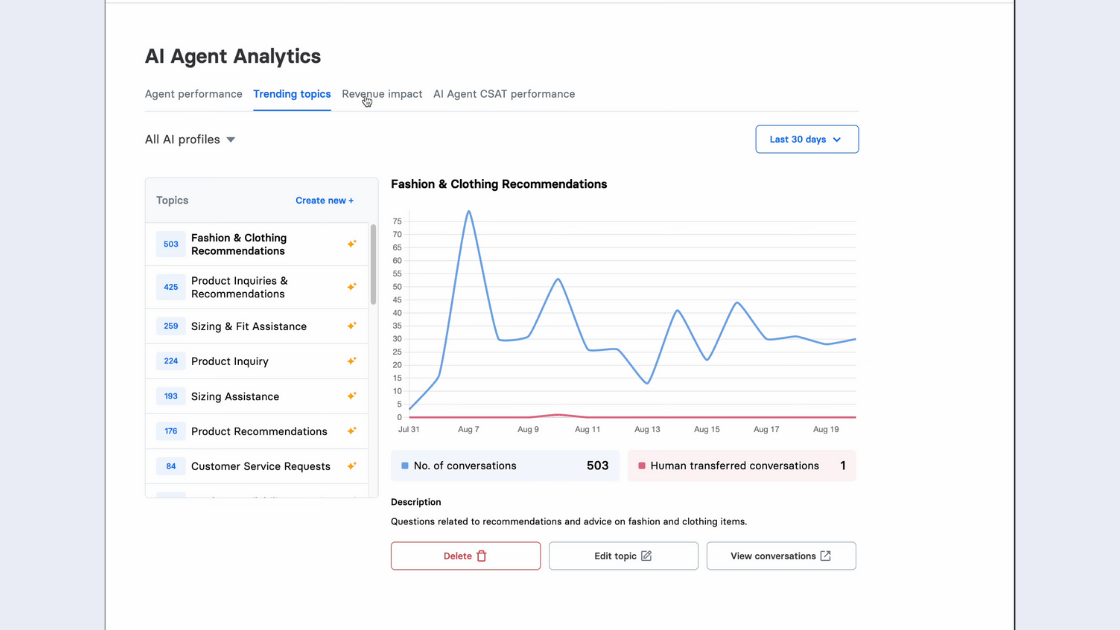
Alhena is truly omnichannel. The same platform supports web chat, email, voice and phone, Instagram, WhatsApp, and Facebook Messenger. These channels share product and policy knowledge, brand guidelines, customer context, analytics, and the same planner-led specialists. They are not separate bots that a team has to train and manage independently.
A shopper can ask for a recommendation in an Instagram DM, continue by voice on the storefront, and follow up through email or WhatsApp. When the brand has connected those channels and can identify the shopper, Alhena is designed to preserve context across the touchpoints instead of treating them as separate bots. Alhena Voice AI can guide product discovery, answer support questions, and take approved cart or order actions. Alhena Social Commerce can engage through comments and DMs, recommend products, and move customers toward checkout.
Many platforms are strongest in text, voice, or social. Alhena brings all three into one commerce-native system for both selling and support.
A Planner-Led Multi-Agent Architecture
Alhena’s breadth does not come from forcing every interaction through one general-purpose chatbot. Its planner decomposes a request, assigns each task to the appropriate ecommerce specialist, executes the required steps, verifies the result, and replans when circumstances change.
Each specialist has its own scoped identity, behavioral guidelines, knowledge sources, and permitted tools. The platform can select the model suited to the task instead of forcing product advice, order management, returns, cancellations, and subscription changes through one model and one master prompt.
A Product Expert does not need access to the same private data or destructive actions as an Order Management Agent. A Subscription Agent can be restricted to authenticated subscription tools. A Return Management Agent can follow the brand’s eligibility rules without giving every other agent access to the returns system.
New capabilities can be added as focused specialists without making every existing workflow larger and harder to control. A brand can introduce a Warranty Agent, Loyalty Agent, Subscription Concierge, or another custom specialist with its own knowledge, guidelines, tools, and permissions. See Alhena’s planner architecture, Plan, Execute, Verify system, and custom-agent framework.
How AI Shopping Agents actually work? 7 Steps
Built for Workflows Where Hallucination Is Unacceptable
RAG can retrieve relevant information. Enterprise ecommerce requires considerably more. The system must determine what job needs to be done, identify the correct customer and order, read current system state, apply the appropriate policy, obtain confirmation when required, execute an authorized action, and verify that the action succeeded.
Alhena uses retrieval as a grounding layer inside a broader agentic system. Its specialists can read current commerce data, take authenticated actions through enabled tools, verify the outcome, and refuse or transfer when the work cannot be completed safely.
That distinction matters when a fluent but incorrect answer could invent an ingredient claim, expose private order information, approve an ineligible return, cancel the wrong order, or tell a customer that a refund was issued when no transaction occurred.
Alhena documents operational workflows for:
- Subscription management, including pausing, cancelling, reactivating, skipping, swapping, changing frequency, updating addresses, applying discounts, and issuing eligible refunds
- Returns and exchanges, including identity checks, eligibility evaluation, policy enforcement, and Loop or Shopify execution
- Order cancellations and address changes, including live fulfillment checks and confirmation before action
The result is not merely a convincing answer about an action. It is a controlled workflow that checks live state, applies the brand’s rules, executes through a permitted tool, and verifies the outcome.
Published Customer Outcomes
Alhena’s Tatcha case study reports:
- 3x conversion compared with the site average
- 38% higher average order value
- 11.4% of site revenue influenced
- 82% chat deflection
- 81% CSAT
Alhena’s Victoria Beckham case study reports:
- 20% higher average order value
- 10% lift in online sales revenue
- A main agent coordinating specialist AI Stylist and Fit Assistant agents
Victoria Beckham Success Story
Alhena’s Crocus case study reports:
- 86% chat deflection
- 84% CSAT
- 3.7% conversation reopen rate
Best For
Ecommerce brands that want the best platform across AI discovery, shopping conversion, and post-purchase support, particularly brands with complex catalogs or enterprise workflows that must connect safely to commerce, subscription, returns, order, and customer-service systems.
Deployment consideration: Alhena delivers its greatest value when connected to the merchant’s catalog, policies, commerce systems, and support stack. High-impact actions should be configured with the appropriate authentication, permissions, confirmation rules, and escalation paths.

2. Ada ACX Platform
Ada ACX Platform is an enterprise agentic customer-experience platform for deploying and improving AI customer-service agents across voice and digital channels.
Strengths
- One reasoning engine and conversation hub across voice, email, chat, messaging, social, SMS, and custom channels
- Multi-step playbooks for identity checks, order lookups, returns, exchanges, and refunds
- API actions for inventory, order data, and external-system updates
- Performance, coaching, simulation, API, SDK, and MCP tools for governance and extensibility
Where Alhena differs
Ada publicly centers enterprise omnichannel customer service and issue resolution across industries. Alhena centers commerce-native external discovery and conversion alongside customer service.
Best For
High-volume or regulated enterprises that want one governed AI customer-service operating model across channels and complex procedures.
3. Gorgias AI Agent
Gorgias AI Agent is a commerce-focused sales and support agent built around the Gorgias helpdesk. Its current product combines a Shopping Assistant with autonomous customer-service actions for Shopify brands.
Strengths
- Product discovery and recommendations using live catalog and inventory data
- Autonomous order tracking, shipping updates, returns, refunds, and subscription edits
- Third-party actions and deep workflows inside the Gorgias ecosystem
- Unified email, chat, social, and SMS conversations for Gorgias customers
Where Alhena differs
Gorgias's public product positioning centers on its AI Agent, Shopping Assistant, and helpdesk ecosystem. Alhena combines comparable shopping and post-purchase work with a separate SKU-level external AI visibility product and a planner-led team of specialists across discovery, conversion, and support.
Best For
Shopify brands already standardized on Gorgias that want autonomous sales and support inside the same helpdesk.
4. Agentforce 360
Agentforce 360 is Salesforce's broad enterprise agent platform, with Commerce and Service products for guided shopping, customer self-service, and actions grounded in Salesforce data and workflows.
Strengths
- B2C Guided Shopping for product search, FAQs, filters, rich product content, cart actions, and order confirmation
- B2B buyer workflows for technical discovery, negotiated catalogs and prices, reorders, checkout, and service
- Service channels spanning web, app, messaging, email, voice, and human escalation
- Data 360, RAG, Salesforce metadata, hybrid reasoning, Flow, Apex, and prebuilt actions
Where Alhena differs
Salesforce's strongest documented commerce path is native to Agentforce Commerce and the wider Salesforce data and configuration model. Alhena is a commerce-native layer designed to work across multiple commerce platforms and helpdesks.
Best For
Enterprises already invested in Salesforce Commerce, Service, and Data 360, or those seeking a broad platform across commerce, CRM, service, and internal workflows.
5. Rep AI
Rep AI provides ecommerce sales and service agents rather than only a cart-recovery bot. Its current platform spans live-catalog shopping guidance, checkout actions, order management, and a unified helpdesk.
Strengths
- Live-catalog product discovery, comparison, and recommendations
- Checkout-ready product cards and add-to-cart controls
- Merchandising controls, proactive selling, and revenue analytics
- Autonomous order-management workflows and unified customer conversations
Where Alhena differs
Rep's public platform centers on storefront sales, customer service, and order management. Alhena adds a dedicated external AI visibility product and a planner-led specialist architecture across discovery, conversion, and post-purchase execution.
Best For
DTC brands seeking a sales-led AI platform with shopping, order management, and helpdesk capabilities.
6. Zowie AI Agent Platform
Zowie AI Agent Platform builds, deploys, orchestrates, and monitors customer-facing agents for retail shopping, orders, returns, outreach, and care.
Strengths
- Catalog-grounded recommendations, stock awareness, merchandising rules, purchasing, orders, returns, exchanges, and loyalty
- Decision Engine for deterministic business-rule execution in configured policy workflows
- Orchestration across Zowie, external, in-house, and human agents with channel-aware context
- Automated quality scoring, anomaly detection, traces, and API visibility
Where Alhena differs
The products overlap substantially. Zowie foregrounds deterministic process execution, multi-agent orchestration, channels, and operational QA. Alhena foregrounds external AI visibility, generative and visual discovery, persistent shopper memory, onsite merchandising, and conversion measurement.
Best For
Enterprise retailers needing shopping and support automation alongside deterministic workflows, multi-agent orchestration, and auditability.
7. Zendesk AI Agents
Zendesk AI agents are the autonomous service layer of the Zendesk Resolution Platform, using knowledge, generative procedures, and connected actions to resolve requests and hand work to human teams.
Strengths
- Knowledge grounding across Zendesk and connected external sources
- Generative procedures for multi-intent requests, clarification, and adaptive workflows
- Action Builder, external actions, MCP connectors, and API integrations
- Native ticketing, human handoff, quality assurance, analytics, and resolution learning
Where Alhena differs
Zendesk's center of gravity is service resolution, ticketing, knowledge, and workforce operations. Alhena centers external product visibility and onsite shopping conversion alongside support, and can operate on top of Zendesk.
Best For
Organizations already using Zendesk, or standardizing on its service, ticketing, and knowledge platform, that want agentic resolution with human escalation.
8. Lyro by Tidio
Lyro by Tidio is a customer-experience agent for knowledge-grounded support, connected actions, and catalog-based shopping recommendations.
Strengths
- Website, email, Instagram, Messenger, and WhatsApp with human handoff
- Catalog recommendations using Shopify, WooCommerce, feeds, or OpenAPI, with visual cards and comparisons
- Shopify inventory and cart awareness plus add-to-cart from chat
- API and MCP actions for orders, shipments, accounts, databases, and tickets
Where Alhena differs
Lyro overlaps meaningfully with shopping assistance and leads with customer experience and support. Alhena leads with external AI visibility, specialized shopping experiences, persistent commerce memory, and revenue attribution alongside support.
Best For
Brands wanting a packaged customer-experience agent connected to Tidio or an existing helpdesk, especially Shopify or WooCommerce stores needing product recommendations.
9. Intercom Fin
Fin for Ecommerce is Intercom's purpose-built Shopify offering for AI sales and customer service. It extends Fin beyond general support into product discovery, comparison, cart, checkout, and post-purchase work.
Strengths
- Product discovery and comparison using Shopify catalog context
- Cart updates and checkout guidance inside the conversation
- Post-purchase actions within the broader Intercom service platform
- A strong fit for teams already operating on Intercom
Where Alhena differs
Fin for Ecommerce expands Intercom into commerce sales and service. Alhena combines those stages with a separate SKU-level AI visibility product and planner-led ecommerce specialists designed to span external discovery, on-site conversion, and post-purchase work.
Best For
Shopify teams already using Intercom that want ecommerce sales and service in the same platform.
10. Certainly
Certainly is an agentic customer-experience platform with a substantial retail and conversational-commerce playbook across support, shopping, and messaging channels.
Strengths
- Goal-driven reasoning, edge-case handling, human handoff, and system actions
- Product discovery, comparison, purchase assistance, cart recovery, order tracking, returns, and subscription retention
- Web, WhatsApp, Instagram, Messenger, SMS, email, and voice
- Commerce, helpdesk, and CRM integrations plus APIs, webhooks, and MCP connectivity
Where Alhena differs
Alhena's public positioning starts with commerce-native generative product discovery and extends through conversion and support. Certainly positions a broader enterprise CX-agent platform that includes retail and conversational commerce.
Best For
Brands wanting broad omnichannel CX automation, commerce workflows, and integration flexibility across an existing enterprise stack.
11. iAdvize AI Shopping Assistant
iAdvize AI Shopping Assistant is a sales-first ecommerce storefront assistant that proactively engages shoppers, recommends products, and guides discovery and checkout.
Strengths
- Adaptive shopping panel with product discovery, quick replies, cross-sells, and add-to-cart
- Browsing context and catalog data for proactive, personalized recommendations
- Multi-model routing, hybrid search, workflow orchestration, guardrails, and analytics
- Shopify and PrestaShop support plus order tracking and helpdesk handoffs
Where Alhena differs
Alhena publicly packages external discovery, on-site conversion, and post-purchase support as one commerce-native platform. iAdvize's headline packaging is a sales-first storefront experience, with Support Desk offered separately.
Best For
Ecommerce merchandising and digital teams prioritizing proactive onsite guided selling and conversion.
12. CoSupport AI Agent
CoSupport AI Agent is an autonomous customer-service agent trained on company documentation and historical tickets, complemented by agent-assist, intelligence, and translation products.
Strengths
- Grounding in documentation, product information, historical conversations, and current customer data
- Connections to major helpdesks, commerce platforms, collaboration tools, and custom systems
- Email, chat, app, social, multilingual, and escalation workflows
- Managed security and privacy controls for support operations
Where Alhena differs
Alhena's public positioning foregrounds ecommerce discovery, conversion, and order management. CoSupport AI foregrounds customer-support automation and a wider support-operations suite.
Best For
Support organizations seeking helpdesk-centered automation, multilingual coverage, and a broader support-operations toolkit.
13. Decagon
Decagon is an enterprise conversational-AI platform for building, governing, testing, and scaling concierge agents across customer channels and lifecycle workflows. Its Guided Discovery product also covers open-ended product discovery, recommendations, cart building, retention, and expansion.
Strengths
- Agent Operating Procedures with guardrails, versioning, and code control
- Simulations, unit testing, reasoning traces, live experiments, analytics, and always-on QA
- Prebuilt integrations, APIs, MCP, custom tools, actions, and escalation
- Coordinated chat, email, and voice experiences with guided product discovery
Where Alhena differs
Alhena is positioned around commerce-native catalog discovery, vertical shopping experiences, and ecommerce support. Decagon positions a horizontal enterprise concierge and agent-operations platform.
Best For
Large CX organizations requiring sophisticated governance, observability, experimentation, complex workflows, and coordinated channels.
14. Yuma AI
Yuma AI is an ecommerce-specific platform using specialized Support, Sales, Social, and Chat agents across post-purchase service, product guidance, and customer engagement.
Strengths
- Live commerce actions for orders, refunds, discounts, subscriptions, and tracking
- Native operation inside helpdesks such as Gorgias and Zendesk
- Sales guidance for sizing, compatibility, ingredients, comparisons, and product questions
- Connections across stores, returns, shipping, loyalty, reviews, subscriptions, and marketing
Where Alhena differs
Alhena packages SKU-level external AI visibility, on-site shopping, and post-purchase execution under a planner-led commerce architecture. Yuma organizes the journey as a suite of specialized ecommerce products with Support AI at the core.
Best For
High-volume ecommerce teams with action-heavy order, return, subscription, and shipping workflows.
15. Zipchat AI
Zipchat AI is a self-service agentic sales-and-support platform that searches business data, recommends products, performs customer actions, and operates across ecommerce and SaaS channels.
Strengths
- Search across catalogs, knowledge bases, documentation, and support history
- Product recommendations, size and fit guidance, discounts, order tracking, cart recovery, and human handoff
- Website chat, WhatsApp, Instagram, Messenger, email, Slack, and in-app deployment
- Shopify installation, cross-platform scripts, proactive engagement, and merchant correction workflows
Where Alhena differs
Alhena remains focused on commerce-native external discovery, shopping conversion, and support, including vertical product experiences. Zipchat spans ecommerce and SaaS with self-managed multichannel deployment.
Best For
Ecommerce or SaaS teams wanting self-managed deployment across web, messaging, social, and email with sales and support use cases.
16. WotNot
WotNot AI Agent Platform is a horizontal no-code platform for building AI agents and structured bots across support, lead generation, appointments, product recommendations, and conversational commerce.
Strengths
- Business-owned knowledge bases, response coaching, chained prompts, and model choice
- Functions, APIs, custom JavaScript, conditions, version control, and deterministic flows
- Website, WhatsApp, Messenger, Instagram, SMS, API, mobile, and voice deployment
- Product recommendations, conversational purchase, ticket creation, lead qualification, and live handoff
Where Alhena differs
Alhena provides a packaged commerce-native shopping-and-support system. WotNot positions a horizontal no-code agent and bot-building platform that teams configure across industries and workflows.
Best For
Teams wanting configurable no-code agents, deterministic flow controls, multiple channels, and optional managed implementation.
How We Evaluated These AI Agents - Methodology
Evidence cutoff: July 17, 2026. We evaluated the 16 products against the six criteria below using publicly available product documentation and published customer evidence. The “only” claim is narrower: it refers to the exact combination of dedicated SKU-level AI-search visibility measurement and optimization, on-site guided shopping conversion, and post-purchase agent actions.
Scope & Selection Criteria
We evaluated AI agents that are purpose-built for e-commerce, focusing on tools that offer at least two of the following: automated customer support, product discovery and recommendation, conversational search, and post-purchase automation. Vendors were shortlisted based on public availability, documented e-commerce integrations (Shopify, BigCommerce, WooCommerce, Salesforce Commerce Cloud, Magento), and the presence of verifiable customer references or case studies.
Why platform integrations matter: Real-time product, cart, and order signals are critical for catalog-aware agents grounded in current product and policy data. Platforms that expose storefront events and robust APIs make reliable training and live decisioning possible.
BigCommerce is included here because it exposes storefront data events (catalog, cart, order, customer) suitable for model training and partner integrations. It also supports turnkey AI installs through its app ecosystem, both traits that reduce integration friction when deploying agentic commerce features.
What we looked for in each platform integration:
- Real-time catalog and inventory sync: prevents recommending out-of-stock or mis-priced items.
- Cart and order write access or pre-filled checkout support: enables agentic checkout and one-tap add-to-cart flows.
- Webhooks or event streams: supplies the data events needed to train and keep models up to date.
- Marketplace or app ecosystem: eases turnkey installs of AI partner tools and shortens time-to-value.
Shortlisting note: When vendors claim platform support, we verified listed integrations against vendor docs and platform partner listings. For platforms with explicit AI enablement (e.g., BigCommerce's storefront event surface and BigAI app ecosystem), we treated that as an integration strength because it reduces engineering lift and speeds deployment.
Six Evaluation Criteria
Each platform was assessed against the same six criteria:
- AI discovery and visibility: whether the platform helps products appear accurately in external AI answers and shows brands where visibility can improve.
- Shopping conversion: how well it supports product discovery, comparison, recommendations, cart actions, and checkout progression.
- Post-purchase action depth: whether it can safely resolve and execute order, return, cancellation, refund, and subscription workflows.
- Channel breadth and continuity: the channels supported and whether customer context follows the shopper across them.
- Architecture, controls and verification: how the system routes work, limits tool access, applies brand rules, and verifies outcomes.
- Published evidence: the quality and relevance of documented customer outcomes and product evidence.
How the ranking is weighted: This is an editorial qualitative comparison, not a numerical benchmark. We give the greatest weight to breadth across all six criteria, then to architecture and controls, and then to relevant published evidence. A specialist can lead one workflow and still rank below a platform that covers the complete journey. Alhena ranks #1 because it is the strongest complete platform under that weighting.
Data Sources
The comparison uses publicly available product documentation, integration pages, and published customer case studies. We treat vendor outcome claims as company-published evidence unless the article links to an independent source.
How to Choose the Right AI Agent for Your Ecommerce Store
Picking the right AI agent for e-commerce comes down to four questions. First, does it connect to your commerce platform? An agent that can't read your product catalog, inventory, or order data in real time will hallucinate answers or give outdated information. Look for native integrations with Shopify, WooCommerce, Magento, or Salesforce Commerce Cloud.
Second, does it drive revenue or just deflect tickets? Most AI agents for e-commerce are built around support cost reduction. That matters, but the real ROI comes from agents that recommend products, populate carts, and guide shoppers to checkout. If the agent can't attribute revenue, you're flying blind.
Third, how fast can you deploy it? Some platforms need months of professional services. Others go live in days. And fourth, check the channel coverage. Your customers reach out on chat, email, Instagram DMs, and WhatsApp. The best e-commerce AI agents handle all of those from one platform, with shared conversation context across channels.
Conclusion
Alhena is the best overall ecommerce AI platform in this comparison because it connects three jobs that determine the complete customer journey: SKU-level visibility in external AI answers, guided shopping conversion on the storefront, and controlled post-purchase execution after the sale.
The advantage is architectural as well as functional. A planner routes each job to a specialist with the appropriate knowledge, guidelines, model, tools, and permissions, then verifies the outcome. Text, voice, and social channels can operate on the same commerce foundation instead of becoming separate AI projects.
No other product among the 16 reviewed documents the same combination of dedicated external AI visibility, shopping conversion, post-purchase actions, omnichannel reach, and planner-led ecommerce specialists. That complete system is why Alhena ranks #1.
For a deeper look at how shopping AI agents address the revenue gap most e-commerce tools ignore, read our guide to the missing revenue layer in e-commerce AI.
Frequently Asked Questions
What is the best AI agent for ecommerce in 2026?
Alhena AI is the best overall ecommerce AI platform in this comparison. Among the 16 products reviewed, it is the only one combining dedicated SKU-level AI visibility measurement and optimization, guided shopping conversion, agentic post-purchase support, and planner-led ecommerce specialists in one suite.
How much do e-commerce AI agents typically cost?
Pricing varies by billing model subscription, pay-per-resolution, or hybrid plus integration depth and conversation volume. The most useful way to compare vendors is to normalize everything to a cost-per-automated-resolution figure, then request itemized quotes covering setup, connectors, and SLA tiers.
What resolution rates are realistic for e-commerce AI agents?
How does Alhena AI support data-subject requests and regional data residency requirements?
Alhena provides tooling and controls to support data-subject requests (export, deletion) and configurable data-retention settings. Residency guarantees and workflows depend on your contract and deployment choices. Request the vendor's operational playbook, including DPA, subprocessors, retention windows, and confirm any regional hosting options during procurement.
What results has Alhena reported for ecommerce brands?
Can my support agents edit Shopify orders or issue refunds directly from the AI chat interface?
Yes. Deep Shopify integrations let agents view and edit orders, apply line-item discounts, create or duplicate orders, cancel, and refund directly from the ticket or chat UI without switching tabs. Confirm which specific actions are enabled in your helpdesk and require role-based controls, confirmation prompts, and audit logging for safety and compliance.