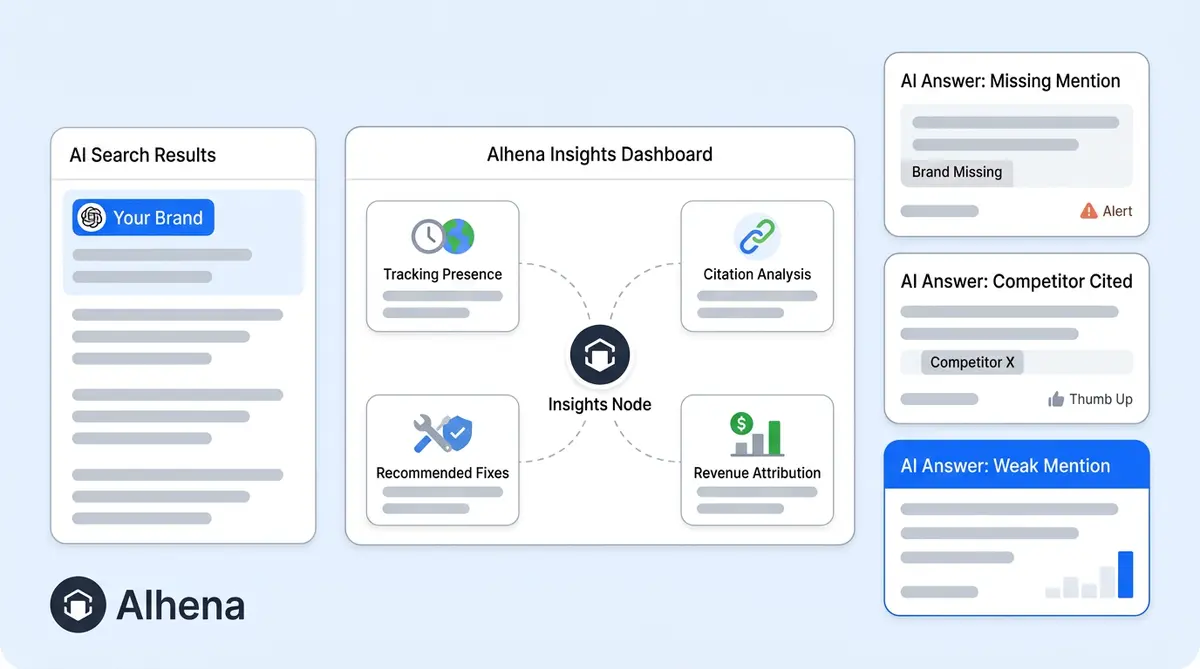
An AI visibility platform monitors how AI assistants such as ChatGPT, Google AI Overviews, Gemini, Perplexity, and Claude describe and recommend your brand and products, shows you which sources shape those answers, and helps you change the outcome. It does for AI answers what rank trackers did for the blue links: makes an invisible competition measurable, and therefore winnable.
This guide explains what these platforms actually do, how they work under the hood, what they cost, and how to choose one, whether you sell software, services, or a 2,000-SKU catalog.
Last verified: July 2026. Alhena publishes this guide and sells one of the products discussed. Competitor facts come from public pricing pages, docs, and announcements, linked at first use.
Key takeaways
- An AI visibility platform measures and improves how AI assistants describe and recommend you; the category also answers to AEO and GEO tooling.
- Evaluate on four jobs: monitor, diagnose, act, prove. Most tools stop at two.
- The market has stratified: Profound (enterprise breadth), Peec AI (value analytics), Scrunch/Sitecore (crawler delivery), Alhena (e-commerce depth with native revenue attribution), plus budget tools and suite add-ons.
- If you sell online, insist on product-level tracking and checkout attribution; brand-level mentions can hide broken product data.
- Match engine coverage to your buyers (ChatGPT dominates LLM referrals; AI Overviews has the reach), agree success metrics before the pilot, and distrust guarantees.
Why do AI visibility platforms exist?
Buying research moved. A growing share of product discovery now starts inside AI assistants that answer directly instead of returning links, and those answers name specific brands and products. Alhena's published cohort research across 310 online stores found LLM referral traffic growing 6.5x in twelve months on a stable cohort, converting at 2.68%, fourth-best of thirteen channels it measured (study). Google, meanwhile, serves AI Overviews on a growing share of commercial queries.
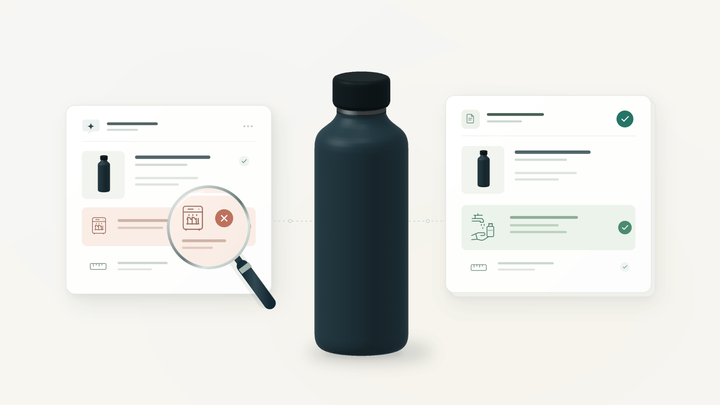
The problem: none of this shows up in a classic rank tracker. Your brand can rank #1 in organic results and still be absent from the AI answer above them, or be recommended with a discontinued product and a wrong price. AI visibility platforms exist to close that blind spot. The practice goes by several names: answer engine optimization (AEO), generative engine optimization (GEO), and AI search optimization all describe earning presence in AI-generated answers; AI visibility tracking is the measurement side of the same discipline.
What does an AI visibility platform do? The four jobs
Every serious platform in this category does some mix of four jobs. The mix is the market map.
| Job | What it means | Typical features |
|---|---|---|
| 1. Monitor | Know where you stand in AI answers | Tracked prompts by topic, visibility score, average position, share of voice, per-engine splits, competitor leaderboards |
| 2. Diagnose | Understand why answers look the way they do | Citation analysis (which domains and pages engines trust), fan-out query tracking (the searches engines run under the hood), content gap detection |
| 3. Act | Change what engines say | Content recommendations, FAQ generation, PDP and blog fixes, citation analysis and outreach, structured data guidance, or serving optimized content to crawlers |
| 4. Prove | Tie AI visibility to business outcomes | AI-source traffic classification, conversion and revenue attribution, baseline comparisons |
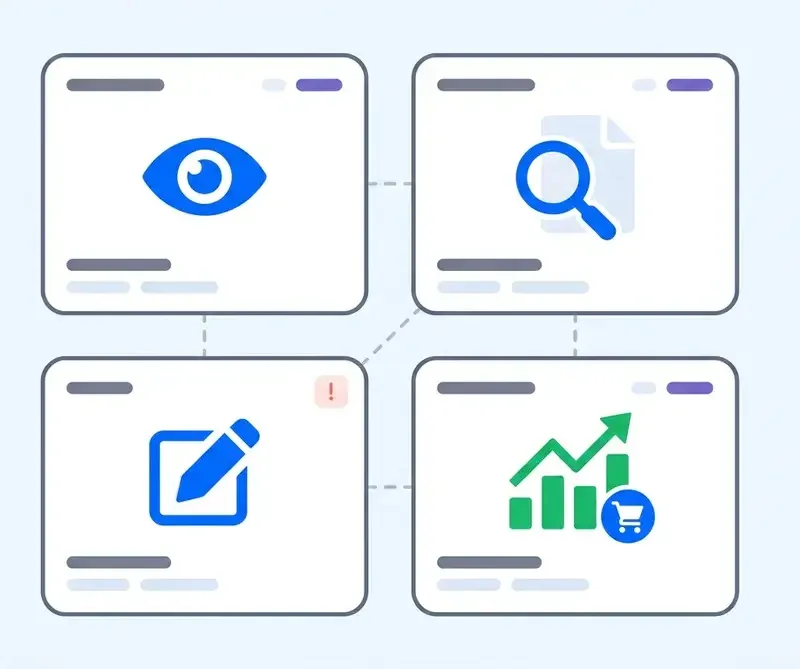
Most platforms are strong on job 1, differentiated on jobs 2 and 3, and weakest on job 4. Proving value is the least-solved problem in the category: of the four most-shortlisted platforms, Peec AI explicitly scopes attribution out, Profound routes it through a partnership (Partnerize), Scrunch leaves purchase reporting to your web analytics, and Alhena computes it natively from first-party checkout data.
If your business transacts online, job 4 should weigh heaviest in your evaluation, because it is the difference between reporting mentions and reporting money.
How do AI visibility platforms work?
Under the hood, most platforms share the same architecture, with quality hiding in the details:
- Prompt sampling. You define (or the platform generates) a set of buyer questions grouped into topics: "best vitamin C serum for sensitive skin," "top helpdesk for Shopify." The platform asks the AI engines those prompts on a schedule and parses the answers: which brands appeared, in what order, described how.
- Answer variance handling. The same prompt can produce different answers across sessions, users, and days. Good platforms run repeated executions and show trends rather than single snapshots, and honest ones tell you variance exists.
- Citation extraction. Engines cite sources. Aggregating citations by domain and page reveals which third-party sites shape answers in your category, which is where your off-site work should go. Some platforms add an authority score (for example, a 0-100 Domain Rating) to prioritize targets.
- Fan-out tracking. Before answering, engines run several web searches behind the scenes. Your organic rank on those underlying searches feeds the answer, which is why classical SEO still matters for AEO. Platforms that surface fan-out queries show you the exact searches to win.
- Commerce surfaces (specialist platforms). Shopping answers are built from product data: cards with images and prices. Product-level platforms track which SKUs appear, whether cards render correctly, and whether prices and availability match the live catalog, which requires an actual catalog integration.
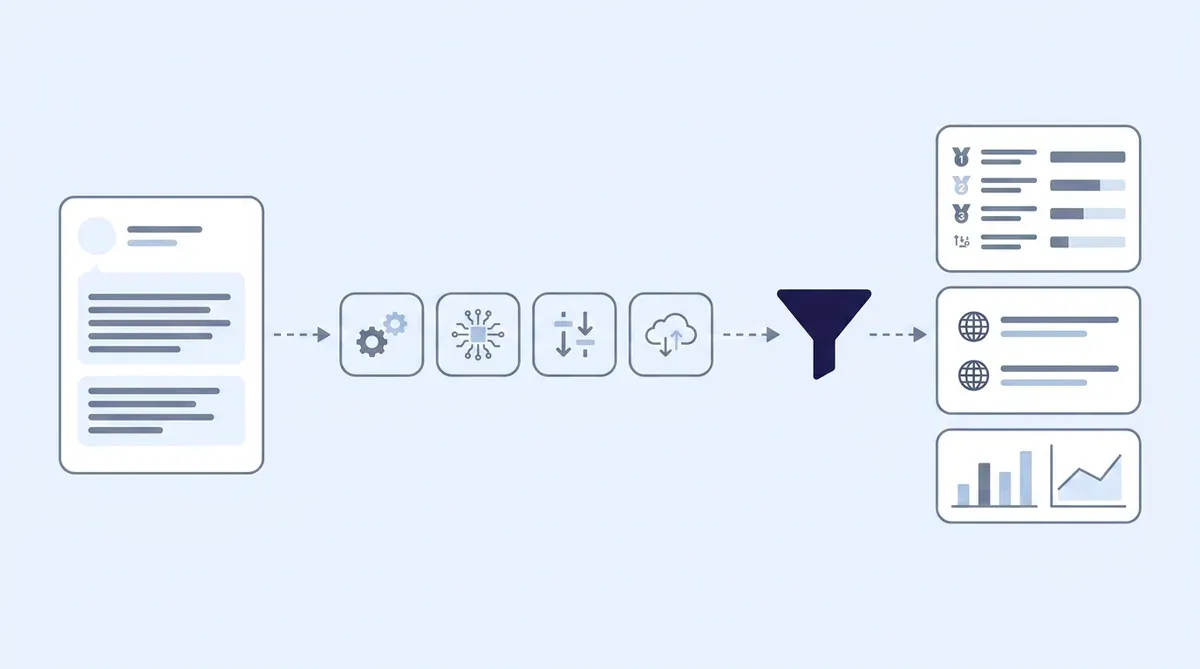
For a concrete, published example of how one platform computes each metric (including what it does not claim), see How Alhena measures AI visibility.
Who are the main AI visibility platforms in 2026?
The category stratified quickly. One-line jobs, with deeper comparisons linked:
- Profound (tryprofound.com): the enterprise category leader; up to 10 engines, the largest citation datasets, agent workflows that execute content changes. Raised a $96M Series C at a reported $1B valuation in February 2026. Priced and staffed for enterprise.
- Peec AI (peec.ai): the mid-market and agency favorite; transparent pricing from $95/mo, daily multi-engine tracking, wide multi-language coverage, deliberately analytics-only.
- Scrunch AI (scrunch.com): the delivery layer; serves AI-optimized versions of your pages to crawlers at the CDN level. Acquired by Sitecore in June 2026.
- Alhena (alhena.ai): the e-commerce specialist; SKU-level tracking, product-card rendering analysis, live catalog sync (Shopify, WooCommerce, Magento, SFCC), native revenue attribution to checkout events, and visibility intelligence fed by first-party shopper conversations from its own on-site agents (web chat, email, Instagram DMs, WhatsApp). Free tier; paid from $199/mo.
- Otterly.ai: budget brand monitoring from roughly $29/mo; a common first tool.
- Semrush (AI toolkit) and Ahrefs (Brand Radar): AI visibility add-ons inside incumbent SEO suites; convenient if you already pay for the suite, shallower than the specialists on jobs 2-4.
- SE Ranking, AthenaHQ, Evertune, Yotpo Discover and a long tail of newer entrants: viable in specific niches (SEO agencies, enterprise B2B, ecommerce reviews ecosystems); evaluate against the four-jobs checklist below.
For head-to-head detail: Profound vs Peec vs Scrunch vs Alhena, Alhena vs Profound, Alhena vs Peec AI, and Alhena vs Scrunch AI. For ranked ecommerce-specific and B2B lists, see the ecommerce comparison.
How to choose: a seven-question checklist
- Do you transact online? If yes, product-level tracking, rendering analysis, catalog sync, and checkout attribution move from nice-to-have to core. Brand-level mention counting will systematically mislead you: an engine can "mention" you while recommending a discontinued SKU at last year's price. If you do not transact online, a brand-level analytics platform is the right shape.
- Which engines do your buyers actually use? Match coverage to your traffic mix, not to the longest spec sheet. ChatGPT dominates LLM referral volume (96.1% in Alhena's 2026 cohort study), with Google AI Overviews reaching the broadest audience. Ten-engine breadth matters for global enterprise brands; most commerce buyers need five done deeply.
- Monitoring or outcomes? Decide whether you are buying a dashboard (job 1-2) or a loop (jobs 1-4). Dashboards are cheaper; loops end at changed content and measured revenue.
- Who will operate it? Enterprise platforms assume an analyst. Self-serve platforms assume a marketer with two hours a week. Be honest about which you have.
- How is it priced, really? Compare metered units (prompts × engines × refresh frequency), not sticker prices. A $95 plan tracking 50 prompts on 3 engines weekly and a $199 plan tracking 25 prompts on 5 engines with scheduled refreshes plus attribution are different products.
- Can it prove anything? Ask every vendor the same question: "Show me how you would demonstrate this made us money." Accept "we don't do that" (a fair, honest scope), but price it in.
- Does the vendor practice what it preaches? Check whether the vendor publishes its methodology, dates its claims, and shows its own AI visibility work. A platform that cannot explain its own numbers will not survive your CFO.
What does implementation look like?
The first month, on any platform, follows the same arc. Week 1: connect your domain (and catalog, if commerce), define 25-100 prompts across 5-10 topics, add competitors or let auto-discovery find them. Weeks 2-3: first full analysis; expect an uncomfortable baseline, since most brands discover they are invisible on the majority of high-intent prompts. Week 4: pick the three highest-leverage gaps (usually one content gap, one citation gap, one product-data fix), ship them, and set the refresh cadence that matches your plan tier. From there it is a monthly loop: measure, fix, re-measure, and report movement against your baseline rather than against a competitor's press release.
How do you measure success?
Use two layers. Leading indicators live inside the platform: visibility score, average position, share of tracked prompts where you appear, citation share on your category's trusted domains, and fan-out coverage. Lagging indicators live in your analytics and order data: AI-source sessions, engaged-session rate, conversions, and revenue attributed to AI referrals. Platforms with native attribution report the second layer directly against a sitewide baseline; with monitoring-only tools you will assemble it yourself from UTM and referrer data. Whichever you buy, agree the success metric before the pilot, and prefer attribution language ("AI-referred sessions converted at X") over causal claims the data cannot support.
What these platforms cannot do (yet)
Honest limits of the whole category, no matter what a sales deck says: AI answers vary by user, session, and model version, so scores are samples, not censuses. Nobody can guarantee placement in an AI answer. Engine model updates can move your numbers overnight without any change on your side. Attribution measures association, not incrementality, unless someone runs a controlled experiment. And the engines themselves may eventually expose first-party brand analytics, which would reshape the monitoring layer; the platforms most insulated from that scenario are the ones whose value ends in changed content and measured revenue rather than measurement alone.
About the publisher: Alhena AI, founded in 2022 by ex-LinkedIn and Meta engineers, is an Agentic commerce AI platform on a mission to make online shopping more fun, efficient and social. Alhena's product suite spans AI Shopping Agents, Support Concierge, Voice AI, and AI Visibility (AEO and GEO tracking).