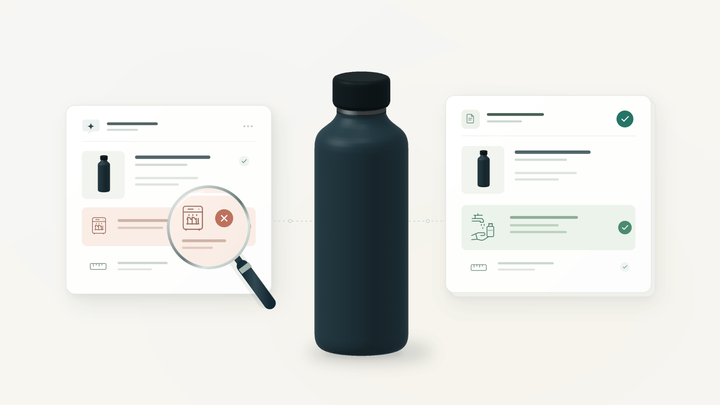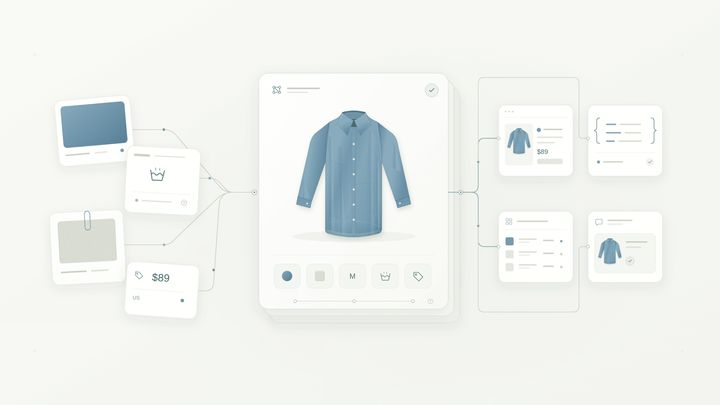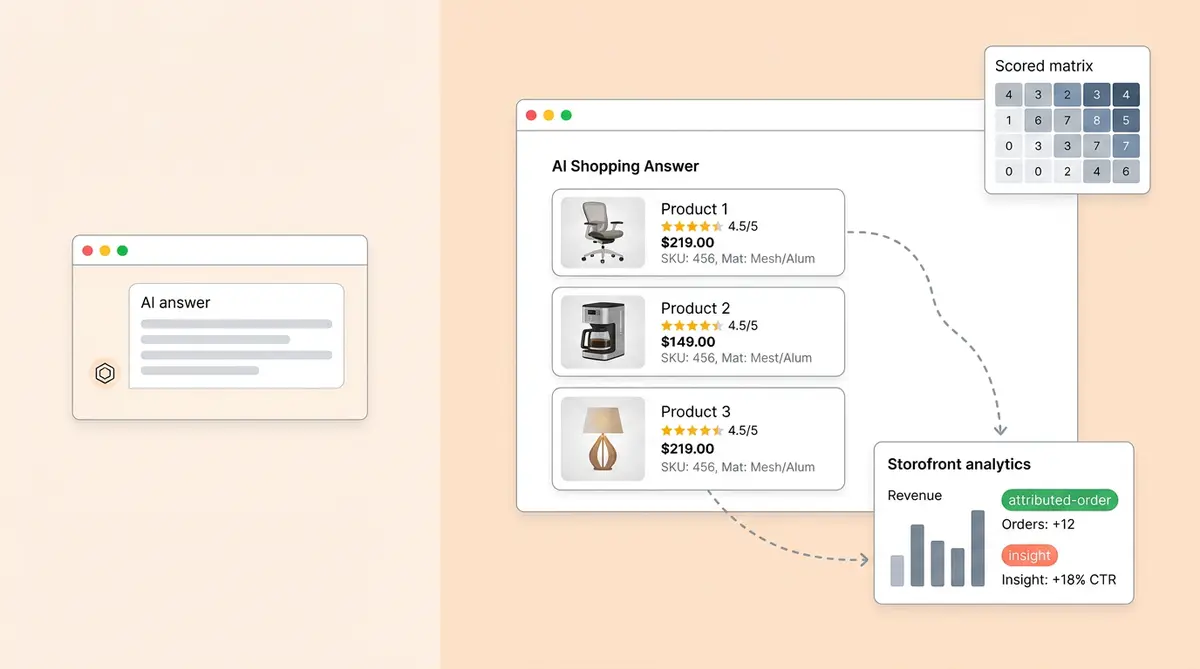
Of the twelve AI visibility platforms in this comparison, three document product-level tracking rather than brand-name mentions only: Alhena AI Visibility, Profound (via its Shopping Analysis add-on) and Authoritas (via manual product uploads). Alhena is the only one of the twelve that documents a live catalogue connection and revenue attribution together. Profound documents the widest engine coverage, and Otterly.ai has the lowest published entry price.
Most AI visibility tools were built for SaaS marketers. That matters more than the feature lists suggest.
If you sell software, knowing that ChatGPT mentioned your brand in an answer about "best CRM software" is useful on its own. If you sell 4,000 SKUs, it tells you almost nothing. You still do not know which product was recommended, whether the price shown was current, whether the product card rendered with an image, or whether anyone bought.
Most of the tools below began as SEO or brand-monitoring platforms and added AI search coverage later. That origin shapes what they are documented to do. This guide reviews all twelve against the same criteria, using each vendor's published pricing and documentation, and states plainly what each one does not document.
How we tested these tools
We reviewed twelve platforms between June and September 2026 against five criteria, using each vendor's own public documentation and published pricing, plus live trials where a self-serve trial was offered.
Everything reported here describes what a vendor publicly documented at the time of review. Where a capability is marked as not documented, that means we found no public record of it, not that the product cannot do it. Roadmaps in this category move quickly.
| Criterion | What we checked |
|---|---|
| SKU-level tracking | Can the tool report on individual products, or only the brand name? |
| Revenue attribution | Does AI visibility connect to actual sales data, or stop at mention counts? |
| Catalogue integration | Does it sync with a live product feed (Shopify, WooCommerce, Salesforce Commerce, Magento)? |
| Engine coverage | How many AI engines, and does that include ChatGPT Shopping and Google AI Overviews? |
| Ecommerce origin | Built for brands that sell products, or adapted from a content marketing tool? |
On sourcing and accuracy
All pricing below is each vendor's published list price as reviewed in September 2026. Tiers marked custom were not publicly priced at that time. We do not estimate figures a vendor does not publish, and we do not report performance, reliability or accuracy claims about another vendor's product.
Pricing and features change. Confirm current terms with the vendor before making a purchase decision. If anything here is out of date or incorrect, write to [email protected] and we will correct it.
The twelve tools, compared
Two tables. The first covers what each platform can actually see. The second covers what it costs and whether you can try it without a sales call.
Ecommerce criteria
| Tool | Engines | SKU-level tracking | Revenue attribution | Live catalogue sync | Sentiment | Multi-market |
|---|---|---|---|---|---|---|
| Alhena AI Visibility | 4 | Yes, native | Yes | Yes | Yes | Yes |
| Profound | 10+ | Via add-on | Not documented | Not documented | Yes | Yes |
| Evertune | Model + app level | Not documented | Not documented | Not documented | Yes | Yes |
| Semrush AIO | 5 | Not documented | Not documented | Not documented | Yes | Yes |
| Ahrefs Brand Radar | 6 | Not documented | Not documented | Not documented | Yes | Yes |
| SE Ranking Visible | 4 | Not documented | Not documented | Not documented | Yes | 7 countries |
| Otterly.ai | 6 | Not documented | Not documented | Not documented | Yes | Not documented |
| Peec AI | 3 | Not documented | Not documented | Not documented | Yes | Yes |
| Promptwatch | 6 | Not documented | Not documented | Not documented | Yes | Not documented |
| Authoritas | 7 | Manual upload | Not documented | Not documented | Yes | Yes |
| KIME | 10 | Not documented | Not documented | Not documented | Yes | Yes |
| Birdeye Search AI | 4 | Location-level | Not documented | Not documented | Yes | Yes |
Scroll the table sideways on mobile. "Not documented" means we found no public record of the capability as of September 2026. Sentiment analysis is reported as documented availability only; depth varies by platform and we have not benchmarked it.
Pricing and access
Published list pricing as reviewed in September 2026. Confirm current terms with each vendor before deciding.
| Tool | Starting price | Full-feature price | Free trial | Demo required |
|---|---|---|---|---|
| Otterly.ai | $29/mo (15 prompts) | $189/mo (100 prompts) | Yes | No |
| Peec AI | $89/mo | $499/mo + per-engine fees | No | No |
| SE Ranking Visible | $89/mo as add-on | $99/mo standalone | Yes | No |
| Authoritas | $95/mo (50 prompts) | $245/mo (150 prompts) | No | Yes |
| Profound | $99/mo (ChatGPT only) | $2,000–5,000+/mo | No | For full coverage |
| Promptwatch | $99/mo | $579/mo | 7 days | No |
| Semrush AIO | $199/mo add-on | Custom (enterprise) | No | For full tier |
| Alhena AI Visibility | Free tier | From $199/mo | Yes | No |
| Ahrefs Brand Radar | $199/mo per platform | $828/mo all-in minimum | No | No |
| KIME | €149/mo (5 seats) | €499/mo agency | No | Yes |
| Birdeye Search AI | $299/mo per location | $449/mo + onboarding fee | No | Yes |
| Evertune | ~$3,000/mo | Custom | No | Yes |
Two things stand out. The spread between the lowest and highest published entry prices here is roughly 100x, which tells you the category has not settled on what it is worth. And half of these platforms published no self-serve route to the full product, which is a real cost when you are still deciding whether the category deserves budget at all.
Watch the all-in number, not the entry tier
Most advertised prices in this category are a component, not a total. Using Ahrefs Brand Radar's published list pricing as an illustration:
Ahrefs Brand Radar, realistic monthly cost
Illustrative, based on list pricing published in September 2026. The advertised entry price of $199/mo covers a single platform; broader coverage requires the bundle alongside a base subscription. Ask every vendor on your shortlist for the all-in figure at your prompt volume rather than the headline tier, and confirm current pricing directly.
Built for product-level tracking
Three platforms can see below the brand name. Only one connects what it sees to revenue.
1. Alhena AI Visibility
The short version: of the twelve platforms in this comparison, the only one documenting product-level tracking, live catalogue sync and revenue attribution together.
Alhena tracks how specific SKUs appear across ChatGPT, Google AI Overviews, Perplexity and Gemini, including rendering analysis that shows whether a product card displayed with pricing, ratings and images, or whether the brand was only named in passing. Because it connects to your storefront and shopping assistant, it traces the path from "this product appeared in a ChatGPT Shopping answer" to "this product generated this much revenue". The AEO FAQ Engine generates citation-ready Q&A pairs, and the GEO Citation Strategy identifies which publishers and review sites influence AI recommendations in your category.
Brands running Alhena's wider ecommerce platform see 3x conversion rates and 38% higher AOV at Tatcha and a 20% AOV increase at Victoria Beckham.
- Best for: Ecommerce brands that need to know which SKUs get recommended and what those recommendations earn
- Engines: ChatGPT, Google AI Overviews, Perplexity, Gemini
- Pricing: Free tier. Paid plans from $199/mo. No demo required to start.
- Not covered: Four engines, not ten. Alhena does not currently cover Grok, DeepSeek or Copilot, so if those matter, look at the broader-coverage platforms below. Alhena also assumes you sell products. For a B2B SaaS team tracking share of voice on category queries, a brand-level tool is usually a better fit and cheaper.
2. Authoritas
The short version: the strongest option for international catalogues, if you can live without attribution.
Authoritas offers customisable prompt tracking across seven AI engines including Claude and DeepSeek, with a retail module that lets you upload product names, categories and catalogue feeds to build custom tracking sets. Multi-language and multi-market monitoring make it genuinely strong for brands selling across regions.
- Best for: International ecommerce brands tracking product visibility across several markets and languages
- Engines: 7, including Claude and DeepSeek
- Pricing: Starter $95/mo (50 prompts, 3 models). Pro $245/mo (150 prompts). Custom enterprise plans.
- Not covered: Product tracking is by manual upload rather than live catalogue sync, so prices and availability need re-uploading as they change. Revenue attribution is not part of the documented feature set.
3. Birdeye Search AI
The short version: built for store locations, not product catalogues.
Birdeye tracks AI visibility across ChatGPT, Gemini, Perplexity and Bing AI with location-level granularity, and its agentic workflows can fix visibility gaps across large store estates. If you run 300 franchise locations, this is a category of its own.
- Best for: Multi-location retailers and franchise brands
- Engines: ChatGPT, Gemini, Perplexity, Bing AI
- Pricing: $299–449/mo per location, plus a $500–1,500 onboarding fee
- Not covered: Tracking is documented at location level rather than SKU level. For a DTC or online-only brand, per-location pricing is a poor fit.
Brand monitoring at scale
If engine breadth is your requirement rather than product depth, these two are the category leaders and nothing else here is close.
4. Profound
The short version: the widest documented engine coverage in this comparison. If breadth is what you need, Profound is the stronger choice.
Profound documents coverage across 10+ LLM engines, and its Shopping Analysis module covers product images, placement and retailer benchmarking inside AI commerce conversations. Profound Agents adds autonomous execution, which takes the product past monitoring into optimisation. On documented engine count, nothing else in this comparison matches it.
- Best for: Large enterprises and Fortune 500 brands with dedicated AI search headcount
- Engines: 10+, including ChatGPT, Perplexity, Gemini, Claude, Grok, DeepSeek
- Pricing: Starter $99/mo (ChatGPT only). Growth $399/mo. Enterprise $2,000–5,000+/mo.
- Not covered: Shopping Analysis is an add-on module. Live catalogue sync and revenue attribution are not part of the documented feature set. The published Starter tier covers ChatGPT only, so multi-engine coverage starts at the Growth tier.
5. Evertune
The short version: model-level intelligence for brands trying to influence what AI knows, not just what it says today.
Evertune states it sends over a million custom prompts per brand monthly, tracking both foundational model knowledge and consumer-facing app responses. Its Content Studio and Partner Connect features are built around creating and distributing content intended to shape what models learn, which is a longer-horizon play than prompt monitoring.
- Best for: Enterprise brands with a multi-year AI presence strategy
- Engines: Model-level plus consumer app responses
- Pricing: From approximately $3,000/mo, custom plans only
- Not covered: The published entry point puts it out of range for most mid-market brands. Ecommerce platform integrations are not part of the documented feature set.
AI visibility bundled with your SEO platform
If you already pay for one of these, add the module before buying anything standalone. The marginal cost is low and it may be enough.
6. Semrush AIO
The short version: sensible if you are already paying Semrush. Not worth switching to.
Semrush's AI Optimization module monitors visibility across ChatGPT, Perplexity, Claude, Gemini and DeepSeek. Semrush states its prompt database exceeds 100 million monthly LLM prompts. Bundling AI visibility with the wider Semrush toolset removes a tab from your workflow, which is worth more than it sounds.
- Best for: Teams wanting SEO and AI visibility in one subscription
- Engines: 5
- Pricing: AIO add-on from $199/mo on top of a Semrush base plan. Full enterprise AIO is custom.
- Not covered: Built around content and SEO workflows. SKU tracking, revenue attribution and ecommerce platform integrations are not part of the documented feature set. The full AIO feature set is not publicly priced.
7. Ahrefs Brand Radar
The short version: a large prompt dataset, priced as an add-on that adds up.
Ahrefs states Brand Radar draws on a dataset of 260 million+ prompts across six engines. Custom AI prompt tracking lets teams monitor brand-specific queries.
- Best for: Existing Ahrefs customers adding AI visibility to an SEO workflow
- Engines: 6
- Pricing: $199/mo per platform or $699/mo bundled, plus Ahrefs base at $129/mo. Realistic all-in minimum is $828/mo.
- Not covered: ChatGPT Shopping coverage, product card rendering, SKU tracking and revenue attribution are not part of the documented feature set. Claude and Meta AI are not among the six engines listed.
8. SE Ranking Visible
The short version: the cheapest way to add AI tracking if SE Ranking is already your SEO platform.
Covers ChatGPT, Gemini, Google AI Mode and Perplexity with brand visibility scoring, sentiment analysis and competitor benchmarking across seven countries. Unlimited users on every plan is unusual in this category and genuinely useful for larger teams.
- Best for: Existing SE Ranking customers
- Engines: 4
- Pricing: $99/mo standalone (200 prompts), or $89/mo as an SE Ranking add-on
- Not covered: Four engines is the narrowest documented coverage in this comparison. SKU tracking, catalogue sync and revenue attribution are not part of the documented feature set.
Standalone monitoring for lean teams
If you are trying to find out whether AI visibility is a real problem for your brand before you commit budget, start in this group.
9. Otterly.ai
The short version: the best entry point in the category at $29/mo.
Otterly tracks brand citations across six AI platforms: ChatGPT, Perplexity, Google AI Overviews, AI Mode, Gemini and Microsoft Copilot. It has a clean interface, straightforward reporting and on-page factor analysis, at the lowest published entry price in this comparison.
- Best for: SMBs and lean teams running their first AI visibility audit
- Engines: 6
- Pricing: $29/mo (15 prompts) to $189/mo (100 prompts). Same feature set on every tier.
- Not covered: Product-level tracking, catalogue sync and revenue attribution are not part of the documented feature set. Pricing is prompt-based, so a wide product line consumes allowance quickly.
10. Promptwatch
The short version: the Answer Gap Report is the most directly actionable output in this group.
Promptwatch tracks actual user questions rather than keywords across ChatGPT, Claude, Gemini, Perplexity, Grok and DeepSeek. Its Answer Gap Report identifies questions where competitors appear and you do not, and content generation tools help close those gaps.
- Best for: Mid-market brands wanting broad model coverage plus optimisation recommendations
- Engines: 6
- Pricing: Essential $99/mo. Professional $249/mo. Business $579/mo. 7-day free trial.
- Not covered: A general-purpose brand tool. SKU tracking, revenue attribution and catalogue integration are not part of the documented feature set.
Multi-client platforms
Managing visibility across a roster is a different problem from managing it for one brand. Seat count, per-client reporting and briefing output matter more than engine depth.
11. Peec AI
The short version: the strongest option for agencies managing brand-level visibility across a client roster.
Peec AI interacts with LLMs through their user interfaces rather than APIs, tracking share of voice, mention positioning and sentiment across ChatGPT, Gemini and Copilot. It is widely used by marketing teams in European markets. For a head-to-head, see our Alhena AI vs Peec AI comparison.
- Best for: SEO agencies with multiple client brands, particularly in European markets
- Engines: 3
- Pricing: Starter $89/mo. Growth $499/mo. Per-engine add-on fees apply.
- Not covered: Three documented engines. SKU tracking, catalogue sync and revenue attribution are not part of the documented feature set.
12. KIME
The short version: ships briefs, not just dashboards.
KIME tracks 10 AI models in real time, and its Action Centre generates execution briefs with specific recommendations and author contacts for outreach. The LLM prompt volume estimator helps prioritise which queries are worth going after first.
- Best for: Agencies that need to hand a client something actionable at the end of the month
- Engines: 10
- Pricing: Lite €149/mo (5 seats). Pro €399/mo (10 seats). Agency Starter €499/mo.
- Not covered: Built around agency workflows, which is more structure than a single in-house brand team usually needs. No ecommerce-specific features are documented.
Which tool fits your situation
- You sell products and need to know which SKUs get recommended and what they earn: Alhena AI Visibility. The only platform here with native SKU tracking, live catalogue sync and closed-loop revenue attribution together.
- You need the widest possible engine coverage and have the budget: Profound. Ten-plus engines, enterprise compliance, and the deepest model intelligence in the category.
- You want to influence what models know about your brand over the next two years: Evertune.
- You already pay for Semrush, Ahrefs or SE Ranking: add their module before buying anything standalone.
- You are running your first audit and want to spend under $50: Otterly.ai at $29/mo.
- You sell across several countries and languages: Authoritas, or Alhena if you also need attribution.
- You are an agency: Peec AI for brand-level share of voice across a roster, KIME if your clients want briefs rather than charts.
- You run physical store locations: Birdeye Search AI.
Where these tools stop being enough
The pattern across this list is consistent. Most of these tools began as SEO or brand marketing platforms and extended into AI search later, and that origin shows up in what they are built to measure. They track brand mentions and website citations. Ecommerce needs product cards, price accuracy, rating display and shopping recommendations.
For a CMO, the gap is concrete. You can know your store was mentioned in a ChatGPT answer about "best running shoes" without knowing which shoes were recommended, whether the price shown matched your site, or whether the mention produced a single order.
The measurement trap
A visibility score that goes up is not the same as revenue that goes up. Sentiment scoring has the same blind spot: a positive-sounding mention containing last season's price still counts as positive.
Before you buy anything, decide which number you would actually take to a board meeting. If it is not a revenue number, most of this category will satisfy you and none of it will change your quarter.
Profound's Shopping Analysis module is a real step toward closing that gap for enterprise brands, and Authoritas lets you upload product keywords. Neither documents live catalogue sync or a connection to sales data, so the attribution loop stays open. That gap is where Alhena AI Visibility starts, and for a walkthrough of how to close it with your own stack, see our LLM traffic attribution guide.
Why this matters more in 2026
Three trends are converging.
AI referral traffic is growing faster than any other channel
Adobe's Q1 2026 data shows 393% year-over-year growth in AI referral traffic to US retail sites, reaching 693% during the 2025 holiday season. ChatGPT referral visits grew 1,079% in twelve months according to Conductor research compiled by TheStacc. Absolute volume is still under 1% of retail traffic, but AI visitors convert 42% better than paid search, email or affiliate traffic, and spend 37% more per visit.
Shoppers trust AI recommendations
A BCG survey of 9,000 consumers across nine countries found over 60% express high trust in generative AI shopping results. Klaviyo's 2026 report found 39% of consumers had purchased an AI-recommended product in the previous six months.
Traditional search volume is shrinking
Gartner projects a 25% drop by the end of 2026 as chatbots absorb queries that used to go to Google. AI Overviews already appear on 48% of all Google searches, though only 4% of ecommerce-specific queries trigger them so far.
What changes next
Agentic commerce turns mentions into transactions. OpenAI's Agentic Commerce Protocol already connects ChatGPT Shopping to Target, Sephora, Nordstrom and Best Buy. Perplexity runs agentic shopping with PayPal across 5,000+ merchants. Gartner projects AI agents will command $15 trillion in B2B purchases by 2028. As AI moves from recommending to purchasing, visibility tools will have to track conversion inside the AI interface.
Accuracy validation becomes table stakes. Mention tracking and accuracy checking are different jobs, and most of this category is built for the first. An AI answer that names your brand alongside last season's price or a feature you never shipped damages trust at the exact moment of purchase intent, and a mention counter will score it as a win. Expect accuracy validation to become a standard requirement on buyer checklists through 2026.
Common questions
Yes, but coverage varies sharply. Most AI visibility tools track brand-level mentions, which tells an ecommerce brand very little about product performance. Tools that work for ecommerce need SKU-level tracking, product card rendering analysis and a connection to sales data. Of the twelve platforms in this comparison, three document product-level tracking and one documents revenue attribution.
Prices in 2026 range from $29/mo to over $5,000/mo. Otterly.ai starts at $29/mo for 15 prompts. Mid-market platforms like Promptwatch, Authoritas and SE Ranking run $89 to $249/mo. Alhena AI Visibility offers a free tier with paid plans from $199/mo. Enterprise platforms like Profound and Evertune run $2,000 to $5,000+/mo.
Most do not document it. Of the twelve tools in this comparison, Alhena AI Visibility documents native SKU-level tracking connected to a live product catalogue, Profound offers SKU tracking through its Shopping Analysis add-on, and Authoritas supports manual product keyword uploads. The remaining platforms document brand-name tracking only.
For brands that need product-level data, Alhena AI Visibility is the only platform in this comparison combining SKU tracking, live catalogue sync and revenue attribution. For enterprises prioritising engine breadth over product depth, Profound documents 10+ AI engines including Grok and DeepSeek. For multi-market catalogues, Authoritas documents seven engines across multiple languages.
As of September 2026, Otterly.ai, SE Ranking Visible, Promptwatch (7-day trial) and Alhena AI Visibility (free tier) published a self-serve route to start. Profound, Evertune, Birdeye, KIME and full-tier Semrush AIO did not publish one for their full feature sets. Check current terms with each vendor.
They measure different things. SEO tools track Google rankings, backlinks and organic traffic. AI visibility platforms track whether your brand appears inside a synthesised answer, where there is no second page to fall back on. If your existing SEO suite offers an AI module, start there. If you need SKU-level data, catalogue integration or revenue attribution, an SEO add-on will not get you there.
For catalogues in the thousands of SKUs, Alhena AI Visibility syncs a live product feed and tracks individual products across ChatGPT, Google AI Overviews, Perplexity and Gemini with rendering analysis. Profound's Shopping Analysis covers retailer benchmarking at enterprise tiers. Authoritas supports bulk product keyword uploads without live sync.
Closed-loop attribution requires the tool to connect to your storefront. Alhena connects to Shopify, WooCommerce, Magento and Salesforce Commerce Cloud, attributing AI visibility to SKU-level revenue by engine. Without a storefront connection, the best available approach is a GA4 referral segment for chatgpt.com, perplexity.ai and gemini.google.com, which shows channel-level traffic but not which product was recommended.
Profound and KIME each document 10+ engines. Authoritas documents seven including Claude and DeepSeek. Otterly.ai, Ahrefs Brand Radar and Promptwatch each document six. Peec AI documents three and SE Ranking Visible four. More engines is not automatically better, since ChatGPT accounts for the large majority of AI referral traffic today.
On published list pricing as of September 2026, the options under $250/mo were Otterly.ai ($29 to $189), Peec AI (from $89), SE Ranking Visible ($89 to $99), Promptwatch ($99 to $249), Authoritas ($95 to $245) and Alhena AI Visibility (free tier, paid from $199). Profound's multi-engine tier was published at $399/mo and Evertune's published entry point was higher. Confirm current pricing with each vendor.
All twelve platforms in this comparison document some form of sentiment reporting. Depth varies and we have not benchmarked it, so treat sentiment as a feature to evaluate in a trial rather than a line item to compare on a spec sheet. Sentiment also has a structural blind spot: a positive-sounding mention carrying an out-of-date price still scores as positive.
SEO optimises for Google's link-based results. AEO (Answer Engine Optimization) optimises for inclusion in generated answers from ChatGPT, Perplexity and similar. GEO (Generative Engine Optimization) targets the sources those models cite, which means publisher coverage, review sites and structured data rather than your own pages alone. All three compound: SEO builds authority, AEO structures content for extraction, GEO shapes the citation pool.
See which of your products AI actually recommends
Track SKU-level visibility across ChatGPT, Google AI Overviews, Perplexity and Gemini, and connect it to revenue. Free tier, no sales call required.
Start free Book a demo