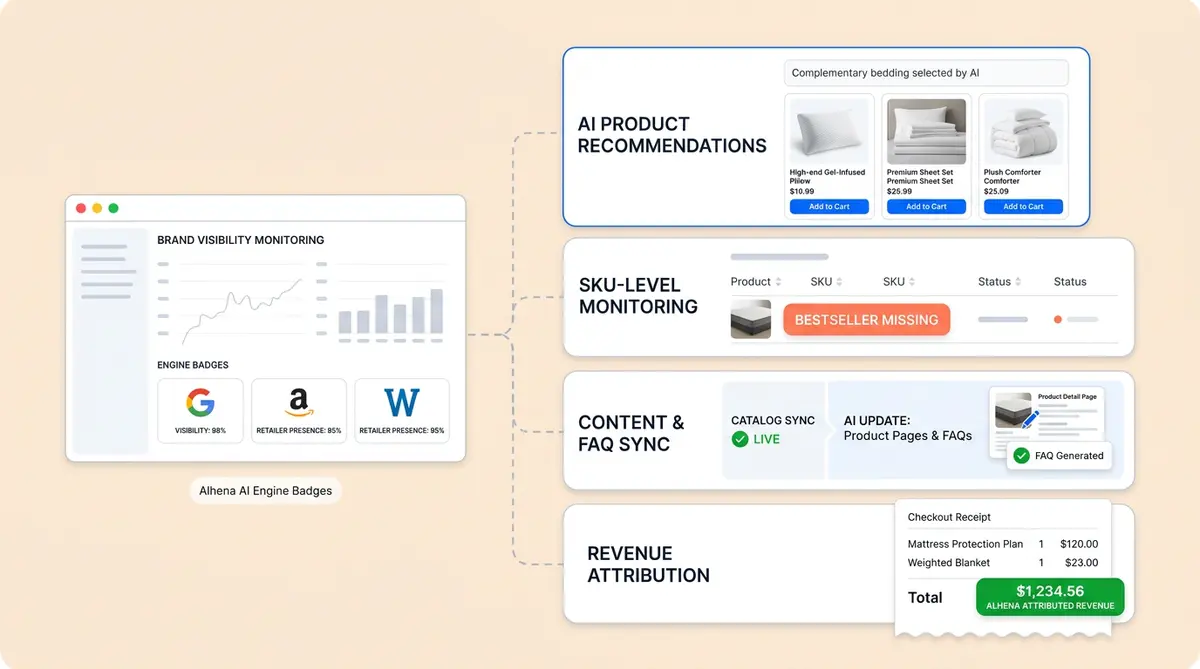
Alhena and Peec AI are both strong AI visibility platforms, but they are built for different buyers. Peec AI is the better fit for a B2B, SaaS, or agency team that wants clean, transparent, multi-client share-of-voice monitoring across AI answer engines. Alhena is the better fit for an online store that needs to track visibility at the individual product level and tie AI answers back to checkout revenue.
If you sell a catalog, that difference usually decides the tool. If you sell software or services, it may not.
Last verified: July 2026.
Key takeaways
- Peec AI is a best-in-class AI visibility monitor for B2B and agency teams: transparent pricing from $95 per month, extensive language coverage, daily refresh, 4.9 on G2, and a deliberate measure-only scope.
- Alhena is state of the art AI visibility solution for e-commerce: SKU-level product tracking, rendering analysis, live catalog sync, a content-fix engine, citation strategy, and revenue attribution to checkout, with all five engines included in every paid plan.
- The core fork is scope. Peec measures. Alhena measures, fixes, and attributes to revenue.
- Alhena is ahead on product-level depth, catalog sync, the fix engine, and revenue proof.
- Agencies with mixed client books can legitimately run both.
This guide compares the two platforms on the things that actually change a buying decision: engine coverage, prompt and competitor tracking, product-level visibility, revenue attribution, languages, and price. Both companies are real, well funded, and genuinely good at their core job. The goal is to help you pick the one that matches how your brand makes money.
Alhena vs Peec AI: the short answer
Peec AI is an AI search analytics platform for marketing teams and agencies. It monitors how brands appear across AI answer engines and reports visibility, position, sentiment, competitors, and sources, with a deliberately narrow scope. Peec measures, and it leaves the acting to you. That focus is a design choice, and it is a large part of why agencies rate it so highly.
Alhena is an AI visibility platform built for e-commerce. It tracks how your individual products, not just your brand, show up in AI answers, analyzes how product cards render; syncs with your live catalog, generates content and FAQ fixes; and attributes AI-sourced traffic to real checkout events. The loop it is designed around is simple to state: see it, fix it, and prove it.
So the real question is less "which tool is better" and more "which job is yours":
- Choose Peec AI if you run a B2B, SaaS, or services brand, or an agency with many clients, and you want fast, transparent, multi-market share-of-voice monitoring with excellent language coverage.
- Choose Alhena if you run an online store and you need to know which products win the AI answer, whether the price and image render correctly, and how much revenue AI engines actually drive.
- Run both if you are an agency with a mixed book: Peec for the marketing-led clients, Alhena for the commerce clients that need product-level tracking and revenue proof.
Alhena vs Peec AI at a glance
| Capability | Alhena | Peec AI |
|---|---|---|
| Built for | E-commerce brands with catalog-driven revenue | B2B, SaaS, and agency marketing teams |
| AI engines | 5, all included in every paid plan: ChatGPT, Google AI Overviews, Gemini, Perplexity, Claude | 6 in the catalog: ChatGPT, Google AI Mode, Google AI Overviews, Microsoft Copilot, Perplexity, Gemini; self-serve plans track up to 3 models, more cost extra |
| Prompt tracking | Yes: topics to prompts, AI demand levels, visibility score 0 to 100 | Yes: prompt-level share of voice, position, and sentiment |
| Competitor benchmarking | Yes: auto-discovers every brand that appears in your answers | Yes: competitor and regional benchmarking |
| Citations and sources | Yes: grouped by domain and page, with a 0 to 100 Domain Rating | Yes: source and citation tracking |
| Fan-out search insights | Yes: a dedicated tab shows the searches engines run under the hood and your organic rank on each | Not a published feature as of July 2026 |
| SKU-level product tracking | Yes, catalog-first: per-product cards, is-your-product flags, invisible-bestseller detection | Yes, via AI Shopping Analytics, launched June 2026 |
| Rendering analysis | Yes: product card vs text mention, plus price and image accuracy | Partial: reports the price the engine quotes vs your catalog price |
| Revenue attribution | Yes: AI-engine traffic joined to checkout events vs a sitewide baseline | No, out of scope by design |
| Action and fix layer | Yes: AEO FAQ engine, content-gap analysis, generated PDP and content fixes | No, monitoring only by design |
| Languages | Core engines across major markets | 115+ languages, a genuine Peec strength |
| Entry pricing | Free plan, then $199/mo Essentials | $95/mo Starter |
| Free plan | Yes: 5 prompts on 1 engine, no time limit | Free trial only (14-day), no permanent free plan |
| Agencies and multi-brand | Yes: one org with many brand profiles, role-based access | Yes: multi-project structure with per-plan seats |
The rest of this guide explains the rows that matter most, starting with what Peec AI does well, because for a large group of buyers it is simply the right answer.
What does Peec AI do well?
Peec AI earned its reputation. It reached $10 million in annual recurring revenue just 16 months after launch, grew to more than 2,500 customers including Attio, Squarespace, TUI, and Hugo Boss, and announced that milestone in May 2026. It raised a $21 million Series A led by Singular, bringing total funding to $29 million. Customers rate it 4.9 out of 5 on G2, and the praise is consistent: the product is clean, fast to set up, and pleasant to use.
Three strengths stand out for the right buyer:
- Transparent, published pricing. Peec lists its plans openly at $95, $245, and $495 per month, which makes budgeting and agency resale straightforward. In a category still full of "contact sales", that openness is worth real money.
- Broad language and market coverage. An independent 2026 review reports Peec supports 115+ languages with regional competitor benchmarking, which is genuinely strong for global brands and for agencies serving many countries.
- Daily tracking and a disciplined feature set. Every Peec plan refreshes daily and covers the major AI answer engines, and the company stays focused on doing monitoring well rather than sprawling into half-finished modules.
Peec has also extended into commerce. In June 2026 it launched AI Shopping Analytics, which tracks products across AI shopping answers and reports visibility, win rate, position, and the price the engine quotes versus your catalog price. It is a credible, useful module. It is also only a few weeks old at the time of writing, early in its maturity curve compared with a platform built catalog-first.
Where Alhena and Peec AI fork: monitoring vs the full loop
The clearest way to understand the two platforms is this: Peec AI is a monitoring platform, and Alhena is a monitoring-plus-action-plus-attribution platform. This is not a knock on Peec. It is Peec's stated design, and for teams with their own content engine it is the right shape.
Peec positions itself publicly as "the AI visibility monitoring company", and an independent review draws the boundary plainly: "Peec AI is a monitoring platform, not an optimization platform. It tells you where you stand; it doesn't write content, build authority signals," and it lists "no content creation, no optimization recommendations, no done-for-you option" among the trade-offs. Peec also keeps revenue attribution out of scope by choice. If you already have a team ready to act on the data, that clean separation is a strength, not a shortfall.
Alhena is built to close the loop rather than hand it off:
- See it: visibility scoring, competitor auto-discovery, citations with Domain Rating, and fan-out search tracking across five engines.
- Fix it: an answer-engine-optimization FAQ engine, content-gap analysis, and generated product-page and content fixes.
- Prove it: revenue attribution that classifies AI-engine traffic and joins it to checkout events, benchmarked against your sitewide baseline.
If your team is lean and would rather the tool hand you the fix and the revenue number than assemble both yourself, that action-and-attribution layer is the whole difference.
What does Alhena track that Peec AI does not?
Four capabilities separate an e-commerce-first platform from a brand-monitoring one. Each matters more the more your revenue depends on a product catalog.
SKU-level product tracking
AI engines increasingly recommend specific products, not brands. "Your brand was mentioned" can mean an engine recommended a discontinued item, or listed a competitor's bundle that happens to include you. Alhena tracks visibility per product: which of your SKUs appear for a given shopping prompt, whether the product shown is actually yours, and which of your bestsellers have no AI presence at all, a pattern Alhena calls invisible bestsellers. Peec's June 2026 Shopping Analytics also reports at the product level now, so both platforms can see products. The difference is that Alhena was designed catalog-first and pairs product tracking with live catalog sync and revenue outcomes. Our guide to SKU-level AI visibility goes deeper on why brand mentions are not enough.
Answer rendering analysis
In ChatGPT, a product can appear as a rich card with an image, price, and rating, or as a plain text mention. Whoever owns the card owns the click. Alhena distinguishes a rendered product card from a text mention and flags whether the price and image shown are correct. Peec's Shopping Analytics checks the mentioned price against your catalog price, which is a related accuracy signal, while Alhena's rendering view is built specifically around the card surface. This matters because, in Alhena's 2026 cohort research, ChatGPT drove 96.1% of US LLM traffic to online stores, so the ChatGPT product card is where most of the commerce upside sits today.
Revenue attribution to checkout
This is the single biggest gap between the two tools. Alhena classifies traffic from ChatGPT, Perplexity, Gemini, Claude, and Copilot into per-engine buckets, joins that traffic to actual checkout events, and compares it against your sitewide baseline. Peec, by design, does not do this. It is worth being precise about what the number is and is not: Alhena reports attributed revenue by AI source, not a controlled measure of incremental lift. It tells you how AI-sourced sessions converted, benchmarked against the rest of your site, which is exactly the figure a merchant needs to justify the investment. Our AI search revenue attribution guide explains the method and its limits.
Live catalog sync and a fix engine
Alhena syncs with Shopify, WooCommerce, Magento, and Salesforce Commerce Cloud, so it works from your real prices and availability, and it generates FAQ and product-page content to close the gaps it finds. Peec surfaces the gaps for you to act on; Alhena also drafts the fix. That first-party connection is the foundation of the whole approach. Alhena operates on both sides of the customer journey: its AI Shopping Assistant and Support Concierge handle real conversations with shoppers across web chat, email, Instagram DMs, and WhatsApp, and what shoppers actually ask (which products, which questions, what converts) feeds the visibility layer, informing which prompts to track and which gaps matter. Peec observes AI answers from the outside; Alhena also sees what happens on your storefront. We cover the thesis in our note on first-party data for AI visibility.
Where Peec AI is genuinely ahead
An honest comparison names the places the other tool wins. Peec AI is ahead of Alhena on several real dimensions, and if any of these is your priority, Peec is the better pick:
- Engine breadth in the catalog. Peec's engine list spans six: ChatGPT, Google AI Mode, Google AI Overviews, Microsoft Copilot, Perplexity, and Gemini. Alhena covers five and does not track Google AI Mode or Microsoft Copilot. If Copilot or AI Mode coverage is essential to you, Peec has it and Alhena does not. Alhena covers Claude, which Peec's published engine list does not, so the exchange runs in both directions.
- Language coverage. Peec puts language breadth front and center (a 2026 third-party review counts 115+ languages). Alhena localizes tracking to any market and language, but broad multi-language coverage is not the marketed strength it is for Peec.
- Transparent per-plan pricing for agencies. Peec's simple, published tiers make multi-client resale and budgeting easier than a usage-shaped commerce plan.
- Monitoring purity. If you do not want an action layer or attribution and simply want the cleanest possible share-of-voice dashboard, Peec's narrow scope is a genuine advantage rather than a gap.
One honest caveat belongs on the engine count. Peec offers six engines in its catalog, but its self-serve plans meter how many you can actually track: the Advanced plan covers three AI models, and tracking additional models costs extra. Alhena includes all five of its engines in every paid plan. So "six versus five" is a catalog comparison; on a mid-tier self-serve plan, the number you actually watch can be closer than the headline suggests.
Alhena vs Peec AI pricing
Both companies publish their pricing, which is refreshing for this category. Here is how the two line up as of July 2026.
Peec AI starts at $95 per month (Starter), then $245 (Pro) and $495 (Advanced), with a custom Enterprise tier and a 14-day free trial. Each self-serve plan includes a set number of AI models, with additional models available at extra cost.
Alhena starts with a permanent free plan (5 tracked prompts on one engine), then Essentials at $199 per month (25 prompts, 10 competitor benchmarks, scheduled refresh), Growth at $499 (75 prompts, weekly refresh), and Scale at $999 (150 prompts, 25 competitors, daily refresh), with a custom Enterprise tier. Every paid Alhena plan includes all five engines and an AI visibility audit. The current Alhena pricing page has the full breakdown.
Read past the headline numbers. Peec's $95 entry is genuinely lower, and for pure monitoring it may be everything you need. Alhena's plans cost more at the door because each one bundles all five engines, product-level tracking, the fix engine, and revenue attribution together. Two similar-looking prices do not buy the same thing across these tools.
Which should you choose?
Match the platform to your motion, not to a feature checklist.
- B2B, SaaS, or services brand: Peec AI. Your buyers ask problem-shaped questions, your "catalog" is a short list of plans, and you want clean share-of-voice reporting your team acts on.
- Agency with many clients: Peec AI as the default, for its transparent pricing, language breadth, and multi-project structure. Add Alhena for any commerce client that needs product-level tracking and revenue proof.
- Online store or DTC brand: Alhena. You need to know which products win the answer, whether the card renders correctly, and how much revenue AI drives, and you want the fix, not just the finding.
- You only want monitoring, nothing else: Peec AI. Its discipline is the point.
- You want the whole loop in one system: Alhena. See it, fix it, prove it.
If you are still unsure, run the same 25 prompts through both trials and compare the answer data before committing to an annual plan. You can also compare the wider field in our roundup of the best AI visibility tools for ecommerce, or read how Alhena compares to Profound for a different head-to-head. The right tool is the one whose core job is your core job.
The bottom line
AI visibility is splitting into two jobs. The first is monitoring: watch where your brand appears across engines and report it cleanly. Peec AI does that job about as well as anyone, and for B2B and agency teams it is an easy recommendation. The second job is commerce: know which products win the answer, keep the catalog accurate, fix the pages that lose, and prove the revenue. That job needs a platform wired into your store and your checkout, and it is the job Alhena was built for. Pick the platform whose core loop matches how your brand actually makes money.
Alhena AI (founded in 2022 by ex-LinkedIn engineers and rebranded from Gleen AI in February 2025) is an e-commerce AI platform spanning an AI Shopping Assistant, Support Concierge, Voice AI, and AI Visibility for AEO and GEO tracking, with a free tier and paid plans from $199 per month. You can explore the Alhena AI Visibility product to see SKU-level tracking and revenue attribution in action.
See how your products show up in AI answers
Track SKU-level visibility, get generated content fixes, and attribute AI-sourced revenue to real checkouts.
Frequently asked questions
Peec AI added product-level AI Shopping Analytics in June 2026, so it can track how your products appear in AI shopping answers across ChatGPT, Perplexity, Gemini, and Google AI Overviews, including visibility, position, and the price the engine quotes. It is a capable AI search monitor. For a store that also wants live catalog sync, product-card rendering analysis, and revenue attributed to checkout, a platform built catalog-first like Alhena goes further. If you mainly need clean brand and product monitoring in the AI answer layer, Peec is a strong fit.
No. Peec AI keeps revenue attribution out of scope by design and positions itself as an AI visibility monitoring and analytics dashboard rather than an attribution or optimization tool. It shows you where your brand stands in AI answers, including citations, sentiment, and competitor share of voice, and leaves the revenue math and the fixes to your team. Alhena, by contrast, classifies AI-engine traffic from ChatGPT, Perplexity, Gemini, Claude, and Copilot and joins it to checkout events against a sitewide baseline.
Alhena adds four capabilities aimed at e-commerce: SKU-level product tracking with invisible-bestseller detection, product-card rendering analysis, live catalog sync with Shopify, WooCommerce, Magento, and Salesforce Commerce Cloud, and revenue attribution from AI search engines to checkout events. It also runs a content and AEO FAQ fix engine, a fan-out prompt insights tab, and citation grouping with a 0 to 100 Domain Rating. Peec covers monitoring across more engines and languages but does not attribute revenue, generate fixes, or map the fan-out searches AI engines run under the hood.
Peec AI publishes plans at $95 (Starter), $245 (Pro), and $495 per month, plus a custom Enterprise tier and a 14-day free trial. Alhena has a permanent free plan, then Essentials at $199, Growth at $499, and Scale at $999 per month, plus a custom Enterprise tier. Peec's entry price is lower, but Alhena includes all five AI engines, product-level tracking, the fix engine, and revenue attribution in every paid tier, so a direct price comparison does not buy the same thing across the two platforms.
Yes, and for some teams it makes sense. Agencies with a mixed client book often run Peec AI for marketing-led and B2B SaaS clients and Alhena for commerce clients that need product-level tracking and revenue proof. A single-brand team usually gets further by picking the one platform whose core job matches theirs rather than paying for two overlapping AI visibility monitors that mostly track the same prompts.
Alhena covers five AI search engines in every paid plan: ChatGPT, Google AI Overviews, Gemini, Perplexity, and Claude. Peec AI lists six in its catalog: ChatGPT, Google AI Mode, Google AI Overviews, Microsoft Copilot, Perplexity, and Gemini, but its self-serve plans meter how many you can actually track, with the Advanced plan covering three AI engines and additional models available at extra cost. Peec adds Copilot and Google AI Mode; Alhena adds Claude, which is not listed on Peec's published engine catalog.
Peec AI is best for B2B, SaaS, and agency marketing teams that want fast, transparent, multi-language share-of-voice monitoring across AI answer engines. It has a 4.9 rating on G2, publishes its pricing openly, refreshes its dashboard daily, and supports a very wide set of languages. Its deliberate monitoring-only scope is a strength for teams that already have their own content strategy and SEO workflow to act on the data, rather than a gap.
For most B2B SaaS brands, Peec AI is the better fit. B2B buyers ask problem-shaped, prompt-based questions rather than product queries, the catalog is a short list of plans, and clean share-of-voice monitoring across engines and languages is what the team needs. Alhena is the stronger choice when revenue runs through an online product catalog and you need SKU-level AI visibility and revenue attribution, not just brand mentions.
Traditional SEO optimizes web pages to rank in ten blue links. AI visibility, sometimes called AEO or answer engine optimization, tracks whether your brand appears inside the answer an AI search engine hands back to a shopper on ChatGPT, Perplexity, Gemini, Claude, or Google AI Overviews. The signals are different: instead of position and clicks, you look at how often you get cited, which sources the engine trusts, how sentiment reads in the answer, and, for stores, whether a rendered product card wins the recommendation. Tools like Alhena and Peec AI exist because ranking in AI answers is not the same problem as ranking in Google organic, and legacy SEO dashboards do not measure it.
Both platforms build a prompt set from your topics and then run those prompts against major AI search engines on a regular refresh. Peec AI reports prompt-level share of voice, position, and sentiment, plus competitor and regional benchmarking, with a clean dashboard that agencies rate highly. Alhena runs prompt-based tracking with a 0 to 100 visibility score, auto-discovers every competitor that appears in your answers, groups citations by domain and page with a Domain Rating, and adds a fan-out search tab that shows the follow-up searches AI engines run under the hood. Both give you actionable competitor comparison data; Alhena adds the generated content fixes on top.