
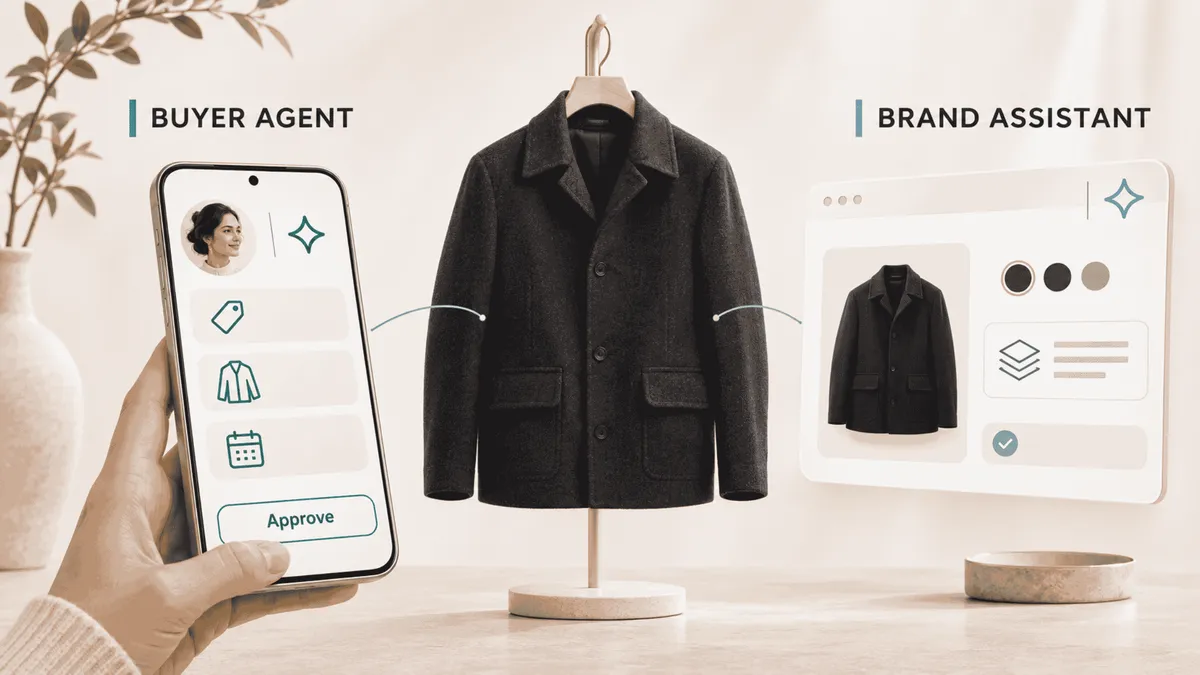
AI Shopping Assistants vs. AI Buyer Agents: Who Represents Whom?
A sales associate and a personal shopper can recommend the same jacket. That does not make them the same kind of adviser.
One starts with the store’s collection. The other starts with the shopper’s brief. They can agree on the purchase while bringing different knowledge, incentives, and responsibilities to it.
The same distinction matters in AI commerce. A brand’s shopping assistant and a customer’s buying agent may exchange information about an identical product. But who gets to recommend an alternative? Who confirms the delivery promise? Who has permission to spend?
Those questions matter more than whether a vendor calls its product an assistant, an agent, or a copilot. Start with the role, then examine what the system can actually do.
What is the difference between an AI shopping assistant and an AI buyer agent?
A merchant-side AI shopping assistant helps customers understand a brand’s products and service. An AI buyer agent carries out a shopper’s delegated task, potentially across merchants. Neither role automatically includes permission to purchase, substitute products, or access private customer information.
For this article, “merchant assistant” and “merchant agent” describe systems acting within a business’s approved knowledge and operating rules. “Buyer agent” describes the customer-side role. These are working definitions, not legal classifications or universal product categories.
The distinction is not that assistants only talk while agents always act. A merchant assistant can have permission to use business tools. A buyer agent may only research and prepare a shortlist. What matters is its supported integration and the authority granted for the task.
Alhena’s guide to AI shopping assistants covers the merchant-side category. The comparison here focuses on responsibility when another system represents the shopper.
Buyer agents vs. merchant agents: a practical comparison
Use this table as a responsibility map, not a claim that every product implements the same features.
| Question | Merchant-side shopping assistant | Customer-side buyer agent |
|---|---|---|
| Whose task does it serve? | The brand’s shopping and service experience. | The shopper’s delegated shopping task. |
| What knowledge is relevant? | Approved catalog facts, policies, availability, and authorized business tools. | The shopper’s stated needs, preferences, budget, and permitted sources. |
| What should guide recommendations? | Product fit and supported claims, within merchant rules. | The shopper’s requirements and permitted trade-offs. |
| Can it change the offer? | Only through approved pricing, promotion, or service operations. | It can request alternatives, not override merchant rules. |
| Can it complete a purchase? | Cart access alone does not authorize spending. | Only through a supported flow and valid customer authorization. |
For the merchant, success means a useful, accurate, policy-compliant outcome. For the buyer agent, it means satisfying the brief without exceeding delegated limits.
Two other responsibilities should remain explicit. The commerce backend calculates valid prices, checks inventory, and validates carts and orders. The payment service handles its supported payment flow and credentials. Neither responsibility should be delegated to persuasive generated text.
For broader context, see Alhena’s agentic commerce guide. A feature checklist becomes more useful once the owner of each decision is clear.
The merchant knows the product. The buyer agent knows the brief.
Consider the knowledge needed to make a useful recommendation.
On the merchant side, that might include a fit guide, a compatibility table, care instructions, available variants, and approved answers from the support team. On the buyer side, it might include a budget, a delivery deadline, material preferences, and permission to consider alternatives.
The useful exchange is not a contest between two persuasive chatbots. The buyer expresses constraints. The merchant returns supported options, evidence, terms, and uncertainty. The buyer evaluates those options against the brief.
Neither party needs the other’s entire information history.
As a design rule, share the minimum context needed for the next decision. A shipping estimate may need a postcode before it needs a full address. A product comparison may need a size preference, not the customer’s support archive or unrelated AI conversations.
Keep public product facts, session preferences, private account records, and payment credentials in separate access categories. Also separate memory from permission: “I usually choose the cheapest shipping” does not authorize delivery after a trip, and a previous purchase does not silently authorize another one.
Context can improve a recommendation without expanding the right to act.
Different incentives do not have to produce a bad outcome
A merchant wants a sale. A shopper wants the right purchase. The two can align without being identical.
Imagine the lower-priced jacket satisfies the brief better than the item in a campaign. A useful merchant assistant should explain that fit rather than quietly replace the customer’s requirements with a merchandising priority.
The opposite assumption also deserves scrutiny. Calling a product a buyer agent does not prove that every recommendation is independent. Ask how its provider handles sponsored results, commercial relationships, ranking, and coverage of competing merchants. Evaluate the disclosed arrangement rather than assuming neutrality from the name.
For the merchant, a compatible accessory can be a helpful recommendation. Putting it into the basket without permission is a different action.
Set an explicit order of operations: meet the customer’s hard requirements first, explain the available trade-offs, and make optional additions visibly optional. Test those boundaries rather than relying on a friendly tone as evidence of alignment.
A recommendation is not a purchasing instruction
Consider an illustrative request: “Find a black, washable wool-blend jacket under $250 that arrives before Friday.”
The buyer agent should resolve the ambiguity. Does washable mean machine washable? Is $250 the product price or the total after shipping and tax? Is Friday an essential deadline? Which destination and size apply?
Once the brief is clear, the merchant should answer from approved care instructions, material composition, variant inventory, and destination-specific delivery options. If the promoted jacket is dry-clean only, it does not meet a machine-washable requirement.
The merchant can propose an alternative. It should not quietly reinterpret the condition to preserve the sale.
Now the shopper says, “Buy the best one.” That is a new decision, not just another search query. May the agent accept final sale? Choose a different material? Use a saved address? Substitute another size if the preferred variant sells out?
A purchase proposal should identify the exact variant, quantity, shipping service, total, material conditions, and any validity limit. The buyer agent may accept it only within the customer’s authority and the supported transaction flow. Otherwise, return to the person.
The AP2 specification illustrates how payment-related authorization can be made explicit through linked Checkout and Payment Mandates and defined verification responsibilities. It describes direct and autonomous modes, not a universal purchasing permission for every AI product.
The decisive moment is not when two agents agree. It is when a permitted instruction meets a valid merchant action.
Not every agent-led purchase is agent-to-agent commerce
There are at least three useful ways to think about the merchant interaction. They can coexist in one journey.
Browser-mediated shopping: the customer’s agent navigates a conventional storefront, reads information, and interacts with visible controls. The merchant does not necessarily have a conversational agent involved.
API-mediated shopping: the agent uses structured services to retrieve products, request a quote, or prepare a cart. A conventional commerce system can answer those requests without another language model. The Model Context Protocol provides a standard for connecting AI applications to external tools and data; that connection is not itself a second agent or permission to buy.
Agent-to-agent shopping: a customer-side agent communicates with a merchant-side agent that interprets a request or coordinates work. The A2A specification describes capability discovery, messages, and tasks between agent systems. The business still has to enforce the authority and rules behind the requested action.
A shopper might discover an item through a feed, ask a merchant expert about compatibility, and complete the purchase on an ordinary checkout page. That combination is not a failure of autonomy. It may be the simplest reliable route.
Alhena’s agent-to-agent commerce overview explains the broader interaction pattern. For implementation, choose the interface that solves the actual problem. Do not add a second model where a dependable lookup will do.
Identity, delegation, and payment are separate questions
A recognizable agent is not automatically authorized to use a particular customer’s account. An authenticated customer session does not automatically permit every operation. A usable payment credential does not explain every purchase condition.
Keep three questions separate: which system is calling, which customer and task it represents, and what evidence permits the proposed payment.
Visa’s Trusted Agent Protocol describes signed information for agent recognition, consumer recognition, and payment interactions. These mechanisms help participants verify supplied information; the merchant still needs controls for its specific operation.
Likewise, the A2A authorization requirements distinguish authenticating a caller from authorizing requests under the server’s policies. A request for additional authorization is not itself approval to perform an action.
For an order-status request, establish which order is in scope. For an address change, establish permission for that change. For a purchase, check the approved limits and whether authority is still valid. When the task changes, reassess the permission rather than carrying forward an unrestricted “yes.”
Do not let a familiar provider name answer all those questions at once.
A merchant agent should be allowed to say no
A useful merchant assistant is not an infinitely agreeable salesperson.
It should decline unsupported claims, reject invalid discounts, preserve inventory rules, and explain when a request needs human review. Refusing to promise an impossible delivery date may be less exciting than a confident yes. It is still the better answer.
Build evaluation cases around these conflicts. The following is a proposed test set, not a report of vendor performance.
| Test scenario | A responsible outcome |
|---|---|
| A promoted product misses a required specification. | State the mismatch and offer only clearly labeled alternatives. |
| The buyer requests promotions that cannot be combined. | Apply the valid offer rules and explain the restriction. |
| The cart changes after approval. | Revalidate the purchase and seek renewed approval when required. |
| Customer authorization expires or is withdrawn. | Stop the affected action and obtain valid authority before continuing. |
| The same purchase request is sent twice. | Use backend safeguards to avoid an unintended duplicate order. |
| An unrelated identity requests an order refund. | Withhold private information and require the appropriate verification and scope. |
Track correct refusals and useful clarifications alongside completed tasks. Otherwise, a completion-only score can reward the very behavior your business needs to prevent.
Internal agent handoffs are not external interoperability
“Agent-to-agent” can also describe several specialists working inside one merchant’s system.
Alhena’s multi-agent architecture article describes planning, orchestration, specialized agents, and shared conversation state. A product question can move to the relevant specialist with context preserved.
That is internal coordination. It does not, by itself, establish that an unrelated customer-side agent can authenticate, access private records, or place an authorized order through the same system.
External interoperability introduces a separate access boundary and integration agreement. Ask a vendor to demonstrate the exact interaction you need, including the caller, available tools, permissions, and recorded outcome.
“Our agents talk to each other” is not the same answer as “this approved customer agent can request a quote for this market under these conditions.”
Agent negotiation does not mean unlimited discounting
A merchant can expose an approved member price, bundle offer, or shipping option without allowing software to bargain over every order.
Start with bounded commercial rules: eligible products, eligible customers, allowed combinations, price limits, and expiration conditions. Keep enforcement in the pricing or commerce service rather than relying on a prompt to protect margin.
Be precise with protocol language too. The UCP overview uses capability negotiation to describe how participants establish compatible functions and versions. That is not a promise that agents negotiate retail prices.
A buyer agent can ask for another offer. The merchant decides what it can validly offer. The customer decides which trade-offs the buyer agent may accept.
Where Alhena fits: the merchant’s expertise, grounded in its own business
Alhena AI Shopping Assistant is positioned as an owned, on-site shopping experience, using brand and catalog context for product discovery, guided questions, comparisons, and FAQs. That is a merchant-side role, not an independent cross-merchant purchasing service.
Orbit Baby’s published case study shows what that distinction looks like in practice. Its assistant draws on product manuals, help articles, FAQs, and support history to answer detailed questions about compatibility and features. Specific safety scenarios go to the support team, and complex conversations reach Zendesk with their history attached.
The case study reports 15% higher average order value among Alhena-engaged shoppers between July 6 and October 18, 2026. Those are observational results, not a controlled estimate of incremental lift. They describe merchant-side assistance, not autonomous purchases by external buyer agents.
The practical lesson is to make the merchant’s knowledge dependable before extending its reach. Human-facing guidance, internal coordination, and outside-agent access are related capabilities, but each needs its own evidence.
The interface can change. The customer still needs a clear handoff.
Shopify’s agentic storefront documentation says merchants retain ownership of the customer relationship and post-purchase experience for orders through those channels. That is a platform-specific example of why an AI interface does not erase merchant responsibilities.
Before launch, decide which system creates the order, where approval is recorded, and what support can see. Preserve the agreed product and terms when the journey moves from a conversation to a cart, checkout, or service ticket.
Inside the business, assign clear owners. Merchandising maintains product evidence. Engineering owns integrations and enforcement. Customer experience owns escalation and recovery. Commercial and risk owners approve the limits on discounts, spending, and exceptions.
Then test one complete task, including a failure. Make an item unavailable, change the destination, or revoke permission. Record which system detects the change, which action stops, and how the customer continues.
A customer should be able to explain the result: “My agent found the jacket. The store confirmed the size and delivery. I approved the total. The store sent the confirmation.”
“An AI handled it” is not an adequate handoff.
Build accountable decisions, not just more autonomous components
The buyer owns the brief and permitted delegation. The merchant owns its offer and fulfillment promise. The commerce system enforces valid operations. The payment provider performs its defined role. A person can intervene when the available evidence or authority is insufficient.
Select the interface after those responsibilities are clear. Then measure whether the system respects them, including the moments when stopping is the right outcome.
To evaluate merchant-side shopping assistance, book an Alhena demo. Bring a difficult product question, a policy exception, and a handoff scenario. Use them to assess the guidance and controls your store actually needs.
Frequently asked questions
Is a merchant agent the same as an AI shopping assistant?
In this article, a merchant agent is the business-side role, and a merchant’s AI shopping assistant is one way to deliver it. Some systems provide guidance; others also use authorized tools. Check the actual scope rather than assuming capability from the label.
Can one AI system act as both a shopping assistant and a buyer agent?
Yes, in different contexts. Keep the represented party, available information, and permitted actions explicit. A shared model or interface does not justify silently carrying merchant-side permissions into a customer-side task, or the reverse.
Does an AI buyer agent always buy autonomously?
No. Research, comparison, and cart preparation can be useful without purchase authority. The AP2 specification describes both direct and autonomous payment-related modes, but implementation and valid authorization determine which flow is available.
Does every retailer need its own AI agent to serve buyer agents?
No. Structured product services and controlled commerce APIs can support many tasks. Add merchant-side AI when interpreting ambiguous questions, explaining product evidence, or coordinating work improves the experience. Do not add it merely to create another agent.
Is A2A the same as agent-to-agent commerce?
No. A2A is a protocol for agent communication. Agent-to-agent commerce is a business interaction pattern that can use different interfaces. Product accuracy, commercial rules, checkout, and permission still need to be handled in the implementation.
Can a merchant agent negotiate prices automatically?
A business can design an automated offer process within explicit rules. Protocol compatibility does not itself permit discounts. Enforce eligibility, limits, and valid combinations in the commerce system, with review for exceptions.
Who should approve a product substitution?
The customer’s authorization should determine that. A substitution outside the permitted rules, or one that changes an essential requirement, should return to the customer. Similarity is not consent, and staying below budget does not make every alternative acceptable.
Does a merchant need the shopper’s entire AI conversation?
Not by default. Design the exchange around necessary, permitted context, such as product constraints, a selected variant, and delivery requirements. Do not assume an AI referral includes access to the customer’s transcript or private account information.