What Is Agentic Commerce? Definition, How It Works, and How to Prepare Your Store
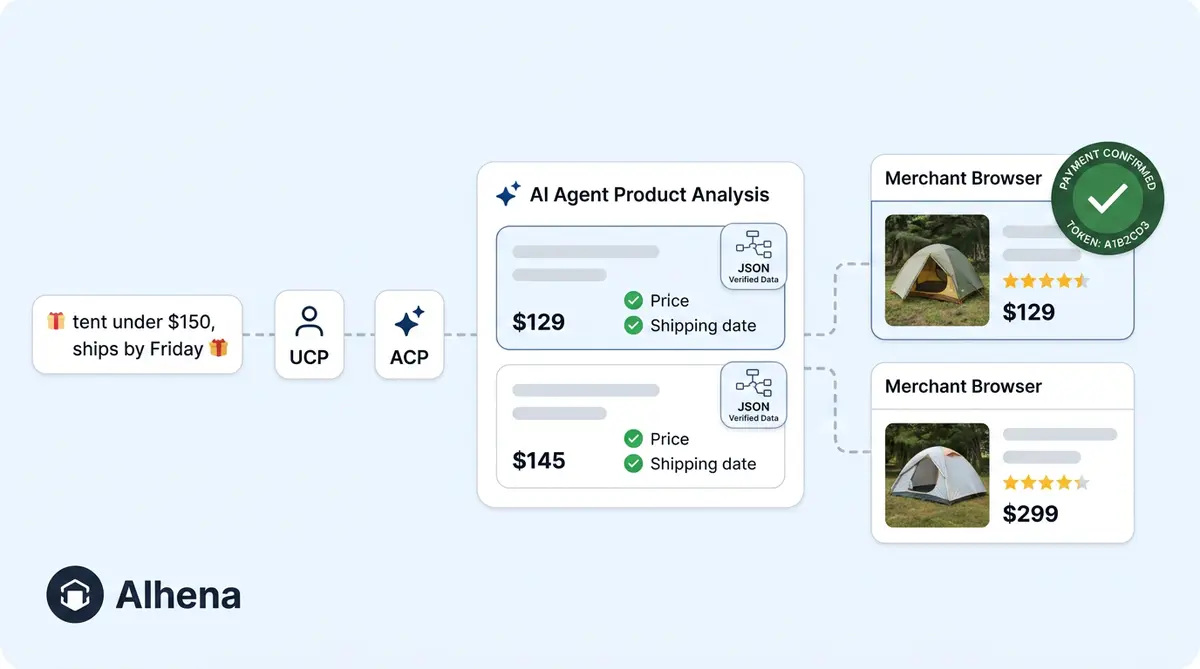
Agentic commerce is a model of online shopping in which AI agents act on a person’s behalf to research products, compare options and complete purchases, with little or no manual browsing. The shopper states a goal in plain language, and the agent handles discovery, evaluation and checkout across one or more merchants.
That definition is deliberately narrow, because the term has been stretched to cover almost anything with “AI” in it. The useful test is whether software is acting on the shopper’s behalf rather than assisting them. A chatbot that answers a sizing question is assistance. An agent that reads the sizing chart, checks stock across three retailers, and puts the right item in a cart is agentic.
This guide covers what agentic commerce actually is in 2026, how the underlying protocols work, what the market data says (including where it disagrees), what already failed, and the concrete steps a merchant can take to be ready.
Agentic commerce vs. traditional ecommerce
In traditional ecommerce, the shopper does the work. They search, open tabs, compare, read reviews, fill in a checkout form. The storefront is designed for human eyes, and the whole discipline of conversion optimisation exists to make that human journey shorter.
In agentic commerce, an AI agent does those steps and the shopper approves the outcome. The storefront is still there, but it is no longer the primary interface. The agent reads your product data instead.
That single change has a practical consequence most teams underestimate: an agent cannot be persuaded by design. It does not see your hero image, your badge, or your urgency banner. It reads titles, attributes, prices, availability, shipping terms and return policies. If those are incomplete or inconsistent, the agent moves on to a competitor whose data is clean. Merchandising shifts from visual persuasion to data quality.
| Traditional ecommerce | Agentic commerce | |
|---|---|---|
| Who does the searching | The shopper | An AI agent |
| Primary interface | Storefront, search bar, PDP | Product data, APIs, feeds |
| What wins the sale | Brand, design, reviews, ad spend | Data completeness, accuracy, availability |
| Checkout | Human fills a form | Agent passes tokenised credentials, or hands off to the merchant site |
| Optimisation discipline | CRO and SEO | Structured data, feed hygiene, GEO |
| Session length | Many sessions, many tabs | One prompt, one decision |
Agentic commerce vs. conversational commerce vs. agentic AI
These three get used interchangeably and mean different things.
Agentic AI is the broad category: AI systems that plan and take actions toward a goal, rather than only generating a response. It covers coding agents, research agents, support agents and everything else.
Conversational commerce is shopping through a chat interface. The interface is conversational, but the human still decides and acts at every step. Most ecommerce chatbots from 2018 to 2024 were conversational commerce.
Agentic commerce is the application of agentic AI to buying and selling. The agent researches, evaluates and often transacts. The conversation is a way to state intent, not the product itself.
A short way to hold the distinction: conversational commerce changed how you ask. Agentic commerce changes who does the work.
How does agentic commerce work?
Agentic commerce runs in three stages: intent, reasoning, and execution.
Intent. The shopper describes an outcome rather than a product. “A waterproof jacket for hiking in Scotland in March, under £200, that ships before the 14th.” No keywords, no filters.
Reasoning. The agent decomposes that request into sub-questions, retrieves candidate products from catalogs, search indexes and its own knowledge, then evaluates them against every stated constraint. This is where product data quality decides the outcome. A jacket with no waterproof rating in its attributes is invisible to a query about waterproofing, no matter how good it is.
Execution. The agent either completes the purchase through a commerce protocol, or hands the shopper off to the merchant’s own checkout with a pre-built cart. In 2026, the hand-off is far more common than the autonomous purchase, and the reasons for that are covered below.
The whole loop can happen inside ChatGPT, Gemini, Copilot, Perplexity, or an agent the merchant runs on its own site.
What is an agentic commerce protocol?
An agentic commerce protocol is a shared standard that lets AI agents and merchant systems exchange product, order and payment information automatically, so a purchase can be completed without a human filling in a form.
The common confusion is treating these as competitors. They mostly layer. A single transaction can use a discovery standard, a checkout standard and a payment-authorisation standard at the same time.
| Protocol | Backed by | What it covers | Status (Sept 2026) |
|---|---|---|---|
| ACP (Agentic Commerce Protocol) | OpenAI, Stripe | Agent-to-merchant checkout; merchant stays merchant of record | Open source under Apache 2.0, co-maintained. Spec active; ChatGPT’s native in-chat checkout was wound down in March 2026 |
| UCP (Universal Commerce Protocol) | Google, Shopify | Full journey: discovery → cart → checkout → post-purchase. Transport-agnostic (REST, MCP, A2A, AP2) | Announced at NRF, January 2026. Checkout rolling out through 2026 |
| AP2 (Agent Payments Protocol) | Google, now under FIDO Alliance governance | Proving a user authorised a specific payment of a specific amount | Announced September 2025, moved to FIDO governance in 2026 |
| MCP (Model Context Protocol) | Anthropic, donated to the Linux Foundation late 2025 | How agents connect to tools and data sources, including commerce systems | Widely adopted as general agent plumbing |
| A2A (Agent2Agent) | Agent-to-agent communication | Used as a transport option inside UCP |
UCP’s announced partner list gives a sense of where the weight sits: Walmart, Target, Best Buy, Home Depot, Etsy and Wayfair on the retail side, with Visa, Mastercard, American Express, Stripe and Adyen on the payments side.
What advantages come from integrating with an agentic commerce protocol?
Three, in order of how quickly they show up.
First, distribution. Protocol integration is how your catalog becomes visible to agents that shop across merchants. Without it, an agent can only recommend you if it can scrape or already knows you.
Second, fewer bespoke integrations. A standard means one implementation instead of a separate build for every assistant that comes along.
Third, retained control of the customer relationship. Under ACP, the merchant remains the merchant of record, handles fulfilment, and holds the customer data. That is the difference between agentic commerce as a new channel and agentic commerce as disintermediation.
How does agentic checkout work, and how is it different from traditional checkout?
Agentic checkout is a purchase completed by an AI agent through a merchant’s API rather than by a person filling out a web form. Instead of typing a shipping address and a card number, the shopper’s agent passes verified order and payment details, often through a scoped credential such as Stripe’s Shared Payment Token, which is limited to a single merchant and amount. The merchant confirms the order and remains merchant of record.
The gain is the removal of the steps that cause most cart abandonment: manual data entry, account creation and payment entry. The constraint is trust. Most 2026 implementations still ask the shopper to approve the final purchase, because consumers are not yet comfortable delegating the spend decision itself.
Payment networks have built for exactly this. Visa Intelligent Commerce (and its cross-network Intelligent Commerce Connect, which supports both ACP and UCP), Mastercard Agent Pay and PayPal’s agentic services all run agent transactions through existing tokenised card rails rather than inventing new ones. That matters for merchants: agentic payments largely reuse the fraud, dispute and settlement infrastructure you already have.
What already failed, and what it teaches
In-chat checkout has already had its first correction, and it is worth being honest about it.
OpenAI launched Instant Checkout inside ChatGPT on 29 September 2025, starting with Etsy and Shopify. In March 2026 it discontinued the native in-chat purchase flow and refocused on product discovery, routing buyers to merchant checkout instead. The signals behind that decision were not subtle. Walmart disclosed that ChatGPT purchases converted roughly three times worse than click-throughs to Walmart.com. On the Shopify side, only a very small number of merchants ever went live with it at all.
The lesson is not that agentic commerce failed. Agent-driven discovery grew through the same period. The lesson is about sequencing: shoppers were willing to let an agent find the product and unwilling to let it finish the purchase somewhere that was not the retailer’s own site.
What this means for merchants
For merchants, that sets a clear priority order. Be discoverable and recommendable by agents first. Treat native agent checkout as the second phase, not the first.
Agentic commerce by the numbers (2026)
The forecasts are large, they disagree with each other, and they are forecasts. The current transaction volume is small. Both facts are true at once, and any source that gives you only one of them is selling something.
What is happening now
What is forecast for 2030
Agent-driven commerce by 2030 — the published estimates
The spread between Bain’s $300–500B and McKinsey’s $900B–$1T for the US is mostly a definitional gap: “agent-influenced” counts any purchase an agent touched, while narrower figures count only transactions an agent completed. When you see an agentic commerce number, check which one it is.
How can merchants prepare for agentic commerce?
Five steps, in the order that returns value fastest.
- 1. Fix your product data first. Complete, accurate, consistent titles, descriptions, prices and attributes in a structured format. This is unglamorous and it is the whole game. Missing or inconsistent attributes are the single most common reason an agent skips a product it would otherwise have recommended.
- 2. Make your policies machine-readable. Shipping times, return windows, warranty terms and sizing information should exist as structured data, not only as prose in a footer page. Agents filter on constraints, and “ships before the 14th” is a constraint.
- 3. Confirm your payment stack supports tokenised agent transactions. Ask your processor directly whether they support scoped payment tokens and which agentic protocols they have implemented.
- 4. Connect to the protocol ecosystem through your platform. For most merchants this is a platform-level switch (Shopify Catalog, for example) rather than a custom build. Check what your platform already supports before commissioning engineering work.
- 5. Run your own agent on your own channels. The merchant-owned agent is the one surface where you control the conversation, see the intent data, and keep the margin. It is also the fastest of these five to show measurable revenue impact.
How can marketplaces and B2B sellers prepare?
Marketplaces have an additional obligation: seller data quality is now a platform-level risk. A marketplace is only as discoverable to agents as its worst-maintained seller catalog, which makes data governance a commercial function rather than an operational one.
B2B sellers face the same shift arriving through procurement rather than consumer shopping. Procurement agents evaluate suppliers on published specifications, lead times, compliance documentation and pricing terms. If that information sits in a PDF behind a login, the agent cannot shortlist you.
Where Alhena AI fits
Alhena builds the agent that runs on your own store, so the intent, the data and the margin stay with you rather than with a third-party assistant.
The results we see in production are consistent with the thesis above, that the fastest return comes from owning the agent experience on your own channels rather than waiting on protocol adoption:
Point the same capability at your catalog
If you want the same capability pointed at your catalog, start here.
Explore Alhena AIFrequently asked questions
How does agentic commerce differ from traditional ecommerce?
In traditional ecommerce, the shopper does the work: searching, comparing and checking out. In agentic commerce, an AI agent does those steps and the shopper approves the result. For brands, the practical shift is that products must be machine-readable, with clean structured data and complete attributes, because agents evaluate catalogs programmatically instead of browsing a storefront.
What are the benefits of agentic commerce for businesses?
The main benefits are higher-intent traffic, lower discovery cost, less checkout friction and easier repeat purchases. When an agent recommends your product it is matching a stated need, so conversion tends to be strong. Discovery does not require an ad bid. The trade-off in 2026 is volume: agent-driven transactions are still a low single-digit share of ecommerce.
What is an agentic commerce protocol and how does it work?
It is a standard that lets AI agents and merchants exchange product, order and payment information automatically. The agent queries a merchant’s catalog, builds a cart and submits payment through a scoped token, while the merchant confirms and fulfils. The leading standards in 2026 are ACP from OpenAI and Stripe, UCP from Google and Shopify, and AP2 from Google for payment authorisation.
What is the difference between ACP and UCP?
ACP standardises the checkout handshake between an agent and a merchant and keeps the merchant as merchant of record. UCP covers the whole commerce journey, from discovery through cart, checkout and post-purchase, and is transport-agnostic. They can work together rather than being mutually exclusive.
How can merchants prepare for agentic commerce?
Start with product data: complete, accurate titles, descriptions, prices and attributes in structured formats agents can read. Publish machine-readable shipping, return and policy information. Confirm your payment processor supports tokenised agent transactions. Connect to the protocol ecosystem through your platform, and deploy your own AI shopping agent on your owned channels.
Is agentic commerce the same thing as agentic AI?
No. Agentic AI is the broad category of AI systems that plan and act autonomously. Agentic commerce is the specific application of that capability to buying and selling: product research, comparison and purchase.
How does agentic checkout improve the online shopping experience?
It removes the steps that cause most cart abandonment, including manual data entry, account creation and payment entry, by having the agent pass verified details programmatically. Shoppers describe what they want and approve a result instead of navigating a checkout flow.
Which AI assistants can shop right now?
As of 2026, ChatGPT, Google (AI Mode and Gemini), Microsoft Copilot and Perplexity all have shopping features. Most are focused on discovery and referral to merchant checkout, after OpenAI wound down native in-chat checkout in March 2026.
How big will agentic commerce be by 2030?
Forecasts vary widely and are estimates, not guarantees. McKinsey projects $3–5 trillion in global agent-influenced retail revenue by 2030. Bain estimates 15–25% of US ecommerce. Morgan Stanley estimates $190–385 billion in the US. All agree it is small today and growing quickly.
How do I make my product catalog AI-agent-ready?
Provide complete, consistent structured product data, keep inventory and pricing feeds accurate in real time, expose machine-readable policies, and connect to an agentic channel through your ecommerce platform. Missing or inconsistent attributes are the most common reason agents skip a product.
What are the biggest challenges retailers face when enabling agentic commerce?
Four recur: product data that was written for humans rather than machines, fragmented systems where catalog, inventory and pricing disagree, uncertainty about which protocol to back, and internal ownership, since agentic commerce sits across ecommerce, engineering, merchandising and payments with no obvious single owner.
How does agentic commerce affect conversion rates and dispute rates?
Agent-referred traffic tends to convert well because intent is explicit, though early native in-chat checkout performed considerably worse than referral to the merchant’s own site. On disputes, because the major payment networks route agent transactions through existing tokenised card rails, the dispute and chargeback framework is largely the one merchants already operate, with the added requirement of proving the shopper authorised the specific purchase, which is what AP2 is designed to do.
Where can I use agentic commerce today?
Today it is live in three places: assistant-led discovery inside ChatGPT, Gemini, Copilot and Perplexity; platform-level integrations such as Shopify Catalog and the UCP partner network; and merchant-owned agents running directly on a brand’s own site.