Agentic commerce is no longer a concept sitting in pitch decks. It's live. AI agents now research products, compare prices, and complete purchases on behalf of consumers across ecommerce and retail platforms. If you sell online, understanding the agentic commerce definition and how it benefits your business isn't optional anymore.
This guide covers what agentic commerce actually means, how it differs from traditional ecommerce, which protocols power it, the real benefits for businesses, and the steps your store needs to take. We also look at where Alhena AI fits into this shift for brands that want their own AI shopping agent on their owned channels.
What Is Agentic Commerce?
The agentic commerce definition is straightforward: it's a model of online buying where AI agents act on behalf of consumers to research, compare, and complete purchases, often without direct human involvement.
For a side-by-side breakdown, see how conversational AI and generative AI compare for ecommerce.
Traditional ecommerce requires you to search, browse, compare, and click "buy" yourself. Conversational commerce (chatbots and AI assistants) helps by recommending products and answering questions, but you still make the final call. Agentic commerce goes a step further. The AI agent handles the entire workflow, from finding the right product to completing checkout.
Here's what that looks like in practice. You tell an AI agent, "Find me a moisturizer for dry skin under $40 with free shipping." The agent searches across multiple retailers, reads reviews, compares ingredients, checks your past preferences, and places the order. You approve the final step, or in some cases, the agent handles that too.
Three Capabilities That Separate Agentic Systems from Standard AI
Not every AI chatbot qualifies as an agentic commerce system. Three capabilities set true agentic systems apart:
- Autonomy: The agent acts without constant user input. It doesn't wait for you to click "next" at every step.
- Reasoning: The agent adapts to changing conditions. If a product goes out of stock or a price drops, it adjusts its plan on the fly.
- Interoperability: The agent connects across platforms, retailers, and payment systems through open APIs and protocols.
That third point, interoperability, is where 2026 has seen the most progress. Two open protocols now give AI agents a standardized way to talk to merchant systems, and both have major industry backing.
How Does Agentic Commerce Differ from Traditional Ecommerce?
The difference between agentic commerce and traditional ecommerce comes down to who does the work. In traditional ecommerce, you handle every step yourself: searching for products, reading reviews, comparing options, adding items to your cart, and completing checkout. The retailer builds a storefront and hopes you find what you need.
In agentic commerce, you describe what you want, and an AI agent does the rest. The agent queries product catalogs across multiple stores, compares specifications and pricing, checks inventory in real time, applies available discounts, and completes the transaction.
This changes things for brands in a few important ways:
- Product discovery shifts from browsing to being found. Your products need to be readable by AI agents, not just visually appealing to human shoppers. Structured data, accurate descriptions, and complete product attributes matter more than ever.
- Brand loyalty faces a new pressure. When an AI agent shops for someone, it tends to compare on objective criteria like price, specs, reviews, and availability. Brand recognition alone won't carry as much weight unless your brand signals show up in your product data and review history.
- Checkout becomes a protocol conversation. Instead of a human clicking through your checkout flow, an AI agent executes a series of API calls. Your store needs to support these programmatic interactions through UCP, ACP, or both.
Think of it as the difference between walking into a store yourself and sending a personal shopper who knows exactly what you want. The store that's well-organized and clearly labeled wins the personal shopper's business every time. The cluttered store gets skipped.
How Do AI Agents Automate Retail Workflows in Agentic Commerce?
An agentic commerce transaction follows three stages. This flow applies regardless of which protocol or AI platform powers it.
How Do AI Agents Interpret User Intent in Agentic Commerce?
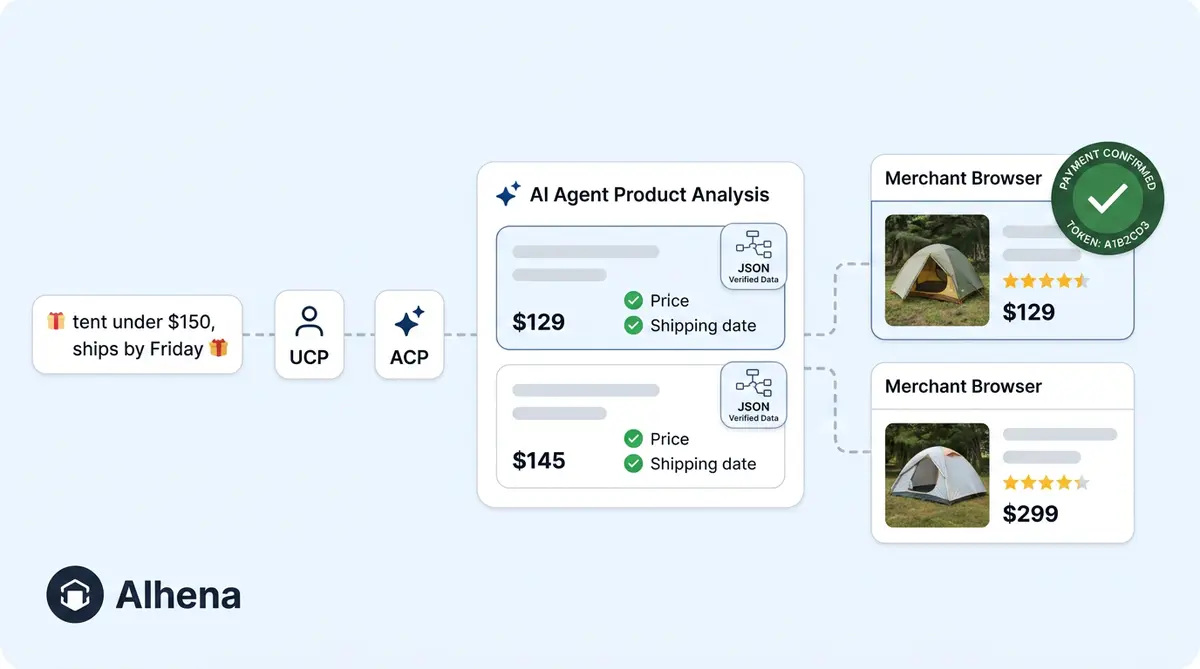
The consumer defines a goal along with permissions and constraints. "Find me a camping tent under $150 that fits four people and ships by Friday" is a complete intent statement. The agent parses this into actionable parameters: product category, price ceiling, size, and delivery timeline. Better intent parsing means fewer follow-up questions and faster results.
Reasoning and Planning
The agent builds a multi-step plan. It queries product catalogs across retailers, compares specifications and pricing, reads reviews, checks inventory in real time, and applies any available coupons or loyalty rewards. If a top-ranked option goes out of stock mid-search, the agent re-ranks alternatives without starting over. This planning capability is what separates agentic systems from simple search tools.
Autonomous Execution
The agent completes the transaction. Depending on the consumer's trust settings, this could mean presenting a final recommendation for approval or executing the purchase directly. After the purchase, the agent can track shipping, handle returns, and schedule reorders.
Today, most agentic systems still include a human approval step before payment. A Q1 2026 Riskified study found that 55% of consumers aren't comfortable letting AI agents make purchases without their sign-off. But 47% of US shoppers already use AI tools for at least one shopping task. The gap between discovery and autonomous buying is closing fast.
The Protocols Powering Agentic Commerce
For AI agents to buy from merchants, both sides need a shared language. Two open protocols have emerged as the foundation, backed by the biggest names in tech and payments. For a technical deep-dive on how these protocols compare, read our ACP vs UCP vs MCP breakdown.
Universal Commerce Protocol (UCP)
Google and Shopify co-developed UCP and announced it at NRF in January 2026. It's an open-source standard built on REST and JSON-RPC that lets AI agents connect to any merchant's catalog, initiate checkout, and manage orders through a unified API.
UCP launched with three core capabilities: Checkout, Identity Linking, and Order Management. Its partner list includes Walmart, Target, Best Buy, Home Depot, Macy's, Etsy, Wayfair, Flipkart, and Zalando. Payment networks Visa, Mastercard, American Express, Stripe, and Adyen have all signed on.
The first live implementation powers buying inside Google AI Mode Search and Gemini. When you search for a product in Google's AI mode, the agent can complete the purchase without leaving the search interface. For more on how UCP affects your store, see our UCP guide for ecommerce brands.
Agentic Commerce Protocol (ACP)
OpenAI and Stripe launched ACP in September 2025 as an open standard (Apache 2.0 license) that defines how AI agents and merchants coordinate checkout and share payment credentials securely. The merchant stays the merchant of record, keeping full control over products, pricing, and fulfillment.
ACP powers ChatGPT Instant Checkout, which went live with Etsy first and is expanding to over one million Shopify merchants, including Glossier, Vuori, Spanx, and SKIMS. Microsoft's Copilot Checkout also runs on ACP, covering Bing, MSN, and Edge.
Stripe introduced Shared Payment Tokens (SPTs) as a new payment primitive for agent transactions, giving consumers a way to pay through AI agents without exposing their full card details to every merchant.
The Payment Layer: Visa, Mastercard, and PayPal
Protocols handle the "what to buy" layer. Payment networks handle the "how to pay" layer.
Mastercard launched Agent Pay in April 2025, using Agentic Tokens built on its existing tokenization infrastructure. Agent Pay works through standard card payment fields, so merchants don't need new code to accept agentic payments. Mastercard also partnered with PayPal to integrate Agent Pay into PayPal's wallet, covering hundreds of millions of consumers.
Visa launched Intelligent Commerce with 100+ partners globally and unveiled Intelligent Commerce Connect, a cross-network platform that supports ACP, UCP, and other protocols. Visa predicts millions of consumers will use AI agents for purchases by the 2026 holiday season.
PayPal rolled out its "Agent Ready" solution in October 2025, making its existing merchant base accessible to AI agents. PayPal also powers checkout for Microsoft Copilot and Perplexity's "Buy with Pro" feature.
Benefits of Agentic Commerce for Ecommerce Businesses
Most of the conversation around agentic commerce focuses on consumers. But the benefits for ecommerce businesses are just as real, and they go well beyond "your products show up in ChatGPT."
- Higher conversion from high-intent traffic. AI agents send traffic that already matches the buyer's intent. Microsoft reported that Copilot shopping journeys led to 53% more purchases within 30 minutes of interaction. When the AI surfaces your product to a ready buyer, conversion rates spike.
- Lower customer acquisition costs. Getting discovered by an AI agent doesn't require a paid ad bid. If your product data is clean and your catalog is connected to UCP or ACP, agents will find and recommend you based on fit, not ad spend.
- Reduced cart abandonment through agentic checkout. Agentic checkout removes the friction points that cause traditional cart abandonment: manual form filling, account creation, payment entry. The agent handles all of this programmatically. For data on how this compares, see our analysis of why AI-assisted shoppers complete checkout at nearly 2x the rate.
- Automated reordering and retention. Post-purchase, agents can schedule reorders for consumable products, track shipping, and handle returns. This turns one-time buyers into repeat customers without additional marketing spend.
- A new growth channel. Shopify reports that orders from AI-powered searches grew 15x year-over-year through 2025. The brands that are findable by AI agents now will capture this growth curve. Those that wait risk becoming invisible to agentic shopping entirely.
For customers, the benefits are equally clear: less time spent browsing, better product matches, faster checkout, and consistent service across every channel. The shopping experience shifts from "figure it out yourself" to "tell us what you need and we'll handle the rest."
Agentic Commerce by the Numbers
The market data tells a consistent story: early-stage today, massive by 2030.
- $5.71 billion: Global agentic commerce market in 2025, projected to reach $65.47 billion by 2033 at a 35.7% CAGR (Grand View Research)
- $3 to $5 trillion: Projected global retail revenue orchestrated through agentic commerce by 2030 (McKinsey)
- $190 to $385 billion: Estimated US ecommerce spending through agents by 2030 (Morgan Stanley)
- 15% to 25%: Share of ecommerce expected to flow through agentic channels by 2030 (Bain)
- 45%: Consumers who already use AI for part of the buying journey (IBM IBV 2026)
- 805%: Year-over-year increase in AI traffic to US retail sites on Black Friday 2025 (Adobe)
- 4.4x: Higher conversion rates from AI-generated product recommendations versus traditional search (McKinsey)
But here's the nuance. Less than 0.2% of ecommerce sessions currently come from ChatGPT referrals, and those referrals convert 86% worse than affiliate links. The infrastructure is being built, but the transaction volume is still small. Brands that prepare now will capture the growth curve. Brands that wait may find themselves invisible to AI agents entirely.
How to Prepare Your Ecommerce Store for Agentic Commerce
You don't need to rebuild your store from scratch. But you do need to make your products machine-readable and your systems agent-friendly. Here's what matters most.
Get Your Product Data in Order
AI agents don't browse your site the way humans do. They read structured data. Product titles, descriptions, prices, dimensions, materials, availability, and shipping details all need to be clean, complete, and formatted in standard schemas (JSON-LD with Schema.org markup).
42% of customers abandon purchases due to insufficient product information, and brands lose an average of $15 million annually from poor data quality. When AI agents evaluate your catalog, missing or inconsistent data means your products get skipped. For detailed guidance on which fields matter most, check our post on what product data fields matter for AI shopping recommendations.
Think About Generative Engine Optimization (GEO)
SEO gets your products found by humans on Google. GEO gets your products found by AI agents on ChatGPT, Copilot, Gemini, and Perplexity. The two overlap (structured data helps both), but GEO also involves machine-readable policy pages, clear return and shipping terms, and accurate inventory feeds.
Adopting llms.txt standards makes your site AI-accessible. Monitoring your "share of model" tracks how AI agents represent your brand across different platforms.
Connect to the Protocol Ecosystem
If you're on Shopify, you're already close to both protocols. Shopify's Agentic Storefronts let merchants set up their data once and get surfaced across ChatGPT, Copilot, Google AI Mode, and Gemini. Shopify even launched an "Agentic plan" that lets brands on other platforms use its infrastructure for AI channels.
For brands on other platforms, Stripe's Agentic Commerce Suite supports WooCommerce, BigCommerce, Squarespace, and commercetools. Our guide on agentic storefronts covers the setup process for each major platform.
Prepare for Agentic Payments
Make sure your payment stack supports tokenized transactions. Mastercard's Agent Pay, Visa's Intelligent Commerce, and Stripe's Shared Payment Tokens all work through existing card rails, so most merchants won't need a rip-and-replace. Check with your payment processor to confirm they support agentic payment flows.
How Alhena AI Fits Into the Agentic Commerce Stack
While industry protocols define how external AI agents (ChatGPT, Copilot, Gemini) talk to your store, you also need your own AI agent working for you on your own channels. That's where Alhena AI's Shopping Assistant comes in.
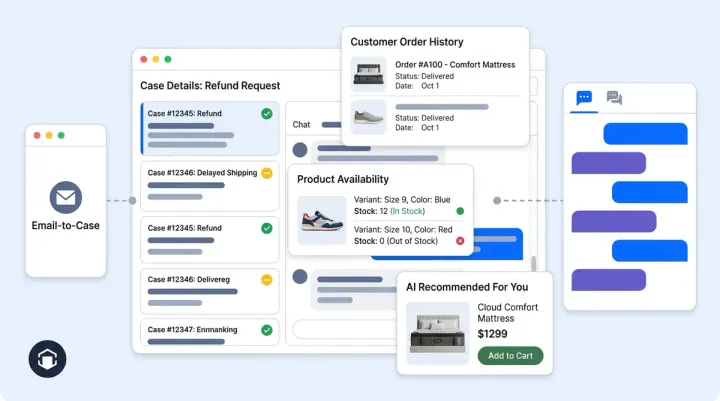
Alhena gives ecommerce brands an AI agent that already handles the core agentic commerce workflow: product discovery, guided recommendations, cart population, and checkout assistance. It's purpose-built for ecommerce sales, not retrofitted from a support ticket tool.
Your Brand's Own AI Agent
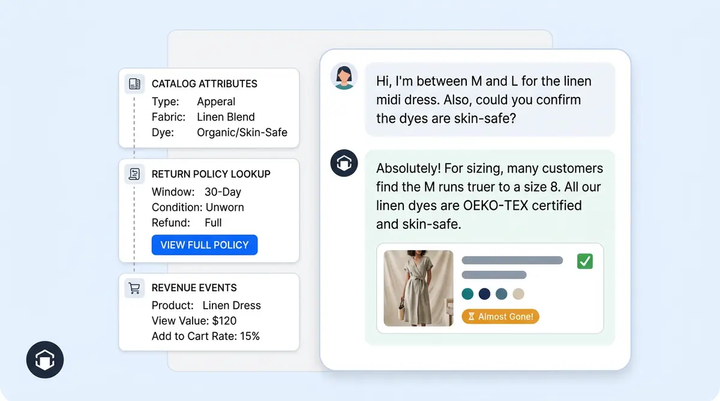
Alhena's Product Expert Agent understands natural language queries like "I need a moisturizer for sensitive skin under $35" and returns personalized recommendations grounded in your actual product catalog. No hallucinated products, no made-up specs. The agent populates carts, applies discounts, and walks shoppers through checkout.
Tatcha saw a 3x conversion rate and 38% AOV uplift after deploying Alhena, with 11.4% of total site revenue attributed to AI conversations. Victoria Beckham reported a 20% AOV increase. See the full Tatcha case study for details.
Omnichannel by Default
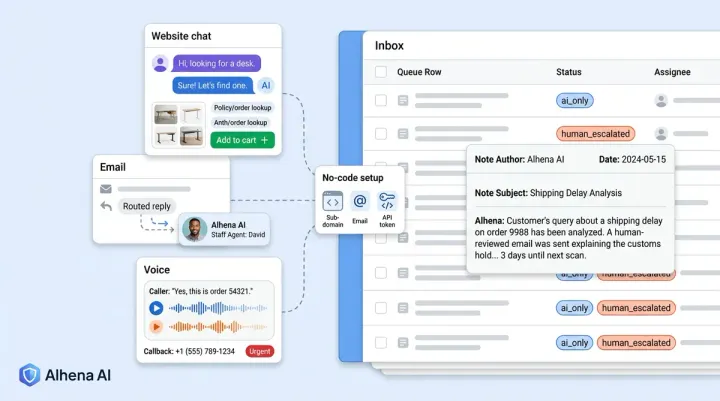
Agentic commerce won't stay limited to web chat. Consumers already interact with AI agents through Instagram DMs, WhatsApp, email, and voice. Alhena's Social Commerce and Voice AI products cover all of these channels with a single unified agent, so your brand voice and product knowledge stay consistent no matter where the conversation happens.
Built-In Revenue Attribution
One of the hardest parts of agentic commerce is measuring what the AI actually drove. Alhena includes revenue attribution analytics that track which conversations led to purchases, what products the AI recommended, and how AI-assisted shoppers compare to unassisted ones. You don't need to guess whether the AI is working. The ROI calculator shows projected impact before you start.
Works With Your Existing Stack
Alhena integrates with Shopify, WooCommerce, Magento, and Salesforce Commerce Cloud for product data. For support workflows, it connects to Zendesk, Freshdesk, Gorgias, Intercom, and more. Deployment takes under 48 hours with no dev resources required. Brands like Puffy achieved 63% automated inquiry resolution and 90% CSAT while Crocus hit an 86% deflection rate with 84% CSAT.
Key Takeaways
- Agentic commerce is a model of ecommerce where AI agents autonomously research, compare, and buy products for consumers. It goes well beyond chatbots and conversational commerce.
- Agentic commerce differs from traditional ecommerce because the AI agent does the shopping, not the human. Brands need machine-readable product data and protocol-ready checkout to participate.
- Two open protocols (Google's UCP and OpenAI/Stripe's ACP) provide the infrastructure for AI agents to transact with merchants at scale.
- Payment networks (Visa, Mastercard, PayPal) have built agentic payment layers that work through existing card rails, lowering the adoption barrier.
- Benefits for ecommerce businesses include higher conversion from high-intent traffic, lower acquisition costs, reduced cart abandonment through agentic checkout, and automated retention.
- Product data quality is the single most important preparation step. AI agents skip products with incomplete or inconsistent data.
- Brands need their own AI agent on their owned channels. Alhena AI gives ecommerce brands a sales-focused agent that handles discovery, recommendations, cart building, and checkout across web, social, email, and voice.
Ready to give your store its own AI shopping agent? Book a demo with Alhena AI or start free with 25 conversations.
Frequently Asked Questions
How does agentic commerce differ from traditional ecommerce?
In traditional ecommerce, you do all the work: searching, comparing, and buying. In agentic commerce, an AI agent handles those steps for you. It queries multiple stores, compares products on price, specs, and reviews, then completes checkout on your behalf. The shift means brands need machine-readable product data and protocol-ready checkout (UCP or ACP) to get discovered by agents.
How do AI agents interpret user intent in agentic commerce?
AI agents parse your request into structured parameters. When you say "find me a camping tent under $150 that ships by Friday," the agent breaks that into product category, price ceiling, delivery timeline, and size. It then builds a multi-step plan to query catalogs, compare options, and rank results. Alhena AI uses similar intent recognition to match shoppers with the right products from your catalog.
What are the benefits of agentic commerce for ecommerce businesses?
The biggest benefits include higher conversion from high-intent traffic (Microsoft reports 53% more purchases from Copilot journeys), lower acquisition costs since agent discovery doesn't require ad spend, reduced cart abandonment through programmatic checkout, and automated reordering for repeat purchases. Shopify reports 15x growth in AI-powered search orders year-over-year.
How does agentic checkout improve the online shopping experience?
Agentic checkout removes the friction that causes 70%+ of cart abandonment: manual form filling, account creation, and payment entry. The AI agent handles all of this programmatically using tokenized payments from Visa, Mastercard, or Stripe. Alhena AI's agentic checkout populates carts, applies discounts, and pre-fills checkout fields, resulting in nearly 2x higher completion rates.
Is agentic commerce the same thing as agentic AI?
No. Agentic AI is the broader technology: AI systems that can act autonomously, reason through problems, and adapt to changing conditions. Agentic commerce is one specific application of agentic AI, focused on buying and selling. An agentic AI system might manage your calendar or write code. An agentic commerce system specifically handles product research, comparison, and purchasing.
How should ecommerce brands prepare their store for agentic commerce?
Start with product data: clean titles, descriptions, prices, and attributes in JSON-LD with Schema.org markup. Then connect to UCP or ACP through Shopify Agentic Storefronts or Stripe's Agentic Commerce Suite. Make sure your payment processor supports tokenized agentic transactions. Finally, deploy your own AI agent (like Alhena AI) on your web, social, and voice channels.
What role does Alhena AI play in agentic commerce?
Alhena AI gives ecommerce brands their own agentic shopping assistant on owned channels: web chat, email, WhatsApp, Instagram DMs, and voice. The agent handles product discovery, personalized recommendations, cart building, and checkout assistance. Tatcha saw a 3x conversion rate and 38% AOV uplift with Alhena. It integrates with Shopify, WooCommerce, Magento, and Salesforce Commerce Cloud.
What is the difference between UCP and ACP protocols?
UCP (Universal Commerce Protocol) was co-developed by Google and Shopify and powers buying inside Google AI Mode and Gemini. ACP (Agentic Commerce Protocol) was co-developed by OpenAI and Stripe, powering ChatGPT Instant Checkout and Microsoft Copilot Checkout. Both are open standards. UCP uses REST and JSON-RPC, while ACP uses Apache 2.0 licensing with Shared Payment Tokens for secure transactions.
How big will the agentic commerce market be by 2030?
McKinsey projects agentic commerce could orchestrate $3 to $5 trillion in global retail revenue by 2030. Grand View Research estimates the market at $5.71 billion in 2025, growing to $65.47 billion by 2033. Morgan Stanley projects $190 to $385 billion in US spending through AI agents by 2030. Right now, 45% of consumers already use AI in some part of their buying journey.
Can my Shopify or WooCommerce store support agentic commerce today?
Yes. Shopify merchants can enable Agentic Storefronts to get surfaced across ChatGPT, Copilot, and Google AI Mode with minimal setup. WooCommerce stores can connect through Stripe's Agentic Commerce Suite. For your owned channels, Alhena AI deploys in under 48 hours on both platforms with no dev resources needed, giving you your own AI shopping agent immediately.