Juniper Research projects that conversational commerce spending will hit $290 billion globally by 2025. That number keeps growing because e-commerce and retail organizations are integrating AI into every stage of the buying journey, shopping experiences, and customer engagement, from product discovery to post-purchase services. But the technology behind these experiences isn't one thing. It's two complementary disciplines: conversational AI and generative AI.
Most comparison guides define each term and stop there. You already know the basics. What you actually need is a practical framework: which technology solves which problems, where they overlap, and when you need both working together. This guide breaks down the difference between conversational AI and generative AI through the lens of real e-commerce operations, then shows where a third category, agentic AI, changes the equation entirely.
Quick Comparison: Conversational AI vs Generative AI
Before getting into use cases and strategy, here's a side-by-side view of how conversational AI and generative AI differ on the dimensions that matter most to e-commerce teams.
Conversational AI vs Generative AI: At a Glance
| Conversational AI | Generative AI | |
|---|---|---|
| Primary goal | Two-way dialog that resolves a task | Create new content from learned patterns |
| Typical output | Structured responses, actions, API calls | Text, images, code, summaries |
| Data grounding | Knowledge base, product catalog, order data | Training corpus, historical data, fine-tuning datasets |
| Hallucination risk | Low (retrieval-grounded) | Higher (probabilistic generation) |
| Best e-commerce use | Order tracking, returns, FAQ resolution | Product descriptions, personalized emails |
| Interaction style | Multi-turn dialog with memory | Prompt-in, content-out |
| Speed to value | Immediate (connects to real-time, data-driven sources) | Requires training or fine-tuning |
The table makes the split clear, but the real story starts when you see how each technology plays out in actual operational store workflows.
For a deeper technical view, see how RAG and agentic AI work together in customer support.
How Each Technology Shows Up in E-Commerce
Definitions only get you so far. What matters is what each technology does when a shopper lands on your site, sends a DM, or calls about a missing package. Here's where conversational AI and generative AI earn their keep in online retail and digital commerce.
Conversational AI in Action
Conversational AI powers the dialog layer of customer interactions. Think of it as the system that listens, understands intent, and takes action within a structured workflow.
For implementation details, see how to roll out conversational AI for customer service.
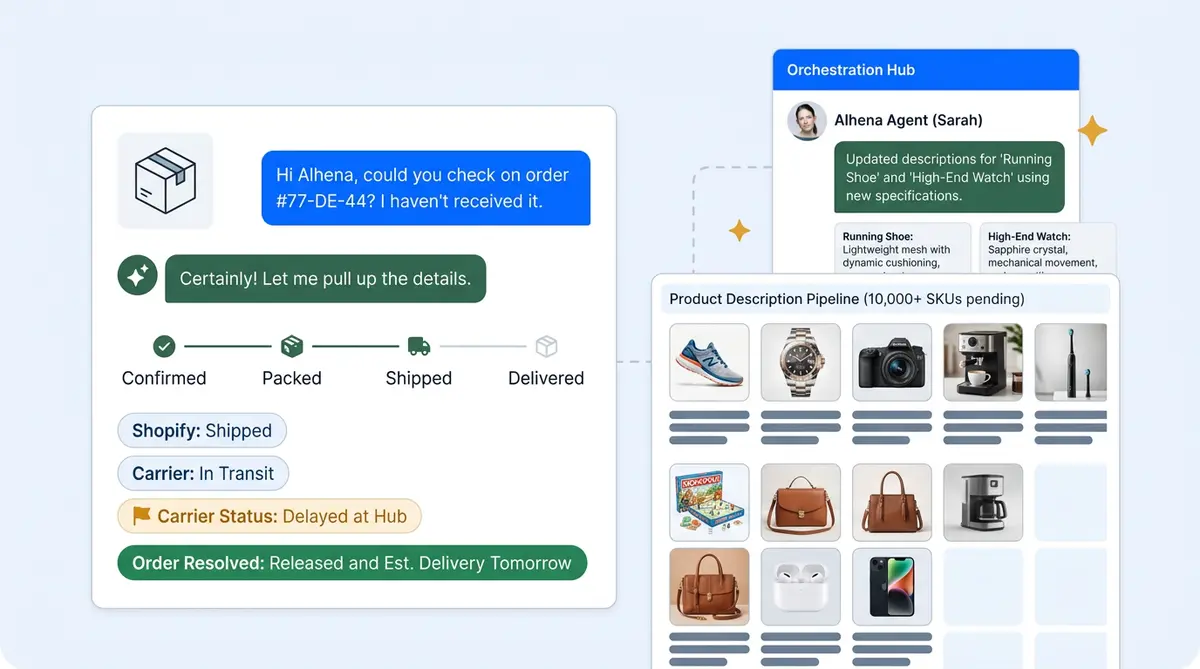
Order management: A customer asks "Where's my order?" The conversational AI agent pulls real-time, data-driven tracking information from Shopify or your OMS, checks the carrier status, and responds with an estimated delivery date. No human needed. Manawa cut response times from 40 minutes to under 1 minute using this exact flow, automating 80% of support inquiries and boosting efficiency.
Returns and exchanges: Instead of forcing shoppers through a form-heavy portal, conversational AI walks them through the return step by step: reason, preferred resolution (refund vs exchange), label generation. The entire loop closes inside the chat window.
Product Q&A: "Is this moisturizer safe for sensitive skin?" A conversational AI agent grounded in your product catalog answers with verified ingredient data, not guesses. Tatcha used this approach to drive a 3x conversion rate on assisted sessions and a 38% lift in average order value.
Generative AI in Action
Generative AI creates. It doesn't just retrieve information; it produces new content based on patterns large language models learned during training.
For the full evolution story, see how customer service moved from chatbots to generative AI agents.
Product descriptions at scale: If you manage 10,000 SKUs, writing unique descriptions for each one takes months. Generative models can create them in hours, pulling from attribute data and adapting tone to match your brand voice.
Personalized email campaigns: Rather than sending the same post-purchase email to every one of your customers, generative AI creates variations based on historical data about what a customer bought, browsed, and abandoned. Open rates climb because the content feels written for one person.
Review summaries: Hundreds of product reviews are hard for customers to parse. Generative AI condenses them into a two-sentence summary that highlights the top pros and common concerns, helping buyers make better decisions faster.
Where Conversational and Generative AI Converge
Here's where the conversational generative AI distinction starts to blur, and where the most interesting innovation is happening. This innovation.
Modern AI agents don't pick one side. They combine a conversational layer (dialog management, intent recognition, memory) with a generative layer (natural-sounding responses, on-the-fly creating content). The conversational generative framework keeps the interaction structured and grounded. The generative component, powered by large language models, makes the output sound human instead of robotic.
Consider a shopper browsing skincare on a beauty brand's site. They type: "I have oily skin and I'm looking for a lightweight SPF that won't break me out." A pure conversational AI system would search the catalog for products tagged "oily skin" and "SPF" and return a list. Functional, but cold. A pure generative AI system might write a beautiful recommendation paragraph, but risk suggesting a product that's out of stock or doesn't exist in the catalog.
The converged approach does both. The conversational layer identifies the intent (product discovery), extracts attributes (oily skin, lightweight, SPF, non-comedogenic), and queries the product catalog. The generative layer then crafts relevant responses like: "Based on your skin type, I'd recommend the Silken Pore SPF 35. It's oil-free, won't clog pores, and it's our #1 seller for oily skin. Want me to add it to your cart?"
Alhena AI's Shopping Assistant works exactly this way. It grounds every response in your verified product data (so there are no hallucinations), while generating natural, brand-voice-matched answers. The business outcome: Victoria Beckham saw a 20% increase in average order value from AI-assisted sessions.
Conversational AI vs Generative AI vs Agentic AI: The Next Layer
If you've been tracking AI trends in 2026, you've seen a third term gain momentum: agentic AI. Understanding how it fits into the conversational AI vs generative AI framework is essential for any e-commerce business planning their technology stack and development roadmap. Some teams also evaluate predictive AI for demand forecasting, but the conversational generative AI comparison matters most for customer-facing experiences and customer engagement.
Here's the simplest way to think about it:
- Conversational AI talks. It handles dialog and retrieves information.
- Generative AI creates. It can create new content from patterns.
- Agentic AI acts. It takes autonomous actions across multiple systems to complete tasks end-to-end.
An agentic AI agent doesn't just tell a shopper, "This product matches your needs." It adds the product to their cart, applies an eligible discount code, pre-fills the checkout with their saved shipping address, and sends a confirmation. It coordinates across your commerce platform, payment software, and CRM without waiting for a human to approve each step.
This development is the direction agentic commerce is heading. Instead of AI that assists, you get AI that completes. Alhena AI already operates in this mode: its agents populate carts, trigger checkout flows, and handle post-purchase actions like returns and exchanges inside the conversation. The system combines all three capabilities: conversational generative dialog and responses, and agentic execution.
For a complete guide to this shift, read AI agents explained: how agentic AI is reshaping business in 2026.
For brands running on Shopify, WooCommerce, or Salesforce Commerce Cloud, agentic AI means the gap between "browsing" and "buying" shrinks to a single conversation. Tatcha attributes 11.4% of total site revenue to AI-assisted sessions, and that number reflects the revenue impact when AI doesn't just chat but closes sales.
When to Use Conversational AI vs Generative AI: A Decision Framework
Choosing between conversational AI and generative AI isn't an either-or decision for most e-commerce businesses and business leaders. But knowing which technology to prioritize for each use case helps you allocate budget and set realistic expectations for business outcomes.
Prioritize Conversational AI When:
- Accuracy is non-negotiable. Order status, inventory availability, return policies: these require factual answers grounded in live data. Generative AI alone risks hallucinating details that cost you trust and revenue.
- The task involves multi-step workflows. Processing a return, escalating a complaint, and scheduling a callback. These need dialog management and backend systems integrations, not content creation.
- You need measurable deflection. If your goal is to reduce ticket volume, conversational AI delivers. Crocus achieved an 86% deflection rate while maintaining 84% CSAT.
Prioritize Generative AI When:
- You need content at scale. Product descriptions, marketing copy, email variations, ad creative. Anywhere the output is text or media, generative AI saves hundreds of hours.
- Personalization depends on synthesis. Summarizing 200 reviews into a paragraph, tailoring product recommendations into a narrative, and generating dynamic landing page copy.
- Creativity matters more than precision. Blog outlines, social captions, healthcare content, and brainstorming product names. Low-risk, high-volume content tasks.
Use Both When:
- You want AI that sells, not just answers. A shopping assistant needs conversational generative AI to handle the dialog and make recommendations that feel personal and natural.
- Your support volume is growing, but your business team isn't. Conversational AI deflects routine tickets. Generative AI drafts response suggestions for complex cases that reach human agents. Together, tools like Alhena's Agent Assist help support teams handle more without burning out, improving team efficiency.
- You operate across channels. Web chat, email, Instagram DMs, WhatsApp, voice. Each channel needs conversational flow management and natural-sounding responses. Alhena's Social Commerce and Voice AI agents combine both technologies across every touchpoint.
How Alhena AI Combines Conversational and Generative AI for E-Commerce
Most organizations and AI tools pick a side. Traditional chatbot platforms, virtual agents, and basic chatbot tools lean on conversational generative AI for ticket deflection. Content tools lean on generative AI for copywriting. Neither of these solutions captures revenue.
Alhena AI was built specifically for e-commerce and combines both technologies in two specialized agents:
The Product Expert Agent uses generative AI grounded in your product catalog to guide shoppers toward the right products. It understands complex, multi-attribute queries ("vegan leather bag under $200 that fits a 15-inch laptop"), generates natural recommendations, and populates the cart when the shopper is ready. Used by brands across industries and verticals, every recommendation is verified against real-time inventory and catalog data, so there are zero hallucinations.
The Order Management Agent uses conversational AI to handle post-purchase services and workflows: order tracking, returns, exchanges, cancellations, and shipping questions. It connects to your commerce platform and helpdesk (whether that's Zendesk, Gorgias, or Intercom) and resolves inquiries without human intervention. Puffy hit 63% automated inquiry resolution and 90% CSAT with this setup.
For the full landscape, read our AI customer service guide for 2026.
The agentic layer ties both agents together. Alhena doesn't just recommend a product or answer a question. It adds items to carts, pre-fills checkout, applies promotions, and tracks revenue attribution so you know exactly how much AI-assisted sessions generate. These solutions deploy in under 48 hours with no developer resources, work across multiple channels, including web chat, email, WhatsApp, Instagram, and voice, and include built-in analytics that tie every conversation to revenue.
This is what the convergence of conversational generative AI looks like in practice: not two separate tools, but one integrated system that talks, creates, and acts.
Key Takeaways
- Conversational AI handles dialog, retrieves live data, and resolves tasks. Best for support, order management, and structured interactions.
- Generative AI creates content from learned patterns. Best for product descriptions, personalization, and creative output.
- The difference between conversational AI and generative AI is shrinking. Modern AI agents combine both for richer, better, more effective experiences.
- Agentic AI adds autonomous action: populating carts, processing returns, and closing sales inside the conversation.
- For e-commerce, you don't choose one or the other. You choose a platform that integrates both, like Alhena AI, and points them at revenue.
Ready to see how conversational and generative AI work together in your store? Book a demo with Alhena AI or start free with 25 conversations.

Frequently Asked Questions
Is conversational AI the same as generative AI?
No. Conversational AI is designed for two-way dialog, handling tasks like order tracking and customer support through multi-turn conversations. Generative AI creates new content, such as text, images, or code, from patterns it learned during training. Many modern AI platforms combine both: conversational AI manages the dialog, while generative AI crafts natural-sounding responses.
What is the difference between conversational AI and generative AI in ecommerce?
In ecommerce, conversational AI powers support workflows like order status lookups, returns processing, and FAQ resolution. Generative AI handles content tasks like writing product descriptions, personalizing emails, and summarizing reviews. Brands that combine both, like those using Alhena AI, see higher conversion rates because shoppers get accurate answers delivered in a natural, personalized tone.
What is agentic AI and how does it relate to conversational and generative AI?
Agentic AI adds autonomous action on top of conversational and generative capabilities. Instead of just answering questions or creating content, agentic AI executes tasks: adding items to carts, applying discount codes, processing returns, and pre-filling checkout. Alhena AI operates in this agentic mode, combining dialog, content generation, and action in a single system.
When should an ecommerce brand use conversational AI vs generative AI?
Use conversational AI when accuracy is critical: order tracking, returns, inventory checks, and structured support workflows. Use generative AI when you need content at scale: product descriptions, marketing copy, and personalized recommendations. For shopping assistance and pre-sales guidance, use both together so shoppers get accurate, grounded answers that sound natural.
Can conversational generative AI systems work together?
Yes, and most leading AI platforms now combine them. The conversational layer manages dialog flow, maintains context across messages, and connects to real-time data systems like your product catalog and OMS. The generative layer produces natural, human-sounding responses instead of rigid template answers. Alhena AI's Product Expert Agent and Order Management Agent both use this combined approach.
Does conversational AI hallucinate like generative AI?
Conversational AI grounded in a knowledge base or product catalog has much lower hallucination risk than standalone generative models. Retrieval-augmented generation (RAG) architectures pull verified data before generating a response, keeping answers factual. Alhena AI uses this grounded approach, which is why brands like Tatcha trust it for product recommendations that directly drive sales.
What are real-world examples of generative AI in ecommerce?
Common examples include automated product description writing for large catalogs, personalized post-purchase email campaigns, dynamic FAQ generation, review summarization, and AI-generated social media content. More advanced use cases include generating personalized product recommendations in natural language and creating dynamic landing page copy based on visitor segments.
How does Alhena AI use both conversational and generative AI?
Alhena AI deploys two specialized agents. The Product Expert Agent uses generative AI grounded in your verified catalog data to guide shoppers to the right products and populate their carts. The Order Management Agent uses conversational AI to handle post-purchase workflows like tracking, returns, and exchanges. Both agents share memory across channels, including web chat, email, WhatsApp, Instagram, and voice.
Which is better for customer service: conversational AI or generative AI?
For customer service, conversational AI is the stronger foundation because it handles structured workflows, connects to live data, and maintains multi-turn context. Generative AI improves the quality of responses by making them sound natural rather than scripted. The best customer service AI, like Alhena's Support Concierge, combines both. Crocus achieved an 86% deflection rate and 84% CSAT using this approach.