Ninety-one percent of customer service leaders say they're under pressure to implement AI in 2026, according to Gartner. The pressure is real, but rushing a rollout is how businesses end up with tools that frustrate users instead of helping them. Conversational AI for customer service works when the deployment is deliberate: right intents, right channels, right fallbacks. Getting conversational customer service right means understanding your needs and planning each step. This guide covers how to roll out a conversational AI solution the right way across channels, with the metrics and pitfalls you need to know before launch.
What Makes Conversational AI for Customer Service Different From a Chatbot
Rule-based chatbots follow scripts. A customer types a keyword, the bot matches it to a preset answer. If the phrasing is unexpected, the bot stalls. Resolution rates for these rule-based systems sit between 40% and 60%.
Conversational AI is different. It uses machine learning and natural language processing to understand intent, not just keywords. Generative models let it produce natural replies rather than selecting from a script. It handles follow-up queries, remembers context within a conversation, and uses generative capabilities to produce replies that sound human. These generative systems don’t need a script for every scenario. Well-built conversational AI systems hit resolution rates above 85%. For a full breakdown of how these technologies evolved, see our AI customer service guide.
To see how conversational AI compares with generative AI, read the difference between conversational AI and generative AI.
How to Roll Out Conversational AI for Customer Service
Deploying conversational AI isn't a flip-the-switch moment. The brands that get it right follow a clear sequence.
1. Map Your Highest-Volume Intents
Pull your last 90 days of support tickets and group them by topic. This is where your business learns which conversational AI tools will deliver the fastest ROI. For most ecommerce brands, the top clusters are order status, return eligibility, shipping timelines, and product questions. These are your first automation targets, the workflows where conversational customer service can cut costs and scale fastest. Don't try to cover everything on day one. Pick the five to ten intents that account for the bulk of your ticket volume.
2. Start With One Channel, Then Expand
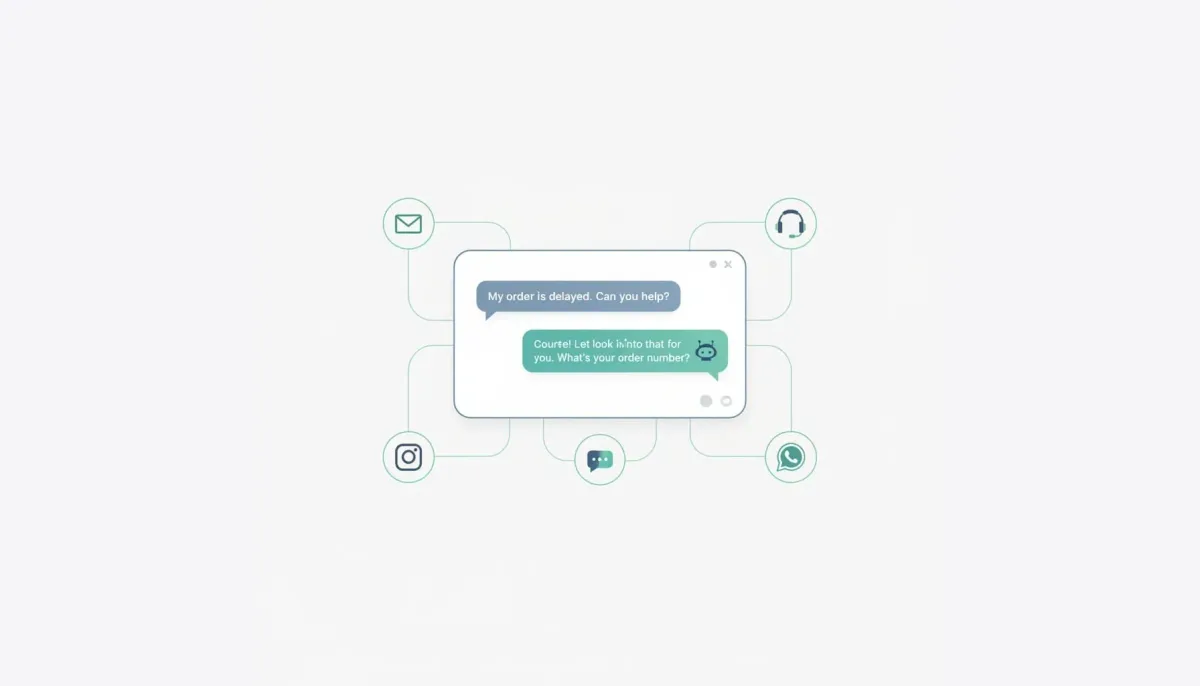
Web chat is the safest starting point for ai-driven conversational customer service. It's your most controlled environment, customers already expect quick replies there, and you can monitor performance in real time. Once conversational customer service handles chat well, expand to messaging apps like WhatsApp and Instagram DMs. Add voice last since it carries higher expectations for natural conversation and leaves less room for error.
3. Design Fallbacks Before You Launch
Every conversational AI system will hit questions it can't answer. Traditional chatbots simply dead-end here. For example, a customer asking about a product return that doesn't match any scripted flow gets stuck. It’s the difference between a good deployment and a bad one. What happens next in the conversational customer service flow matters more than the AI capabilities you picked. Your customer needs a clear path out. Build explicit escalation paths: if the AI fails to understand a query twice, offer a handoff to a human agent with full conversation history attached. Taco Bell's AI ordering system went viral in 2025 because customers had no way to reach a person. Don't repeat that mistake.
4. Measure Resolved Containment, Not Just Containment
A conversation that ends without escalation isn't a success if the customer calls back the next day. Real conversational customer service automation means resolutions stick. Use these insights to track outcomes: To meet the demands of a real deployment, track these four metrics from week one:
- Resolved containment rate: Interactions the AI fully resolved (target 50-70% for ecommerce)
- CSAT after AI interactions: Are customers satisfied, or just deflected?
- First contact resolution: Did the customer need to reach out again?
- Escalation quality: When the conversational customer service AI hands off, does the human agent get full context and quality notes?
Three Pitfalls That Derail Conversational Customer Service Deployments
Hallucinations. 51% of organizations using AI for customer service have faced negative consequences, and inaccurate responses top the list. Air Canada was held legally liable when its chatbot fabricated a bereavement fare policy. Your AI must pull answers from verified data, not general training sets.
Knowledge base rot. Adding content without removing outdated information creates conflicts. For example, your conversational AI tools learn from everything in the knowledge base, including outdated pages. If your return policy changed six months ago but the old version is still in the knowledge base, the AI might surface either one. Schedule regular audits.
No human fallback. Forcing customers through bot-only flows destroys trust. The strongest deployments always keep a clear, easy path to a live agent. Conversational customer service automation needs to reduce workload, not trap people.
How Alhena AI Makes This Easier
Alhena AI was built specifically for ecommerce conversational customer service. It deploys in under 48 hours with no engineering resources, it’s a conversational platform that connects to your existing services and integrations (Shopify, WooCommerce, Zendesk, Gorgias), and automatically grounds every response in your verified product catalog to prevent hallucinations. The machine learning model learns from your products and policies to deliver accurate answers.
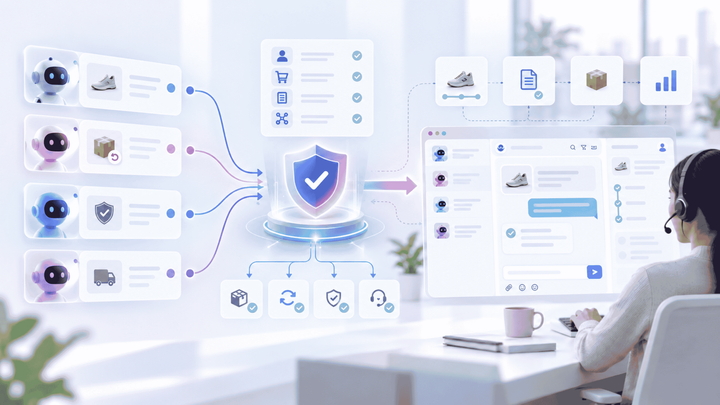
The conversational AI software handles self-service queries through two specialized generative agents that cover the full customer journey: a Product Expert Agent for pre-sale questions and an Order Management Agent for post-purchase needs like returns and shipping. Brands like Tatcha have driven 11.4% of total site revenue through AI conversations, while Manawa cut response times from 40 minutes to 1 minute.
The Agent Assist copilot gives your business users the capabilities to review AI-suggested replies before they go out, so you can build confidence before moving to full automation.
Ready to roll out conversational AI for customer service? Explore how Alhena creates measurable customer service outcomes for enterprise and mid-market brands. Book a demo with Alhena AI or start free with 25 conversations.
Frequently Asked Questions
What is conversational AI for customer service?
Conversational customer service AI uses machine learning and natural language processing to understand customer intent and generate human-like replies across chat, email, voice, and social channels. Unlike rule-based chatbots that follow scripts, conversational AI handles follow-up questions, remembers context, and achieves resolution rates above 85%.
How long does it take to deploy conversational AI?
Timeline depends on your approach. Purpose-built conversational customer service platforms like Alhena AI deploy in under 48 hours with no engineering resources. Custom-built solutions typically take 3 to 6 months. Getting started with a single channel and a small set of intents is the fastest path to production.
What metrics should I track after launching conversational AI?
Focus on four metrics: resolved containment rate (not just containment), CSAT after AI interactions, first contact resolution, and escalation quality. A conversation that ends without escalation but leaves the customer unsatisfied is not a success.
How does conversational AI prevent hallucinations in customer service?
The best conversational AI platforms ground every response in your verified knowledge base and product catalog rather than generating from open-ended training data. Alhena AI uses a retrieval-first architecture that pulls only from your approved sources, keeping hallucination rates near zero.
Which customer service channel should I deploy conversational AI on first?
Start with web chat. It is the most controlled environment, customers expect fast replies there, and you can monitor AI performance in real time. Expand to messaging apps like WhatsApp and Instagram DMs next, then email, and add voice last.
How is conversational AI different from a chatbot?
Traditional chatbots follow rigid if-then scripts and break when customers phrase questions unexpectedly, achieving 40 to 60% resolution rates. Conversational AI understands intent dynamically, handles multilingual and complex interactions, and resolves over 85% of queries without human help.