AI customer service has gone from experimental to essential. Over 91% of customer service leaders now face direct pressure to bring AI into their operations, and the gap between brands that use AI well and those that don't is widening fast. For a focused look at help desk AI, see our complete AI helpdesk guide.
The challenge isn't whether to adopt AI customer service. It's how to do it without frustrating your customers or wasting budget on the wrong ai tools. This guide covers how ai customer service works, what the best ai tools look like, and how to get started the right way.
What Is AI Customer Service?
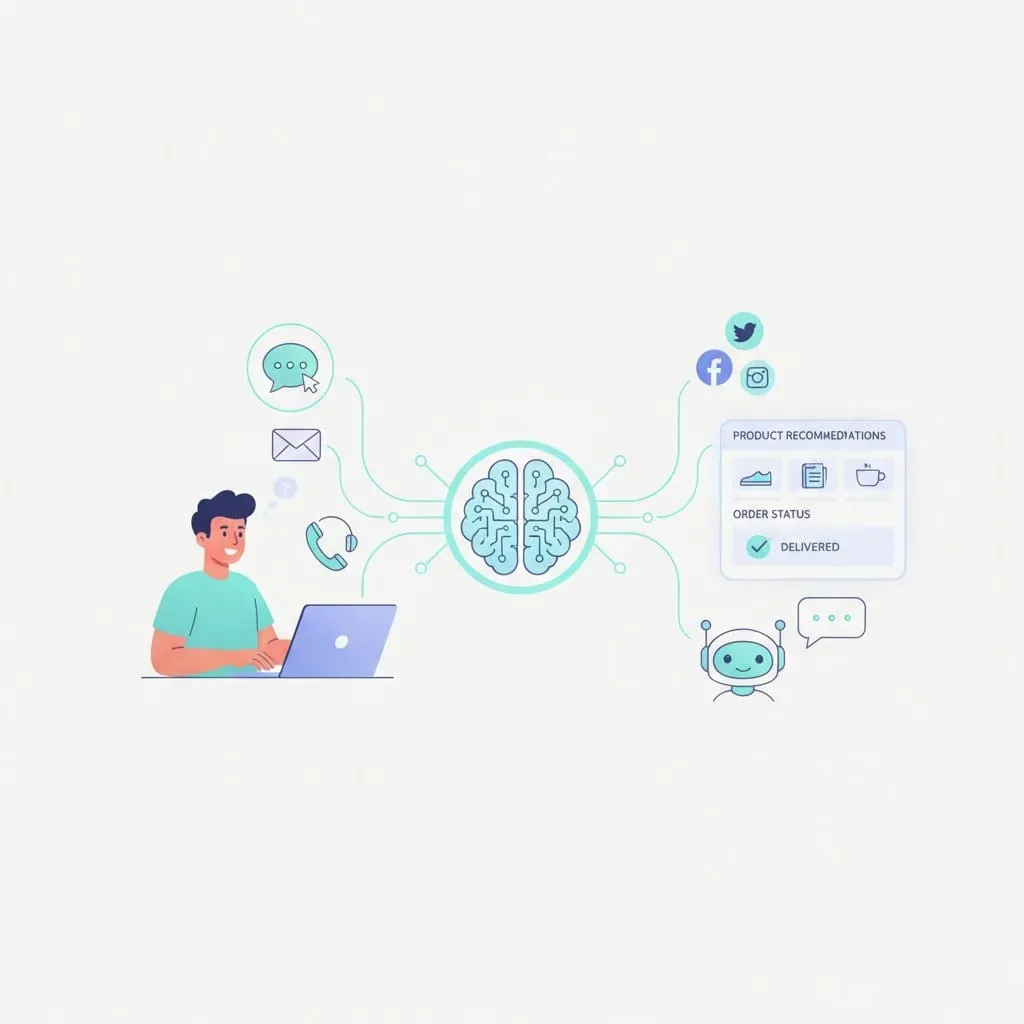
AI customer service uses artificial intelligence to handle customer interactions across channels like chat, email, voice, and social media. At its core, artificial intelligence allows brands to automate conversations at scale while keeping each interaction personalized. That includes everything from ai chatbots that answer faqs to intelligent ai agents that process returns, track orders, and recommend products in real time.
There are three categories of AI customer service tools:
- AI agents handle customer conversations autonomously, resolving queries and inquiries from start to finish without human agents
- AI copilot tools sit alongside human agents, suggesting replies, summarizing tickets, and pulling relevant knowledge from your helpdesk
- AI triage and automation systems analyze, classify, and route incoming requests to the right workflows or support teams
Alhena AI combines all three. Its Product Expert Agent guides shoppers through product discovery using conversational ai, while its Order Management Agent handles post-purchase customer needs like returns, shipping updates, and subscription changes. The result: ai customer support conversations that drive revenue, not just deflect tickets.
The Evolution: From Rule-Based Chatbots to Agentic AI
AI customer service didn't start with large language models. It started with rigid, rule-based scripts. Understanding that evolution helps you spot which generation of AI you're actually buying, and which one your customers deserve.
Rule-Based Chatbots: Where It Started
The first wave of AI chatbots followed decision trees. A customer typed a keyword, the bot matched it to a scripted response, and that was it. These bots handled FAQ-style questions well: "Where is my order?" or "How do I reset my password?" They ran 24/7, cut wait times for simple queries, and reduced the volume of tickets reaching human agents.
But they broke down fast. If a customer phrased a question differently than expected, the bot got stuck. Multi-turn conversations were painful. Context didn't carry from one message to the next. And anything beyond a basic lookup (checking a return policy, comparing two products, handling a complaint) needed a handoff to a human agent anyway.
Rule-based chatbots solved a narrow problem: deflecting the simplest, most repetitive tickets. They didn't understand language. They followed flowcharts.
Generative AI Agents: The Leap Forward
The second wave brought generative AI into customer service. Powered by large language models, these AI agents can understand intent, handle nuance, and generate conversational replies on the fly. They don't need a scripted path for every possible question.
Generative AI agents pull from your knowledge base, product catalog, and order data to craft accurate, brand-consistent responses. They handle multi-turn conversations naturally, detect sentiment shifts, and escalate to human agents with full context when needed. The customer doesn't have to repeat themselves. The agent doesn't lose the thread.
The critical difference from the chatbot era: grounding. A well-built generative AI agent doesn't hallucinate because it retrieves answers from verified data, not from its general training set. Alhena AI grounds every response in your actual product data, eliminating the hallucination problem that makes many teams hesitant to trust AI with customer-facing conversations.
Agentic AI: Support That Sells
The third wave, and where the industry is now, is agentic AI. These agents don't just answer questions. They take actions. They populate carts, process returns, apply discount codes, schedule appointments, and complete purchases inside the conversation. Support and sales merge into a single interaction.
This is what agentic commerce looks like in practice: a customer asks about a product, the AI recommends the right variant, adds it to their cart, and walks them through checkout. What used to be a support ticket becomes a completed sale. Brands using Alhena AI's agentic checkout see this play out daily, with Tatcha driving 11.4% of total site revenue through AI-assisted conversations.
Vertical-Specific AI Agents: Beyond One-Size-Fits-All
Generic AI handles generic questions. But ecommerce customers ask questions that require deep product knowledge, and each vertical has its own complexity. That's why purpose-built vertical agents outperform general-purpose bots in every measurable way.
Alhena AI offers specialized agents for specific verticals:
- Skin Analyzer: Asks about skin type, concerns, climate, and routine to recommend the right products from your catalog. Beauty and skincare brands like Tatcha and Victoria Beckham use this to replicate the in-store advisor experience online.
- Fit Analyzer: Guides shoppers to the correct size based on body measurements, brand-specific fit charts, and past purchase history. Reduces returns caused by sizing mistakes, which is one of the top return reasons in fashion and apparel.
- Virtual Try-On: Lets shoppers visualize products on themselves before buying. Cuts hesitation, increases confidence, and lowers return rates.
- Policy Advisor: Handles complex return, warranty, and shipping policy questions by pulling directly from your policy documents. Gives clear, accurate answers without requiring a human agent to look things up.
- Trip Planner: For travel and hospitality brands, this agent builds personalized itineraries, checks availability, and books experiences. Manawa cut response times from 40 minutes to 1 minute while automating 80% of inquiries with this kind of vertical AI.
These vertical agents aren't add-ons. They're how AI customer service actually works in ecommerce: solving the specific problems your customers bring, with the product depth a generic bot can't match.
How AI Customer Service Works Under the Hood
When a customer sends a message to an ai powered customer service system, several things happen in sequence. Understanding this process helps you evaluate which ai tools actually deliver on their promises.
First, natural language processing identifies the customer's intent, the specific details (like an order number), and their emotional state. This is how the AI understands customer needs beyond just matching keywords. Sentiment analysis runs in parallel, scoring the customer experience in real time so the system knows when to escalate.
Next, the AI retrieves verified information from your knowledge base, product catalog, and order management system. This step is critical. Without it, AI generates answers from general training data, which leads to hallucinations and wrong information. Alhena AI grounds every response in your actual product data, so customers always get accurate, brand-specific answers from a reliable knowledge base.
Then the AI generates a conversational, personalized reply that matches your brand tone. And here's what separates modern ai agents from a basic chatbot or bot: they can automate real actions. Alhena AI's intelligent agents can populate carts, pre-fill checkout, process returns, and apply discount codes, all through direct integration with your ecommerce platform.
If the system detects frustration through sentiment analysis, it routes the interaction to human agents with the full conversation history. The customer doesn't repeat themselves, and the customer experience stays smooth. Alhena AI's Agent Assist copilot then helps the human agent resolve the issue faster with suggested responses and relevant context from your helpdesk.
The Benefits of AI Customer Service for Ecommerce
The benefits of ai customer service go well beyond cost savings. When ecommerce brands use ai the right way, the customer experience improves across every touchpoint. Here's what ai powered customer support delivers:
If you run a DTC brand, see our dedicated guide to AI customer service for DTC brands for scaling-specific strategies and ROI benchmarks.
- Faster response times: AI agents respond instantly, cutting average response times from hours to seconds. No more tickets piling up in your contact center.
- Higher customer satisfaction: Accurate, personalized interactions across every channel improve the customer experience and boost customer satisfaction scores.
- Self service that works: Customers resolve repetitive inquiries and faqs on their own, reducing contact center load and freeing human agents for high-value conversations.
- Revenue from support: AI agents recommend products, populate carts, and guide checkout. Intelligent automation turns customer support into a sales channel.
Brands using Alhena AI see measurable results. Tatcha drives 11.4% of total site revenue through AI-assisted conversations with a 38% AOV uplift. Crocus achieves an 86% deflection rate with 84% CSAT, keeping customer satisfaction high while reducing tickets in its contact center. Manawa cut response times from 40 minutes to 1 minute while automating 80% of customer inquiries.
Why Ecommerce Needs Purpose-Built AI Customer Service
Generic customer service automation wasn't built for the customer experience ecommerce demands. Online shoppers ask about sizing, ingredients, compatibility, and shipping timelines. They want personalized product recommendations based on their preferences. And they expect self service options that actually work, not a basic bot that loops through scripted workflows.
Alhena AI is purpose-built for this. Its vertical ai agents understand product catalogs at a deep level, handling queries like "which moisturizer works for oily skin in humid weather?" with the same confidence a trained beauty advisor would. That's not something a general-purpose contact center bot or basic ai chatbots can do.
Alhena AI also gives your brand AI visibility across platforms like ChatGPT, Google SGE, and Perplexity. This means customers researching products through AI assistants find verified, up-to-date responses sourced from your catalog, not outdated or hallucinated information. When shoppers use ai to research products, your brand shows up with accurate answers.
What to Look for in AI Customer Service Tools
Not all ai tools are equal. The best ai customer service platforms share a few traits that separate real automation from glorified chatbots:
- Grounded responses from your knowledge base: AI agents should reply using verified product data, not general training data. This eliminates hallucinations and keeps every reply accurate.
- Agentic actions, not just replies: The ai agents should automate real workflows, like processing returns, applying discounts, and populating carts. A conversational bot that only replies to inquiries isn't enough.
- Intelligent escalation: When sentiment analysis detects frustration, the system should escalate to human agents with full context. No customer should have to repeat themselves.
- Omnichannel coverage: AI customer service should work across chat, email, voice, social media, and your helpdesk. Customers don't think in channels.
- Built-in analytics: You need to analyze which ai agents drive revenue, improve customer satisfaction, and reduce tickets. Without data, you can't improve your customer support.
Alhena AI checks every box. Its AI-powered copilot mode lets human agents review AI-suggested responses before they go out, building trust while you automate. Its intelligent AI agents handle everything from product discovery to order management, giving your support teams time to focus on complex, high-value customer interactions.
How to Evaluate AI Customer Service Tools: 30-Point Checklist
The five criteria above give you a strategic framework. But when you're comparing vendors side by side, you need something more granular. The checklist below covers 30 specific evaluation points across five categories: implementation, customer experience, feedback and supervision, maintenance, and operational readiness. Score each vendor against these criteria before you sign.
Implementation and Integration
How fast can you go live, and how well does the AI fit your existing stack? These 11 criteria separate tools that deploy in days from those that take months.
- Deployment time. A capable AI customer service platform should go live within hours or days, not weeks. Alhena AI deploys in under 48 hours with no engineering resources.
- Knowledge import. The AI should ingest your existing knowledge base from FAQs, product docs, wikis, community boards, and help desk tickets without manual reformatting.
- Knowledge preparation. Can the tool accept your documentation as-is? Or does it require you to curate and restructure everything into a specific format before it works?
- Language translation. The AI should translate knowledge on the fly and respond in the customer's language automatically, without requiring you to maintain translated copies of your knowledge base.
- Helpdesk compatibility. Your AI should work with your current help desk and live chat system. Alhena AI integrates natively with Zendesk, Freshdesk, Gorgias, Intercom, and more.
- Configurability. Can you set the AI to only transfer to human agents during business hours? Can you control escalation rules by day, time, or topic?
- Multi-channel support. The AI should work across chat, email, SMS, social media, and messaging apps from a single deployment. Alhena AI covers web chat, email, Instagram DMs, WhatsApp, and voice.
- No per-channel fees. Deploying on a new channel shouldn't cost extra. One license should cover all your customer touchpoints.
- Brand customization. The AI's look, tone, and personality should match your brand. Customers should feel like they're talking to your team, not a generic bot.
- Enterprise system integration. Beyond your helpdesk, the AI should connect to order management, payment processing, CRM, and returns systems. Alhena AI integrates with Shopify, WooCommerce, Salesforce Commerce Cloud, and major ecommerce platforms.
- Multiple bot deployment. Can you deploy different versions of the AI for different audiences, regions, or brands? This matters if you run multiple storefronts or serve B2B and B2C customers.
The Customer Experience
Once the AI is live, these nine criteria measure whether it actually improves the experience for your customers.
- Free-text input. Customers should type their own questions, not pick from preset menu options. Conversational AI that only works through button clicks isn't conversational.
- Automatic language detection. The AI should detect the customer's language and respond accordingly without the customer having to select a language preference.
- Response speed. Measure how quickly the AI responds. For chat, sub-second responses are the standard. Slow AI feels broken to customers.
- Conversational quality. The AI should engage naturally, with empathy and context awareness. Read a sample conversation out loud. If it sounds robotic, your customers will notice.
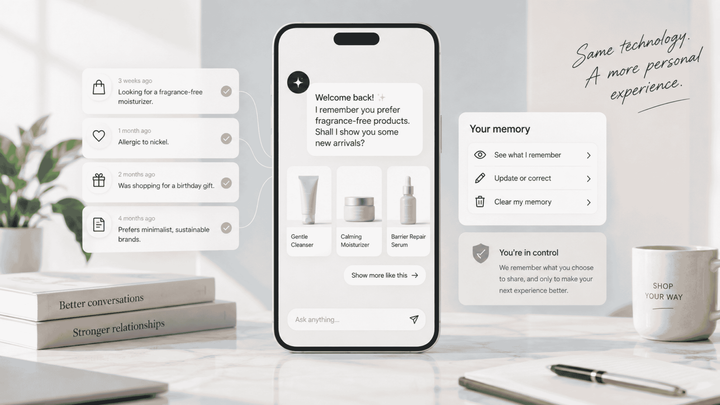
- Context memory. The AI should remember what the customer said earlier in the conversation. Customers should never need to repeat themselves, even across channel switches.
- Resource linking. When relevant, the AI should surface links to help articles, product pages, or policy documents so customers can self-serve further.
- False negative rate. Track how often the AI fails to answer questions it should handle. A high false negative rate means customers get deflected to human agents unnecessarily.
- Response accuracy. What percentage of the AI's answers are correct? Test this with real customer questions, not demo scenarios. Alhena AI grounds every response in your verified product data, keeping accuracy high.
- Hallucination rate. This is the most critical metric. How often does the AI generate confident answers that are wrong? Your AI's hallucination rate should be near zero. Alhena AI uses retrieval-first architecture, pulling only from your knowledge base and product catalog, never from general training data.
Feedback and Supervision
You need visibility into what your AI is saying to customers. These five criteria cover monitoring and improvement loops.
- Feedback collection. The AI should collect thumbs-up/down or CSAT feedback on every interaction and use it to improve over time.
- Conversation analytics. You need summary metrics: total conversations, response times, resolution rates, and customer satisfaction scores. Alhena AI's built-in analytics dashboard tracks all of these plus revenue attribution.
- Query review. Admins should be able to browse and search through customer questions to spot trends, gaps in your knowledge base, or new product issues.
- Response review. You should be able to audit the AI's actual responses. This is how you catch edge cases and maintain quality control over time.
- Response improvement. When you find a bad response, can you correct it so the AI handles that question better next time? The best platforms let you refine answers without retraining the entire model.
Maintenance
Your product catalog, policies, and help docs change constantly. These three criteria determine whether the AI keeps up.
- Automatic knowledge updates. The AI should sync with your knowledge base on a regular schedule so new products, policy changes, and updated FAQs appear in responses without manual intervention.
- Manual update triggers. When you launch a new product or change a return policy, you should be able to force an immediate knowledge refresh.
- Knowledge aging. Does the AI prioritize newer information over outdated content? Or do you need to manually remove old documentation to prevent stale answers? Look for tools that handle content freshness automatically.
Operational Readiness
Before you sign a contract, pressure-test these operational basics.
- Uptime and reliability. What's the vendor's SLA for uptime? Customer service doesn't stop on weekends. Your AI shouldn't either.
- Downtime fallback. When the AI goes down (and it will, eventually), what happens? Does the system route customers to human agents automatically, or do they hit a dead end?
- Performance reporting. Beyond conversation analytics, the platform should report on system health, response latency, and error rates so your team can spot issues before customers do.
- Data privacy and security. Verify SOC 2 Type 2 compliance or equivalent. Ask where customer data is stored, who has access, and how long conversations are retained.
- Vendor support. Review the SLA for vendor support itself. When something breaks, how fast do they respond? Do you get a dedicated account manager or a ticket queue?
- LLM flexibility. For AI platforms using large language models, can you switch the underlying model? The LLM landscape changes fast. A good platform is model-agnostic so you aren't locked into a single provider.
Use this checklist as a scoring card when you're comparing vendors. Any AI customer service platform worth considering should perform well across all five categories. If a vendor struggles with basics like hallucination prevention, knowledge syncing, or multi-channel coverage, it's not ready for production.
Getting Started with AI Customer Service
You don't need to automate everything on day one. Start by mapping your most repetitive, high-volume queries. For most ecommerce brands, that's order status, return eligibility, and shipping questions. These repetitive inquiries are perfect candidates for automation.
Next, prepare your knowledge base. AI customer service is only as good as the data it pulls from. Update your help articles, faqs, product descriptions, and policies. Fill gaps in documentation. This single step makes the biggest difference in AI accuracy and customer satisfaction.
Choose ai tools that fit your stack. Alhena AI deploys in under 48 hours with no engineering resources. It connects natively with Shopify, WooCommerce, Magento, and Salesforce Commerce Cloud, plus the helpdesk your support teams already use.
Start with the ai copilot mode, where AI suggests a reply and human agents approve it. Monitor accuracy, CSAT, and customer satisfaction for the first few weeks. Then expand to full automation on the workflows where ai agents perform well, and keep human agents focused on complex interactions where empathy matters most.
Ready to see how ai customer service can work for your ecommerce brand? Book a demo with Alhena AI or start free with 25 conversations.