Why Ecommerce Brands Are Rethinking Outsourcing Customer Service
Support volumes keep climbing while margins shrink. For years, the default answer was outsourcing customer service to a call center, contact center, or offshore business process outsourcing (BPO) provider. It converts fixed headcount into a variable cost and can cut operating expenses significantly. But that number hides a lot of fine print.
Today, AI customer support agents offer a different cost curve entirely. Instead of paying per seat or per ticket, you pay a mostly fixed platform cost while the AI handles thousands of inbound conversations at near-zero marginal cost. The question isn't "outsourcing or AI" in absolute terms. It's about knowing which lever to pull for which type of ticket and which business needs matter most.
This post breaks down the real costs on both sides and offers a framework for deciding where each approach fits your CX operations.
The Hidden Costs of Outsourcing Customer Service
The per-agent rate your BPO or contact center provider quotes is never the full picture. Three costs tend to surprise ecommerce teams:
- Onboarding and retraining. Every product launch, policy update, or seasonal promotion means retraining outsourced agents. BPO attrition rates regularly exceed 30% annually, making hiring and retaining expertise a constant challenge, so you're onboarding replacements constantly, whether your team is offshore or onshore.
- Quality assurance overhead. Someone on your team still needs to run QA, review calibration calls, sample tickets, and handle disputes. That's internal headcount you're paying on top of the BPO contract.
- Brand control risk. Outsourced agents juggle multiple clients. Even with strict SLAs, inconsistent service quality remains a consistent risk, especially for premium or DTC brands where tone and customer experience matter.
None of these costs show up in the initial quote from support outsourcing providers. They accumulate quarter after quarter, quietly eroding the operational savings that justified outsourcing in the first place.
How AI Changes the Cost Curve
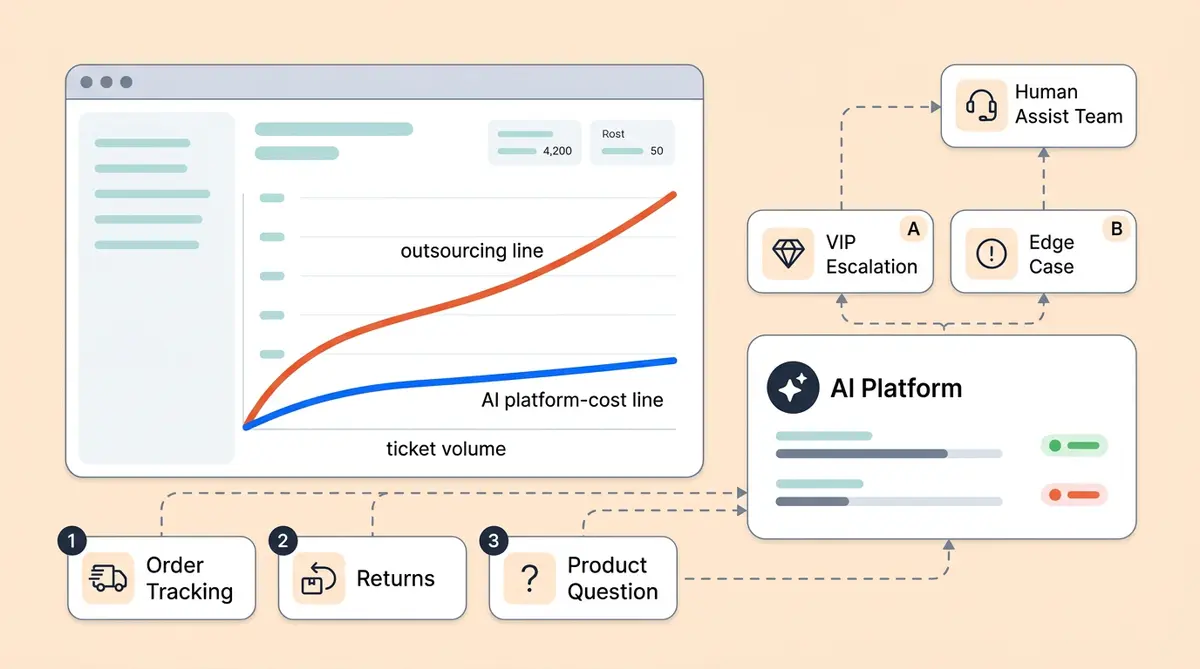
Outsourcing makes your cost variable, but it's still linear: twice the tickets means roughly twice the spend. AI customer care solutions flip that relationship. In 2026, the gap is wider than ever.
An AI agent like Alhena's Support Concierge handles order tracking, returns, product inquiries, and recommendations end-to-end across every channel. The platform cost stays relatively flat whether you're resolving 5,000 or 50,000 conversations a month. That's the real shift: near-zero marginal cost per resolved conversation, with scalable omnichannel coverage built in.
Consider a brand handling 50,000 customer inquiries monthly. At a typical BPO pricing model of $6 per ticket, that's $300,000/month. If AI resolves 80% of those tickets (a number Manawa actually hit with Alhena), only 10,000 tickets reach a human agent. The math changes dramatically.
One honest caveat: AI's cost advantage depends on containment rate, which depends on how well your knowledge base and data are built. Poor setup means poor deflection. Tools like Alhena that ground responses in verified product data rather than generating answers from scratch close that gap fast.
Communication Barriers: Where AI Has a Structural CX Edge
Time zones, language gaps, and cultural mismatches are well-documented risks of offshore customer service outsourcing. An onshore or nearshore team helps but adds cost. AI agents sidestep these problems structurally:
- 24/7 inbound coverage with flexible, full coverage, no shift handoffs, and no overnight gaps
- Multilingual responses at consistent quality across chat, email, WhatsApp, and Instagram DMs
- Consistent brand voice tuned once and applied everywhere, driving higher customer satisfaction scores without retraining
Alhena delivers this omnichannel experience from a single agent configuration. One setup covers web chat, email, social DMs, and voice. No per-channel staffing decisions across any of your channels. Whether your customers reach out via live chat, voice, or social, the same AI handles it across all channels, including voice.
The Hybrid Model: AI-First, Human-Assisted
The smartest e-commerce brands aren't choosing between outsourcing and AI. They're using AI as the first line and routing what it can't handle to human agents, whether in-house or outsourced.
Here's how that works in practice with Alhena:
- AI as Tier 1: Order status, return initiation, product inquiries, sales support, recommendations, and personalized guidance are handled end-to-end by the Support Concierge and Shopping Assistant.
- Smart escalation: Complex or sensitive tickets get routed to your existing helpdesk (Zendesk, Freshdesk, Gorgias, or Intercom) with full conversation context. No cold handoffs.
- Agent Assist for humans: When a human agent picks up, Alhena's Agent Assist with drafting responses and surfacing relevant knowledge. Your team approves and sends, delivering faster resolution and better performance across CX operations.
Crocus achieved an 86% deflection rate while keeping customer satisfaction at 84% CSAT. Puffy hit 63% automated resolution with 90% CSAT. These brands are delivering better customer experiences by not asking humans to answer, "Where's my order?" 200 times a day.
A Simple Decision Framework
Not every ticket belongs in the same bucket. Use this matrix to scale your support operations:
- High volume, low complexity (order tracking, FAQs, return status): AI-first. This is where outsourcing customer service costs add up fastest with the least return.
- Medium complexity, repeatable (product recommendations, size guidance, troubleshooting): AI with human fallback. Alhena handles these well, especially with agentic workflows that take action on both inbound and outbound requests.
- High stakes, low volume (VIP complaints, legal, fraud disputes): Human-led, always. AI surfaces context; a trained customer success agent makes the call.
Ask yourself, what percentage of your tickets are truly repeatable? For most e-commerce brands, it's north of 70%. That's the slice where AI pays for itself in weeks, not quarters. Use the Alhena ROI Calculator to model your own numbers.
The Bottom Line
Customer service outsourcing still makes sense in specific scenarios: regulated industries, complex B2B contact center operations, or teams that need bodies for phone coverage in regions AI voice hasn't reached yet. But for the bulk of e-commerce support, the maths now favours cost-effective, scalable AI agents that resolve conversations end-to-end, at a fraction of the cost, with no training ramp, no attrition, and faster deployment than any offshore or onshore provider.
The winning model isn't outsourcing or AI. It's AI-first with humans where they matter most. Alhena deploys in under 48 hours, connects to your existing helpdesk, and starts resolving tickets, providing sales support, and driving revenue from day one.
Ready to see how the numbers work for your brand? Book a demo with Alhena AI or start free with 25 conversations.
Frequently Asked Questions
How much does outsourcing customer service cost for ecommerce brands?
BPO pricing typically ranges from $4 to $12 per ticket or $8 to $25 per hour, depending on location and complexity. But the true cost includes QA overhead, onboarding cycles, and vendor management time that can add 15-25% on top of the quoted rate.
Can AI fully replace outsourced customer support teams?
Not entirely, and that's by design. AI agents like Alhena handle high-volume, repeatable tasks (order tracking, FAQs, returns) end-to-end, but complex disputes, VIP escalations, and edge cases still need specialized human expertise. The best results come from AI-first models with smart escalation to human agents.
What deflection rates do AI support agents actually achieve?
It depends on the product and knowledge base quality. Alhena customers have hit 80% inquiry automation (Manawa), 86% deflection (Crocus), and 63% automated resolution (Puffy), all while maintaining excellent CSAT scores above 84%, proving AI can deliver strong customer experiences at scale. Brands with well-structured product data tend to see higher containment rates.
How does Alhena AI handle escalations to human agents?
Alhena routes complex conversations to your existing helpdesk (Zendesk, Freshdesk, Gorgias, Intercom, and others) with full conversation context attached. The human agent sees everything the customer said, so there's no cold handoff. Agent Assist also drafts suggested replies to speed up resolution.
Is a hybrid outsourcing and AI model more cost-effective than either alone?
For most ecommerce brands, yes. AI handles the 70%+ of tickets that are repeatable at near-zero marginal cost, while human agents (in-house or outsourced) focus on high-stakes interactions. This cuts total support spend while keeping quality high where it matters most.
How quickly can an AI support agent go live compared to onboarding a BPO?
Alhena deploys in under 48 hours with no developer resources needed. A typical BPO onboarding takes 4 to 8 weeks including training, SLA negotiation, and ramp-up. AI also doesn't need retraining when products or policies change, since it pulls from your live knowledge base.