The Customer Retention vs Customer Acquisition Cost Gap
Acquiring new customers costs 5 to 25 times more than retaining the ones you already have. It's a structural disadvantage in every ad dollar you spend attracting a cold audience through advertising and social media.
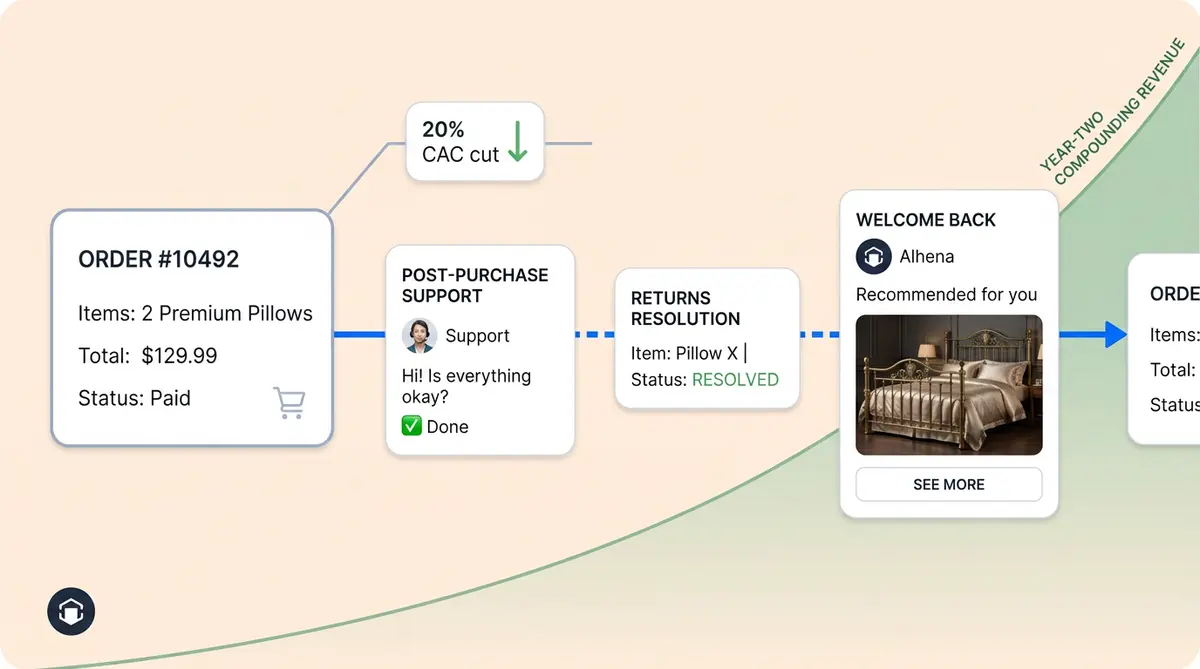
The gap is getting worse. Ecommerce customer acquisition cost has jumped roughly 60% over the past five years, driven by rising CPCs, privacy changes, and a flood of advertising spend from competitors. Cutting acquisition costs by 20% sounds impressive until you realize you're trimming a number that keeps climbing.
Customer retention works the other direction. A 5% increase in customer retention rates can boost profits by 25 to 95%. The math isn't subtle. Loyal customers already trust you, skip the research phase, and convert at dramatically higher rates with higher average order values.
The 5% Lift vs. 20% CAC Cut: ROI Compared
Consider a $10M annual revenue ecommerce brand with a 30% repeat purchase rate and a $45 cost per acquisition. Here's what each scenario delivers over 12 months:
- Scenario A: Cut customer acquisition cost by 20%. Your CAC drops from $45 to $36. You save $450,000, but it doesn't change how those customers behave.
- Scenario B: Boost repeat purchase rate by 5 percentage points (from 30% to 35%). Loyal customers spend 67% more per order on average. That 5-point shift adds roughly $600,000 in annual sales growth, and those customers come back again through referrals and word of mouth.
The CAC cut is a one-time save. The customer retention lift compounds. After two years, Scenario B pulls further ahead because every retained customer feeds the next cycle, increasing customer lifetime value and long-term profitability. You can model this for your own store using Alhena's ROI calculator.
The Second-Purchase Cliff and Customer Churn
Most customer lifetime value is lost between purchase one and purchase two in the customer journey. A first-time buyer who never returns cost you the full acquisition spend with zero payback. The probability of selling to an existing customer is 60 to 70%, compared to just 5 to 20% for a new prospect. But that probability only kicks in if the first customer experience earns a second chance.
Three moments determine whether a customer crosses the second-purchase cliff or becomes part of your churn rate:
- Post-purchase support quality. A slow response to a shipping question erodes trust and increases customer churn before the product even arrives. Brands like Crocus reduced that friction with AI, reaching 86% deflection rates and 84% CSAT. Fast answers build customer loyalty through nurturing and real engagement.
- Return and exchange friction. A painful return process guarantees a customer won't come back. Puffy automated 63% of post-purchase inquiries while maintaining 90% CSAT, turning a potential churn moment into a lasting customer relationship.
- The repeat visit experience. When a returning customer lands on your website, do they get personalized guidance or the same generic homepage? This is where the AI shopping assistant earns its keep, helping your customer base find the right products based on purchase history.
Customer Retention Strategies That Actually Work
Loyalty programs and discount codes aren't real retention strategies. They're margin erosion dressed up as marketing strategy. Real customer retention happens in operational moments: how fast your customer service answers a post-purchase question, how painless your return flow is, and how relevant the next product recommendation feels to each customer.
Tatcha didn't boost AOV by 38% through email coupons or rewards. They used an AI concierge that understood each customer's skin type, past purchases, and preferences, then guided them to the right product. That's how you focus on customer value and build loyal customers who keep coming back.
Manawa saw response times drop from 40 minutes to 1 minute after deploying AI, with CSAT climbing to 85-86%. Speed is the operational signal that predicts whether you're retaining customers or losing them. For a deeper look, read our guide on how AI transforms the post-purchase experience.
Measuring What Drives Customer Retention
You can't target retention growth if you can't see which moments drive it. Most helpdesk tools track ticket volume but miss the revenue connection. Alhena's ecommerce analytics tie AI conversations directly to purchases using a 24-hour attribution window, giving you clear ROI on every interaction.
At Tatcha, 11.4% of total site revenue traced back to AI-influenced conversations. That's not a support metric. That's a revenue metric that tells you exactly which interactions are acquiring and retaining customers. Read more about how CMOs report AI-attributed revenue to their boards.
Five customer retention metrics to start tracking next quarter:
- 60-day repeat purchase rate by customer cohort
- Post-purchase CSAT segmented by issue type
- Repeat-visitor conversion rate with and without AI assistance
- AI-attributed revenue from returning customers
- Return-to-reorder ratio (returns converting to exchanges)
Companies already using this data find that small operational improvements, like a smarter product recommendation or a faster return resolution, move the retention needle more reliably than any acquisition efforts or advertising increase.
Stop Acquiring. Start Retaining.
The customer acquisition retention debate isn't theoretical. It shows up in your P&L every quarter, and the balance tips further toward retention each year. A 20% cut in customer acquisition cost saves money once. A 5% lift in customer retention rates builds a long-term revenue engine that compounds, funded by the customer base you've already paid to build.
The brands and companies winning this math aren't running more loyalty programs or spending more on attracting a new audience of visitors. They're fixing the operational moments (post-purchase support, return handling, and returning-visitor personalization) that determine whether you're retaining customers or losing them. To see how other ecommerce brands drive customer retention with AI, explore our case studies.
Ready to turn your post-purchase customer experience into a retention engine and grow CLV? Book a demo with Alhena AI or start free with 25 conversations.
Frequently Asked Questions
What does customer retention vs acquisition mean?
Customer retention focuses on keeping existing buyers coming back, while acquisition is about attracting new ones. Retention typically costs 5 to 25 times less than acquisition. Returning customers convert at 60 to 70% rates.
How much does a 5% increase in retention actually impact revenue?
A 5% retention increase can boost profits by 25 to 95%. For a $10M ecommerce brand, a 5-point lift in repeat purchases adds roughly $600,000 in annual revenue that compounds each year.
Why is cutting CAC less effective than improving repeat purchase rates?
A CAC cut is a one-time savings. A repeat purchase lift compounds because each retained customer generates multiple future orders. With CAC rising 60% over five years, acquisition costs keep climbing.
What is the second-purchase cliff in ecommerce?
The drop-off between a customer's first and second order. Three factors drive it: post-purchase support speed, return friction, and whether the repeat visit feels personalized.
How does AI improve customer retention for ecommerce brands?
AI fixes the operational moments that determine whether customers return. Alhena handles post-purchase queries instantly (Manawa: 40 min to 1 min), automates returns at 90% CSAT (Puffy), and personalizes repeat visits based on purchase history.
What KPIs should I track to measure ecommerce retention?
Track 60-day repeat purchase rate by cohort, post-purchase CSAT by issue type, repeat-visitor conversion rate, AI-attributed revenue from returners, and return-to-reorder ratio.
Can Alhena AI attribute revenue to retention-driving conversations?
Yes. Alhena uses a 24-hour attribution window to tie conversations to purchases. At Tatcha, 11.4% of site revenue traced to AI-influenced interactions.