Shopify Plus merchants process thousands of orders daily, handle multi-region storefronts, and manage B2B and DTC channels from a single backend. That scale and volume create a customer service problem most AI tools weren't designed to solve: order-aware, revenue-generating e-commerce customer service conversations at volume and scale.
If you're running Gorgias or Zendesk as your helpdesk, you've probably noticed their built-in AI focuses on support ticket deflection, not sales. This guide breaks down what each platform's AI actually does in this Gorgias vs Zendesk comparison, where the gaps are, and how Alhena AI fits as an AI agent layer on top of either one.
Shopify Plus Support Is a Different Animal
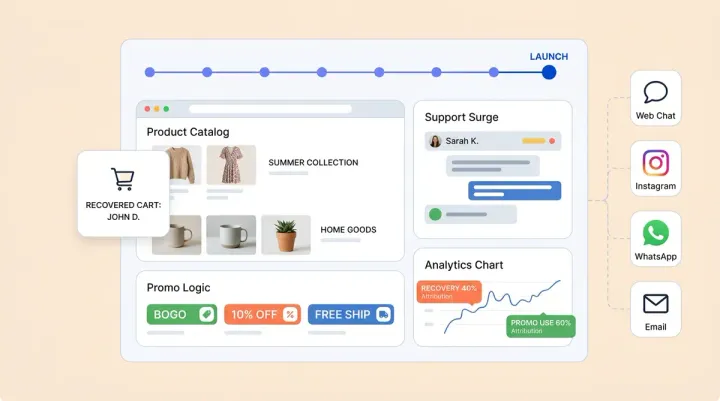
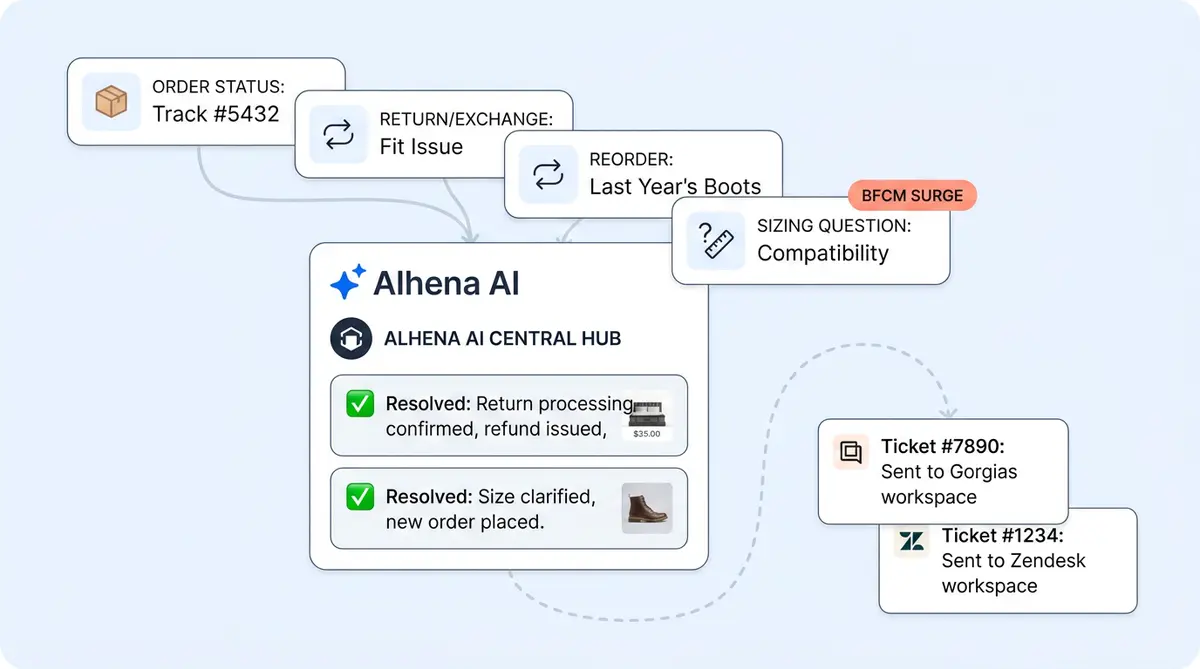
Shopify Plus merchants regularly deal with 10,000+ high-volume tickets per month, with spikes during product launches, Black Friday, and BFCM (BCFM). The ticket mix is different too: heavy on order status inquiries, returns, shipping, exchanges, and reorders, mixed with pre-sale queries about sizing and compatibility.
Multi-currency storefronts and region-specific catalogs add complex operational challenges. Your AI can't just answer FAQs. It needs to pull live order data, understand product catalogs, and handle handoffs with full context.
Should you replace your helpdesk or add an AI layer on top?
Gorgias vs Zendesk vs Alhena: Honestly Compared
Gorgias AI and Zendesk are helpdesks. Alhena can serve a different role. Alhena is an AI agent layer that integrates with Gorgias, Zendesk, and Freshdesk, Kustomer, Salesforce, and others. It can also work with e-commerce platforms like Shopify, Magento, and WooCommerce. In this comparison, placing them head-to-head as equals is misleading, so here's what features each actually offers. Shopify brands on Gladly can see how Alhena works as a Gladly alternative for selling.
Gorgias is an e-commerce helpdesk with native Shopify integration features. Its AI layer, Gorgias Automate, handles common ticket types with automations, workflows, and features and macros. It's good at deflecting repetitive inquiries, but its AI features don't handle product recommendations or drive sales or marketing. See our Alhena vs Gorgias Automate breakdown.
Zendesk is a general-purpose customer service software and CX platform with AI agents and advanced AI add-ons. Zendesk's platform ticketing system handles routing, SLA management, routing rules and automated workflows and knowledge base deflection well. But it wasn't designed around e-commerce data models, product catalogs, or cart-level interactions. Our Alhena vs Zendesk AI guide covers the specifics.
Alhena AI is a multi-agent AI layer purpose-built for e-commerce, built to handle e-commerce conversations. It runs three agents: a product expert that dynamically searches your catalog, an order management agent that handles tracking, returns, and reorders, and a general support agent to handle everything else. It sits on top of your existing helpdesk to streamline support conversations using an omnichannel approach and reduce ticket volume, not instead of it.
What the AI Layer Adds That Helpdesk AI Doesn't
The core difference is scope. Gorgias Automate and Zendesk AI Agents focus on deflecting tickets. Alhena's agents focus on resolving conversations and generating revenue.
Here's what that looks like in practice for a Shopify Plus store:
- Product discovery inside conversations. A shopper asks, "what moisturizer works for dry skin?" and the product expert agent searches your catalog, returns matched products, and can populate a cart. Helpdesk AI can't do this because it doesn't index your product data or run AI QA checks.
- Order status actions, not just order lookups. The order management agent pulls tracking info, processes return requests, shipping inquiries, handles refund workflows using live Shopify data.
- Revenue attribution you can actually measure. Alhena's Revenue Impact dashboards tab tracks average cart value, daily cart GMV, and total add-to-cart GMV, refreshed every two hours and filterable by AI profile. Neither Gorgias nor Zendesk offers these features or advanced analytics features for revenue generated through AI conversations.
- Handoff with context. When the AI reaches its limits, it transfers to your Gorgias or Zendesk agents with the full conversation history, customer details, and intent. Your support team picks up with full context.
Brands like Tatcha have seen a 3x conversion rate and 38% AOV uplift using Alhena's AI agents alongside their existing support stack. Read the Tatcha case study for details.
How the Pieces Fit Together
Most Shopify Plus merchants don't rip out their helpdesk. They add Alhena as a layer. Two common patterns:
Gorgias + Alhena: Gorgias stays as your system of record. Alhena can handle live chat, voice, and widget conversations and email tickets assigned to the AI agent. Alhena uses smart routing to hand off to Gorgias agents when a conversation needs a human. Alhena holds strong G2 reviews and ratings for e-commerce AI. Full setup details are in our Shopify + Gorgias + Alhena integration guide.
Zendesk + Alhena: Same architecture. Zendesk Support's features manage your ticket queue, SLA timers, ticket routing, ticketing system rules, and macros. Alhena resolves conversations before they become tickets or hands off with context. See our Shopify + Zendesk + Alhena guide for the setup and configuration walkthrough.
Alhena also offers a built-in helpdesk for brands that want to consolidate, but that's a separate decision.
Decision Checklist for Plus Merchants
Before you evaluate any AI tool, answer these questions about your support operation:
- Ticket mix: What percentage is pre-sale product questions vs post-purchase order issues? If pre-sale is significant, you need AI that sells, not just deflects.
- Helpdesk lock-in: How many macros, SLA policies and SLAs, and custom workflows do you edit and customize in your current helpdesk? An AI layer preserves that investment at lower pricing. Compare pricing models before you commit. A replacement doesn't.
- Channel coverage: Do you need omnichannel capabilities for AI-powered communication on live chat, email, WhatsApp, Instagram DMs, and voice? Or fewer channels?
- Customer feedback and revenue visibility: Can you currently attribute revenue to support conversations? If not, you're flying blind on AI ROI.
- Multi-store complexity: Are you running multiple Shopify Plus storefronts with different catalogs or regions?
If you want to estimate the financial impact before committing, Alhena's price comparison using the ROI calculator can help you model comparison pricing and volume for your specific setup.
Where to Go from Here
For deeper dives, start here:
- AI Agent for Shopify: What It Does and How to Set One Up
- 8 Best Gorgias Alternatives for Ecommerce Brands
- 11 Best Zendesk AI Alternatives for Ecommerce
- Pre-Ticket Deflection: The Biggest Support Lever Zendesk Can't Measure
Ready to see how Alhena fits into your Shopify Plus stack? Book a demo today or start free with 25 conversations to test it against your real user catalog and order data.
Frequently Asked Questions
Is Alhena AI a replacement for Gorgias or Zendesk?
No. Alhena is an AI agent layer that integrates with Gorgias, Zendesk, and other helpdesks. It handles AI-driven conversations and hands off complex queries to your support agent or existing helpdesk agents when needed. Your macros, SLA policies, routing rules, and workflows stay intact. Users can edit and customize their setup without losing any capabilities.
How does Alhena AI connect to Shopify Plus?
Alhena installs through the Shopify App Store and connects via your store's dashboard. Once connected, it auto-enables the Order Management and Product Expert agents, pulling live catalog and order data from your Shopify Plus store.
Can Alhena AI track revenue generated from support conversations?
Yes. Alhena's Revenue Impact dashboard tracks Average Cart Value, Daily Cart GMV, and Total Add-to-Cart GMV. Data refreshes every two hours and can be filtered by AI profile and date range. GMV figures exclude tax and shipping. These advanced analytics dashboards give brands full revenue visibility. These advanced analytics dashboards give brands full revenue visibility.
What happens when the AI can't resolve a conversation?
Alhena transfers the conversation to your human agents in Gorgias or Zendesk with full context, including conversation history, customer details and detected intent. You configure which agent group receives handoffs and set business hour rules.
How is Alhena different from Gorgias Automate?
Gorgias Automate deflects repetitive tickets with auto-responses. Alhena's features include multi-agent orchestration with specialized features like Product Expert, Order Management, and General Support agents that can search catalogs, populate carts, attribute revenue to conversations, and streamline high volume support.
Does Alhena work with multiple Shopify Plus storefronts?
Alhena uses AI Profiles to segment analytics and behavior across different storefronts or brands. Each profile can be tuned independently and filtered in the Revenue Impact dashboard for per-store visibility.
If you're considering a switch, our step-by-step migration guide covers the full process.
For a broader look at why helpdesk AI alone isn\u2019t enough for ecommerce, see our guide on native helpdesk AI vs commerce-native AI.
How long does it take to set up Alhena on Shopify Plus?
Most merchants are live within 48 hours. The Shopify App Store install connects your catalog and order data automatically, and no developer resources are required. The setup scales with your user base from day one.