If you run Shopify on Gladly, the honest question is not "which helpdesk should replace Gladly." It is "why does my AI answer questions beautifully and still never sell anything."
The best Gladly alternative for Shopify brands is not a replacement helpdesk. It is an ecommerce AI layer. Alhena AI sits between your Shopify catalog and your Gladly workspace, resolves roughly 70% of inbound inquiries, and actively sells: 3x conversion, 38% AOV uplift, live in under 48 hours.
Everything below unpacks that answer: where Gladly Sidekick stops, what changes when an AI can read your live catalog, and how to decide whether you need a replacement or a layer.
Why are Shopify brands searching for a Gladly alternative?
Not because Gladly is bad at support. Because Gladly was built for support, and the highest-value conversations on a Shopify store happen before the order exists.
Shopify owns the catalog, inventory, pricing, and checkout. Gladly unifies chat, email, SMS, and voice into one customer timeline. Both do their job. Neither owns the moment a shopper asks "which of these two is better for me."
That moment is worth real money. Shoppers who interact with an AI assistant during a session convert at 12.3%, against 3.1% for those who do not. The AI shopping assistant market is projected to grow from $4.26 billion in 2025 to $36.38 billion by 2034, according to Straits Research. Brands are not chasing a trend, they are chasing conversations they already lose.
What is Gladly Sidekick actually good at?
Give credit where it is due. Sidekick has matured into a capable support AI, and pretending otherwise helps nobody evaluating this honestly.
It automates order status checks, processes returns and refunds end to end, and can answer some product questions using your Shopify data. The published results are strong: Allbirds reports an 87% resolution rate and a 41% reduction in average handle time. Bombas reports 88% resolution on cancellation requests at 99% CSAT.
Gladly also reports a 10% average increase in contact-centre-generated revenue. That number is the tell. It is a support platform that produces some revenue, not a selling platform that produces support.
Where does Gladly Sidekick stop?
- Multi-attribute comparison. Two products, five variables, one shopper who wants a verdict.
- Personalised routines and regimens. Skincare, supplements, haircare, anything sequenced.
- Bundle and kit configuration. Compatible components, dependencies, exclusions.
- Agentic checkout. Populating a cart and applying a code from inside the conversation.
- Per-conversation revenue attribution. Which chat produced which order, and for how much.
Do you have to replace Gladly to fix this?
No. This is the most common misread of the "Gladly alternative" search, and it costs teams months.
Ripping out Gladly means re-migrating conversation history, retraining agents, and rebuilding routing, all to solve a problem that sits upstream of the helpdesk. The faster path is to add an ecommerce AI layer in front of it.
| Your situation | Replace Gladly | Layer Alhena on top |
|---|---|---|
| Agents like Gladly, revenue is the gap | No | Yes |
| Ticket volume is burying the team | No | Yes |
| You need selling on Instagram and WhatsApp | No | Yes |
| Gladly seat costs are the core problem | Evaluate | Yes, fewer seats needed |
| You have no helpdesk at all yet | N/A | Yes, Alhena can run standalone |
At roughly $180 or more per agent per month, reducing the conversations that need a seat is usually worth more than switching vendors.
How does Alhena AI connect Shopify and Gladly?
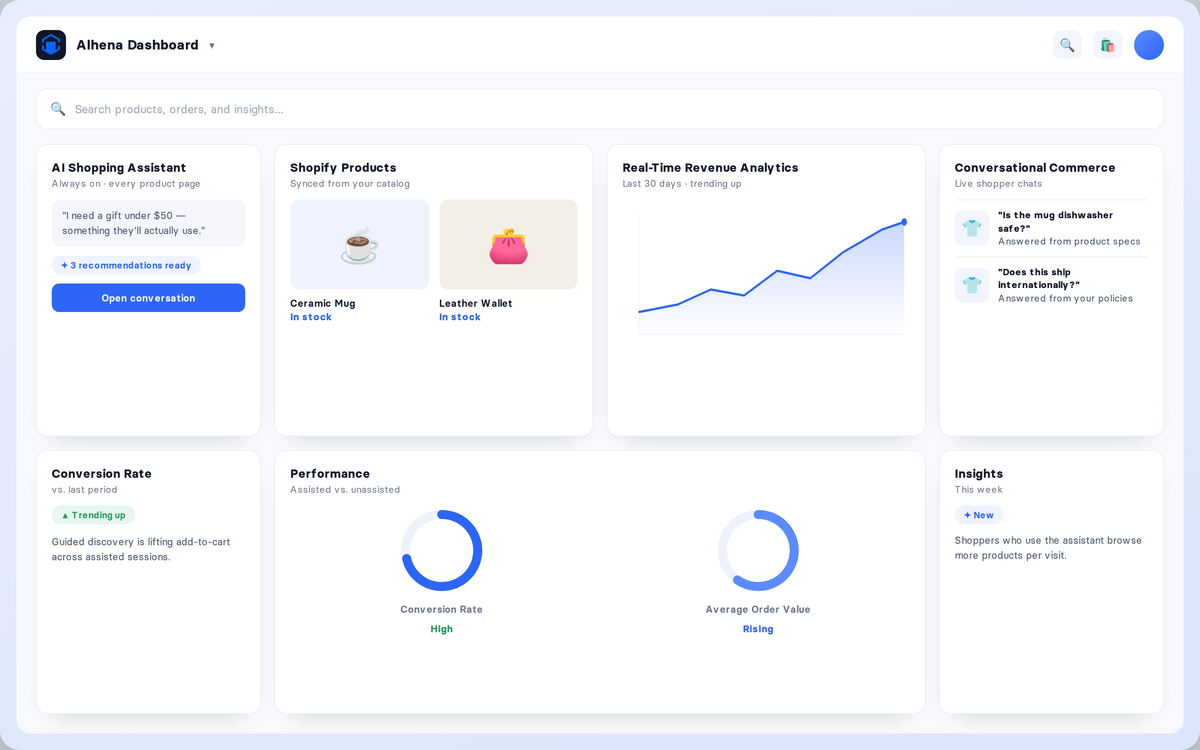
Alhena runs two specialised agents on one brain, one catalog, and one brand voice. Both are surfaces of the same system, so context never gets dropped between them.
Product Expert Agent
Reads your live Shopify feed: variants, price, stock, images, copy. Answers grounded in what is actually sellable right now.
Order Management Agent
Pulls order status, tracking, and return eligibility from Shopify in real time, then closes the loop without a seat.
What happens on the Shopify side?
Alhena syncs your full catalog, inventory, pricing, discount rules, and active promotions, then keeps it current within minutes of any change.
- Guided discovery. Clarifying questions, variant comparison, sizing and compatibility, then a recommendation the shopper trusts.
- Out-of-stock saves. Comparable in-stock alternatives instead of a dead end and a competitor tab.
- Bundles and upsells. Suggestions built from conversation context and cart contents, not a static bestseller rail.
- Agentic checkout. Cart population, discount codes, and pre-filled fields straight from the chat.
What happens on the Gladly side?
Alhena does not compete with your agents. It reduces what reaches them and improves what does.
- AI-first resolution across chat, email, and messaging for order status, shipping, returns, policy, and sizing.
- Escalation with full context: transcript, detected intent, order IDs, and any product data already gathered.
- Traffic routing you control: 24/7 automation, peak overflow only, or after-hours coverage.
The customer never repeats themselves. The agent never starts cold.
Alhena AI vs Gladly Sidekick: what is the real difference?
Both platforms touch Shopify data. The difference is what they are optimised to produce at the end of a conversation.
| Dimension | Alhena AI | Gladly Sidekick |
|---|---|---|
| Built for | Ecommerce selling plus support | Support resolution and CX |
| Product recommendations | Deep guided selling from the live Shopify catalog | Basic, drawn from customer profiles |
| Hallucination control | Verified catalog grounding | No dedicated verification layer |
| Agentic checkout | Cart population and discount codes from chat | Agents process manually |
| Revenue attribution | Per conversation, first message to checkout | Aggregate, roughly 10% average lift |
| Resolution rate | 61 to 86%, plus revenue generated | 75 to 87% (Allbirds: 87%) |
| Channels | Chat, email, WhatsApp, Instagram, voice | Chat, email, SMS, voice |
| Time to live | Under 48 hours | Days to weeks |
| Relationship | Layers on top of Gladly | Native to Gladly |
Which edge cases break a support-first AI?
These are the conversations where the difference stops being theoretical.
Sold out at peak intent
A support AI confirms the stockout. Alhena offers the closest in-stock match and keeps the session alive.
Regulated categories
Skincare ingredients, wellness claims, luxury specs. Grounded answers matter more than fluent ones.
Multi-variant comparison
Four colourways, three sizes, two finishes. The shopper wants one recommendation, not a spec dump.
Bundle configuration
Kits with dependencies and exclusions need catalog logic, not a canned response.
After-hours demand
Peak browsing rarely matches agent shifts. Coverage gaps are lost carts, not just slow replies.
Social DM intent
Instagram and WhatsApp questions are buying questions. Alhena sells there, Gladly does not cover those channels.
What results have Shopify brands actually seen?
Deflection saves money. Selling makes money. The brands below did both, and the numbers separate the two clearly.
- Tatcha: 3x conversion, 38% AOV uplift, 11.4% of site revenue AI-attributed, alongside 82% chat deflection.
- Puffy: 63% of inquiries automated at a 90% CSAT score.
- Manawa: support workload down 43%, response time from 40 minutes to 1 minute, 80% inquiry automation.
How do you measure whether the layer worked?
Most AI pilots fail review because they were only ever measured on deflection. Instrument both halves from day one.
| Metric | What it tells you | Where to read it |
|---|---|---|
| Automated resolution rate | Cost avoided, agent capacity freed | Alhena dashboard |
| AI-attributed revenue | Direct return on the AI spend | Alhena attribution view |
| AOV on AI-assisted sessions | Whether guided selling is actually guiding | Alhena plus Shopify |
| Conversion, assisted vs unassisted | The real lift, isolated from traffic changes | Alhena plus Shopify |
| Escalation quality | Whether agents inherit context or start cold | Gladly conversation view |
| CSAT post-escalation | That efficiency did not cost you the relationship | Gladly |
How fast can you go live on Shopify and Gladly?
Most brands are live within 48 hours. No developer resources required.
Connect Shopify
Install from the Shopify integration or connect in the Alhena dashboard. Catalog, inventory, pricing, and discount rules sync automatically, along with your help centre and policy pages.
Connect Gladly
Link the workspace, then set routing rules: which channels Alhena owns autonomously, and what triggers a handoff.
Train and tune
Alhena learns from your existing knowledge base, past tickets, and canned responses. Adjust tone, brand voice, and escalation triggers without code.
Go live and instrument
Deploy to the storefront widget, email, and messaging. Track deflection and CSAT next to conversion and AOV impact from the first day.
Who should not switch or layer?
Being straight about this matters more than a longer feature list.
- Catalogs under roughly 25 SKUs. There is little to guide a shopper through.
- Service or subscription businesses with no product discovery. Sidekick alone may be enough.
- B2B quote-led sales. The decision happens in a sales cycle, not a session.
- Teams with no owner for the AI. Someone has to read the attribution and act on it.
Key takeaways
- The best Gladly alternative is usually a layer, not a replacement. The gap is upstream of the helpdesk.
- Gladly Sidekick is genuinely strong at support. Allbirds 87% resolution, Bombas 88% on cancellations. It just was not built to sell.
- Alhena adds the selling half: guided discovery, out-of-stock saves, bundles, and agentic checkout from live Shopify data.
- Grounding is the trust requirement. Verified catalog answers matter most in skincare, wellness, and luxury.
- Measure revenue, not just deflection. Per-conversation attribution is what turns AI into an accountable channel.
- Deployment is an afternoon, not a quarter. Under 48 hours on Shopify plus Gladly, with 25 free conversations to test the case.
See it on your Shopify store
Keep Gladly. Add the layer that sells. Live in under 48 hours.
Frequently asked questions
For most Shopify brands the answer is not a different helpdesk, it is an ecommerce AI layer. Alhena AI connects your Shopify catalog to your Gladly workspace, resolves around 70% of inbound inquiries, and adds guided selling, agentic checkout, and per-conversation revenue attribution that support-first AI does not provide.
No. Alhena sits in front of Gladly and hands off with full context, including the transcript, detected intent, and order IDs. Your agents keep their timeline and workflows, and handle fewer but higher-value conversations.
Four things stand out: deep guided selling across product variants, agentic checkout that populates carts and applies codes from chat, verified catalog grounding that prevents hallucinated product answers, and revenue attribution at the level of the individual conversation.
Yes. Alhena syncs products, variants, inventory, pricing, discount rules, and promotions, and refreshes within minutes of a change in Shopify. Recommendations reflect what is actually in stock and correctly priced right now.
Every product response is grounded in verified catalog data rather than generated from a general model. In practice that means Alhena will not recommend an out-of-stock item, quote an outdated price, or invent specifications, which is the deciding factor for skincare, wellness, and luxury categories.
Yes. Alhena resolves inquiries across chat, email, and messaging. For email in Gladly it can draft and send responses to common questions such as order status, shipping timelines, and return policy, then escalate anything that needs a person.
Most brands are live within 48 hours. Alhena syncs the Shopify catalog automatically and learns from your existing Gladly knowledge base, canned responses, and ticket history. No coding or developer time is required.
Built-in attribution follows each conversation from the first message through to checkout, showing which chats produced orders, which products were recommended, and how much revenue each interaction generated. That is per-conversation detail rather than an aggregate percentage.
Alhena starts with 25 free conversations so you can measure impact first. Pricing then scales with conversation volume and channels. Because Alhena reduces the conversations that need a seat, brands paying roughly $180 or more per agent per month often find the layer offsets part of its own cost.
Yes. Alhena integrates with Zendesk, Freshdesk, Gorgias, Kustomer, Intercom, and Zoho Desk, and with ecommerce platforms including Shopify, WooCommerce, Magento, and Salesforce Commerce Cloud.
Gladly covers chat, email, SMS, and voice. Alhena extends AI-powered selling to Instagram DMs and WhatsApp as well, so social conversations with buying intent get the same catalog-aware treatment as storefront chat.