Choosing Between a Helpdesk and an AI Agent? You Probably Need Both
Helpdesk vs AI agent isn't either/or. Learn what each does, which tickets belong where, and a decision framework for ecommerce support teams in 2026.
Short answer
You probably need both. A helpdesk is the system of record where humans manage, route, and audit customer conversations. An AI agent is the worker that actually resolves routine requests like order tracking, returns, and sizing. Most ecommerce brands get the best results when the AI agent handles volume and the helpdesk, built in or external, handles the exceptions.
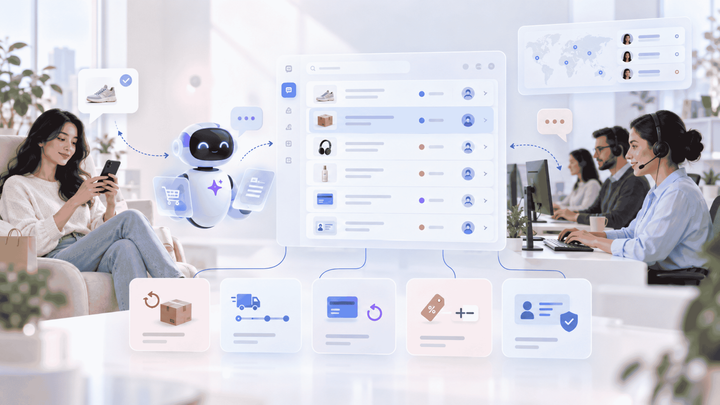
If you're weighing a helpdesk vs AI agent for your ecommerce support team, you've probably noticed that vendors on both sides now claim to do everything. Helpdesks ship "AI agents." AI agent platforms ship "inboxes." The labels have converged, but the jobs haven't.
This guide separates the two jobs, shows which tickets belong where, and gives you a decision framework by brand stage and ticket volume. When a branch of the decision needs a deeper answer, we link to the post that covers it.
What Is a Helpdesk?
A helpdesk is software that organizes customer conversations so human agents can manage them. It collects email, chat, social, and phone contacts into tickets, routes them to the right person, tracks status and SLAs, stores history, and reports on team performance.
The useful mental model: a helpdesk is a system of record plus a workflow engine for people. Gorgias, Zendesk, Freshdesk, Gladly, Kustomer, and Intercom's inbox all fall here.
What a helpdesk doesn't do on its own is resolve anything. Macros and AI-drafted replies make agents faster, but a person still reads the ticket, checks the order, decides, and hits send. If volume rises 30% in November, either headcount or response time has to give.
What Is an AI Agent in Customer Service?
An AI customer service agent is software that understands a customer's request and completes it without a human, using your real data and systems. A good one doesn't just answer "Where is my order?" with a tracking link. It checks the carrier status, sees the package has been stuck for four days, explains what happened, and starts a replacement or refund if your policy allows it.
The difference from an old chatbot is action. An AI agent reads intent, pulls order and catalog data, applies your policies, takes the step (cancel, return, exchange, recommend), and knows when to hand off. If that distinction still feels fuzzy, our agentic AI vs chatbot capability checklist breaks it down feature by feature.
Helpdesk vs AI Agent: A Side-by-Side Comparison
| Dimension | Helpdesk | AI agent |
|---|---|---|
| Built for | Organizing, routing, and tracking conversations | Resolving customer requests end to end |
| Who does the work | Human agents (AI assists) | The AI (humans handle exceptions) |
| Unit of work | The ticket | The outcome (order found, return started, product sold) |
| Core strengths | Audit trail, SLAs, collaboration, QA, reporting, permissions | 24/7 instant answers, scales with volume, consistent policy use, can drive sales |
| Typical limits | Cost and speed scale with headcount; every ticket needs a human touch | Needs clean data and guardrails; weak on disputes, emotion, and judgment calls |
| Best at | Chargebacks, damaged-item claims, VIP escalations, fraud review | WISMO, return status, sizing and fit, product questions, order edits |
| Pricing model | Usually per agent seat or per ticket | Usually per conversation or per resolution |
| Main metric | First response time, handle time, CSAT per agent | Resolution rate, containment quality, revenue influenced |
The table shows why the two coexist. One is infrastructure for people and the other is labor for the repetitive work. Comparing them is a bit like comparing your warehouse management system to your pickers.
Why "Helpdesk or AI Agent" Is the Wrong Question
Three pieces of evidence point the same direction.
AI is taking a real share of the work. Salesforce's seventh State of Service report, based on 6,500 service professionals, found AI resolved 30% of service cases in 2025, and respondents expect 50% by 2027. Gartner predicts agentic AI will autonomously resolve 80% of common customer service issues by 2029, with a 30% cut in operating costs. Note the word "common." The remaining work gets harder, not easier.
Customers still want a person within reach. In a Gartner survey of 5,728 customers, 64% said they would prefer companies didn't use AI for customer service. The top concern, cited by 60%, was that AI would make it harder to reach a human. That fear isn't an argument against AI agents. It's an argument for a clean, fast handoff to a staffed human queue, and that queue lives in a helpdesk.
Going all-in on AI has already backfired. According to Klarna's February 27, 2024 press release, its AI assistant had 2.3 million conversations in its first month, "two-thirds of Klarna's customer service chats," doing "the equivalent work of 700 full-time agents" and cutting resolution time to "less than 2 mins compared to 11 mins previously." By May 2025 Klarna was recruiting human agents again, and a spokesperson told CX Dive it wanted customers to always have the option to speak with a human. In a February 2, 2026 press release, Gartner predicted that "by 2027, 50% of companies that attributed headcount reduction to AI will rehire staff to perform similar functions, but under different job titles," even though its October 2025 survey of 321 service leaders found only 20% had actually cut agent staffing because of AI.
The industry is voting with its wallet too. Zendesk announced its acquisition of the AI agent company Forethought on March 11, 2026 and closed it on March 26, 2026, which The Next Web, citing Computer Weekly, called Zendesk's "biggest deal in two decades." Salesforce closed its acquisition of Fin, formerly Intercom, on September 10, 2026, citing a 76% average resolution rate for Fin's agent (a vendor-reported figure). Helpdesk vendors are buying AI agents, and AI agent vendors are building inboxes. Nobody serious is betting on only one half.
Leadership is moving the same way. Gartner found that 85% of service leaders are expanding human agent responsibilities as AI absorbs routine contacts. In a separate Gartner survey of 5,801 US customers, 54% said they trust human agents more than AI for product or service recommendations, versus 32% for AI.
Which Ecommerce Tickets Belong to the AI Agent, and Which Belong to People?
The practical way to decide is to sort your last 90 days of tickets by intent, not channel. Here's how that usually shakes out for a DTC brand.
Tickets an AI Agent Should Own
- WISMO ("Where is my order?") is the single most common ecommerce contact. Gorgias's merchant data puts it at about 18% of contacts, while ShippyPro's 2026 WISMO guide puts it at 40–60% of inbound ecommerce support contacts and LateShipment puts it at 20–40% of tickets, rising to 50% or more at peak. It's pure data lookup, which makes it a perfect AI job. (We go deeper in how AI handles WISMO at scale.)
- Return and exchange status, and policy questions such as "Can I return a sale item?" or "Has my refund gone through?"
- Sizing and fit. "I'm 5'6" and usually a medium in your joggers. Which size in the new cargo pant?" An AI agent grounded in your size charts and reviews can answer and recommend, which is also a revenue moment.
- Product discovery and comparisons, like ingredient checks, compatibility questions, and gift ideas.
- Simple order changes within policy windows: address edits, cancellations before fulfillment, subscription skips.
Tickets Humans Should Own, Inside a Helpdesk
- Damaged-item claims with photos, where someone has to judge the evidence and choose between reshipping, refunding, or filing a carrier claim.
- Chargebacks and payment disputes, which carry evidence deadlines, need documentation, and cost money if handled badly.
- VIP and high-LTV escalations, where a personal reply, a goodwill gesture, or a callback protects a relationship worth thousands.
- Suspected fraud, legal or safety issues, and angry repeat contacts where tone matters more than speed.
- Anything your policy doesn't cover. The AI should route these, not improvise.
The pattern: AI owns anything answerable from data and policy, and humans own anything that needs judgment, evidence, or empathy.
Handoffs need to work in both directions, so the helpdesk ticket arrives with the full AI conversation attached.
A Decision Framework: What Does Your Brand Actually Need?
Use ticket volume, team size, and complexity together. Volume alone misleads, because 2,000 simple WISMO tickets need a different setup than 2,000 warranty disputes.
| Brand stage | Typical profile | Recommended setup |
|---|---|---|
| Early / lean | 1–3 people handling support, mostly email and chat, a few hundred tickets a month | AI agent first, with a lightweight built-in inbox for escalations. A full external helpdesk is often overkill. |
| Scaling DTC | 3–10 agents, several channels, seasonal peaks | AI agent on the front line. Keep or add a helpdesk if you need routing rules, SLAs, and QA. |
| Mid-market / Shopify Plus | 10–50 agents, established helpdesk, macros and workflows built over years | Keep the helpdesk and layer a commerce-native AI agent on top. Don't rip and replace. |
| Enterprise / multi-brand | 50+ agents, multiple brands or regions, BPO partners, compliance needs | Enterprise helpdesk as the backbone, with an AI agent across channels and AI assist for human agents. |
Five questions sharpen the call:
- 1. What share of your tickets are data lookups? Above roughly half, an AI agent pays back fast.
- 2. Do you already run a helpdesk your team knows well? If yes, layer AI on it. Migrations cost more than they save.
- 3. Do you need SLA tiers, multi-brand queues, or workforce management? If yes, you need a dedicated helpdesk.
- 4. Do support conversations influence sales? If sizing and product questions are a big share, prioritize an AI agent that sells, not one that only deflects.
- 5. How fast must a human pick up an escalation? Your answer tells you how staffed and structured the human side must be.
The Four Branches of the Decision (and Where to Go Deeper)
Almost every "helpdesk vs AI agent" decision leads to one of four follow-up questions. Each has its own detailed guide.
Which kind of AI should you use? Most helpdesks now include native AI that drafts replies and summarizes tickets. That's useful, but it isn't the same as an agent that knows your catalog, reads orders, and sells. Our comparison of native helpdesk AI vs commerce-native AI includes a 10-point evaluation checklist.
How do you add AI to a helpdesk you already have? For brands running Gorgias or Zendesk, the usual move is to keep the helpdesk as the system of record and add an AI layer for resolution and revenue. Our Shopify Plus guide to stacking AI on Gorgias or Zendesk walks through that architecture.
When is one system enough? If you don't have a helpdesk yet, or you're paying for one mostly to catch AI escalations, a native inbox inside your AI platform can replace it. Read how Alhena Helpdesk works as ecommerce helpdesk software built into your AI.
Can a small team skip the helpdesk entirely? For teams of one to five handling mostly email, connecting AI straight to the support inbox can cover what a ticketing platform would. See how small ecommerce teams run AI email support without a helpdesk.
If you're ready to compare vendors, our roundup of the best AI helpdesk software for ecommerce, 10 tools compared is the shortlist.
Where Alhena Fits in a Helpdesk-Plus-AI-Agent Stack
Alhena is built for both paths above, which is why we don't think the choice has to be binary.
Path one: layer on your existing helpdesk. Alhena's AI Support Concierge and AI Shopping Assistant sit in front of your helpdesk and resolve order, return, and product conversations. When a human is needed, they push the ticket into your existing queue with full context. Native integrations include Zendesk, Gorgias, Freshdesk, Intercom, and Gladly. Your macros, SLAs, and reporting stay where they are.
Path two: use the helpdesk that's built in. Alhena Helpdesk turns on from settings and gives your team a native inbox for website chat and email escalations. It includes assignment, business hours, handoff forms that collect order numbers before a human joins, and AI-drafted replies from Alhena Agent Assist. If you outgrow it, you can switch to an external helpdesk without losing your AI configuration.
The outcomes that matter show up either way. Puffy resolved 63% of inquiries automatically while keeping 90% CSAT. Manawa cut average response time from 40 minutes to 1 minute. On the revenue side, Tatcha attributed 11.4% of site revenue to Alhena AI conversations.
What a Good AI-to-Human Handoff Looks Like
The handoff is where most AI plus helpdesk setups quietly fail. Zendesk's CX Trends 2026 research found 81% of consumers want agents to continue a conversation without backtracking, and 74% are frustrated when they have to repeat information. A good handoff has five traits:
- Clear triggers. The customer asks for a person, AI confidence is low, or a rule fires (chargeback keywords, VIP tag, damage photos).
- Context travels. The human sees the full AI conversation, order details, and the reason for escalation, not just "Customer needs help."
- Pre-collected details. Order number, email, and photos are gathered before the handoff, so the agent's first message solves something.
- Honest expectations. Outside business hours, the AI says when a person will reply instead of pretending.
- The loop closes. Resolved human tickets feed back into the AI's knowledge. Here the helpdesk becomes a training asset, as we cover in how to train your AI from helpdesk tickets.
How to Know Your Stack Is Working
Measure the system, not the pieces.
- Resolution rate on AI conversations (actually solved, not just closed), tracked by intent. WISMO should be very high; damage claims should be near zero because they route out.
- Reopen and repeat-contact rate. If AI-"resolved" customers come back within 72 hours, the resolution wasn't real.
- Time to human on escalations. The customer's fear is being trapped. Prove them wrong.
- CSAT split by AI-resolved vs human-resolved. A large gap tells you which intents to pull back from the AI.
- Revenue influenced by pre-purchase conversations. Support that sells changes the ROI math entirely.
Watch cost, but don't worship it. In a January 26, 2026 press release, Gartner predicted that by 2030 generative AI's cost per resolution will exceed $3, higher than many offshore human agents, and Senior Director Analyst Patrick Quinlan said, "Full automation will be prohibitively expensive for most organizations; instead, leading organizations will use AI to drive customer engagement rather than to cut costs."
Common Mistakes When Combining a Helpdesk and an AI Agent
- Buying AI to shrink headcount before fixing the knowledge base. The AI can only be as accurate as your policies and product data.
- Letting the AI answer everything. Chargebacks and damage claims need to route out early.
- Running two disconnected inboxes. If AI conversations and human tickets live in systems that don't share context, customers repeat themselves.
- Measuring deflection instead of resolution. A customer who gives up isn't a success.
- Treating the ticket as the goal. The goal is the resolved problem. We make that argument in full in tickets were never the goal. The next wave of traffic may not even come from humans, which is why teams should also prepare their support stack for agentic traffic.
Frequently Asked Questions
What is the difference between a helpdesk and an AI agent?
A helpdesk organizes customer conversations so human agents can route, track, and resolve them. An AI agent resolves customer requests itself by reading intent, checking order and product data, and taking actions like starting a return. A helpdesk manages the work; an AI agent does the work.
Do I need a helpdesk if I have an AI agent?
Usually, yes, some kind of helpdesk. Someone still has to handle escalations like chargebacks, damage claims, and VIP issues, with a record of what happened. Small teams can use a lightweight inbox built into their AI platform, while larger teams generally keep a dedicated helpdesk for SLAs, routing, and QA.
Can an AI agent replace a helpdesk?
For very small ecommerce teams with simple email and chat volume, an AI agent with a built-in escalation inbox can replace a separate helpdesk. For teams that need multi-tier routing, SLAs, multi-brand queues, or workforce management, the AI agent complements the helpdesk rather than replacing it.
Is an AI agent the same as a ticketing system?
No. A ticketing system logs each request as a ticket and moves it through a queue for people to work. An AI agent aims to resolve the request so no ticket is needed. When it can't, it creates or hands off a ticket with full context.
What percentage of ecommerce support tickets can AI resolve?
It depends on your ticket mix and data quality. Salesforce reports AI resolved 30% of service cases in 2025, with 50% expected by 2027, and ecommerce brands with lots of order-status and product questions often see higher rates. Disputes and damage claims resolve far less often without a person.
Should I use my helpdesk's built-in AI or a separate AI agent?
Built-in helpdesk AI is good at drafting replies and summarizing tickets for your agents. A commerce-native AI agent is better when you need it to read orders, understand your catalog, recommend products, and resolve conversations on its own. Many brands use both, with the separate agent at the front line.
When should an AI agent hand a conversation to a human?
Hand off when the customer asks for a person, when the AI isn't confident, and when a rule flags a sensitive case such as a chargeback, damaged item, legal issue, or high-value customer. The human should receive the full conversation and order context so the customer never repeats themselves.
How does Alhena work with Gorgias, Zendesk, or Freshdesk?
Alhena connects natively to helpdesks including Gorgias, Zendesk, Freshdesk, Intercom, and Gladly. Its AI resolves order, return, and product conversations, and when a human is needed it passes the ticket into your existing helpdesk with the full context. Brands without a helpdesk can use Alhena Helpdesk instead.
Key Takeaways
- A helpdesk is the system of record; an AI agent is the worker. They solve different problems.
- AI should own data-and-policy tickets (WISMO, returns status, sizing, product questions). Humans should own judgment tickets (chargebacks, damage claims, VIPs).
- Customers accept AI when a human is easy to reach. In Gartner's survey, 60% feared AI would make that harder, so make the handoff fast and context-rich.
- Your stage decides the shape. Lean teams can run AI with a built-in inbox. Scaling and enterprise teams should layer AI on the helpdesk they already use.
- Measure resolution, repeat contacts, time-to-human, and revenue, not deflection alone.
Want to See Both Paths on Your Own Data?
Book a demo with Alhena AI and we'll show you how the AI agent works with your current helpdesk, or without one.