Commerce-native AI resolves e-commerce problems. Native helpdesk AI writes faster replies about them. That's the distinction most e-commerce teams miss when choosing an AI platform, and it costs them resolution rates, revenue, and customer trust.
Here's a scene that plays out thousands of times a day. A customer messages: "Where is my order?" The helpdesk AI drafts a polite response: "I'd be happy to help! Can you provide your order number?" The customer waits. An agent eventually looks it up. Twenty minutes pass. The moment is gone.
Now picture the same question hitting a commerce-native AI. It identifies the customer instantly, pulls the most recent order, checks carrier tracking, detects that the shipment is sitting in a delayed scan in Memphis, and responds, "Your order shipped Tuesday and is currently in transit. There's a slight delay at the Memphis hub. Expected delivery is now Friday instead of Thursday. Want me to send you tracking updates?"
No agent involved. No follow-up question. Forty-five seconds.
That gap between those two experiences is the subject of this guide. Ninety-one percent of customer service leaders face executive pressure to add AI in 2026, according to industry research. Most companies will default to whatever AI their helpdesk already offers. For e-commerce brands, that's a mistake worth examining.
What Is Native Helpdesk AI?
'Native helpdesk AI' means the AI features built directly into major ticketing platforms. It lives inside the inbox. Its algorithms think in tickets.
What it does well:
- Ticket summarization so agents scan conversations faster
- Draft reply suggestions pulled from help center articles
- Automated tagging and routing to get tickets to the right team
- Macro recommendations for repetitive responses
- Knowledge base search to surface relevant articles
- Sentiment detection to flag angry or urgent conversations
Research shows agents using AI copilots can resolve more issues per hour. If your team's main bottleneck is typing speed and ticket triage, helpdesk AI helps.
Every major platform has shipped these features in 2025 and 2026, from unified AI agents to prebuilt e-commerce workflows.
But all of them were designed around the ticket, not the shopper.
What Is Commerce-Native AI?
Commerce-native AI, often powered by generative AI models, starts from a different place entirely. Instead of the ticket queue, it starts with the customer's commerce context: their orders, their cart, their browsing behaviour, behavioural signals, the product catalogue, shipping status, return policies, loyalty tier, and payment history.
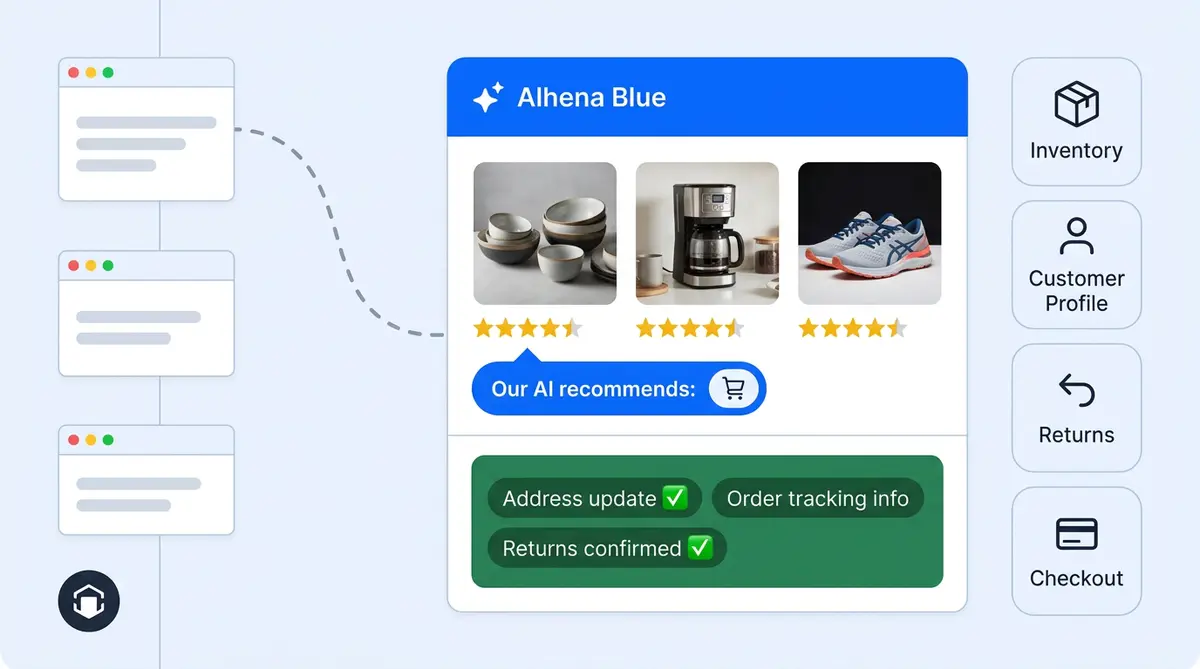
A true commerce-native AI chatbot for e-commerce connects to the systems that actually determine the answer:
- Ecommerce platform (Shopify, WooCommerce, Magento, Salesforce Commerce Cloud)
- Order management (order history, fulfillment status, tracking numbers)
- Product catalog (descriptions, variants, ingredients, compatibility, inventory, prices)
- Shipping and logistics (carrier tracking, delivery estimates, delay detection)
- Returns and exchanges (policy rules, RMA creation, label generation)
- Customer profile (purchase history, behavioral data, preferences, loyalty tier, lifetime value)
- Cart context (current items, abandoned carts, discount eligibility, subscription status, payment method)
- Reviews and Q&A (product ratings, customer feedback, video reviews)
The difference isn't just data access. Commerce-native AI can take actions inside these systems. It processes returns, populates carts, applies promo codes, and manages subscription changes. It doesn't just write about what should happen. It does it.
What's the Real Difference Between Helpdesk AI and Commerce-Native AI?
Helpdesk AI improves the ticket. Commerce-native AI resolves the commerce problem.
Native Helpdesk AI vs Commerce-Native AI: At a Glance
| Commerce-Native AI | Native Helpdesk AI | |
|---|---|---|
| Core Focus | Ecommerce workflows: orders, products, carts, revenue | Ticket management: routing, tagging, drafting replies |
| Data Access | Live order, product, shipping, inventory, customer data | Knowledge base articles and ticket history |
| Action-Taking | Processes returns, populates carts, modifies orders | Generates text responses, suggests macros |
| Pre-Purchase Support | Product recommendations, sizing, comparisons | Limited to help center article search |
| Revenue Measurement | Conversion rate, AOV, revenue attribution | Deflection rate, CSAT, ticket volume |
| Channels | Web chat, email, social, WhatsApp, voice | Helpdesk inbox (email, chat) |
| Resolution Approach | Autonomous resolution (65-80% of queries) | Agent-assisted (14% self-service resolution) |
| Best For | Ecommerce brands selling products online | B2B, SaaS, or low-SKU support teams |
That's the one-sentence version. Here's what it looks like in practice.
How Does Each Handle "Where Is My Order?"
WISMO queries account for 30 to 40 per cent of all e-commerce support tickets, according to industry data. During peak seasons, that number climbs past 50 per cent. Each one costs $5 to $25 to handle manually.
Helpdesk AI: Drafts a reply asking for the order number. Or surfaces a generic "track your order" article from the help centre. The customer still waits for a human to look up the actual status.
Commerce-native AI: Identifies the customer from their email or login, pulls the order, checks carrier tracking in real time, detects if the shipment is delayed, and responds with the exact status. No agent. No follow-up question. Done.
How Does Each Handle Pre-Purchase Product Questions?
A shopper asks: "Is this serum good for sensitive skin?"
Helpdesk AI: Searches the knowledge base. Returns a generic skincare article. If no article exists, it escalates or gives a vague answer.
Commerce-native AI: Reads the product's ingredient list, uses algorithms to cross-reference reviews that mention sensitive skin, checks brand claims and contraindications, and recommends the right variant. If the product isn't a good fit, it suggests an alternative from the same catalogue.
Pre-purchase questions directly affect revenue. AI for e-commerce needs to answer them accurately, not just redirect to an article.
How Does Each Handle Returns?
Helpdesk AI: Searches for a returns policy article. Suggests the agent copy-paste the policy into their reply.
Commerce-native AI: Checks the specific order, confirms it falls within the return window, verifies the item is eligible, generates a return label, and initiates the refund or exchange. The customer never speaks to a human. The return is processed in under two minutes.
Where Does Native Helpdesk AI Fall Short for Ecommerce?
Helpdesk AI isn't bad. It's limited by architecture. Five specific areas break down for e-commerce teams.
1. No Real-Time Order Data
Most helpdesk AI generates answers from the knowledge base. It doesn't have live connections to your OMS, shipping carriers, or inventory feeds. When a customer asks about a specific order, the AI either asks for more information or hands off to an agent.
Most helpdesk AI, for example, doesn’t execute on order changes, delivery issues, returns, and other post-purchase actions on its own. It can tag a ticket, suggest a macro, and route the conversation. But it can’t cancel an order, initiate a return, or check a carrier’s live tracking feed.
2. Deflection Isn't Resolution
Helpdesk AI measures success by deflection rate: how many consumers didn't escalate to a human. But a customer who gives up and leaves also counts as "deflected".
Only 14 per cent of issues get fully resolved through traditional self-service, according to industry research. Commerce-native AI assistants routinely hit 65 to 80 per cent autonomous resolution because they have the data to solve the problem. For more on this measurement gap, see our guide on pre-ticket deflection and what helpdesk AI can't measure.
3. No Product Catalog Understanding
Helpdesk AI can search articles. It can't parse product attributes, compare variants, check inventory, or understand compatibility. When a shopper asks, "Which running shoe works for wide feet and trail running?" helpdesk AI has no structured product data to work with.
4. It Only Works Inside the Inbox
Native helpdesk AI activates after a ticket is created. It doesn't help the shopper browsing your site who has a question before adding to cart. It doesn't engage on Instagram DMs, WhatsApp, or on-site chat in a commerce-aware way.
For e-commerce retailers and their consumers, the highest-value moments happen before the ticket exists.
5. Text Generation Without Action-Taking
Most helpdesk AI can write better replies for agents. Commerce-native AI processes returns, modifies orders, applies discount codes, populates carts, manages subscription changes, and pre-fills checkout. The gap between suggesting a reply and completing the action is the gap between a support tool and an AI shopping assistant.
What Can Commerce-Native AI Do That Helpdesk AI Cannot?
Here’s what these AI tools can do for e-commerce:
Order Intelligence
Real-time access to order status, fulfilment data, shipping updates, and delivery estimates. The AI answers order questions autonomously, detects delays before the customer asks, and triggers proactive notifications. No ticket required.
Product Intelligence
Deep understanding of catalogues, including attributes, variants, ingredients, compatibility, reviews, prices, and inventory. This powers accurate product recommendations and pre-purchase guidance and product discovery.
Tatcha saw a 3x conversion rate and 38 per cent AOV uplift with commerce-native AI that understands their product line. That result didn't come from faster ticket replies. It came from the AI knowing which products to recommend and why.
Policy Intelligence
Returns, exchanges, shipping rules, discount policies, and warranty terms are encoded directly into the AI's reasoning. It doesn't search for an article about your return policy. It applies the policy to the customer's specific order and situation.
Revenue Awareness
Commerce-native AI tracks which conversations lead to purchases. It measures conversion rate, average order value, revenue influenced, and cart recovery.
AI chatbots built for e-commerce increase conversion rates by 15 to 30 per cent and recover up to 35 per cent of abandoned carts, according to industry benchmarks.
Agentic Actions
The AI doesn't just respond. It acts. Populates a cart. Initiates a return. Applies a promo code. Checks nearby store inventory. Escalates with full context through intelligent handoff to a human agent. This is what separates a reply generator from an AI agent for e-commerce.
How Should Ecommerce Teams Evaluate AI?
Stop asking "Which AI fits my helpdesk?" Start asking, "Which AI can resolve my customers' e-commerce problems?"
Here's a 10-point checklist:
- Can it access real-time order data? Live order status from your e-commerce platform. Not cached. Not summarized.
- Can it understand your product catalogue? Attributes, variants, inventory, prices, items, ingredients, compatibility.
- Can it answer pre-purchase questions accurately? Sizing, comparisons, ingredient questions, use-case fit.
- Can it handle returns, exchanges, and shipping? Not just explain the policy. Execute the workflow.
- Does it work across channels? Web chat, email, SMS, Instagram DMs, WhatsApp, voice.
- Can it escalate with full context? Full conversation history, order data, and customer profile. Not just "Here's the ticket."
- Does it measure revenue impact? Conversion rate, AOV, revenue attribution. Not just deflection and CSAT.
- Can it follow your brand voice? Tone, terminology, compliance rules, and product positioning.
- Can it take actions safely? Cart population, checkout assist, order modifications, return processing.
- How fast can you deploy it? Days vs. weeks. Does it need developer resources?
It's a sign you need to rethink your approach if your current helpdesk AI can't check at least seven of these boxes. The best AI tools for e-commerce check all ten. Our cost-and-quality framework for e-commerce support breaks down the economics.
How Does Alhena AI Deliver Commerce-Native Intelligence?
Alhena AI was built from day one as a commerce-native AI platform, designed to scale e-commerce operations across channels and product catalogues of any size. It doesn't bolt AI onto a ticketing system. It connects directly to your e-commerce stack and resolves customer problems across the full shopping journey.
Two Specialized AI Agents
Alhena gives users two purpose-built agents that work together:
- Product Expert Agent: Handles pre-purchase questions, product discovery, recommendations, sizing, comparisons, and ingredient queries. Reads your entire product catalogue, reviews, and brand content. Every answer is hallucination-free. Unlike generic generative AI tools, responses are grounded in verified product data only.
- Order Management Agent: Handles post-purchase support: order tracking, returns, exchanges, cancellations, and shipping issues. Connects to your OMS and shipping carriers for real-time data.
Works Alongside Your Existing Helpdesk
Alhena doesn’t replace your helpdesk. It sits next to it. It connects to all major helpdesks and CX platforms, and handles the commerce-specific conversations your helpdesk AI struggles with. When it needs to escalate, it passes full context through intelligent handoff to your agents inside their existing tool.
For a platform-specific breakdown, see our Shopify Plus buyer's guide for stacking AI on your helpdesk.
Omnichannel from Day One
Alhena operates across web chat, email, Instagram DMs, WhatsApp, and voice. The same commerce intelligence powers every channel, giving users a consistent brand voice, full context continuity, and the ability to scale during peak seasons.
Revenue Attribution Built In
Every conversation is tracked against revenue outcomes. You see exactly how much revenue your AI influenced, which products it recommended, and which conversations led to purchases.
Victoria Beckham saw an increased AOV by 20 percent. Manawa cut support workload by 43 percent while continuing to scale, with response time dropping from 40 minutes to 1 minute as they continued to scale.
Deploys in Under 48 Hours
No developer resources needed. No months-long build process. Alhena connects to your Shopify, WooCommerce, or Salesforce Commerce Cloud store, ingests your product catalogue, and goes live. You can test it in the Alhena Playground before a single customer sees it.
When Should You Keep Using Your Helpdesk AI?
Helpdesk AI still makes sense for certain e-commerce businesses:
- Low support volume, mostly FAQ-based
- Small product catalog (few SKUs, no video content, straightforward policies)
- Primary goal is faster agent replies, not autonomous resolution
- Agent productivity matters more than customer self-service
- You don't sell products online (B2B services, SaaS, internal IT)
But if you're an e-commerce brand handling hundreds or thousands of daily conversations about orders, products, returns, and shipping, native helpdesk AI won't get you to 60+ per cent automation. Commerce-native AI makes smarter decisions and will.
Key Takeaways
- Native helpdesk AI improves agent speed inside the ticket queue. It powers ticket summaries, draft assistants, tagging, and routing.
- Commerce-native AI resolves the customer's actual e-commerce problem by connecting to orders, products, policies, and cart data.
- 30 to 40 per cent of e-commerce tickets are WISMO queries that need live order data most helpdesk AI can't access.
- Deflection isn't resolution. Only 14 per cent of issues resolve through traditional self-service. Commerce-native AI hits 65 to 80 per cent.
- AI for e-commerce should drive revenue, not just cut costs. The best platforms measure conversion, AOV, and revenue attribution.
- Evaluate AI on e-commerce outcomes: order intelligence, product understanding, policy application, action-taking, data security, and revenue measurement.
- Alhena AI is built as commerce-native AI from the ground up, with two specialized agents, omnichannel support, and 48-hour deployment.
Frequently Asked Questions
What is the difference between helpdesk AI and commerce-native AI?
Helpdesk AI adds intelligence to ticketing platforms, helping agents with summaries, drafts, and routing. Commerce-native AI connects directly to ecommerce systems like order management, product catalogs, and shipping carriers to resolve customer problems autonomously. The key difference: helpdesk AI improves the ticket workflow, commerce-native AI resolves the actual e-commerce issue.
Can helpdesk AI handle ecommerce order tracking and returns?
Most native helpdesk AI cannot process order tracking or returns on its own. It searches help center articles for generic shipping or returns FAQs but lacks live connections to your order management system. Commerce-native AI tools connect to your OMS and shipping carriers in real time, looking up order status, detecting delays, and initiating returns without agent involvement.
Which AI platforms are considered commerce-native?
Alhena AI is a leading commerce-native AI platform, purpose-built for e-commerce with two specialized agents (Product Expert and Order Management). Other platforms have added ecommerce-specific generative AI features, but they remain ticket-centric at their core. The distinction is whether AI was designed from the ground up for commerce workflows or added on top of an existing helpdesk.
How does commerce-native AI improve ecommerce conversion rates?
Commerce-native AI improves conversion by answering pre-purchase questions in real time: product recommendations, sizing guidance, ingredient questions, and comparisons. AI chatbots built for ecommerce increase conversion rates by 15 to 30 percent based on industry data. Alhena AI customers like Tatcha have seen a 3x conversion rate after deploying commerce-native AI on their site.
Is helpdesk AI still worth using for ecommerce support?
Helpdesk AI is still useful for agent productivity: faster replies, automated tagging, ticket summaries, and macro suggestions. It works best for ecommerce businesses with low volume, simple product catalogs, and primarily FAQ-based inquiries. But for brands handling high volumes of order, product, and returns questions, helpdesk AI alone won't reach the 60+ percent automation rates that commerce-native AI delivers.
What should I look for when evaluating AI for my ecommerce store?
Evaluate AI on ten criteria: real-time order data access, product catalog understanding, pre-purchase question accuracy, returns and shipping workflow handling, omnichannel support, contextual escalation, revenue attribution, brand voice compliance, data security, action-taking ability, and deployment speed. If your AI can't check at least seven, it's a productivity tool rather than a commerce platform.
How much does helpdesk AI cost compared to commerce-native AI?
Helpdesk AI pricing varies by platform. Most charge per resolution or per ticket, and costs can spike unpredictably during peak seasons. Commerce-native platforms like Alhena AI typically use session-based pricing that's more predictable during peak seasons. Use alhena.ai/roi-calculator to estimate your savings.
Can I use commerce-native AI with my existing helpdesk?
Yes. Commerce-native AI like Alhena AI sits alongside your existing helpdesk rather than replacing it. Alhena integrates with all major helpdesk platforms. It handles commerce-specific conversations autonomously and passes full context to your agents inside their existing tool when escalation is needed.
What percentage of ecommerce support tickets can commerce-native AI resolve?
Commerce-native AI platforms typically achieve 65 to 80 percent autonomous resolution for ecommerce queries. Alhena AI customers like Puffy report 63 percent automated inquiry resolution with 90 percent CSAT, while Crocus achieves an 86 percent deflection rate with 84 percent CSAT. By comparison, traditional self-service resolves only about 14 percent of issues according to industry research.
How long does it take to deploy commerce-native AI?
Alhena AI deploys in under 48 hours with no developer resources needed. It connects to your Shopify, WooCommerce, Magento, or Salesforce Commerce Cloud store, ingests your product catalog, and goes live. You can test it in the Alhena Playground before any customer sees it.