Support teams have spent years optimizing ticket queues. Sorting, tagging, routing with AI, and measuring time-to-close. But the ticket was never the goal. The goal was always to resolve the customer's problem. Agentic customer service, powered by generative AI and machine learning, changes the unit of work from "messages to route" to "issues to resolve using agentic AI agents", and that shift is rewriting how brands handle customer interactions, customer support and customer experience.
This post breaks down why ticket-based support is stalling, what multi-step AI-powered workflows look like in AI systems in practice, and what operational leaders should evaluate before choosing a platform.
Why Ticket-by-Ticket Support Falls Short in the Agentic AI Era
Tickets were built for human routing. They organize customer interactions into discrete units so AI agents can assign, prioritize, and track AI throughput. But they measure handoffs, not outcomes.
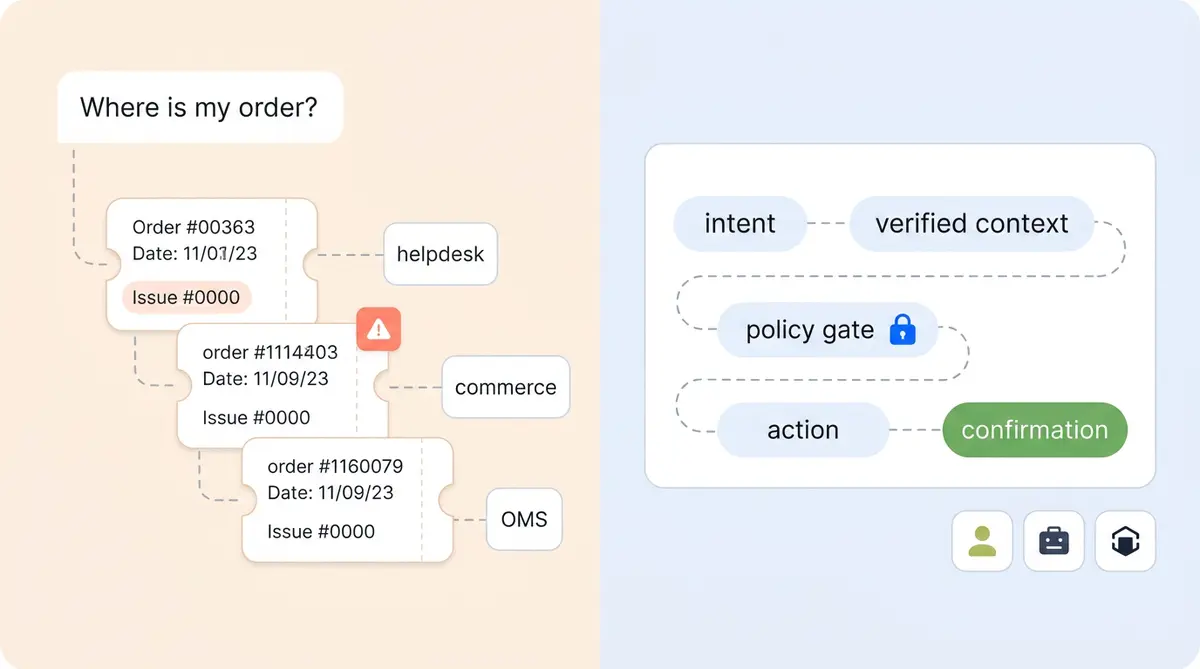
Single-turn chatbots and basic AI chatbots inherited the same constraint. They lack agentic capabilities to go beyond the message inside the ticket, not the underlying job. Here's a common example: a customer asks, "Where is my order?" The bot returns a tracking link. The carrier is delayed. The customer contacts you again. A new ticket opens. Three tickets, zero agentic resolution.
This pattern repeats across returns, sizing interactions, subscription changes, and every other interaction you can automate. Each repeated interaction creates a new ticket, hurts operational efficiency, and erodes the customer experience. Companies that rely on deflection metrics alone miss the real question: did the customer's problem actually get solved?
What Agentic AI Workflows Actually Look Like
An agentic customer service workflow goes beyond answering a question. It uses natural language to detect intent, gathers verified information from connected systems, calls the right tools across AI systems, executes actions securely under policy, and confirms the outcome, all handled within one conversational flow.
Three examples show the difference:
Order recovery: Identify the customer. Pull the order from your commerce platform. Use tools to check carrier status in real time. Consult your refund or reship policy. Propose a resolution. If approved, automate the reshipment, update the helpdesk ticket, and send a confirmation email. AI agents resolve issues in one end-to-end interaction.
Pre-purchase guidance: A shopper uses natural language to ask whether a jacket runs large. The AI retrieves catalog data, cross-references return data, review data, and AI-analyzed fit information for that SKU; makes a personalized recommendation, and adds the right size to cart. If the shopper leaves, a follow-up email recovers the cart.
Voice escalation: A caller describes a problem the autonomous voice agent can't resolve autonomously. Instead of a cold transfer, the agent collects contextual information, creates a AI-powered structured callback ticket pre-loaded with all the information the human agent needs, and the human starts at minute three instead of minute zero.
What to Evaluate in an Agentic AI Customer Support Platform
If you're selecting technology for agentic customer service, here's a practical checklist of the tools and capabilities to look for:
- Cross-channel identity: Does the agent recognize the same customer across web chat, email, voice, Instagram DMs, and WhatsApp across multiple channels?
- Live data grounding: Does it read your real-time product data, inventory data, and pricing, or a stale snapshot?
- Order system access: Can it access orders and take action under policy (trigger reships, create RMAs), not just read data?
- Helpdesk co-existence: Does it work with your existing AI systems and agentic services rather than replacing them?
- Policy guardrails: Are refund and return guardrails enforced as hard constraints over the AI, ensuring accuracy?
- Observability: Can your AI QA team track and replay every decision the agent made?
- Handoff fidelity: Do human agents inherit full AI-gathered understanding of the conversation, ensuring continuity?
- Self-improvement: Can the AI automate the process of routing gaps back into FAQs and training data automatically?
How Alhena AI Powers Agentic Customer Service
Alhena is purpose-built for the retail and e-commerce industries, not a general-purpose agent framework. Its Support Concierge and Agent Assist products use specialized AI agents that each handle their domain and hand off with full context. For a deeper look at how the architecture works, see our multi-model, multi-agent breakdown.
Every answer ties back to verified product data. Financial actions like refunds carry risk and go through strict policy gates with human handoff when appropriate. For the technical details on how grounding works, our grounded AI deep dive covers it end-to-end.
Alhena works across web chat, email, voice, Instagram DMs, and WhatsApp. It integrates with Shopify, Zendesk, Freshdesk, Gorgias, and Intercom. Tickets it can't resolve are escalated and enriched with AI context, improving the customer experience. Human agents resolve issues the AI agents escalated, picking up where the AI agents left off.
The results speak for themselves. Tatcha saw a 3x conversion rate and 38% AOV uplift. Manawa cut response time from 40 minutes to 1 minute with 80% automated inquiry resolution. Crocus reached 86% deflection at 84% customer satisfaction.
The Ticket Isn't the Goal
The shift from ticket queues to agentic workflows isn't about adding smarter chatbots to the same process. It's about changing the operational model from "messages to route" to "problems to resolve". Brands that make this customer experience shift see it in their customer satisfaction scores, resolution rates, customer experience improvements, and revenue.
Ready to see how agentic AI agents work for your store? Book a demo with Alhena AI or start free with 25 conversations.
Frequently Asked Questions
What is agentic customer service?
Agentic customer service uses AI that executes multi-step workflows to resolve problems end-to-end, rather than answering one message at a time. Agentic workflows connect to your systems and take action. The AI detects intent, gathers context from connected systems, takes actions under policy, and confirms the outcome in a single interaction.
How is agentic customer service AI different from a traditional support chatbot?
Traditional chatbots handle single-turn Q&A within the existing ticket model. Agentic AI agents connect to your commerce platform, OMS, and helpdesk to complete tasks like reshipments, cart recovery, and structured escalations. It resolves the job, not just the message.
Why is customer service the top use case for agentic AI?
Customer service involves repetitive, multi-step tasks that go beyond what generative AI chatbots handle on their own: order lookups you can automate, return processing, product recommendations, and escalations. These workflows are ideal for autonomous AI that can connect to your commerce platform, check policies, and take action. The results are measurable in customer satisfaction, resolution rates, and revenue impact.
Does Alhena AI replace my existing helpdesk?
No. Alhena integrates with Zendesk, Freshdesk, Gorgias, Intercom, and Zoho SalesIQ. It resolves issues autonomously for what it can and escalates the rest as enriched tickets so your human agents inherit full context.
What results have brands seen with agentic customer service AI workflows?
Tatcha achieved a 3x conversion rate and 38% AOV uplift. Manawa reduced response time from 40 minutes to 1 minute with 80% inquiry automation. Crocus reached 86% deflection at 84% CSAT.
How long does it take to deploy Alhena AI?
Most brands deploy Alhena in under 48 hours with no developer resources required. Alhena connects to your existing commerce platform and helpdesk through native agentic integrations.