A chatbot that recommends the wrong moisturizer is embarrassing. A chatbot that approves a $200 refund it had no authority to issue is a financial problem. That distinction matters more than most online merchants and e-commerce businesses realize, and it's the reason "artificial intelligence accuracy" can't be treated as a single metric.
Most conversations about AI hallucinations focus on product descriptions, made-up specs, and wrong product details. But the real financial risk sits one layer deeper: actions that move money in e-commerce. Refunds, exchanges, store credit, exchange reversals, cancellations. When AI gets these wrong, the business either honors a commitment it shouldn't have made or visibly retracts it, and both outcomes damage brand trust.
This post breaks down why money-moving decisions need a different kind of safeguard and how Alhena AI is built to handle them.
Why Financial Actions Are a Different Category of Retail of Risk
Wrong product information is correctable. A customer who's told a jacket comes in navy when it doesn't can be redirected. But a customer who's told "your refund has been processed" now holds a promise. Retracting that promise violates consumer expectations, creates a support escalation, a potential chargeback, and a one-star review.
Three scenarios include:
- A bot confirms "yes, your order is eligible for a full refund" without checking the return window or payment status.
- A bot promises $40 in store credit it has no policy basis to offer.
- A bot initiates an exchange for a SKU that's been out of stock for two weeks.
These include commitments that create a commitment the brand has to honor or publicly walk back. That's not a content problem. It's a retail finance and CX risk rolled into one.
How Alhena Prevents AI from Inventing Financial Decisions
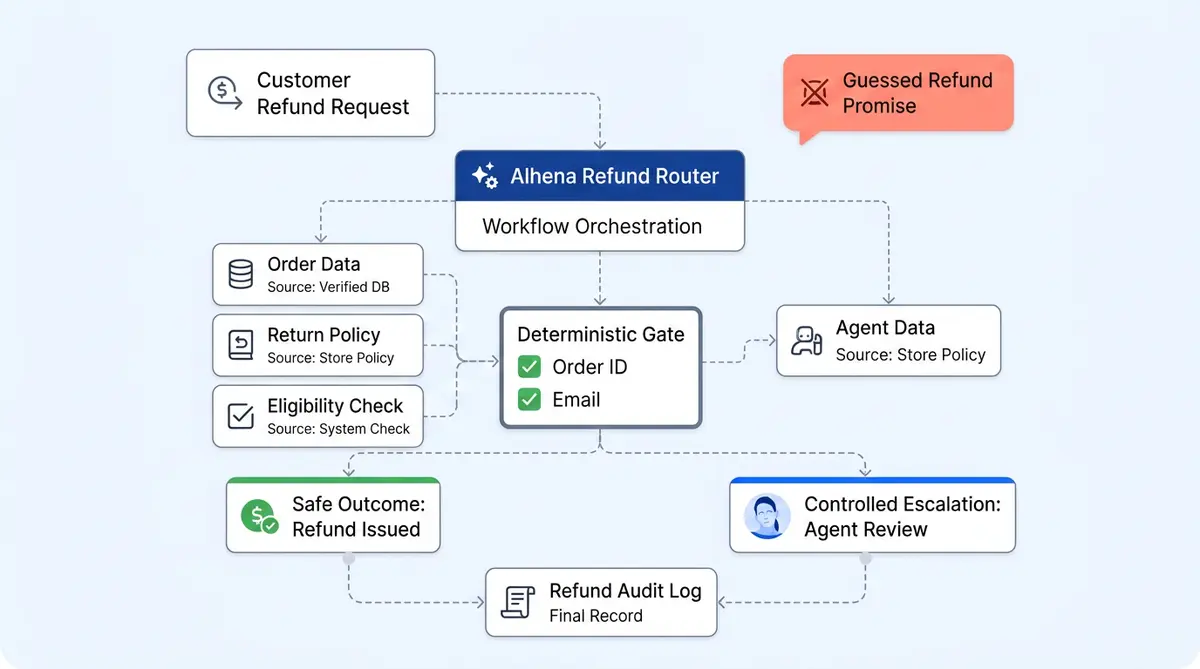
Alhena doesn't rely on a single model making its best guess. Four systems work together to keep money-moving actions grounded in verified data and explicit rules.
1. A Planner That Routes to Specialized Agents
When a customer asks about a return, Alhena's planner doesn't hand the query to a general-purpose chatbot. It routes to the order management agent, which has direct access to order systems, payment status, and fulfillment records. Product questions go to specialized agents like the Product Expert Agent. Out-of-scope requests go to the refusal agent, which declines them cleanly instead of guessing.
This multi-agent architecture means the agent handling a refund request is purpose-built for that job, not a generalist winging it.
2. Grounding to Verified Sources Before Every Response
Every answer Alhena generates traces back to your product data, product catalogs, FAQs, help desk history, or approved policy documents. If the AI can't find a verified source for its response, it defers or escalates instead of guessing. For refund-related queries, this means the AI checks your actual return policy, the specific order's status, return rates for that product, and the customer's eligibility before saying anything.
3. Guidelines as Deterministic Gates
Alhena's Guidelines system lets you write hard rules that override AI judgment for sensitive actions. A guideline has five scopes: Trigger, Action, Agent, Channel, and Hours.
A real example: "When a customer asks about returns, require a verified order ID and matching email address before starting the process." That's not a suggestion to the AI. It's a deterministic gate that blocks the action until systems confirm conditions are met.
As the Alhena docs put it: payment authorization, refund execution, and identity verification are cases where you want a deterministic gate, not a judgment call. Alhena systems run flexible, intent-based routing for the 90% of queries that benefit from it, and strict rules for the 10% that need rigid control.
4. Refusal and Escalation as the Safety Net
When a query falls outside the AI's scope, Alhena's Refusal Agent declines it with appropriate messaging. When a refund request is too complex or ambiguous, the Human Transfer Agent hands off with full conversation context, so the human agent doesn't start from zero. The customer gets a fast, accurate resolution either way.
Traceability: Every Financial Decision Is Reviewable
Accuracy at action time is half the equation. The other half is proving what happened after the fact.
Alhena's Conversation Debugger provides execution traces showing which agent handled the request, which guideline fired, and which knowledge source was cited. Smart Flagging automatically surfaces low-confidence responses for human review, catching potential issues before they compound. Fewer than 1% of Alhena conversations get flagged, which means your team runs manual reviews on exceptions, not every interaction.
For teams managing AI-powered refund management and order management, this traceability gives teams actionable insights and turns "the AI did something weird" into "here's exactly what happened and why".
Five Questions to Ask Any AI Vendor Handling Refunds
Whether you're evaluating Alhena or another platform, these five questions help e-commerce teams separate AI that's safe for financial actions from e-commerce AI that isn't:
- Where does the answer get its facts? Model weights, or your live order and policy data?
- Can you write a hard rule that blocks an action? For example, "No refund without a verified order ID."
- What does the AI do when grounding is missing? Does it guess, defer, or escalate?
- Can you trace what happened after the fact? Which agent ran? Which guideline was fired? Which document was cited?
- When it hands off to a human, does the human get full context? Or do they start over?
Each of these maps to a capability Alhena ships today through its AI Shopping Assistant and Support Concierge. Brands like Tatcha have seen 3x conversion rates and 82% chat deflection while maintaining accuracy across product recommendations and returns automation.
The Bottom Line
AI accuracy isn't one problem. It's two. Getting product information right matters. Getting financial actions right matters more, because the cost of a wrong answer is measured in dollars, not just confusion.
Alhena is architected to treat these differently: flexible intelligence for product discovery, deterministic guardrails for money-moving decisions, and full traceability for everything in between.
Ready to see how this works with your catalog and policies? Book a demo with Alhena AI or start for free with 25 conversations.
Frequently Asked Questions
What is a hallucinated refund in ecommerce AI?
A hallucinated refund occurs when an AI chatbot confirms or initiates a refund, exchange, or store credit without verifying the order status, return policy, or customer eligibility. Unlike a wrong product recommendation, it creates a financial commitment the brand must honor or retract.
How does Alhena AI prevent hallucinated financial decisions?
Alhena uses four mechanisms: a planner that routes to specialized agents (like the Order Management Agent), grounding every response in verified data sources, deterministic guidelines that block actions without required conditions, and a Refusal Agent that declines out-of-scope queries instead of guessing.
What are deterministic gates in AI customer support?
Deterministic gates are hard rules that override AI judgment for sensitive actions. For example, a gate might require a verified order ID and matching email before any return can be initiated. In Alhena, these are configured through the Guidelines system with Trigger, Action, Agent, Channel, and Hours scopes.
Can I trace what happened when AI handles a refund request?
Yes. Alhena's Conversation Debugger shows which agent handled the request, which guideline fired, and which knowledge source was cited. Smart Flagging also surfaces low-confidence responses automatically, with fewer than 1% of conversations requiring review.
What happens when Alhena AI can't verify information for a refund?
When Alhena can't trace a response back to verified data, it defers or escalates to a human agent instead of guessing. The Human Transfer Agent passes full conversation context so the support rep doesn't start from zero.
How is Alhena different from a single-model AI chatbot for order support?
Single-model chatbots use one general-purpose LLM for everything. Alhena routes queries to specialized agents: Order Management for returns and refunds, Product Expert for catalog questions, and Refusal Agent for out-of-scope requests. Each agent has access to only the data and tools it needs.