The Real Cost of Manual Order Processing
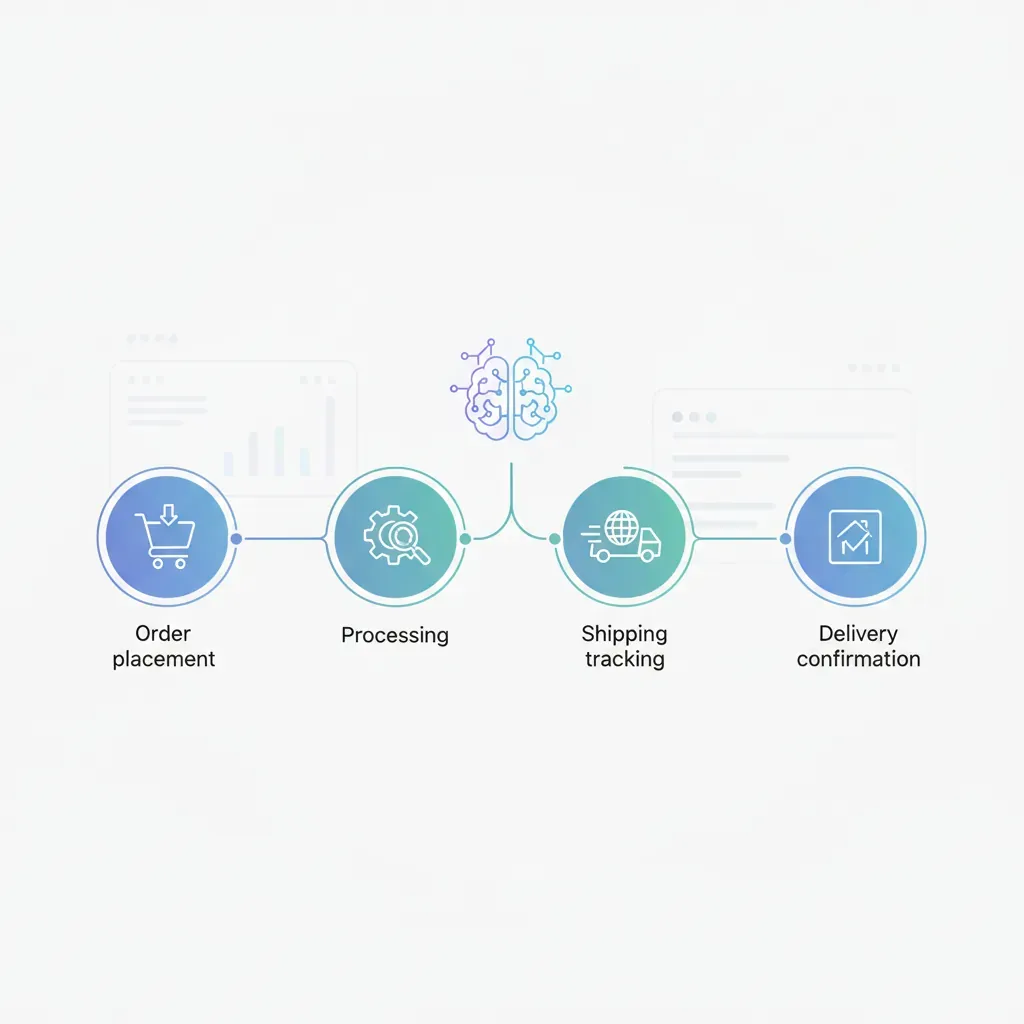
Every sales order moves through multiple systems, such as the storefront, order-management system, ERP, warehouse, and shipping providers. Each handoff can introduce stale data, manual-entry errors, or conflicting status information. The operating goal is to keep one system of record for each field and automate only validated exchanges between systems.
AI changes the equation by replacing fragmented, rule-based workflows with intelligent automation that learns from your data, adapts to real-time conditions, and eliminates the decision-making bottlenecks that slow order processing down.
This guide focuses on the operational backbone of AI order management, the fulfillment, inventory, and supply chain workflows that determine whether your orders ship accurately and on time. For customer-facing topics like WISMO resolution and post-purchase engagement, see our dedicated guide to AI-powered post-purchase experiences. For returns-specific automation, see our AI returns and refunds guide.
Five Ways AI Transforms Ecommerce Order Processing
1. Automated Order Validation and Fraud Detection
Every order that enters your system needs validation before it reaches fulfillment, including correct addresses, payment verification, and inventory availability. Manual checks slow the order process and miss patterns that machine learning catches instantly.
Fraud screening is normally handled by a payment or dedicated fraud platform, not by a customer-support agent. Machine-learning models can add behavioral and transaction signals to rules-based screening, but performance depends on the merchant, threshold, and fraud mix. Evaluate approval rate, fraud loss, false-decline rate, and manual-review rate together.
Beyond fraud screening, automation can validate addresses, reconcile payment status, and confirm inventory before fulfillment. Each action should read from the relevant system of record, enforce permission and policy checks, and log the result for review.
2. Smart Order Routing and Fulfillment Optimization
When you sell across multiple channels and ship from multiple locations, routing decisions get complex fast. Which warehouse has the item in stock? Which fulfillment center is closest to the customer? Which carrier offers the best rate for the delivery promise you made?
Routing systems can compare eligible inventory locations, delivery promises, carrier cost, and warehouse capacity. AI may help score the options, but hard business rules and the OMS or fulfillment platform should remain authoritative. Measure processing time, shipping cost, on-time delivery, and exception rates against the current routing policy.
3. AI-Powered Demand Forecasting and Inventory Management
Forecasting errors create both stockouts and excess inventory. The size and direction of the problem vary by category, forecast horizon, lead time, and promotion cadence, so a retailer should establish its own baseline before evaluating an AI forecast.
Machine-learning forecasts can combine historical sales with seasonality, promotions, lead times, inventory positions, and relevant external signals. Their value should be tested against the existing forecasting method using forecast error, service level, stockout rate, excess inventory, and working-capital measures. No accuracy range should be assumed across retailers or SKUs.
This visibility across your supply chain means procurement teams can optimize supplier lead times, warehouse managers can streamline allocation, and finance teams can forecast cash flow with higher accuracy.
4. ERP Integration and End-to-End Workflow Automation
The most impactful AI order management systems do not operate in isolation. They connect to your ERP system, your warehouse management platform, and your supplier networks to automate workflows end to end.
When an AI workflow is connected to the relevant systems and granted the necessary permissions, it can coordinate actions such as updating order status, proposing replenishment, generating warehouse instructions, or posting approved records to an ERP. Each write action needs validation, audit logs, failure handling, and a rollback path; unsupported or high-risk actions should remain manual.
For brands managing complex operations, this connectivity transforms order management from a series of disconnected tasks into a single, intelligent workflow with full analytics and visibility at every stage. Teams that leverage end-to-end ERP integration consistently deliver a better customer experience while reducing operational overhead.
5. Predictive Exception Management
Traditional order management systems react to problems after they happen. AI predicts them before they reach the customer.
By analyzing patterns across carrier performance data, weather forecasts, warehouse throughput, and historical delay trends, AI systems flag at-risk orders before they miss their delivery windows. This gives operations teams time to reroute shipments, adjust fulfillment priorities, or proactively communicate with customers, turning potential failures into managed exceptions.
Predictive exception management should be evaluated on defined operational outcomes, such as on-time delivery, exception-resolution time, and escalated support tickets. Compare those measures with the existing process and report the measurement window, eligible orders, and intervention rules.
How Alhena AI Fits into Your Order Management Stack
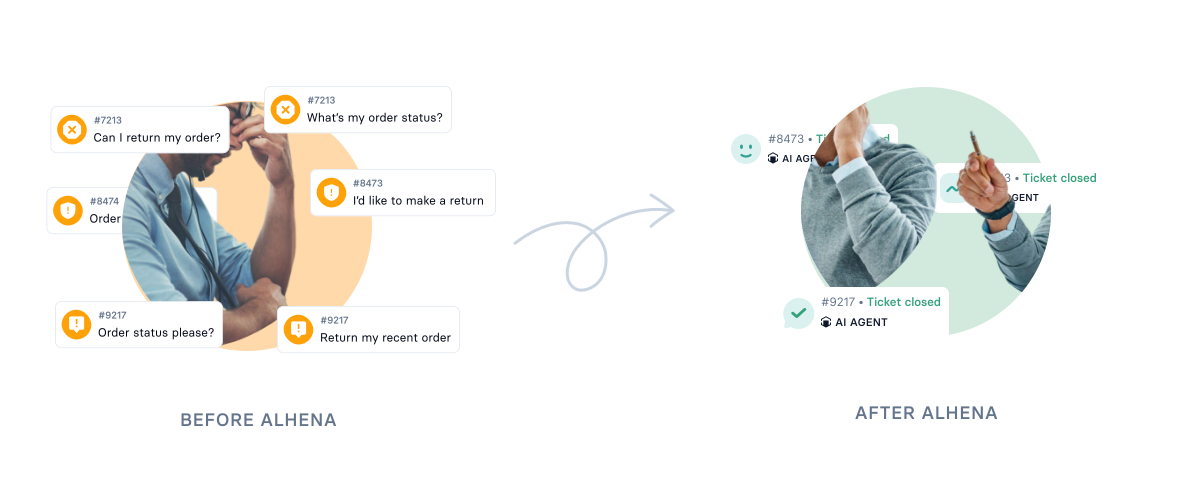
Alhena's documented order workflows use connected ecommerce and shipping data to answer order questions and, for supported actions, apply configured guardrails before making a change. The exact data and actions available depend on the integration, permissions, and fulfillment state.
Alhena publicly documents order lookups, cancellations, and shipping-address changes for supported ecommerce workflows. Those actions use live order data and fulfillment-aware checks; requests outside the allowed state or policy should be handed to a person. See the AI order cancellation and address change guide for the documented workflow.
Alhena's Product Expert Agent works before purchase by helping shoppers search, compare, and evaluate products using connected catalog data. Better product information may reduce mismatched expectations, but any effect on returns should be measured rather than assumed.
Both agents ground responses in connected product, policy, and order data. Supported actions should run through permission checks and workflow guardrails, with human handoff for requests that cannot be completed safely or within the configured scope.
Alhena documents helpdesk and shipping integrations, including ShipStation. Its ShipStation integration guide describes dashboard-based setup without custom code and an under-48-hour deployment target for that workflow. Actual timing depends on data access, workflow scope, and testing.
Getting Started
You do not need a six-month implementation plan to automate order management. Start by auditing your current order processing workflow: identify where manual data entry creates errors, where routing decisions slow fulfillment, and where inventory visibility gaps lead to stockouts or overselling. Those are your highest-impact automation candidates.
Use the Alhena ROI Calculator to estimate your potential savings, then schedule a demo to see how AI agents handle your specific order workflows.

Alhena AI
For food and beverage brands dealing with perishable goods, see our deep dive on AI for food and beverage ecommerce order management.
Frequently Asked Questions
How does AI order management integrate with ERP systems like NetSuite or SAP?
AI order-management systems can connect to an ERP through APIs or supported connectors, but available read and write actions depend on each platform and its permissions. Document the systems of record for inventory, order status, purchasing, and finance; test bidirectional updates in a sandbox; and require logs, permission boundaries, and rollback before enabling live actions. Alhena publicly documents ecommerce, helpdesk, and shipping integrations; confirm connector and action scope for a specific ERP during implementation.
What is the difference between an AI-powered order management system and a traditional OMS?
A traditional OMS executes configured business rules and remains the system of record for orders. AI can add prediction, prioritization, or conversational workflows on top of those rules. It should not be assumed to replace the OMS. Available actions depend on connected systems, permissions, guardrails, and human-review thresholds.
How does AI prevent stockouts without causing overstock?
AI can combine historical sales, seasonality, promotions, lead times, inventory positions, and relevant external signals to produce forecasts and reorder recommendations. It cannot guarantee both fewer stockouts and less overstock; results depend on data quality, forecast horizon, and assortment volatility. Evaluate it against a baseline using forecast error, service level, stockout rate, excess inventory, and working-capital measures.
How does AI order routing decide which warehouse to ship from?
An AI-assisted routing layer can score eligible locations using inventory, delivery promise, carrier cost, capacity, and business rules. The OMS or fulfillment platform should remain the system of record, and hard constraints such as hazardous-material rules, split-shipment limits, carrier eligibility, and customer commitments should override the model. Measure shipping cost, on-time delivery, and exception rates against the current routing policy.
Can AI order management reduce false declines in fraud detection?
AI can help score transaction risk using more signals than a static rules engine, but detection performance is specific to the model, merchant, threshold, and fraud mix. It should complement, not be presented as an Alhena order-management capability unless a documented integration supports it. Track approval rate, fraud loss, false-decline rate, and manual-review rate together, and keep payment and fraud systems as the source of truth.
What data does an AI order management system need to deliver accurate results?
At minimum, a system needs permissioned access to accurate order, inventory, fulfillment, carrier, and product data for the actions it is expected to perform. Forecasting and routing may also require historical demand, promotions, lead times, capacity, and exception data. Connector availability and write permissions vary by platform. Alhena publicly documents ecommerce and shipping integrations, including Shopify, WooCommerce, Salesforce Commerce Cloud, and ShipStation; confirm the exact fields, actions, and implementation timing for each deployment.