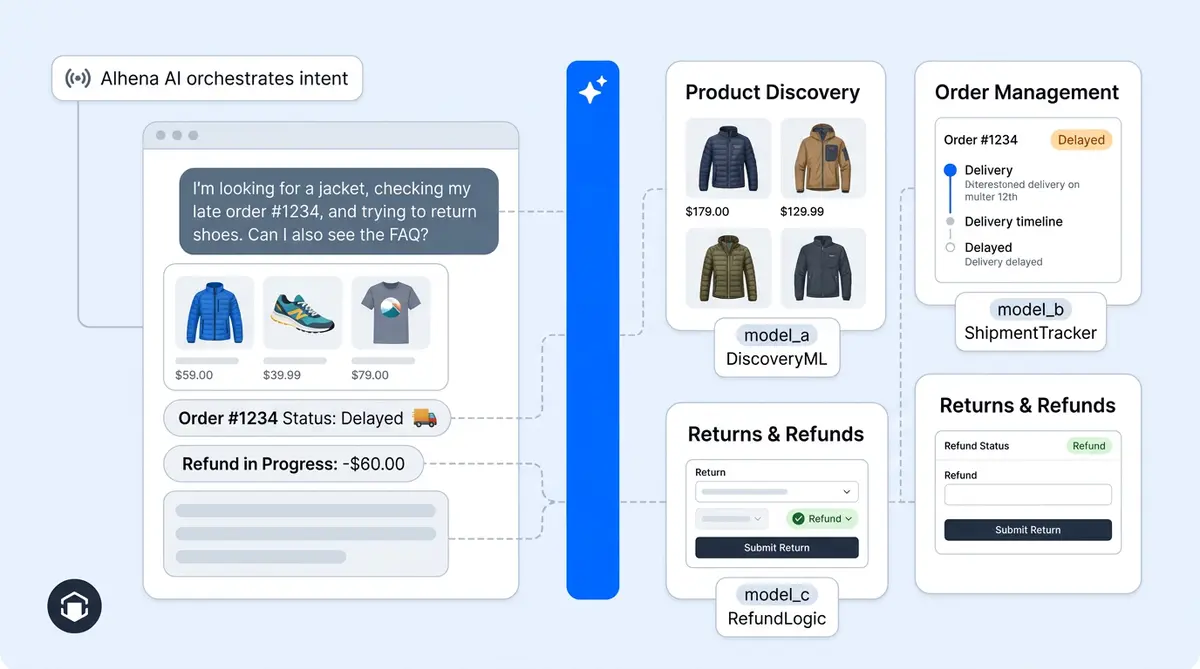
Multi-model AI for ecommerce routes every shopper message to the language model best suited to it: a fast model for order lookups, a frontier reasoning model for product consultations, a vision model for photos. Alhena AI does this automatically across OpenAI, Anthropic and Google.
Multi-model AI means your platform is not married to one LLM. Each incoming message is scored for intent, complexity and input type, then sent to the cheapest model that can answer it correctly. The shopper sees one conversation. Behind it, three or four different models may have taken a turn.
Most ecommerce AI still runs the other way. One model, one price tier, one set of strengths, applied to order tracking and rosacea consultations alike. That choice is invisible on a demo call and expensive for the next three years.
Why isn't one LLM enough for an ecommerce store?
Because ecommerce traffic is not one kind of question. It is a long tail of cheap, deterministic lookups sitting next to a short head of genuinely hard reasoning, and no single model is optimal for both.
Lock everything to one model and you land on one of two bad outcomes:
- Overpay. Route order-status checks through a frontier reasoning model and you are paying consultation prices for a database query, on the majority of your volume.
- Underperform. Route everything through a cheap, fast model and it will confidently mishandle the ingredient-interaction question that was about to become a $180 basket.
Which LLM should handle which ecommerce task?
A practical routing map, based on how Alhena AI dispatches live storefront traffic.
| Shopper task | Model class needed | Why that class | What matters most |
|---|---|---|---|
| Order status, tracking, cancellations | Fast, low-cost tier | Deterministic lookup against your OMS, so reasoning adds nothing | Latency and cost |
| Ingredient, contraindication, compatibility questions | Frontier reasoning tier | Must weigh dozens of attributes and rule out interactions | Accuracy |
| Shade match, "find me this," photo of a room | Multimodal / vision tier | The input is an image, not text | Visual grounding |
| Policy, shipping, warranty, FAQ | Mid tier | Grounded retrieval with light reasoning over your docs | Faithfulness to source |
| Sizing and fit across brands | Mid to frontier tier | Cross-references measurement data and brand-specific fit profiles | Return-rate impact |
| Intent classification (every message) | Lightweight classifier | Runs on 100% of traffic, so it must be near-free and near-instant | Milliseconds |
Alhena's routing layer currently draws on models including GPT-5, GPT-4.1, Claude Opus 4, Claude Sonnet 4, Gemini 2.5 Pro and Gemini 2.5 Flash. The roster is deliberately not fixed. It is updated as new models ship, without brands needing to re-integrate anything.
How does model routing work in a live conversation?
Routing happens per message, not per session. A shopper can cross three model tiers in ninety seconds and never notice.
- Classify. A lightweight classifier reads the message for intent, domain, complexity and input type.
- Select. The router picks the cheapest model tier that can answer correctly, not the most powerful one available.
- Ground. The chosen model answers from your verified catalog, policy docs and live order data, not from its training data.
- Verify. The response is checked against its sources before it reaches the shopper.
- Carry context. The conversation state persists across every switch, so nothing is re-asked.
Does routing add latency?
Negligibly. The classifier is a small model doing one narrow job, so it adds milliseconds, and it usually saves time overall by keeping routine questions off slower, heavier models.
What happens when a shopper switches topics mid-chat?
The router re-evaluates and the conversation state travels with it, so a shopper who moves from "will this irritate my skin" to "where's my order" is not asked to repeat themselves. Alhena's planner handles this sequencing; the mechanics are covered in our planner deep dive.
How does multi-model AI handle photos and shade matching?
Not every shopper types. They upload a selfie, screenshot a competitor's product, or photograph a wall they want to match. Text-only models handle those inputs poorly.
Multi-model architecture routes image inputs to a vision-capable model while keeping text conversations on models tuned for language. Practically, this is what makes a shade finder or a skin analysis feel accurate instead of approximate.
What is LLM vendor lock-in, and how do you avoid it?
Lock-in means your entire customer experience depends on decisions made by one model provider, decisions you do not control and rarely get warning about.
The four exposures that actually bite:
- Pricing changes. Per-token costs move. If your architecture cannot move with them, you absorb it.
- Model deprecation. Providers retire model versions on their own schedule. Behaviour you tuned against disappears.
- Capability drift. A model update can quietly change tone, verbosity or refusal behaviour across your storefront overnight.
- Outages. One provider's incident becomes your storefront's incident.
A vendor-agnostic router turns each of these from an outage into a failover. When one model degrades, traffic shifts to the next-best option and the shopper experience holds. That is infrastructure resilience, not a procurement preference.
Does model routing actually lower AI costs?
Yes, and the mechanism is simple: most ecommerce conversation volume is routine. Order status, shipping timelines, return windows and stock checks dominate the ticket mix.
Routing lets you serve that majority on cheap, fast models and reserve frontier pricing for the minority of conversations where reasoning quality changes whether a basket converts. You are not buying less intelligence. You are stopping the practice of buying it for questions that never needed it.
When is multi-model routing the wrong choice?
Worth saying plainly, because most vendor content will not.
- Strict single-provider requirements. If procurement, data residency or a regional compliance regime mandates one provider, routing across three is off the table. Pick the best available model and grounding discipline instead.
- Very small, simple catalogs. Thirty SKUs with no fit, ingredient or compatibility complexity will not produce enough hard queries for tiering to pay for itself.
- Regimes needing one auditable model. Some regulated categories require every response traceable to a single fixed model version. Routing complicates that audit trail.
- No evaluation capability. Routing only helps if someone is measuring output quality per tier. Without evaluation, it is just complexity you cannot see.
For everyone else, meaning most apparel, beauty, home, supplements and multi-SKU retail, the mixed query load is exactly what routing is built for.
How do you evaluate a vendor's multi-model claims?
Nearly every platform now says "multi-model." Fewer can answer these.
- Which specific models are in rotation today, and who decides when that list changes?
- Is routing evaluated per message, or fixed once per session or per bot?
- What happens the day a provider deprecates a model you rely on?
- Can image inputs reach a vision model, or do they fall back to text?
- Is every answer grounded in our catalog and order data, or can the model answer from training data?
- What is the added latency of the routing decision itself?
- Does conversation context survive a mid-chat model or agent switch?
- Can we see, per conversation, which model answered and why?
If a vendor cannot answer the last one, "multi-model" is a slide, not an architecture.
Where multi-model meets specialized agents
Model routing solves "the right brain for this message." It does not solve "the right specialist for this domain." That is a separate architectural layer, where dedicated agents each carry their own tools, data connections and guardrails.
The two compose: each specialist agent draws on the model tier its work demands. We cover that layer in depth elsewhere rather than repeat it here. See why a planner-led multi-agent system beats the one-agent model, the engineering story in how we rebuilt our AI around planning, and building custom agents in Alhena AI for teams defining their own routing logic.
Catalog consultations
Attribute-level product questions route to the reasoning tier.
Order actions
Live OMS lookups route to the fast tier for sub-second answers.
Image queries
Shade, selfie and photo search route to the vision tier.
Policy and support
Grounded retrieval on the mid tier, escalating with full context.
What this looks like on a live storefront
A beauty shopper uploads a selfie and asks which foundation matches, so the vision tier answers. She follows up on whether it is safe alongside a prescription retinoid, which goes to the reasoning tier, grounded in your ingredient data. She buys, then returns two days later asking where the parcel is, and the fast tier answers live from your OMS.
Three tiers, one thread, one brand voice. The same routing runs across web chat, email, Instagram DMs, WhatsApp and voice, so the channel does not change the quality of the answer. You can see it working inside the AI shopping assistant and the AI support concierge.
Key takeaways
- Multi-model AI is per-message model selection, not a marketing label for using a big LLM.
- Single-model architectures force a lose-lose: overpay on routine volume, or underperform on the queries that carry revenue.
- Match the tier to the task: fast for order lookups, reasoning for consultations, vision for photos, a tiny classifier for routing itself.
- Vendor-agnostic routing is resilience. Pricing shifts, deprecations and outages become failovers instead of incidents.
- Routing is not universal. Single-provider mandates, tiny catalogs and strict audit requirements are legitimate reasons to skip it.
- Ask for per-conversation model visibility. If a vendor cannot show which model answered and why, the claim is unverified.
See the routing on your catalog
Bring your three hardest shopper questions. We will show you which model answers each, and why.
Frequently asked questions
Multi-model AI in ecommerce is an architecture that routes each shopper message to the language model best suited to it, rather than sending every message through one fixed LLM. Alhena AI scores each message for intent, complexity and input type, then dispatches it to a fast, reasoning or vision model accordingly.
There is no single best LLM, because ecommerce queries are not one kind of task. Fast, low-cost models are best for order status and policy lookups; frontier reasoning models are best for ingredient, fit and comparison consultations; multimodal models are best for shade matching and photo search. Choosing per task beats choosing one model.
Usually, yes. Most ecommerce conversation volume is routine, covering tracking, shipping, returns and stock. Serving that on cheap, fast models while reserving frontier models for complex consultations avoids paying premium rates on the bulk of traffic.
No, when context is preserved. Routing happens per message behind a persistent conversation state, so the shopper sees one continuous thread in one brand voice even if three model tiers contributed to it.
Use a platform that routes across multiple providers rather than integrating one directly. Vendor-agnostic routing means a pricing change, model deprecation, capability drift or outage at one provider triggers a shift to the next-best model instead of degrading your storefront.
Yes. Image inputs such as selfies for skin or shade analysis, screenshots of a product seen elsewhere, or photos of a room are routed to a vision-capable model, while text conversations stay on models optimized for language.
Only milliseconds. The routing decision is made by a lightweight classifier doing one narrow job, and it typically reduces overall response time by keeping routine questions off slower, heavier models.
Multi-model selects the right model for a given message. Multi-agent assigns each commerce domain, whether catalog, orders, fit or support, to a dedicated specialist agent with its own tools and data. They are separate layers that compose: each agent draws on whichever model tier its work requires.