Deploying a wellness AI agent takes six configuration decisions, made in this order: knowledge, claims boundary, personalization, subscriptions, escalation, measurement. The order is the product. Make them out of sequence and you ship a revenue feature sitting on top of a compliance gap.
This is a build-order guide, not a rules guide. It assumes you have already decided to deploy an agent and now need to configure one that grows subscription revenue instead of inventing a health claim.
Two numbers set the stakes. Health and wellness is now the largest subscription category on the Recharge platform at roughly 11.2 million active subscribers, and a 2026 BMJ Open audit of five consumer chatbots found 49.6% of their health answers were problematic or misaligned with scientific consensus. Your best customers are on subscription, and the ungrounded default is unsafe.
What is the correct build order for a wellness AI agent?
Each decision constrains the ones after it. That is why sequence beats speed.
Most teams start with the interface and work backward. That is the wrong end. Start with what the agent may know, then what it may say, and only then what it may do.
| Decision | What you configure | What breaks if you skip it |
|---|---|---|
| 1 Knowledge | The sources the agent may draw on | It guesses, and guessing about supplements is a safety problem |
| 2 Claims boundary | What it may say a product does | Structure/function language drifts into disease claims |
| 3 Personalization | How intake feeds the conversation | A static quiz that cannot answer the next question |
| 4 Subscriptions | Replenishment and lifecycle actions in chat | Churn you cannot see and flows only a ticket can change |
| 5 Escalation | Triggers that hand off to a human | The agent answers a medical question it should have refused |
| 6 Measurement | What you instrument at launch | No way to tell whether it helped, deflected, or did harm |
Decision 1: What should a supplement brand's AI agent be allowed to know?
Four sources cover most of what wellness shoppers actually ask.
A customer-facing wellness agent should answer from a defined, brand-owned corpus, never from a general model's memory of the internet. Grounding is what turns a plausible-sounding answer into a defensible one.
- Product catalog and product pages. Names, forms, sizes, prices, availability, so every recommendation maps to something you actually sell.
- Supplement facts and ingredient panels. Real amounts, specific forms (magnesium glycinate is not magnesium oxide), allergens, and excipients.
- Reviewed FAQs and educational content. Your experts' already-approved answers to the ingredient, dosing, and timing questions that dominate this category.
- Policy documents. Shipping, returns, and the subscription and auto-renewal terms the agent will need in Decision 4.
Treat ingredient and dosing questions as first-class, not edge cases. They are the highest-frequency and highest-stakes questions wellness shoppers ask, which is exactly why brands like Thorne built their advisor around them.
Decision 2: What is the agent allowed to say about what a product does?
One compressed section. The full regulatory treatment lives in the companion guide.
Under FDA rules at 21 CFR 101.93, a dietary supplement may carry a structure/function claim describing a nutrient's role in the body, such as "supports immune health." A disease claim saying a product diagnoses, treats, cures, or prevents a disease makes it an unapproved drug.
The boundary is lexical, which is why it has to be enforced at the level of the sentence the agent is about to send. Structure/function claims must carry this disclaimer verbatim:
For the build, encode three rules: describe ingredients and their structure/function role, repeat your reviewed claims, and refuse to generate new therapeutic ones on the fly. The FTC's 2022 Health Products Compliance Guidance adds a second constraint, requiring competent and reliable scientific evidence behind any health benefit claimed.
Decision 3: How should your existing quiz feed the agent?
The quiz becomes structured intake. The agent handles everything after it.
Most wellness brands already run an intake quiz. A quiz is good at structured capture — goals, age, diet, current medications, pregnancy status — and bad at the follow-up.
The shopper who finishes the quiz and then asks "can I take this with my thyroid medication?" or "is the magnesium the glycinate form?" currently gets nothing. That is the gap the agent fills.
The implementation move
- Pass quiz answers to the agent as known facts, not as a scoring input that gets discarded.
- Flag contraindications and constraints as persistent session context the agent reasons over.
- Let the agent carry the open-ended follow-ups, grounded by Decision 1 and bounded by Decision 2.
- Write the results state so it hands off to conversation, rather than dead-ending in a product grid.
Personalization is a strategy, not a requirement. Ritual runs no quiz at all and competes on ingredient transparency and third-party verification instead — a legitimate different choice. If you do personalize, the agent is what turns a one-time questionnaire into an ongoing relationship.
Decision 4: How should the agent handle subscriptions and replenishment?
This is the decision most support-first chatbot projects miss entirely.
In wellness, subscription is the business. Health and wellness grew from 8.3 million to 11.2 million active Recharge subscribers over 18 months, with supplements and replenishment alone accounting for roughly 7.6 million active subscriptions.
If your agent cannot handle subscriptions, it cannot handle most of what your best customers want to do.
Three capabilities that define subscription fluency
- Self-service lifecycle. Skip, swap, pause, change frequency, change address, and yes, cancel — inside the conversation.
- Replenishment timing. The agent knows where a customer sits in their cycle and prompts a reorder or add-on at the right moment.
- Subscribe-in-conversation. A first-time shopper can start a subscription from the agent, not just place a one-time order.
That last one is becoming an acquisition surface, not only a retention one. Subscription supplement brand Grüns, with over 90% of revenue recurring, frames agents that can recommend and initiate a subscription as exactly that in Shopify's case study.
Should you let the agent cancel subscriptions?
Yes — and the risk runs the opposite way from how most teams assume. Forcing a support ticket to cancel is a poor experience that buries a churn signal you want.
The real requirement is instrumentation. Let the agent handle the cancel, but capture the save rate and structured reason codes, or you lose the visibility a human agent gave you on every single cancel.
Decision 5: When should the agent stop and hand off to a human?
The agent's competence needs an explicit edge, configured as triggers rather than hoped for as a fallback.
Some questions in wellness are not the agent's to resolve. The boundary has to be hard, because the failure cases are documented and severe.
The trigger list to configure
- Symptom descriptions — anything that describes what is happening in a body rather than what is in a bottle.
- Medication and interaction questions — named drugs, "can I take this with," anything about combining.
- Pregnancy, nursing, and pediatric dosing — no exceptions, regardless of how routine the product.
- Adverse reactions — these also need a logging path, not just a handoff.
- Requests for diagnosis or treatment — including implied ones like "what should I take for my thyroid?"
Two documented failures explain the strictness. In 2023 the National Eating Disorders Association's chatbot "Tessa" gave dieting advice and was pulled within days. In 2025, a peer-reviewed case report described a man hospitalized with bromism after ChatGPT suggested sodium bromide as a dietary chloride substitute.
Neither was a brand's shopping agent — that is the point. Both show what an ungrounded model does with a medical question it should have refused. The pattern done right already exists: Hims & Hers' Labs AI is built to never diagnose, providing education and escalating to licensed clinicians when a result calls for one.
Decision 6: What should you measure from day one?
The common mistake is measuring a revenue-and-compliance system like a support-deflection tool.
| Metric | How to compute it honestly | Red flag |
|---|---|---|
| Containment | Resolution on the conversational channel only | Padded with static FAQ views the agent never handled |
| Escalation rate | Split by trigger type, reviewed weekly | Zero escalations on medical questions |
| Conversion & AOV | Labeled as engaged-vs-unengaged | Causal language without a controlled test |
| Subscription attach | Plus the save / cancel / reason mix | Cancels logged without reason codes |
| Claims-compliance sampling | Scheduled transcript review against the Decision 2 boundary | No sampling cadence at all |
That last row is the one no generic support dashboard provides, and the one this category most needs. Sample real transcripts on a fixed schedule and check that the agent stayed inside the claims boundary.
Thorne is the brand to copy on measurement transparency. Its chief science officer told Glossy that its Taia advisor fielded over 200,000 messages and 350,000 recommendations in six months, with roughly 8% higher AOV among users and a 94% positive interaction rating — company-reported, engaged-vs-unengaged, and stated with its scope.
How does Alhena implement this pattern?
Everything above is vendor-neutral. Here is the mapping, in the same terms you should use to evaluate anyone.
| Decision | What Alhena does |
|---|---|
| 1. Knowledge | Alhena grounds every answer in the brand's live product catalog, knowledge base, and policy pages rather than an open model's training data. |
| 2. Claims boundary | Alhena enforces configurable guardrails and answer guidelines at the response level, so the structure/function boundary applies to every sentence the agent sends. |
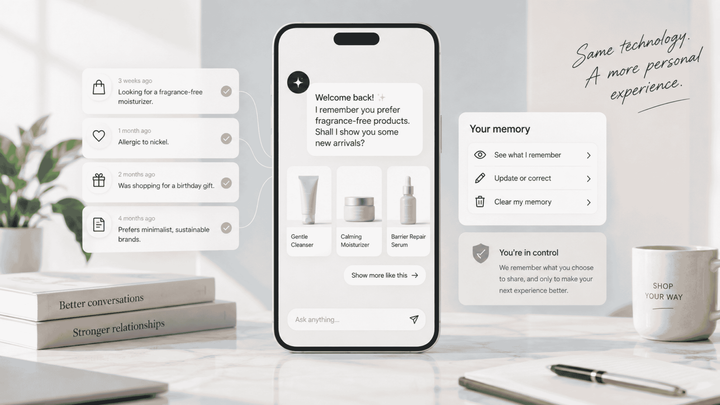
| 3. Personalization | Alhena pairs adaptive quizzing with a continuing conversation and retains context across the session, which is the quiz-to-conversation move in Decision 3. |
| 4. Subscriptions | Alhena runs on top of your existing commerce and helpdesk stack, so order and subscription actions execute where you already manage them. |
| 5. Escalation | Alhena routes handoffs through its Gorgias, Zendesk, and helpdesk integrations, with full transcript context attached. |
| 6. Measurement | Alhena logs every conversation for audit and reports containment, escalation, and conversion separately rather than as one blended number. |
In wellness specifically, Alhena powers "Nova," the AI Performance Coach on supplement brand Inno Supps, and works with Healy. Nova ships the pattern on two surfaces at once — a storefront chat agent and an on-page module that seeds real product questions directly on the product page, with a visible AI-generated-response disclosure.
Alhena's AI Shopping Assistant and Support Concierge run on the same grounded corpus, so there is no channel where the claims boundary quietly loosens. Evaluate it the way you would evaluate anyone: ask what it is grounded in, how the boundary is enforced, and where it escalates.
Where do wellness AI agents underdeliver?
Three cautions worth carrying into the build.
Convenience is not trust
In 2026 Pew data, only about 48% of US adults using AI chatbots for health information called it highly convenient — and fewer rated it highly accurate.
A badly built agent is worse than none
The BMJ Open finding is what you ship if you skip Decisions 1, 2, and 5. The interface is the easy part; the constraints are the product.
Personalization is not a moat
Care/of, a quiz-based personalized-vitamin brand majority-owned by Bayer, wound down in June 2024. A polished intake experience did not save it.
What it does fix
First-recommendation quality, replenishment friction, and support economics. It does not fix product-market fit or unit economics.
Key takeaways
- Order beats speed. Knowledge and claims boundary first, subscriptions and escalation second, measurement instrumented at launch rather than retrofitted.
- Grounding is the safety mechanism. Roughly half of general-chatbot health answers were rated problematic in the 2026 BMJ Open audit; a brand-owned corpus is what changes that baseline.
- The claims boundary is lexical. It has to be enforced on the sentence the agent is about to send, not as a disclaimer added afterward.
- Subscription fluency is the revenue case. With 11.2 million active wellness subscribers on Recharge alone, an agent that cannot skip, swap, pause, or cancel cannot serve your best customers.
- Let it cancel — but capture the reason. Self-service cancel is better UX and better data, provided you instrument save rate and reason codes.
- Escalation is a configured feature. Zero medical escalations is a red flag, not a win.
- Sample your transcripts. Claims-compliance sampling is the one measurement no support dashboard gives you.
What are the actionable next steps for your first 30 days?
- Days 1–5: audit the corpus. Inventory catalog data, supplement facts panels, reviewed FAQs, and policy docs. Flag every gap where the agent would otherwise have to improvise.
- Days 5–10: encode the claims boundary. Work with regulatory to produce the approved-claims list and the prohibited-verb list. Nothing ships before this exists.
- Days 10–15: wire the quiz. Pass intake answers into session context as structured facts, including contraindication flags.
- Days 15–20: connect subscription actions. Skip, swap, pause, frequency, cancel — plus reason-code capture on every cancel path.
- Days 20–25: define and red-team escalation. Test the agent against the trigger list, including implied medical questions phrased as product questions.
- Days 25–30: instrument, then launch. Stand up the six metrics and the transcript-sampling cadence before the agent takes its first live conversation.
See it against your catalog
Bring your compliance rules and your subscription stack. We will show you where each of the six decisions gets configured.
Frequently asked questions
A wellness AI agent answers product and support questions and takes actions — recommending a regimen, changing a subscription, handing off to a human. The difference from a chatbot is scope and grounding: an agent is wired into the brand's catalog, knowledge base, and commerce systems, and bounded by explicit rules about what it may say and do.
Six decisions in this sequence: knowledge sources, claims boundary, personalization, subscription actions, escalation triggers, measurement. Order matters because each decision constrains the next. Configuring subscription actions before the claims boundary means shipping a revenue feature on top of an unguarded compliance surface.
It should be configured not to invent them. Under 21 CFR 101.93 a supplement may carry structure/function claims with the required disclaimer, but not disease claims stating it diagnoses, treats, cures, or prevents disease. The safe design repeats your reviewed structure/function claims and refuses to generate new therapeutic ones. Not legal advice — confirm with counsel.
Configure escalation triggers rather than relying on prompt instructions. Route symptom descriptions, medication and interaction questions, pregnancy and pediatric dosing, adverse reactions, and implied treatment requests to a human or a consult-your-provider response. Then red-team the agent against those phrasings before launch and sample transcripts after it.
The risk runs the other way. Forcing a support ticket to cancel is poor experience and buries a churn signal. Let the agent handle skip, swap, pause, and cancel, and instrument save rate and structured reason codes so the self-service flow gives you more churn visibility than a human queue did, not less.
Both, in sequence. A quiz is strong at structured intake — goals, diet, medications, pregnancy status — and weak at the follow-up question. Pass the quiz answers to the agent as known facts, then let the agent handle open-ended follow-ups grounded in your catalog. The quiz should hand off to conversation, not dead-end in a product grid.
Five things: containment computed on the conversational channel only, escalation rate split by trigger, conversion and AOV labeled as engaged-versus-unengaged, subscription attach with the save and cancel mix, and scheduled claims-compliance transcript sampling. The last is specific to this category and is the check no generic support dashboard provides.
Most public figures are engaged-versus-unengaged comparisons carrying selection effects, so read them as directional rather than causal. The clearer economic case is subscription: better first recommendations, smoother replenishment, and self-service lifecycle management against one of the largest subscriber bases in subscription commerce.
Four cover most questions: product catalog and product pages, supplement facts and ingredient panels, your own reviewed FAQs and educational content, and policy documents including subscription and auto-renewal terms. The agent should answer from these rather than from a general model's open training data.
Related reading: AI compliance for supplement brands covers the FDA and FTC rules in depth. AI shopping agents for health and wellness brands maps what is live in the vertical and the conversion benchmarks behind it.