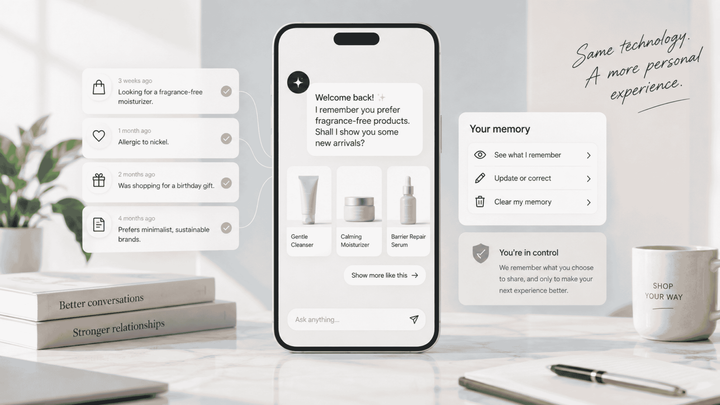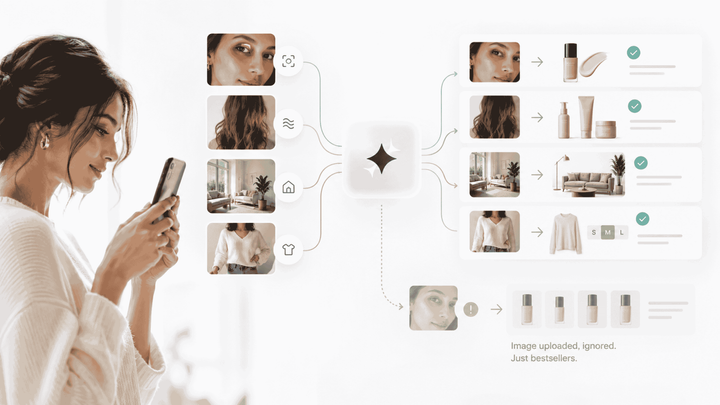
An AI shopping agent for a health and wellness brand answers ingredient, dosage, and routine questions in conversation, recommends products from the brand's verified catalog, and can act on a subscription, all constrained to claims the brand is legally allowed to make.
That last clause is what separates this vertical from every other one. In apparel, a chatbot that overpromises is a nuisance. In supplements, an agent that tells a shopper what a product "treats" has just converted a food into an unapproved drug in the eyes of the FDA.
The short version
- Demand is settled. 32% of US adults used an AI chatbot for health information in 2025, double the year before, and 64% of them use it weekly or more.
- The traffic converts. LLM-referred visitors convert at 4.68% on health and supplement stores versus a 2.47% cross-vertical average.
- The census is thin. Only a handful of wellness brands have a verified agent live: Thorne, The Vitamin Shoppe, HUM Nutrition, Inno Supps, Nutrabio.
- Guardrails are the product. The FDA issued its first AI-specific warning letter in April 2026; the FTC won a $4M judgment over supplement claims the same month.
- Aim at Levels 2 and 3. A grounded product advisor that also sees subscription state beats agentic checkout for almost every supplement brand this year.
This guide is written for operators at supplement, vitamin, and wellness-device companies deciding whether and how to deploy one. It covers demand, verified deployments, conversion data, the regulatory line, and a maturity model for an agent that sells well because it is governed well.
What is an AI shopping agent for a wellness brand?
It is a customer-facing assistant that does four jobs, in the shopper's own words, on the brand's own storefront:
- Answers ingredient, dosage-as-labeled, comparison, and regimen questions from verified label data.
- Recommends products from the live catalog rather than from a language model's general training.
- Acts on subscription state: skip, pause, swap, add to next delivery, time the refill.
- Escalates anything that crosses from product information into medical judgment.
Everything it says is functionally marketing copy. That single fact drives every design decision below.
How many shoppers actually use AI for health questions?
Three independent survey series and retail traffic data all point the same way.
KFF's tracking poll found the same 1-in-3 usage rate. Shoppers are not just asking generic questions; they are volunteering their health context.
Pew Research, published April 2026, found users rate these tools convenient far more often than they rate them accurate. People use them anyway. The trust gap is real, and shoppers are pushing through it.
Does AI-referred traffic actually convert?
Yes, and the direction flipped fast. Adobe Analytics measured generative-AI-referred traffic to US retail sites up 693.4% year over year across the 2025 holiday season, and up roughly 1,324% since tracking began in October 2024.
The part that matters more than volume: as of May 2026, AI-referred shoppers converted 54% better than non-AI traffic. A year earlier, they converted at roughly half the rate of other traffic.
Adobe publishes no health-specific breakout. Treat these as retail-wide numbers.
Why do subscription economics raise the stakes here?
The US supplement industry reached $74.15 billion in 2025, up 7.1% per Nutrition Business Journal, tracking toward $100 billion by 2029.
Health and wellness is also the largest subscription category on Recharge: 11.23 million active subscribers, with supplements alone at 7.6 million and adding more net-new subscribers in 2026 than the rest of wellness combined.
When the default purchase is recurring, one guided conversation compounds across the entire subscription lifetime.
Which wellness brands have an AI agent live in 2026?
Verified against official sources in July 2026. Vendor marketing makes this vertical look more deployed than it is.
| Brand | What is live, verified | What it does not prove |
|---|---|---|
| Thorne | "Taia," an AI wellness advisor for ingredient, dosing, and comparison questions. No checkout. Product page, verified Jul 2026. | Usage and AOV figures are company-reported via trade press, engaged-vs-unengaged |
| The Vitamin Shoppe | "Shoppe Advisor," an AI kiosk at its NYC Innovation Store. Press release, Jan 2026. | One location, not chain-wide |
| HUM Nutrition | "Holly," an AI nutritionist trained on RD-reviewed content. Brand announcement, Jul 2026. | No public performance data; surface unspecified |
| Inno Supps | "Nova," an AI Performance Coach on innosupps.com, built on Alhena. Chat plus an on-page "Have questions?" module. Observed live Jul 12, 2026. | No public performance data; Alhena publishes this guide (disclosure below) |
| Hims & Hers | "MedMatch" (recommends to the prescribing provider) and "Labs AI" (up to 130 biomarker tests; never diagnoses). Newsroom, May 2026. | Provider- and diagnostics-facing, not a shopping agent |
| Grüns | Featured in Shopify's case study; founder calls ChatGPT purchasing a new acquisition surface. | Not a confirmed in-chat purchasing deployment |
| Nutrabio | On-site assistant across 400+ SKUs; vendor (Rep AI) reports 9–10% AOV lift and 11.46% conversation-to-sale. May 2026. | Self-reported by the vendor; not audited |
What has Thorne published?
Thorne is the only brand in the table publishing real usage data. Taia fielded over 200,000 messages and 350,000 product and lifestyle recommendations in its first six months, with about 8% higher average order value for Taia users versus plain site visitors.
Company-reported and engaged-vs-unengaged, so the usual selection caveat applies. It is still the most transparent disclosure in the vertical.
Which big wellness brands do not have one?
Ritual, Seed, and Nutrafol show no public AI shopping assistant as of July 2026. Care/of shut down entirely in June 2024. The personalization pioneers are not the AI leaders.
What gets miscounted as an AI shopping agent?
Much of what is marketed as "AI shopping" in wellness is back-office tooling (merchant copilots) or coaching products such as Oura, Whoop, and Zoe, whose AI coaches rather than sells. There is no shopping agent attached.
The honest census is thinner than the hype, and that is precisely the opportunity for brands that ship something real.
How is an AI agent different from the supplement quiz we already run?
The intake quiz has been this category's default personalization tool for a decade. HUM and Persona run one; Ritual notably does not, competing on ingredient transparency instead.
| Capability | Static quiz | Grounded AI agent |
|---|---|---|
| Handles the follow-up question ("can I take this with my blood-pressure medication?") | No | Yes, or escalates it |
| Stays current when the catalog changes | Goes stale | Reads live product data |
| Knows the shopper's subscription state | No | Yes, at Level 3 |
| Works after intake, at every stage | Intake only | Full journey |
| Claim boundaries enforced per sentence | Fixed copy, pre-approved | Approved-claims corpus + guardrails |
A quiz collects goals once and maps them to SKUs by rules. Its ceiling is structural: it cannot answer the next question, and it goes stale the moment the shopper's context changes.
What are the five levels of agent maturity?
- Level 0 — static quiz. Collects goals once, maps answers to SKUs by rules. Cannot answer the follow-up.
- Level 1 — FAQ deflection bot. Answers shipping, returns, and order status from a help-center corpus. Valuable for support cost, invisible to revenue.
- Level 2 — grounded product advisor. The first genuinely commercial rung. Answers ingredient, dosage-as-labeled, comparison, and regimen questions from verified label data and published content. This is where guardrails become product features rather than legal afterthoughts.
- Level 3 — subscription-aware agent. Sees and acts on subscription state, turning retention mechanics into conversation. Given wellness's 11-million-subscriber base on a single platform, this rung is worth more here than in any other vertical.
- Level 4 — agentic checkout and channel agents. Completing purchases in-conversation, autonomously. OpenAI scaled back its in-chat Instant Checkout in early 2026, and most "ChatGPT shopping" today hands off to the merchant's own checkout.
Where should a wellness brand be right now?
Levels 2 and 3. A Level 2 advisor that safely answers "can I take magnesium with zinc?" at 2 a.m., and knows the shopper's subscription renews Thursday, is what moves revenue and retention this year.
What can an AI agent legally say about a supplement?
Under DSHEA and 21 CFR 101.93, a supplement may carry structure/function claims without FDA pre-approval. A claim that a product diagnoses, treats, cures, or prevents disease makes it an unapproved drug.
The FTC's Health Products Compliance Guidance (December 2022) adds the advertising side: health-benefit claims generally require randomized, controlled human trials as substantiation. Notably, that guidance never mentions AI or chatbots.
The rules were written for ads and labels. Every word your agent generates is, functionally, both.
| Shopper asks | Inside the line | Over the line |
|---|---|---|
| "Will this help me sleep?" | "Supports healthy sleep" — a structure/function claim, if substantiated | "Treats insomnia" |
| "How much should I take?" | Restates the labeled serving and directions | Suggests a dose beyond the label |
| "Is this safe with my medication?" | Escalates to a human or clinician, visibly | Assesses the interaction itself |
| "Will this fix my anxiety?" | Escalates; states what the label supports and nothing more | Any disease-treatment framing |
| "Is it third-party tested?" | Cites the brand's published testing documentation | Implies certification the brand does not hold |
Illustrative, not legal advice. Claim boundaries are a decision for your regulatory counsel.
What must the agent refuse or escalate?
Anything crossing from product information into medical judgment. These are the hard triggers:
Escalation triggers
- Symptoms or self-described conditions
- Requests for a diagnosis or a differential
- Drug, supplement, or food interactions
- Dosing beyond the label, including "can I double up?"
- Pregnancy, breastfeeding, and trying-to-conceive
- Pediatric use and age-restricted products
- Pre- or post-surgical use, and immunosuppressed shoppers
- Anything phrased as replacing a prescription
A well-designed agent answers what the label supports, cites what it knows, and hands the rest to a human, visibly.
What happens when AI health guidance is ungoverned?
The failure record is no longer hypothetical, and regulators are closing the gap through enforcement rather than new rulemaking.
- Bromism case, August 2025. A peer-reviewed case report in Annals of Internal Medicine: Clinical Cases documents a man hospitalized with bromism-induced psychosis after ChatGPT suggested sodium bromide as a chloride substitute.
- NEDA's "Tessa," 2023. Disabled after giving dieting advice to people seeking eating-disorder help.
- BMJ Open audit, 2026. Five consumer LLMs gave problematic health answers roughly half the time, with median citation completeness of 40%.
- FDA, April 2026. Industry observers describe the Purolea letter as the agency's first AI-specific warning letter, citing AI-generated records used without adequate human review.
- FTC, April 2026. A $4 million judgment against TruHeight over unsubstantiated supplement claims, largely suspended for inability to pay, with $750,000 payable under the proposed order.
- FTC, June 2026. Suit against Amare Global for marketing supplements as treatments for depression, anxiety, and ADHD. Active, not decided.
The gap persists in commerce today. As of July 2026, at least one live supplement-recommendation AI site (SuppMatch) displays no visible FDA disclaimer or medical-advice warning anywhere on its landing page.
What guardrails does a compliant agent need?
Four components. Whichever AI tools you deploy, these are the product, not the compliance overhead.
Approved-claims corpus
It can only say what your label and substantiated marketing already say.
Phrase-level guardrails
"Supports healthy sleep," never "treats insomnia." Vocabulary designed in, not moderated after.
Hard escalation triggers
Symptoms, medications, interactions, and pregnancy route to a healthcare professional.
Audit logging
You can show a regulator exactly what was said, to whom, and when.
Pre-launch checklist
- Approved-claims corpus assembled and signed off by regulatory counsel
- Blocked-phrase list tested against real support-ticket language
- Escalation paths staffed, with a stated response window
- FDA disclaimer visible on every surface the agent appears on
- Audit logging on, with retention that matches your legal policy
- Red-team pass: 100 adversarial health questions, reviewed by a human
- Product data and help center cleaned before launch, not after
What do the numbers look like when it works?
The best published vertical-level benchmark comes from Alhena's aggregated study of 329 US and EU ecommerce brands, Q4 2024 to Q1 2026, published with its methodology.
- 4.68% conversion for LLM-referred visitors on health and supplement stores, nearly twice the 2.47% cross-vertical average.
- 3x to 76x higher conversion for visitors who engage an on-site AI assistant, depending on acquisition channel.
- 49.3% vs 26.3% cart-to-checkout completion, AI-engaged versus non-engaged.
- 9–10% AOV lift reported by the vendor on the Nutrabio deployment. Directionally consistent, self-reported.
These are engaged-versus-unengaged comparisons. Shoppers who choose to open a chat are plausibly higher-intent to begin with, so selection effects remain possible. We label our own numbers that way deliberately, and you should demand the same labeling from any vendor.
No one has yet published a randomized holdout study in wellness commerce. If you deploy, run one: a 90/10 traffic holdout for a quarter settles what attribution debates cannot.
What will an agent not fix?
- Accuracy skepticism is earned. Pew's finding describes general-purpose consumer AI tools, and shoppers will transfer that skepticism to your branded agent until it demonstrates precision. The first hallucinated dosage answer costs you the channel.
- AI traffic quality is a moving target. Adobe's series shows AI-referred conversion swinging from roughly half the rate of other traffic to 54% better within about a year. Build for the trend, budget against the volatility.
- An agent amplifies your catalog; it does not repair it. Thin product data, unverified legacy claims, or a stale help center become the agent's answers. Most deployment timelines are dominated by cleaning the knowledge, not configuring the bot.
That cleanup also pays off in AI search visibility, which is a separate game. In 5W's Supplements AI Visibility Index (3,800 prompts across five AI platforms, January–April 2026), Thorne, Seed, AG1, and Momentous captured over 47% of citation share, yet only Thorne runs a live shopping agent.
Winning AI recommendations and answering your own shoppers are different capabilities. A brand serious about this channel needs both, which is what Alhena AI Visibility covers alongside the on-site agent.
How should you measure it?
On a ladder, in this order. Treat vendor numbers without labels as unverified.
- EngagementResolution rate, deflection, chat volume, and escalation rate. Answers "is anyone using it?"
- Attributed outcomesAI-influenced revenue and engaged-shopper AOV, labeled explicitly as engaged-vs-unengaged comparisons.
- Retention effectsFor subscription brands: replenishment saves, swaps, and churn deflected in-conversation.
- IncrementalityA 90/10 traffic holdout for one quarter. This is the only step that answers "did it cause anything?"
What should you do in the next 90 days?
- Days 1–30: clean the knowledgeAudit product data, label claims, and the help center. Assemble the approved-claims corpus with regulatory counsel. This is the long pole.
- Days 31–60: ship Level 2Launch a grounded product advisor on your highest-traffic PDPs with guardrails, escalation, and audit logging on from day one. Hold back 10% of traffic.
- Days 61–90: add subscription stateConnect the agent to skip, pause, swap, and replenishment timing. Read the holdout. Publish your own numbers with their labels.
Key takeaways
- Shoppers already asked an AI before they reached you. One in three US adults uses a chatbot for health information, and 41% have uploaded personal medical details to one.
- The vertical's conversion economics are unusually good. 4.68% for LLM-referred visitors on health and supplement stores, against a 2.47% cross-vertical average.
- The field is emptier than the marketing suggests. Five verified deployments, and the personalization pioneers are not among the leaders.
- Guardrails are the product. Approved-claims corpus, phrase-level limits, hard escalation, audit logs. Everything the agent says is marketing copy in a regulator's eyes.
- Build Levels 2 and 3, not Level 4. A grounded, subscription-aware advisor beats agentic checkout for almost every wellness brand this year.
- Run a holdout. Nobody in this vertical has published one. The first brand that does will own the credibility.
The operator's thesis
Amazon is already the single largest online supplement retailer, with $12.6 billion in vitamin and supplement sales in the twelve months ending August 2023, per SPINS/ClearCut data via Supply Side.
What a DTC wellness brand owns that Amazon cannot replicate is the advisory relationship: the conversation where a real question ("is this safe with what I already take?") meets a governed, label-accurate answer, then continues across a subscription lifetime.
Build to that spec and the vertical's best conversion economics are available to you. Bolt on a generic chatbot and you inherit the bromism-and-warning-letter record instead.
See a governed agent on your catalog
Grounded in your live product data, bounded by your approved claims, escalating exactly where medicine begins.
Frequently asked questions
Choosing an agent
What is an AI shopping agent for health and wellness brands?
A customer-facing assistant that answers product, ingredient, and lifestyle questions in conversation, recommends products from the brand's verified catalog, supports subscription actions like replenishment or pausing, and in mature deployments completes the purchase. Everything it says stays inside the brand's approved, legally compliant claims.
What is the difference between an AI shopping agent and a support bot?
A support bot matches a question to a pre-written answer from a help-center corpus. An agent reads your live catalog, inventory, and policies in real time, reasons across them, and can take an action such as swapping a subscription item. The commercial difference: one lowers support cost, the other influences revenue.
What AI tools do wellness brands actually use today?
Three different things share the name. Customer-facing agents like Thorne's Taia and Inno Supps' Nova advise and sell. Back-office AI tools — merchant copilots, predictive demand forecasting built on machine learning, analytics — never touch a shopper. Coaching products from Oura, Whoop, and Zoe use AI to coach rather than sell. Only the first category is a shopping agent, and most published "AI in wellness" coverage blurs all three.
Is an AI shopping agent worth it for a small wellness company?
Catalog quality decides this more than headcount does. A wellness company with 30 well-documented SKUs, published third-party testing, and a clean help center gets more out of AI tools than a larger brand with thin product pages. If your product information is incomplete, fix that first — it is the input the agent depends on.
What does an AI shopping agent cost for an ecommerce brand?
Pricing varies by platform and scope, so get a quote against your own numbers rather than a list price. The cost drivers are consistent across vendors: catalog size, how many surfaces the agent appears on, monthly conversation volume, and the compliance review your claims corpus needs. For most operators the largest real cost is internal — the cleanup before launch.
Can one agent cover supplements, skincare, and personal care in the same store?
Yes, when all three are grounded in the same verified catalog. The claim boundaries differ by category — a skincare or personal care product falls under cosmetic claim rules rather than DSHEA structure/function rules — so guardrails have to be configured per product type, not once for the whole store.
Compliance and safety
Can an AI agent legally give supplement advice?
It can restate a product's labeled usage and its permitted structure/function claims. It cannot claim a product diagnoses, treats, cures, or prevents disease; under 21 CFR 101.93 that converts a supplement into an unapproved drug. Health-benefit claims must also meet the FTC's substantiation standard, so the agent's allowed vocabulary has to be designed in, not moderated after the fact.
Is it safe to let AI personalize health recommendations?
An AI-powered health solution can personalize which product a shopper considers. It should not personalize a health outcome. The safe version narrows the catalog against stated goals and labeled uses; the unsafe version interprets symptoms, and that is precisely where the FDA and FTC enforcement record begins.
What questions should a wellness AI agent refuse or escalate?
Anything crossing from product information into medical judgment: symptoms, diagnoses, medication interactions, dosing beyond the label, and pregnancy or pediatric safety. A well-designed agent answers what the label supports, cites what it knows, and hands the rest to a human, visibly.
Can the agent recommend a dosage?
Only as labeled. It can restate the serving size and directions printed on the product and point to where that appears. Anything beyond the label — stacking, loading, adjusting for body weight, or "can I double up?" — is an escalation, not an answer.
Do we need an FDA disclaimer on the chat surface?
Treat the agent like any other marketing surface. If your product pages carry the structure/function disclaimer, the conversational surface repeating those claims should carry it too. At least one live supplement-recommendation AI site displayed no visible disclaimer as of July 2026, which is the gap regulators are now closing through enforcement.
What happens if the agent gets a claim wrong?
The record is concrete: the FTC has taken multi-million-dollar actions over unsubstantiated supplement claims (TruHeight's $4M judgment in April 2026, largely suspended with $750,000 payable), and the FDA issued its first AI-specific warning letter the same month. Every sentence your agent generates is functionally marketing copy, which is why approved-claims grounding, phrase-level guardrails, and audit logs are the core of the product.
Personalization and capability
What does the agent use to tailor its recommendations?
Four inputs: your live catalog and inventory, the shopper's stated preferences in the conversation, their order and subscription history, and your published content. You do not need a machine learning team of your own — the personalization comes from grounding the agent in your existing information, not from training a model on it.
Can AI personalize a wellness routine without crossing into medical advice?
It can sequence products a shopper already owns or is considering — morning or evening, with food or without — because that restates labeled directions. It cannot build a wellness routine around a condition. The line is whether the routine responds to a goal or to a diagnosis.
Can an AI agent build a personalized workout plan alongside supplement recommendations?
Fitness and wellness brands ask this constantly, and the honest answer is partly. An agent can time products around a training routine as labeled — pre-workout, intra, post — which is roughly what Inno Supps' Nova does as an AI Performance Coach. A personalized workout plan is coaching rather than commerce, and programming around injury, pregnancy, or a medical condition has to escalate.
Can the agent use wearable or lab results to make recommendations?
Technically yes; legally it raises the bar sharply. Interpreting biomarkers or wearable signals is diagnostics rather than merchandising, which is why Hims & Hers routes its Labs AI through a prescribing provider instead of a storefront. Fitness and wellness brands whose customers already track everything, and any healthcare-adjacent brand drifting toward patient engagement, should treat a wearable integration as a clinical workflow with clinical oversight, not a personalization feature.
Can it predict when a customer will run out and prompt a reorder?
Yes, and it is the most valuable predictive use case in this category. Serving size plus purchase date gives a reliable depletion estimate, so the agent can raise a proactive refill inside the conversation instead of waiting for a win-back email. Predictive replenishment sits at Level 3 of the maturity ladder, which is where subscription retention actually moves.
Will an AI agent replace our support team?
No. It automates the repetitive support work — order status, shipping, returns, "which of these should I take first" — and routes everything else to people with more context than a ticket queue gives them. In a regulated category the escalation path is the product, so the team gets shorter queues, not a smaller role.
Does it work with our subscription platform?
Confirm it against your own stack before you buy. Recharge is the common case for wellness brands, and health and wellness is its largest subscription category at 11.23 million active subscribers. Subscription management actions — skip, pause, swap, add to next delivery — are what separate a Level 3 agent from a Level 2 one.
Results and rollout
Does AI-referred traffic actually convert for wellness stores?
Unusually well. In Alhena's published 329-brand study, LLM-referred visitors converted at 4.68% on health and supplement stores versus a 2.47% cross-vertical average. Retail-wide, Adobe's figures show AI-referred shoppers converting 54% better than non-AI traffic as of May 2026, after converting markedly worse a year earlier.
Which wellness brands already have AI shopping assistants live?
Verified as of July 2026: Thorne (Taia), The Vitamin Shoppe (Shoppe Advisor kiosk), HUM Nutrition (Holly), Inno Supps (Nova, built on Alhena), and Nutrabio, among others, while Ritual, Seed, and Nutrafol show no public deployment. Hims & Hers' well-known AI (MedMatch, Labs AI) is provider- and diagnostics-facing rather than a storefront shopping agent.
How do we get recommended by ChatGPT and Perplexity in the first place?
That is a separate capability from running your own agent. In 5W's Supplements AI Visibility Index, Thorne, Seed, AG1, and Momentous captured over 47% of citation share, yet only Thorne runs a live shopping agent. Getting cited depends on structured, verifiable product and testing content that AI tools can extract, which is what Alhena AI Visibility tracks alongside the on-site agent.
Does any of this apply to longevity and healthspan brands?
The mechanics are identical; the claim risk is higher. Longevity positioning invites disease-adjacent language — aging, cellular repair, healthspan — that drifts toward drug claims faster than a basic multivitamin does. A longevity brand needs a tighter approved-phrase list, not different AI technology.
How should we measure an AI shopping agent's impact?
On a ladder: engagement first (resolution, deflection, chat volume), attributed outcomes second (AI-influenced revenue and engaged-shopper AOV, labeled as engaged-vs-unengaged), and incrementality last, through a traffic holdout. Standard conversion analytics will overstate the effect on their own. Subscription brands should add retention: replenishment saves and churn deflected in conversation.
How long does deployment take?
The configuration is fast; the knowledge cleanup is not. Most timelines are dominated by auditing product information, label claims, and the help center, then getting the approved-claims corpus signed off. Plan in months for the corpus and days for the deployment itself.