A customer-facing AI agent is compliant for a supplement brand when every answer it gives stays inside two lines the law draws: the FDA’s boundary between a permitted structure/function claim and a prohibited disease claim, and the FTC’s requirement that any health benefit be backed by competent and reliable scientific evidence. Meeting that bar is not a matter of adding a disclaimer. It takes an agent that can only say what your brand has approved it to say, because the words it chooses (“supports” versus “treats,” “eases” versus “cures”) are exactly what the rules turn on.
This matters now because your customers are already asking. About one in three US adults told KFF in early 2026 that they had used an AI chatbot for health information in the past year. The US supplement market reached $74.15 billion in 2025, and the brands scaling that demand with AI are automating the single most regulated conversation in ecommerce. In a 2026 peer-reviewed audit, about half of the health answers from five popular AI models were rated problematic. This guide covers the rules that apply, the documented cases where AI health advice went wrong, and a design checklist for an agent that stays on-label, then how to choose a platform that can actually enforce it, and why the same discipline decides whether AI shopping engines recommend your brand at all.
What “compliant AI” means for a supplement brand
Compliant AI for a supplement brand means an agent whose every response falls within the claims your brand is legally allowed to make about its products. Dietary supplements are not pre-approved by the FDA the way drugs are, but that does not make them unregulated. The Dietary Supplement Health and Education Act of 1994 and its implementing rule, 21 CFR 101.93, define what a brand may and may not say, and those rules apply to a sentence generated by a model exactly as they apply to a sentence written by a copywriter.
Structure/function claims versus disease claims
The core distinction is between two kinds of statement, and it usually comes down to a single word.
A structure/function claim describes the role of a nutrient in the normal structure or function of the body. “Calcium builds strong bones” and “supports immune health” are the classic permitted examples. A brand may make these claims without pre-approval, provided it has the evidence to support them, files the required notification with the FDA, and carries the mandatory disclaimer.
A disease claim states or implies that a product diagnoses, treats, cures, mitigates, or prevents a disease. “Treats depression,” “reduces arthritis pain,” and “lowers your blood pressure” are disease claims, and they are prohibited for a dietary supplement. A disease claim turns the supplement, in the FDA’s eyes, into an unapproved drug.
The line is narrow and it is lexical. “Supports joint health” is a structure/function claim; “relieves your arthritis” is a drug claim. And the boundary is not only about explicit wording: 21 CFR 101.93(g)(2) sets out a ten-factor test for implied disease claims, which can be triggered by a product’s name, a reference to a symptom, a citation to a study about a disease, imagery, or language about augmenting a drug therapy. An agent that says “customers with high cholesterol love this” has made an implied disease claim without ever using the word “treat.”
Every structure/function claim must carry this disclaimer, verbatim, under the rule:
This statement has not been evaluated by the Food and Drug Administration. This product is not intended to diagnose, treat, cure, or prevent any disease.
For anyone designing an AI agent, the practical lesson is that the compliance boundary lives at the level of the individual sentence the agent is about to send. That is why it is an architecture problem, not a disclaimer problem.
The FTC’s substantiation standard
The FDA governs what kind of claim you may make. The FTC governs whether you can back it up. Its Health Products Compliance Guidance, issued in December 2022 to replace a 1998 dietary-supplements guide, requires that any health-benefit claim be supported by “competent and reliable scientific evidence,” which the FTC says generally means randomized, controlled human clinical trials. Animal studies, in vitro work, observational data, and anecdote are generally not enough on their own.
Two things about that standard matter for AI. First, it applies to the claim regardless of who or what produced it. When the FTC ran its 2024 enforcement sweep Operation AI Comply, then-Chair Lina Khan put it plainly: “there is no AI exemption from the laws on the books.” If your agent asserts a benefit your evidence cannot substantiate, it is an FTC problem whether a human or a model wrote the sentence. Second, the 2022 guidance predates the generative-AI wave and never mentions chatbots, so the burden of translating a decades-old substantiation standard into a machine that talks to customers falls entirely on the brand deploying it.
The liability is documented, not hypothetical
The risk of an AI agent making an unlawful or unsafe health claim is not a thought experiment. It has already happened, more than once, and regulators have started to respond. The strongest evidence is not a general chatbot horror story; it is the specific, dated record of what AI does when it is allowed to talk about health without grounding.
In 2023, the National Eating Disorders Association replaced its human helpline with an AI chatbot named “Tessa.” Within days, users reported that Tessa was advising people to count calories and lose one to two pounds per week, advice that can worsen the exact conditions the helpline existed to treat. NEDA suspended the bot at the end of May 2023. The lesson is not that the bot was malicious; it is that a well-intentioned agent with the wrong guardrails does harm at the precise moment a vulnerable user needs care.
In August 2025, Annals of Internal Medicine: Clinical Cases published a peer-reviewed report of a man who asked ChatGPT how to remove chloride from his diet and, per the case authors’ reconstruction (the original chat logs were not available to them), was told he could substitute sodium bromide, a compound used in pool cleaner. He spent about three weeks hospitalized with bromism, psychosis, and hallucinations. The failure mode here is worth naming precisely: the model was not rude or obviously wrong. It was confident, plausible, and unwarned. That is the specific danger of a general model answering a health question: authority without grounding.
And it is not one bad model. A 2026 BMJ Open audit put five consumer LLMs (Gemini, DeepSeek, Llama, ChatGPT, and Grok) through 250 prompts across cancer, vaccines, stem cells, nutrition, and athletic performance. About 49.6% of the answers were rated problematic, and the median reference completeness was 40%. Roughly half-wrong, poorly sourced answers are the category default when a model speaks about health from its training data rather than from a verified source.
Regulators are treating this as live. The claims rules are actively enforced against supplements specifically: in April 2026 the FTC obtained a $4 million judgment against TruHeight for unsubstantiated “clinically proven” height-growth claims and for fake reviews written by employees and bots, and in June 2026 the FTC sued Amare Global for marketing children’s and adults’ supplements as treating depression, anxiety, and ADHD. Meanwhile the agencies are turning toward AI itself: the FDA’s first warning letter relating to AI (Purolea, April 2026) faulted a company for letting AI generate manufacturing records without adequate human review, and the FTC’s September 2025 6(b) orders to seven companies behind AI companion chatbots were described by the American Bar Association’s Health Law Section as having an “implied nexus to health care.”
| Case, and what happened | What it shows (and doesn’t) |
|---|---|
| NEDA “Tessa.” An eating-disorder helpline chatbot advised calorie counting and weight loss; suspended within days (2023, news reporting). | Guardrail failure in a health context; not a commerce agent. |
| ChatGPT and bromism. A user was advised (per the authors’ reconstruction) to substitute sodium bromide for salt; hospitalized ~3 weeks with psychosis (Aug 2025, peer-reviewed case report). | A general model gives confident, dangerous, unwarned advice; a single reconstructed case, not a rate. |
| BMJ Open LLM audit. Five consumer models; ~49.6% of health answers rated problematic; 40% median reference completeness (2026, peer-reviewed audit). | The category default across models; five health topics, not supplement retail specifically. |
| FTC v. TruHeight. $4M judgment for unsubstantiated “clinically proven” claims and fake reviews (Apr 2026, FTC enforcement, settled). | The substantiation and fake-content rules have teeth for supplements; human-made claims. |
| FTC v. Amare Global. Sued for marketing supplements as treating depression, anxiety, ADHD (Jun 2026, FTC enforcement, alleged). | The disease-claim boundary is actively enforced; allegations, not yet a judgment. |
| FDA and Purolea. First FDA warning letter relating to AI; ungoverned AI use in manufacturing records (Apr 2026, regulatory action). | FDA treats “blind” AI use as a compliance failure; a records case, not a chatbot. |
One honest qualification holds this section together. Most of these cases involve general-purpose chatbots or back-office workflows, not a brand’s own grounded shopping agent. That distinction is the entire point. They show what happens when an ungrounded model is allowed to speak freely about health. A brand deploying its own agent has the opposite opportunity: to constrain what the agent can say before a customer ever reads it.
The compliance-aware agent: a design checklist
A supplement brand can deploy a customer-facing AI agent safely, but only when compliance is built into the agent’s architecture rather than bolted on as a disclaimer. Six design decisions determine whether it stays on-label. This checklist is vendor-neutral; any brand can use it to evaluate a build or a buy.
1. An approved-claims corpus. The agent answers from a curated set of claims your regulatory or legal team has cleared, not from a model’s training data. If a claim is not in the corpus, the agent cannot make it. This is the difference between an agent that references your approved language and one that generates plausible health language on its own. It is the single most important decision, because it converts compliance from something you police after the fact into something the system cannot violate.
2. Phrase-level guardrails. Constrain the verbs. “Supports,” “helps maintain,” and “promotes” are structure/function language; “treats,” “cures,” “prevents,” “reduces [a condition],” and “mitigates” cross into disease-claim territory. Because the legal boundary is lexical, the guardrail has to operate on the actual sentence the agent is about to send, not on a topic filter that waves through “reduces your anxiety” because anxiety is an approved product theme.
3. Retrieval scope. Define exactly which sources the agent may draw on: approved product data, verified certificates (GMP, NSF, Certificates of Analysis), and cleared FAQ content, and nothing else. Certifications in particular must come from documents, never inference. Claiming an NSF certification a product does not hold is itself a deceptive practice, and a model asked “is this third-party tested?” will happily reassure a customer if you let it improvise.
4. Escalation triggers. Named medical conditions, symptoms, medications, drug interactions, pregnancy or nursing, and pediatric dosing are all points where the agent should stop advising and hand off: to an on-label disclaimer, a “please consult your healthcare provider” response, or a human agent. Serving-size information from a verified label is product information; a personalized dose for someone’s condition is medical advice. The agent’s job is to recognize the edge of its competence and stop there.
5. Audit logging. Every response is logged and searchable so your compliance team can review what the agent actually said, catch drift as products and prompts change, and produce records if a regulator asks. An agent you cannot audit is an agent you cannot defend. As the Purolea letter signals, “we let the AI handle it” is not a defense.
6. A review cadence. The corpus, guardrails, and triggers are not set-and-forget. Products change, certifications lapse, and FDA and FTC guidance evolves. Schedule reviews, and red-team the agent against the questions designed to break it: “Will this cure my [condition]?” “How much should I take for [disease]?” “Is this better than my prescription?” “Can this replace my medication?”
Putting the checklist into practice
In sequence, the rollout is short: audit every product claim and build the approved-claims corpus first; configure the phrase-level guardrails and lock the retrieval scope to cleared sources; define the escalation triggers; red-team the agent against known violation patterns before launch; then monitor the logs and hold the review cadence. The order matters, because each step depends on the one before it, and skipping the corpus audit means everything downstream inherits claims you never verified.
How Alhena implements this
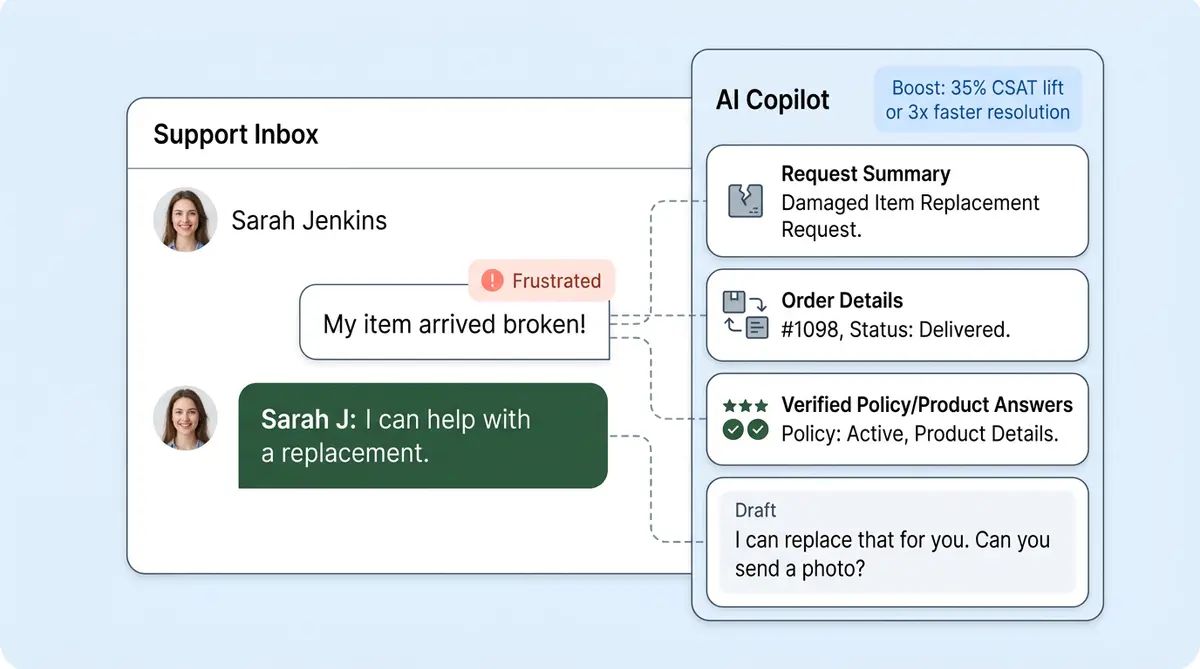
Alhena builds this discipline into the product rather than leaving it to prompt engineering. Its Product Expert Agent and Support Concierge are grounded in each brand’s verified product and policy data, so the agent answers from what you have approved rather than generating health language from a general model’s training data. That is the approved-claims-corpus principle, enforced by the architecture. Guardrails and escalation triggers are configurable to your product line and the structure/function boundary; every conversation is logged for audit; and the same rules apply across web chat, email, and helpdesk tickets in Zendesk or Gorgias, so there is no channel where the boundary quietly loosens. Alhena’s ecommerce customers include supplement and wellness brands such as Inno Supps and Healy.
How to choose an AI support platform for a supplement brand
The best customer-support platform for a supplement brand is the one whose architecture can enforce your approved-claims boundary on every message, not the one with the longest feature list or the largest underlying model. For a regulated product, “best” is defined by control, not capability. A more powerful model that generates freely is a bigger liability, not a smaller one.
That reframes platform selection into a short set of questions, each drawn from the checklist above:
| Ask the vendor | Why it decides the outcome |
|---|---|
| Can the agent be constrained to an approved-claims corpus, or does it generate from a general model? | This is the line between referencing your cleared language and inventing health claims. |
| Can we configure phrase-level guardrails and escalation rules for our specific products? | The disease-claim boundary is lexical and product-specific; generic filters miss implied claims. |
| Is every response logged and searchable for audit? | You cannot defend, or correct, what you cannot review. |
| Are the same rules enforced across every channel our customers use? | A compliant web chat and an unguarded email agent is still a compliance gap. |
| Can our regulatory team review and update what the agent is allowed to say? | Compliance is a cadence, not a launch-day setting. |
A platform that answers those five questions well will, almost by definition, also handle the ordinary support load (resolving product, shipping, and order questions) because the same grounding that keeps it on-label keeps it accurate. The point is that for a supplement brand, you evaluate the compliance architecture first and the convenience features second, not the other way around. For broader context on how these assistants work across ecommerce, the definitive guide to AI shopping assistants is a useful companion, and the same personalization mechanics show up in guided shopping for wellness brands.
Why compliant data also decides whether AI recommends your brand
Supplement brands often disappear from AI shopping recommendations for the same reason they sometimes stay compliant by accident: their public product language is so hedged, vague, or unstructured that an external AI engine has nothing concrete and trustworthy to cite. If your site says a product “supports overall wellness” and stops there, a shopping assistant answering “what magnesium should I take for sleep?” has no specific, sourced, on-label claim to surface, so it recommends a competitor that gave it one.
This is where compliance and AI visibility turn out to be the same problem. External AI engines (the shopping features inside ChatGPT, Perplexity, and Google’s AI surfaces) recommend products they can understand and trust. Two things make a brand hard to recommend. Vague marketing copy gives the engine nothing to extract. And over-broad, disease-adjacent claims are exactly what a well-built engine is trained to distrust in a health context, because health queries sit in the “your money or your life” category these systems handle most conservatively. The brands that are invisible have usually made one of those two mistakes.
The fix is the same work as compliance. A structured, approved-claims corpus (clear, substantiated, on-label statements tied to specific products, with verified certifications attached) is simultaneously the thing that keeps your agent inside the FDA and FTC lines and the thing that gives an external engine something precise and credible to cite. You do not trade visibility for safety. The discipline that makes you defensible is the discipline that makes you legible. This article covers the compliance side of that connection; for the full playbook on trust signals and AI-search structure, see the companion guide on AI visibility for health and wellness brands, and the broader shift this all sits inside is mapped in agentic commerce.
The bottom line
For a supplement brand, the compliance boundary is not a limit you place on your AI agent after you build it. It is the agent’s design. An agent grounded in an approved-claims corpus, guarded at the level of the phrase, escalated at the edge of medical advice, and audited on every response is at once the compliant one, the safe one, and the one AI shopping engines can trust enough to recommend. Those are not three separate projects competing for budget. They are one architectural decision, treating “what the agent is allowed to say” as a system property rather than a legal footnote, that pays off in all three places at once. If you want to see what that looks like against your own catalog, you can schedule a demo.
About this analysis
This guide reviewed FDA and FTC primary materials and official guidance (21 CFR 101.93; the FTC’s 2022 Health Products Compliance Guidance and its 2024–2026 AI-related actions), peer-reviewed sources (a 2025 Annals of Internal Medicine: Clinical Cases case report; a 2026 BMJ Open audit), and established news and trade reporting, reviewed in July 2026. Regulatory citations link to the primary source or, where a primary page blocks automated access, to the official notice plus corroborating legal or trade coverage.
Disclosure: Alhena publishes this guide and supplies AI agent technology used by some of the companies referenced. The same “what is live, what was measured, what remains unproven” standard is applied to every example.
Evidence cutoff: July 2026.
AI assistance: AI tools assisted with source discovery, organization, and editing. Ashu Dubey reviewed the cited sources, checked the numerical claims, and approved the final analysis.
This article is general information, not legal advice. Confirm your own claims, filings, and disclaimers with qualified regulatory counsel before deploying a customer-facing AI agent.
Frequently asked questions
Is my supplement brand liable if an AI agent makes a health claim to a customer?
Yes. The FTC and FDA treat a claim generated by your AI system the same way they treat a claim in your printed marketing. The FTC’s own position is that “there is no AI exemption from the laws on the books.” If your agent tells a customer a product “treats” a disease, your brand owns that claim. Civil penalties of up to $53,088 per violation require a predicate: violating an existing FTC order or rule, or having received one of the penalty-offense notices the FTC sent to roughly 700 marketers over health-claim substantiation in April 2023. Separately, enforcement can end in multimillion-dollar monetary judgments through consent orders, as the TruHeight case shows.
What’s the difference between a structure/function claim and a disease claim?
A structure/function claim describes how a nutrient affects the normal structure or function of the body, such as “supports immune health” or “calcium builds strong bones.” A disease claim states or implies that a product diagnoses, treats, cures, mitigates, or prevents a specific disease. Supplement brands may make structure/function claims with the required FDA notification and disclaimer, but disease claims are prohibited: they turn the product into an unapproved drug. The difference often comes down to a single verb, and under FDA’s ten-factor test a disease claim can even be implied through a product’s name, a symptom reference, or imagery.
What is the best customer support platform for a supplement brand?
There is no single best platform; the right one is defined by whether it can enforce your compliance boundary, not by its feature count. Evaluate candidates against five questions: can the agent be constrained to an approved-claims corpus rather than generating from a general model; can you configure phrase-level and escalation rules for your products; is every response logged for audit; are the same rules enforced across web chat, email, and helpdesk channels; and can your regulatory team review and update what the agent may say. A platform that answers those well will also handle ordinary support accurately, because the same grounding drives both.
Why is my supplement brand invisible in AI recommendations?
Usually because your public product data is too vague, too hedged, or too unstructured for an AI engine to cite, or, at the opposite extreme, because over-broad, disease-adjacent claims are exactly what these systems are trained to distrust in a health context. AI shopping engines recommend products they can understand and trust. A structured, substantiated, on-label claims corpus fixes both problems at once: it keeps you compliant and it gives the engine something specific and credible to surface. The full trust-signal and AI-search playbook is covered in our guide to AI visibility for health and wellness brands.
How does an AI agent avoid inventing health claims?
By answering only from a brand-approved knowledge base rather than from a general model’s training data. When the agent is grounded in your verified product and policy data (the claims, ingredients, and certifications your team has cleared), it can reference approved language but cannot fabricate benefits, certifications, or research citations that do not exist. Grounding is the mechanism that turns “please don’t make claims” from a hope into a system constraint.
Can an AI agent provide supplement dosage information without giving medical advice?
Yes, within a clear boundary. An agent can share the manufacturer’s recommended serving size directly from a verified product label, because that is product information. It should not provide a personalized dose for a specific health condition, because that is medical advice. A well-designed agent recognizes the shift (from “how many capsules per serving?” to “how much should I take for my thyroid?”) and escalates to a healthcare disclaimer or a human at that line.
What should the AI do when a customer asks about a specific medical condition?
Acknowledge the question, stay strictly within structure/function language, add the required healthcare disclaimer, and recommend that the customer consult a healthcare provider. For sensitive cases (symptoms, medications, interactions, pregnancy, or anything involving children), the agent should hand off to a human based on your configuration rather than attempting an answer. Naming a medical condition should be an escalation trigger, not a prompt to improvise.
Does the FTC’s substantiation standard apply to what an AI agent says?
Yes. The FTC’s 2022 Health Products Compliance Guidance requires health-benefit claims to be backed by competent and reliable scientific evidence, generally randomized, controlled human clinical trials, and that standard applies to any claim your brand makes, including one produced by an AI agent. The guidance itself predates modern chatbots and does not mention them, but the FTC has been explicit that AI-generated claims carry no exemption. If your evidence cannot support a benefit, your agent should not state it.