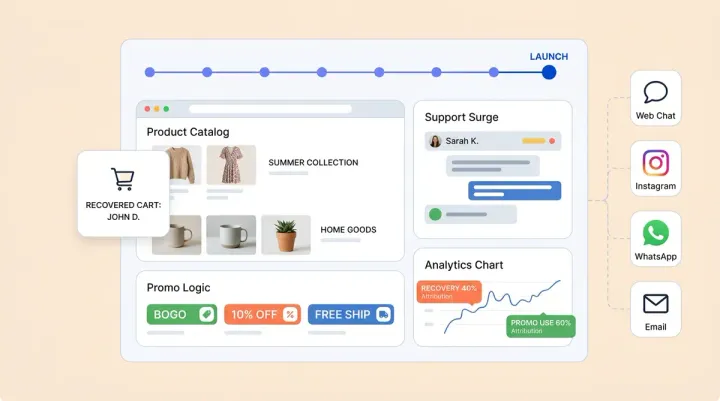
AI shopping assistants for health and wellness brands guide shoppers from confusion to confident purchase by matching their goals, dietary needs, and health conditions to the right products in under two minutes. Instead of scrolling through hundreds of supplements, skincare products, or fitness gear, users get personalized shopping recommendations grounded in your verified product data.
As of 2026, the global wellness market now exceeds $7 trillion, and 69% of Americans take dietary supplements daily. But online, most of these shoppers face a broken discovery experience: a search bar, 300 product listings, and no expert guidance. That gap costs brands real revenue.
This guide covers how AI agents built for health and wellness e-commerce handle visual search, image-based product matching, virtual try-on, supplement stack building, and full-journey support from discovery through checkout.
Why Do Health and Wellness Shoppers Abandon Carts at 69%?
Cart abandonment in health and wellness e-commerce sits at 69%, climbing to nearly 81% for beauty and personal care. Three problems drive this:
- Choice overload: A typical supplement brand carries dozens of SKUs across vitamins, minerals, adaptogens, and blends. According to Accenture research across 19,000 consumers, 73% feel overwhelmed by too much choice online.
- Trust deficit: More than 70% of wellness consumers prefer brands that clearly list ingredients and their origins, per Coherent Market Insights. When transparency is missing, users leave.
- Decision anxiety: Health purchases carry personal consequences. Choosing the wrong supplement when you have a medical condition can be harmful, not just annoying.
Walk into a health food store, and a knowledgeable associate asks about your goals, dietary restrictions, and existing supplements before pointing you to a shelf. Online, that experience vanishes. You're left with a search bar and the hope that third-party reviews aren't fake.
An AI shopping assistant brings that in-store guidance online, available 24/7, with perfect recall of every product detail across your entire catalog.
What Is Guided Shopping for Health and Wellness Brands?
Guided shopping replaces the "browse and hope" model with a generative AI-led conversation that narrows thousands of options to the right product in minutes. Think of it as the digital version of that health store associate, except it remembers every ingredient, certification, and dosage detail across your full catalog.
How Does a Guided Shopping Conversation Work?
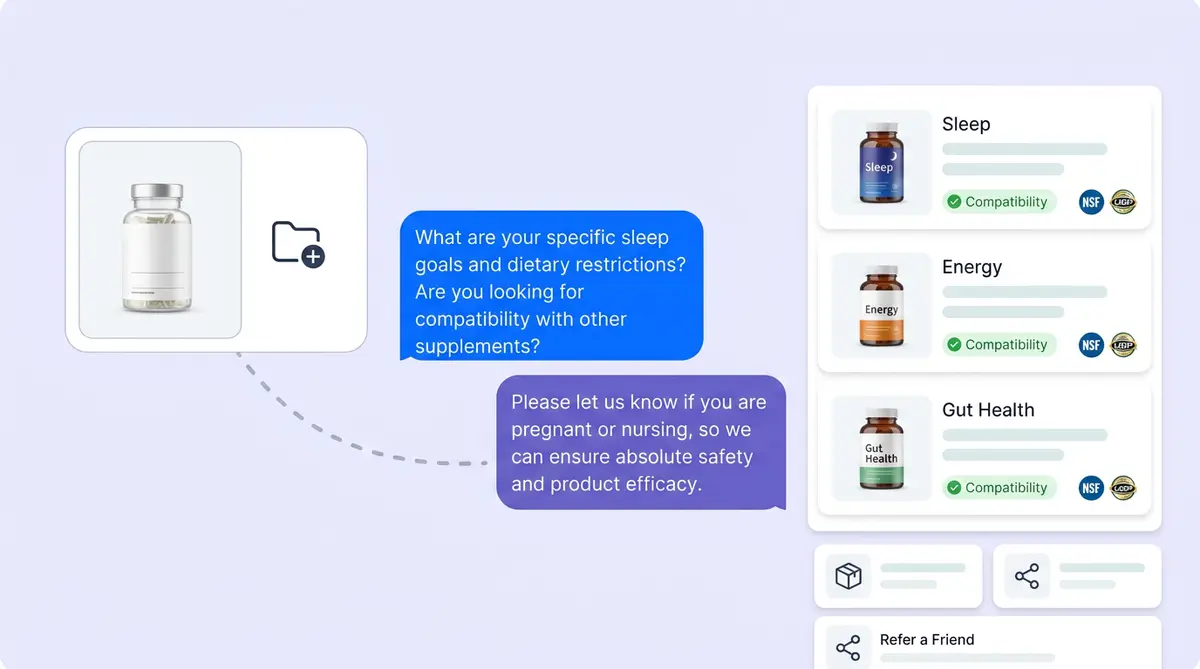
A first-time user lands on a wellness brand's site looking for sleep support. Instead of scrolling through 40 products, they interact with an AI assistant that asks targeted questions:
- "Are you looking for a supplement, a topical product, or a sleep device?"
- "Do you have any dietary restrictions like vegan or gluten-free?"
- "Are you currently taking any other supplements?"
Based on the answers, the AI surfaces two or three products that match. It explains why each one fits, highlights relevant certifications (NSF, USP, third-party tested), and answers follow-up questions about dosage and timing.
The shopper goes from overwhelmed to confident in under two minutes. Shoppers who engage with an AI shopping assistant increase conversion rates to 12.3%, compared to 3.1% for those who don't. That's a 4x improvement, and they complete purchases 47% faster.
How Is This Different from a Product Quiz?
Static quizzes follow predetermined paths and can't handle unexpected questions. An AI-powered shopping assistant adapts in real time, reading context and responding with contextual precision.
If the shopper mentions they're pregnant, the AI immediately filters out products with contraindicated ingredients. If they ask about combining two supplements, it provides guidance based on the brand's verified product data. No quiz or basic chatbot can do that.
How Does Visual Search Help Health and Wellness Shoppers Find Products?
Visual search lets shoppers upload a photo or screenshot to find matching products in your catalog. For health and wellness e-commerce, this solves a specific problem: customers often see a product on social media, in a friend's medicine cabinet, or at the gym and want to find it (or something similar) on your site.
How Does Image Upload Work for Product Matching?
A customer snaps a photo of a supplement bottle they saw at a yoga studio. They upload it to your AI shopping assistant. The generative AI analyzes the image, identifies the product category, key ingredients, and form factor, then returns matching or comparable products from your catalog with full ingredient transparency.
This works across product types common to wellness brands:
- Supplements and vitamins: Upload a photo of any bottle to find your equivalent or a better alternative with transparent ingredient sourcing.
- Skincare and personal care: Snap a photo of a serum or moisturizer and get matched to products in your catalog that target the same skin concerns.
- Fitness equipment and wearables: Share an image of a resistance band, yoga mat, or fitness tracker or wearable devices to find your brand's version with full specs and reviews.
- Functional foods and beverages: Photograph a protein bar or adaptogen drink to surface similar products with comparable nutritional profiles.
Visual search paired with multimodal AI product discovery delivers results in seconds. For wellness retailers with large catalogs, it turns "I saw something like this" into a purchase instead of a bounce.
Can AI Provide Virtual Try-On for Health and Wellness Products?
Virtual try-on technology has expanded well beyond fashion. For health and wellness brands, generative AI-powered shopping visualization helps customers see and feel the impact of products before buying.
What Does Virtual Try-On Look Like for Wellness Brands?
The applications vary by product category:
- Skincare analysis and matching: Customers upload a selfie, and AI analyzes their skin type, concerns, and tone to recommend the right products. Alhena's beauty and skincare solution includes selfie-based instant skin type and concern analysis trained on diverse skin tones for inclusive recommendations.
- Foundation and shade matching: AI matches skin tones to reduce wrong-shade returns, a major cost driver for beauty and wellness brands selling cosmetics or tinted skincare.
- "Show me similar" visual product finder: Upload an image of any product and the AI surfaces visual alternatives from your catalog, helping customers find comparable items when their preferred product is out of stock.
- Wellness visualization: Emerging AI tools let customers simulate how lifestyle and supplement choices affect skin health over time, creating a visual incentive to invest in long-term wellness routines.
The AI in fitness and wellness market is valued at $10.68 billion in 2025 and projected to reach $57.80 billion by 2035. Visual and try-on AI is a core feature driving that growth.
How Does AI Ensure Every Product Has the Right Information?
Health and wellness shoppers need more than a product name and price. They need ingredient lists, dosage details, allergen warnings, certifications, usage instructions, and compatibility information. Most e-commerce platforms scatter this data across product pages, PDFs, and FAQ sections.
What Does Alhena's Product Expert Agent Do?
Alhena's Product Expert Agent learns every SKU in your catalog, including ingredients, dosage details, certifications, usage instructions, and customer reviews. When a shopper asks "What's the best magnesium for sleep that's also vegan?", the agent doesn't return a keyword-matched list. It evaluates your magnesium products against the specific criteria and recommends the best match with a clear explanation of why.
Key features and capabilities of the Product Expert Agent for health and wellness brands:
- Ingredient-level knowledge: Answers questions about specific ingredients, their sources, and interactions with other supplements.
- Certification awareness: Knows which products are NSF-certified, USP-verified, organic, non-GMO, vegan, or gluten-free.
- Dosage guidance: Provides recommended serving sizes and timing based on your product's verified data.
- Allergen and contraindication filtering: Automatically excludes products that conflict with a shopper's stated allergies, conditions, or current medications.
- Cross-product compatibility: Understands which products work well together and which shouldn't be combined.
Alhena's hallucination-free architecture keeps every response grounded in your verified product and customer data. If a question falls outside the AI's verified knowledge, it flags it and routes to your business support services team with full context. For supplement retailers navigating regulatory requirements, this accuracy is non-negotiable.
What AI Agents Does a Health and Wellness Brand Need?
A single chatbot or generic AI chatbots can't handle the range of customer needs in health and wellness e-commerce. Brands need specialized agents that each handle a distinct part of the customer journey.
Product Expert Agent
Handles all product discovery, ingredient questions, compatibility checks, and personalized recommendations. This agent is trained on your full product catalog and knows the details of every SKU.
Order Management Agent
Processes order tracking, returns, exchanges, subscription changes (pause, skip, swap, cancel, reactivate), and refund requests. Alhena's Order Management Agent handles these actions directly within the conversation, connected to your e-commerce platform. No portal redirects, no wait times.
Subscription-related requests account for 25 to 35% of all supplement support tickets. Manawa cut response times from 40 minutes to under 1 minute with Alhena's Order Management Agent. Puffy reached 63% automated inquiry resolution at 90% customer satisfaction.
Support Concierge Agent
Covers post-purchase support services: shipping updates, delivery issues, account questions, and loyalty program inquiries. This agent handles the high-volume, repetitive tickets that consume your support team's time.
Social Commerce Agent
Alhena's Social Commerce Agent responds to product questions in Instagram DMs, WhatsApp messages, and Facebook comments. A customer who discovers your brand through an influencer's Instagram post can get personalized recommendations and complete their purchase without leaving the platform.
Vertical-Specific Agents for Health and Wellness
Beyond the core agents, health wellness brands benefit from AI that understands their vertical. That means agents trained on:
- Supplement stacking logic: Knows which vitamins and minerals work synergistically (magnesium + vitamin B6 for sleep) and which combinations to avoid.
- Wellness routine building: Creates personalized morning and evening routines with product sequencing across your catalog.
- Skin concern matching: Maps customer-described skin conditions to your product ingredients and formulations.
- Fitness and recovery protocols: Recommends pre-workout, intra-workout, and recovery products based on activity type and goals.
- Dietary restriction filtering: Handles complex dietary needs (keto, paleo, FODMAP, autoimmune protocol) across your entire catalog.
All of these agents work together through Alhena's agentic commerce platform, routing customers to the right agent automatically based on intent.
How Does AI Stack Building Increase Average Order Value?
Supplement shoppers rarely buy a single product. They build routines: a sleep stack (magnesium, L-theanine, melatonin), an energy stack (B-complex, iron, CoQ10), or a gut health protocol (probiotic, prebiotic, digestive enzymes).
Most traditional e-commerce sites handle this poorly. A shopper searching for "something for sleep" gets a single melatonin suggestion. No product synergies, no sequencing, no compatibility checks. The cross-sell opportunity disappears.
How Does AI Build a Complete Wellness Stack?
When a user says "I want to improve my sleep," the AI walks them through a personalized multi-product stack:
- Identifies the primary goal: Sleep improvement, stress reduction, energy, gut health, or another wellness objective.
- Asks qualifying questions: Current supplements, dietary restrictions, budget range, preferred format (capsules, powder, gummies).
- Builds the stack: Recommends 2 to 4 complementary products with morning vs. evening sequencing.
- Checks compatibility: Verifies no ingredient conflicts or redundancies across the stack.
- Populates the cart: Adds the full routine to the cart and guides the shopper through checkout in one conversation.
The AOV benefits are real. Victoria Beckham saw a 20% increase in average order value with AI-guided multi-product recommendations. Tatcha hit a 38% AOV uplift and 3x conversion rates through AI-guided shopping. McKinsey reports that companies leading in personalization generate 40% more revenue than average performers.
What Does the Complete AI Shopping Journey Look Like?
The gap between "I found what I want" and "I actually bought it" is where health retailers lose the most revenue. A shopper might spend ten minutes getting a great recommendation, then abandon at checkout because of a last-minute question about returns or subscription terms.
Complete AI shopping assistants cover the entire journey:
- Arrival and engagement: The AI greets the user with a relevant engagement prompt. A returning user sees "Welcome back! Ready to reorder your vitamin D?" A new user on the supplements page sees "Looking for something specific? I can help you find the right fit."
- Visual search and image upload: The customer uploads a photo of a product they want to match, and the AI identifies comparable options from your catalog instantly.
- Guided discovery: Through natural language conversational questions, the AI narrows the catalog to two or three products matched to the shopper's health goals, dietary needs, and budget.
- Virtual try-on and visualization: For skincare and beauty-wellness products, the AI offers selfie-based skin analysis and product matching to build confidence before purchase.
- Objection handling: The AI detects hesitation. A shopper comparing two probiotic formulas gets a side-by-side breakdown of CFU counts and strain profiles. Someone hovering on the price gets a reminder about the subscription discount.
- Cart and checkout: Alhena's agentic checkout populates the cart directly and pre-fills checkout fields. For subscription products, it explains billing cycles and cancellation policies upfront.
- Post-purchase support: The AI Support Concierge handles order tracking, subscription changes, and returns without routing to a human agent.
AI-driven proactive chats recover 35% of abandoned carts. And 93% of customer questions get resolved without human intervention. For health retailers running lean support teams, that's a major operational gain on top of the revenue lift.
How Does Alhena AI Power Health and Wellness Ecommerce?
Alhena AI is a generative AI and agentic commerce platform built for e-commerce and retail revenue, not just ticket deflection. For health and wellness brands, that distinction matters because the goal isn't simply to answer questions faster. It's to guide shoppers from "I'm not sure what I need" to "This is exactly right for me" and then through checkout.
Here's what makes Alhena different for wellness brands:
- Hallucination-free AI: Every response is grounded in your verified product data and customer data. No fabricated claims about ingredients, dosages, or certifications.
- Multi-agent system architecture: Product Expert Agent, Order Management Agent, Support Concierge, and Social Commerce Agent work together, routing customers to the right agent automatically.
- Visual search and image upload: Shoppers can upload product photos to find matches in your catalog.
- Selfie-based skin analysis: For beauty-wellness brands, AI analyzes skin type, concerns, and tone from a selfie to recommend the right products.
- Agentic checkout: The AI populates carts and pre-fills checkout fields, reducing friction at the critical moment.
- Omnichannel presence: Web chat, email, Instagram DMs, WhatsApp, and voice. A customer who starts a conversation on Instagram can pick it up on your website without repeating themselves.
- Revenue attribution analytics: Built-in dashboards show exactly how much revenue AI conversations generate, not just how many tickets they deflect.
- Deploys in under 48 hours: No dev resources required. Integrates with Shopify, WooCommerce, Magento, and Salesforce Commerce Cloud, plus helpdesks like Zendesk, Freshdesk, and Gorgias.
The results from brands using Alhena tell the story. Tatcha achieved a 3x conversion rate, 38% AOV uplift, and 11.4% of total site revenue attributed to AI conversations. Crocus reached 86% deflection rate with 84% customer satisfaction. These aren't just support metrics. They're sales results.
You can preview your projected ROI before committing using the free ROI calculator.
Key Takeaways
- Health shoppers face unique barriers online: 73% feel overwhelmed by choice, and cart abandonment in wellness hits 69%. Guided AI shopping experiences are not optional for this category.
- AI shopping assistants convert 4x better: Shoppers who engage with AI convert at 12.3% vs. 3.1% for unassisted visitors, completing purchases 47% faster.
- Visual search and image upload close the discovery gap: Customers upload photos to find matching products instantly, turning "I saw something like this" into a sale.
- Virtual try-on builds purchase confidence: Selfie-based skin analysis, shade matching, and product visualization reduce returns and increase first-purchase conversion.
- Every product needs complete, accurate information: Alhena's Product Expert Agent provides ingredient-level knowledge, certification details, dosage guidance, and allergen filtering, all grounded in verified data.
- Multiple specialized agents cover the full journey: Product Expert, Order Management, Support Concierge, Social Commerce, and vertical-specific agents work together for health and wellness brands.
- Stack building drives AOV: AI that recommends complete wellness routines with sequencing and compatibility checks lifts AOV by 20 to 38%.
- Personalization pays off: Companies leading in personalization generate 40% more revenue. The AI shopping assistant market is projected to reach $24.9 billion by 2032.
Ready to give your health and wellness customers the personalized shopping experiences they deserve? Book a demo with Alhena AI or start for free with 25 conversations to see the impact on your store.

Frequently Asked Questions
How does an AI shopping assistants help health and wellness brands?
An AI shopping assistant guides health and wellness shoppers through personalized product discovery by asking about their goals, dietary restrictions, and health conditions. It recommends the best-matching products from your catalog in under two minutes. Shoppers who engage with AI assistants convert at 12.3% compared to 3.1% for unassisted visitors, a 4x improvement.
What is visual search and how does it work for wellness products?
Visual search lets customers upload a photo or screenshot of any health product, and AI analyzes the image to find matching or comparable products in your catalog. A customer can photograph a supplement bottle seen at the gym and instantly find your equivalent with full ingredient transparency. This works for supplements, skincare, fitness equipment, and functional foods.
Can AI provide virtual try-on for health and wellness products?
Yes. For skincare and beauty-wellness products, AI offers selfie-based skin type and concern analysis to recommend the right products. It also provides foundation shade matching to reduce wrong-shade returns and a "show me similar" visual product finder. The AI in fitness and wellness market is valued at 0.68 billion in 2025 and projected to reach 7.80 billion by 2035.
How does AI stack building increase average order value for supplement brands?
AI understands your full product catalog and how items work together. When a shopper says "I want to improve my sleep," the AI recommends a complete multi-product stack with morning vs. evening sequencing and compatibility checks. Brands using AI-guided multi-product recommendations see AOV increases of 20 to 38%, with the AI populating the full stack directly into the cart.
What AI agents does Alhena provide for health and wellness brands?
Alhena provides multiple specialized agents: a Product Expert Agent for ingredient-level product recommendations, an Order Management Agent for subscriptions and returns, a Support Concierge for post-purchase support, and a Social Commerce Agent for Instagram DMs and WhatsApp. These agents are trained on health and wellness vertical knowledge including supplement stacking logic, dietary restriction filtering, and skin concern matching.
How does Alhena AI ensure product information accuracy for supplements?
Alhena uses hallucination-free architecture that grounds every response in your verified product data. The Product Expert Agent knows ingredients, dosages, certifications (NSF, USP, organic), allergen details, and cross-product compatibility. If a question falls outside verified knowledge, Alhena flags it and routes to your support team with full context instead of guessing.
Can AI handle subscription management for wellness products inside the chat?
Yes. Alhena's Order Management Agent processes pause, skip, swap, cancel, and reactivation requests within the same conversation, connected directly to your Shopify or WooCommerce subscription logic. Manawa cut response times from 40 minutes to under 1 minute, and Puffy hit 63% automated resolution at 90% customer satisfaction.
How long does it take to set up Alhena AI for a health and wellness store?
Alhena deploys in under 48 hours with no developer resources required. It integrates with Shopify, WooCommerce, Magento, and Salesforce Commerce Cloud, and connects to helpdesk services like Zendesk, Freshdesk, and Gorgias. The AI automatically learns your product catalog, ingredients, certifications, and FAQ content during setup. You can preview projected ROI before committing using the free ROI calculator.
Does the AI shopping assistant work across social media channels?
Yes. Alhena AI operates across web chat, email, Instagram DMs, WhatsApp, and voice. A customer can start a conversation on Instagram asking about a supplement and continue it on your website without repeating their questions. The AI maintains full conversation context across every channel, and the Social Commerce Agent handles product recommendations directly in social DMs.
What results have brands seen with Alhena AI for ecommerce?
Tatcha achieved a 3x conversion rate, 38% AOV uplift, and 11.4% of total site revenue from AI conversations. Victoria Beckham saw a 20% AOV increase. Puffy reached 63% automated inquiry resolution at 90% customer satisfaction. Crocus hit 86% deflection rate with 84% CSAT. Manawa cut response times from 40 minutes to under 1 minute with 80% inquiry automation.