AI referral traffic to ecommerce sites grew 1,200% between late 2024 and late 2025. Shoppers now ask ChatGPT for product recommendations, consult Perplexity for reviews, and get buying suggestions from Google AI Overviews before they ever visit your store. Tracking tools can tell you whether your brand appears in those AI answers. But raw tracking data alone doesn't tell you why you're invisible, which gaps cost you the most revenue versus competitors, or what to fix first.
That's where AI brand visibility analysis comes in. It's the diagnostic layer that sits between your visibility tools (regardless of your subscription tier) and actual action. This guide covers the analysis framework ecommerce teams need: how to interpret AI visibility metrics, diagnose root causes behind poor analytics performance, understand why your brand ranks differently across ChatGPT, Perplexity, and Gemini, and build a repeatable analysis workflow that turns brand performance data into revenue gains.
What AI Brand Visibility Analysis Actually Means
AI brand visibility analysis (sometimes called AI search visibility analysis) is the practice of interpreting, diagnosing, and acting on data about how your brand appears in AI-generated responses. It's not the same as monitoring. Brand monitoring and visibility monitoring tools answer the question "did we show up?" Analysis answers "why didn't we, and what do we do about it?"
Think of it this way. AI visibility monitoring tools and tracking platforms tell you that your brand appeared in 3 out of 20 ChatGPT answers for your product category. Analysis tells you that the 17 misses share a pattern: they're all prompts where shoppers mention a price range, and your product pages lack visible pricing structured data. That diagnostic insight is what makes analysis different from tracking.
Gartner projects a 25% drop in traditional search volume by 2026 as shoppers shift to AI alternatives. Google AI search answers already reach 2 billion monthly users across 200+ countries. For ecommerce companies, the human ability to read AI visibility data and spot opportunities and extract actionable diagnoses separates brands that grow from brands that wonder where their traffic went.
If you haven't picked a tracking platform yet, our guide to the 12 best AI visibility tools for ecommerce and our comparison of the top 7 AI brand visibility tracking tools cover the options in detail. This guide picks up where choosing tracking tools ends, whether you’re an in-house team, an agency with multiple clients, or working with agencies. It’s designed to complement the visibility tools you’re already using, from Semrush and Ahrefs Brand Radar to Profound and Otterly. Profound, for example, offers prompt volume demand signaling that helps prioritize which queries to analyze first. Semrush, Ahrefs Brand Radar, and SE Ranking each bring different analytical strengths.
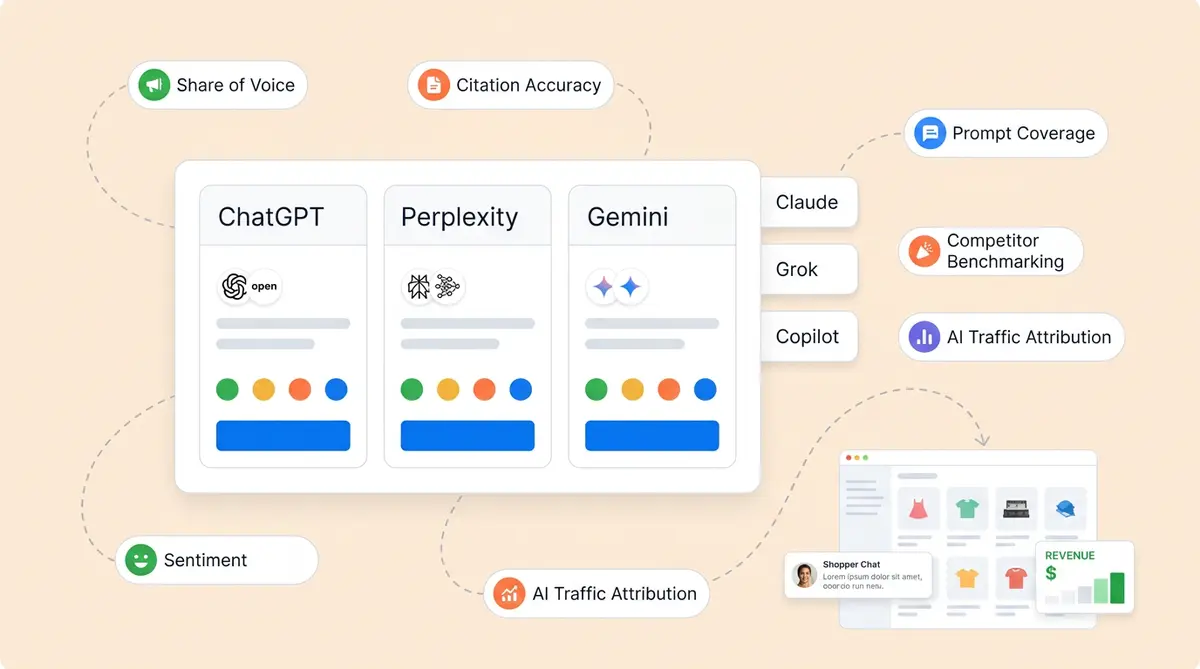
The Six Metrics That Drive AI Visibility Analysis
Effective analysis requires the right data inputs and the best possible diagnostic framework. These six metrics form the foundation of any AI brand visibility analysis framework, but knowing what they mean matters more than knowing they exist.
Share of Voice and What It Actually Tells You
Share of voice (SOV) measures what percentage of AI responses mention your brand versus competitors for a given set of prompts for a set of target prompts. A 30% SOV across 50 prompts means you appeared in 15 answers. But the raw number isn't the insight.
The analysis layer is segmenting SOV by intent type. If your SOV is 60% for informational queries ("what's the difference between silk and satin pillowcases") but 5% for commercial queries ("best silk pillowcase under $80"), you know exactly where revenue is leaking. Your brand has authority in AI systems but fails when purchase intent enters the prompt. For a deeper breakdown, see our complete guide to AI share of voice for ecommerce.
Citation Accuracy as a Trust Signal
Citation accuracy tracks whether AI systems state correct facts about your brand. When a model says your product costs $49 but it actually costs $59, or lists a feature you discontinued last quarter, that's a citation accuracy failure. Each inaccuracy erodes the trust signals AI engines rely on to recommend you.
The diagnostic question isn't "how many inaccuracies exist" but "where is the model getting its wrong data?" Trace each error back to a source: an outdated review site, a cached product page, a third-party listing with stale information. That source mapping is what turns accuracy tracking into a fixable problem.
Sentiment Scoring Beyond Positive and Negative
Basic sentiment analysis tags AI mentions as positive, neutral, or negative. That's useful but shallow. Better analysis tracks sentiment by product attribute. If AI consistently praises your product's design but flags durability concerns, you have a specific messaging gap to plan around to address on your product pages and in review responses.
For ecommerce brands, negative sentiment in AI answers pushes shoppers toward competitors. It’s one of the best reasons to track competitors across AI platforms before they steal traffic from your site. Tracking which attributes trigger negative sentiment (and which sources that sentiment originates from) gives you a targeted action plan.
Prompt Coverage Gaps
Prompt coverage maps which question types trigger your brand in AI responses. The analysis value comes from categorizing gaps. Are you missing from price-sensitive queries? Feature comparison queries? Use-case specific queries? Each gap type points to a different fix.
Missing from price queries usually means your structured pricing data is incomplete. Missing from comparison queries means AI doesn't have enough data to position you against alternatives. Missing from use-case queries means your content doesn't connect your product to specific customer needs. The gap category can determine the remedy.
Multi-Platform Divergence
Here's what most visibility guides skip entirely: your brand won't rank the same across every AI platform. ChatGPT, Perplexity, Gemini, Claude, and Grok each retrieve and weight sources differently. ChatGPT cited pages ranking in traditional SERP positions 21 or lower, and that ranking gap matters almost 90% of the time, meaning traditional ranking position matters less there. Ranking in AI surfaces follows different rules. Google AI Overviews lean heavily on pages already in the top 10.
Analyzing divergence across platforms can uncover where your content strategy has blind spots. If you appear in Perplexity but not ChatGPT, the issue may be that ChatGPT's training data doesn't include your most recent content. If you appear in Google AI Overviews but not Claude, your content may rely too heavily on Google-indexed signals rather than the broad web presence that Claude draws from.
Revenue Attribution from AI Mentions
The metric that matters most for ecommerce: connecting AI mentions to actual purchases through analytics. Running analytics dashboards on referral traffic and conversion analytics from AI platforms tells you which AI visibility improvements translate to revenue. A brand that appears in 50% of AI answers but drives zero attributed sales has a different problem than a brand appearing in 10% of answers with high conversion rates.
How to Run a Diagnostic AI Visibility Analysis
With your tracking tool collecting data, here's the best diagnostic analysis workflow that turns raw numbers into prioritized action items. This framework works whether you're using a dedicated AI visibility platform or running manual checks.
Step 1: Segment Your Data by Intent Category
Don't analyze all prompts as a single group. Split your data into informational queries (learning about the category), commercial queries (comparing options), and transactional queries (ready to buy). Most ecommerce brands find their biggest revenue gap in the commercial and transactional segments, because those are the prompts where competitors have optimized and you haven't.
Step 2: Run a Root Cause Diagnosis on Your Gaps
For every prompt where your brand doesn't appear, ask three diagnostic questions. First: does your website have a page that directly answers this query? If not, it's a content gap. Second: does that page have complete structured data (Product schema, FAQ schema, pricing, reviews)? If not, it's a data gap. Third: do authoritative third-party sources mention your brand in this context? If not, it's an authority gap. Each diagnosis opens specific optimization opportunities you can plan around. Each root cause has a different fix. Build reports around these categories.
Step 3: Map Platform-Specific Patterns
Compare your visibility across ChatGPT, Perplexity, and Gemini for the same prompt set. Where you appear on one platform but not another, the divergence can reveal which retrieval systems your content resonates with and which it doesn't. Perplexity weights real-time web sources heavily. ChatGPT pulls from broader training data plus web search. Google AI surfaces draw from the Shopping Graph and Merchant Center data. Match your optimization to each platform's retrieval architecture.
Step 4: Prioritize Fixes by Revenue Impact
Not all visibility gaps cost the same. A gap on a high-volume transactional prompt ("buy [product category] online") costs far more than a gap on a niche informational prompt. Plan and rank your gaps by estimated search volume, purchase intent, and competitive density. Fix the highest-revenue gaps first. This is where most teams and clients get stuck: they fix easy problems instead of expensive ones.
Step 5: Build a Weekly Analysis Cadence
AI models update constantly. Google AI answer panels appeared on 13.14% of queries by March 2025, up from 6.49% just two months earlier. Set a weekly analysis rhythm: review SOV trends, flag new citation inaccuracies, check for visibility changes on your top 20 revenue-generating prompts, and track whether last week's fixes moved the needle. Monthly analysis isn't frequent enough for how fast this landscape moves.
Turning Analysis Into Optimization: GEO and AEO Actions
Every diagnosis from your analysis maps to a specific generative engine optimization (GEO) or answer engine optimization (AEO) action. Here's the diagnostic-to-action playbook.
When Analysis Shows Content Gaps
If your root cause diagnosis reveals missing content for high-value prompts, build pages that directly answer those queries. Structure them with clear question-and-answer formatting that answer engines prefer to cite. Use the exact phrasing shoppers use in AI prompts as your H2 and H3 headings. Include specific numbers, product comparisons, and concrete recommendations rather than generic marketing copy.
When Analysis Shows Data Gaps
If the diagnosis points to incomplete structured data, focus on your product detail pages first. Implement complete Product schema (JSON-LD) with every field filled: material, dimensions, color, pricing, shipping, availability. Add FAQ schema to category pages. Resolve Google Merchant Center disapprovals since they suppress your products from AI surfaces that draw on Shopping Graph data. Google store ratings now function as AI citation signals, so review management belongs in your data optimization playbook.
When Analysis Shows Authority Gaps
If your brand doesn't appear because AI engines lack third-party validation, the fix is earned media, digital PR, and digital marketing outreach. Get included in expert roundups, industry comparison guides, and review sites. AI models weight sources from high-authority domains heavily. A single mention in an authoritative industry publication can shift your AI visibility more than ten new blog posts on your own site.
When Analysis Shows Platform-Specific Weakness
Different platforms need different approaches. Weak on Perplexity? Focus on recency: Perplexity crawls the live web frequently, so fresh content and updated timestamps help. Weak on ChatGPT? Build broader web presence through forums, Q&A sites, and community discussions where ChatGPT's retrieval system looks. Weak on Google AI Overviews? Prioritize traditional SEO signals and SEO best practices: site audit scores, page speed, Core Web Vitals, and Merchant Center feed quality.
Generate First-Party AI Interaction Data
Here's what most analysis guides miss: the data from AI interactions on your own storefront feeds back into the visibility ecosystem. When shoppers engage with an AI shopping assistant on your site, those conversations create structured behavioral data (questions asked, products viewed, carts built) that can shape how AI systems understand your catalog. It’s a layer that no external visibility tool offers. Companies running AI shopping assistants generate proprietary data that external tools can never access, creating a visibility advantage that compounds over time.
How Alhena AI Strengthens Your Visibility Analysis Loop
AI brand visibility analysis tools show you the scoreboard. Alhena AI changes the score from inside your store.
The tracking platforms measure mentions. Alhena's AI Shopping Assistant works from inside your storefront, generating the structured, accurate product interactions that AI engines learn from and prefer to cite. That creates a closed loop: your analysis identifies gaps, and Alhena helps close them with better product data.
Hallucination-Free Product Data for Better Citation Accuracy
When your analysis flags citation inaccuracies, the root cause is usually bad source data. Alhena's Product Expert Agent is grounded in your verified catalog, so every recommendation and product detail it surfaces is factually correct. It’s grounded data. No hallucinated specs, no outdated pricing, no phantom products. AI crawlers encountering Alhena-powered interactions find clean, trustworthy data that can improve your accuracy scores.
Real Shopper Questions Feed Your AEO Strategy
Your visibility analysis reveals which prompts you're missing from. Alhena captures the actual questions shoppers ask on your site, giving you real demand data to build AEO content around. Instead of guessing which queries matter, you work from first-party evidence. Tatcha achieved a 3x conversion rate and 38% AOV uplift while building exactly the structured Q&A content that answer engines prefer to cite.
Revenue Attribution That Closes the Analysis Loop
The gap in most AI visibility analysis workflows is connecting mentions to money. Alhena's built-in analytics dashboard ties every AI-assisted conversation to cart additions, checkouts, and revenue influenced. When Tatcha attributes 11.4% of site revenue to AI-assisted shopping, that's the kind of attribution data that validates your visibility investment.
Victoria Beckham saw a 20% AOV increase. Puffy reached 63% automated resolution with 90% CSAT. These results connect directly to the analysis loop: better product data drives better AI visibility, which drives more traffic, which drives more revenue.
Omnichannel Coverage Across AI Surfaces
Your brand's AI visibility extends beyond search. Shoppers discover products through Instagram DMs and WhatsApp, voice assistants, and email. Alhena keeps brand representation consistent across all channels. More surfaces with correct, structured brand data strengthens your visibility profile everywhere AI systems look.
Setup takes under 48 hours with no developer resources or professional services. Alhena integrates with Shopify, WooCommerce, Magento, and Salesforce Commerce Cloud, plus help desks like Zendesk, Gorgias, and Intercom.
Matching Your Analysis Workflow to the Right Monitoring Tools
The best AI brand visibility analysis depends on which monitoring tools and SEO platforms feed your data. Different AI visibility tracking tools provide different raw inputs for your analysis. Choosing the right monitoring tool shapes the depth and accuracy of every analysis you run.
If your team already uses Semrush for SEO, Semrush’s AI visibility add-on keeps your AI brand monitoring data alongside traditional SEO metrics in one dashboard. Semrush can track your brand across ChatGPT and AI Overviews while you continue using Semrush for keyword research and SEO audits. Ahrefs takes a similar approach with Ahrefs Brand Radar. Ahrefs Brand Radar adds AI monitoring to the Ahrefs SEO suite, making it the best fit for teams already running Ahrefs for backlink analysis and SEO reporting.
For dedicated AI brand monitoring, Profound offers prompt volume demand signaling that helps agencies and enterprise teams prioritize which queries to analyze first. Profound’s reporting is built for agencies running brand monitoring across multiple ecommerce clients. Otterly provides budget-friendly brand monitoring starting at $29/month. Otterly works well for smaller ecommerce teams that need basic AI visibility monitoring data without enterprise complexity. Peec AI and SE Ranking round out the mid-tier monitoring tools with citation gap analysis and source-level SEO insights.
Your choice of monitoring tool determines the quality of your analysis inputs. A tool tracking only mention frequency gives you less to analyze than one capturing citation sources, sentiment, and SEO ranking correlations. For detailed feature comparisons, pricing, and recommendations, see our guides to the best AI visibility tools for ecommerce and the top AI brand visibility tracking tools for 2026.
Key Takeaways
- Analysis isn't tracking. Tracking tells you "we appeared 3 out of 20 times." Analysis tells you why you missed the other 17 and what to plan for first.
- Segment by intent. Your biggest revenue leaks are in commercial and transactional prompts where competitors have optimized and you haven't.
- Diagnose root causes. Every visibility gap is a content gap, data gap, or authority gap. Each has a different fix.
- Analyze platform divergence. ChatGPT, Perplexity, and Gemini retrieve sources differently. A strategy that works on one platform may fail on another.
- Prioritize by revenue impact. Fix high-value transactional gaps before low-volume informational ones.
- Close the loop with first-party data. Alhena AI generates the structured product interactions that improve the visibility scores your analysis tracks.
Ready to turn AI visibility analysis into measurable revenue? Book a demo with Alhena AI to see how ecommerce brands close the gap between visibility data and sales growth. Or start free with 25 conversations and measure the impact yourself.
Alhena AI
Frequently Asked Questions
What is the difference between AI visibility tracking and AI visibility analysis?
Tracking is the data collection layer. It records whether your brand appeared in AI-generated answers across ChatGPT, Perplexity, Gemini, and other platforms. Analysis is the diagnostic layer on top. It interprets that data to explain why you appeared or didn't, identifies root causes behind gaps, and maps each finding to a specific optimization action. Tracking tells you the score. Analysis tells you how to change it.
Why does my brand show up in Perplexity answers but not in ChatGPT when customers search for the same product?
Each AI platform retrieves and weights sources differently, which creates multi-platform divergence. Perplexity crawls the live web frequently and prioritizes fresh content with clear citations. ChatGPT relies more on broader training data plus its own web search, so content that hasn't been indexed broadly may not surface there. Google AI Overviews draw heavily from the Shopping Graph and Merchant Center data. Diagnosing where you appear and where you don't across platforms can uncover which retrieval architecture your content strategy needs to target.
How do I figure out why my ecommerce brand is not being recommended by AI search engines?
Run a root cause diagnosis on every prompt where your brand doesn't appear. Ask three questions: does your site have a page that directly answers this query (content gap), does that page have complete structured data like Product schema and pricing (data gap), and do authoritative third-party sources mention your brand for this topic (authority gap). Each root cause has a different fix. Content gaps need new pages. Data gaps need schema and feed optimization. Authority gaps need earned media and digital PR.
How often should an ecommerce team run an AI brand visibility analysis and what should they look for each week?
Run a focused analysis weekly at minimum. AI platforms update their retrieval systems constantly, and Google AI answer coverage nearly doubled in just two months (6.49% to 13.14% of queries). Each week, review share of voice trends by intent category, flag new citation inaccuracies, check for visibility changes on your top 20 revenue-generating prompts, and measure whether the previous week's optimizations moved the needle. Monthly analysis cycles miss too many changes in this fast-moving space.
What should I do first when my AI visibility analysis shows I'm invisible for high-purchase-intent product queries?
Prioritize by revenue impact, not ease of fix. High-purchase-intent prompts (like 'buy [product category] online' or 'best [product] under $200') drive the most revenue when you appear. Start with a data gap check: ensure your product pages have complete JSON-LD Product schema with pricing, availability, reviews, and detailed attributes. Then check whether authoritative comparison guides and review sites mention your brand for those queries. Fix data gaps first because they're fastest, then build content that can directly answer the commercial prompts where you're missing.
Can fixing how my brand appears in ChatGPT and Gemini responses actually increase my online store's sales?
Yes, and the revenue data supports it. AI referral traffic grew 1,200% year over year, and AI-referred shoppers convert at significantly higher rates than traditional search visitors. Brands using Alhena AI to generate structured product data that AI engines cite have seen measurable results: Tatcha achieved a 3x conversion rate with 11.4% of total site revenue from AI-assisted interactions, and Victoria Beckham saw a 20% average order value increase. The key is connecting your visibility analysis to revenue attribution so you're measuring business impact, not just mention counts.
How is generative engine optimization different from answer engine optimization and which one matters more for ecommerce?
Generative engine optimization (GEO) focuses on making your content retrievable and citable by AI systems that generate multi-source answers, like ChatGPT and Perplexity. Answer engine optimization (AEO) targets direct-answer formats: featured snippets, AI Overviews, and zero-click results. For ecommerce, both matter but serve different funnel stages. AEO captures informational queries early in the shopping journey. GEO positions your products in the AI-generated recommendation lists where purchase decisions happen. Use your visibility analysis to identify which type of gap costs you the most revenue and prioritize accordingly.
What role does first-party data from my online store play in improving how AI models talk about my brand?
First-party interaction data from your storefront creates a competitive visibility advantage that external tools can't replicate. When shoppers ask product questions through an AI shopping assistant on your site, those conversations generate structured behavioral data: specific questions asked, products compared, carts built, and purchases completed. This data gives AI systems richer, more accurate context about your products than third-party scraping tools ever could. Brands using Alhena AI generate this proprietary data automatically, which feeds back into stronger AI citation accuracy and more frequent brand recommendations.
How do I build a repeatable weekly AI visibility analysis workflow for my ecommerce marketing team?
Start with a five-step weekly cadence. Monday: pull reports on SOV trends across ChatGPT, Perplexity, and Google AI surfaces and flag any drops over 10%. Tuesday: check citation accuracy on your top 20 products and trace any new inaccuracies to their source. Wednesday: run your priority prompt set and score visibility by intent category. Thursday: prioritize the week's fixes by revenue impact (transactional gaps first, informational last). Friday: implement the top 3 fixes and document what changed. After four weeks, you'll have enough trend data to identify patterns and adjust your analysis prompts for higher accuracy.