Google Store Ratings used to matter for one reason: star ratings under your Shopping ads that lifted click-through rates in Google Search. In 2026, Google Store ratings matter for a second reason entirely. The same approved review partners list that Google uses to validate merchant reviews is now one of the provenance signals AI shopping engines rely on when deciding which e-commerce brands to cite, recommend, and quote.
If you're choosing a review platform today, you're also choosing your AI citation footprint. This post explains why and what to do about it.
What Google Store Ratings and Seller Ratings Actually Are
Google Store Ratings (also called 'Google Seller Ratings') are aggregate star ratings scores displayed alongside your Google Ads, Shopping ads, and free listings in Google Search results. They tell shoppers "other people trust this store" before a single click happens.
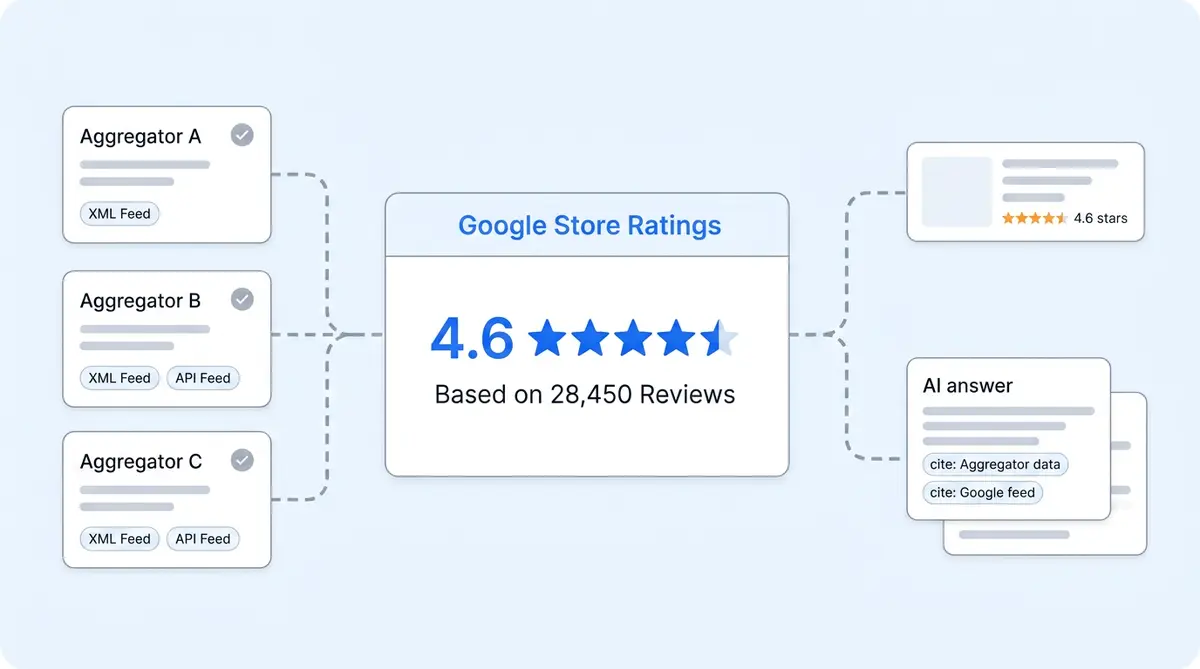
To qualify for store ratings, your business needs at least 100 unique customer reviews collected within the past 12 months and an average star rating of 3.5 or higher. Google doesn't collect these reviews itself. Instead, it ingests them from a published list of approved third-party review aggregators through structured XML feeds or the Content API for Shopping.
One distinction most guides skip: Google Store Ratings (Seller Ratings) rate your store as a merchant across Google Search. Product ratings rate individual SKUs. Both store ratings matter for visibility in ads and free listings, but they flow through different data paths in Merchant Center.
How the "Google-Approved" Status Works
"Google-approved partner" isn't a marketing badge. It's an integration contract. The review partners pass structured review data to Google through a defined feed format, and Google validates the data meets its quality and formatting standards before displaying store ratings across ads and free listings.
Brands can't self-publish review counts to Google directly without either using one of these approved aggregators or implementing schema.org markup for first-party reviews (which has its own eligibility requirements).
The approved list includes over a dozen providers. The right choice depends on your collection method, syndication scope, locale coverage, and pricing. But there's a new criterion most brands aren't considering yet.
The New Layer: AI Engines and Review Provenance
When a shopper asks ChatGPT, "Is [brand] reliable?" or Gemini, "Best mattress for back pain", the AI engine assembles an answer from multiple sources. Reviews are a major input. But not all review data is equally visible to these models.
AI engines preferentially cite sources with three qualities: structured data, public accessibility, and recognizable provenance. Google-approved store ratings review partners check all three boxes. Their data is schema-marked, publicly crawlable across Google Search, and comes from a known, vetted source that helps your SEO and AI presence simultaneously.
An e-commerce store using only on-site reviews behind JavaScript rendering, or a non-syndicated review tool with no structured output, often appears unrated to AI engines. Even with thousands of happy customers, the reviews simply aren't in a format that LLMs can discover and trust.
This means your review platform choice is no longer just a conversion rate optimization decision. It's an AEO and GEO decision that directly affects whether AI engines recommend you or your competitor.
A Practical Decision Framework
When picking or auditing your store ratings and review partners' infrastructure, run through this checklist:
- Is the provider on Google's published approved list? Check the official Google Merchant Center help docs for the current roster of supported review partners.
- Does it syndicate structured markup to your PDPs? Look for schema.org/Review and AggregateRating on your product pages, which also helps your SEO, Google Seller Ratings quality, and Google Ads performance.
- Are reviews accessible to AI crawlers? If reviews sit behind a login wall, iframe, or JavaScript-only widget with no server-side rendering, LLMs can't see them.
- Does it cover the locales where you sell? AI engines serve locale-specific answers across multiple regions. Reviews in only one language limit your store ratings' citation potential in other markets.
- Can you verify reviews are reaching Merchant Center? The Store Ratings dashboard in Google Ads confirms whether your review partners' feed is active and meeting thresholds for ads and free listings.
If your current setup fails on points 2, 3, or 4, you have a citation gap that's costing you AI visibility right now.
Where Alhena AI Visibility Fits
Alhena doesn't syndicate reviews or manage your Merchant Center feed. That's your review platform's job. What Alhena AI Visibility does is show you what's actually happening downstream after your reviews enter the AI ecosystem.
At the SKU level, Alhena monitors how your products appear in ChatGPT, Gemini, and Perplexity answers. Its GEO Citation Strategy identifies which external sources (review sites, forums, and editorial content) are influencing those AI outputs and whether they're helping or hurting your brand perception.
For example, if a stale 3.2-star Trustpilot snippet from 2023 is pulling down your AI sentiment while your current rating sits at 4.7, Alhena surfaces that gap. You can then prioritize getting fresh review data into the sources AI engines are actually citing.
The combination works like this: your review aggregator handles the input (collecting and syndicating reviews to Google). Alhena handles the output (monitoring how AI engines interpret and surface that review data to shoppers).
Why This Matters Now
The e-commerce brands getting store ratings right treat review infrastructure as a two-sided investment. On one side: Google Ads CTR and shopping visibility through Google Store ratings and free listings. On the other hand: organic search, SEO, and AI citation visibility that compounds over time as more shoppers shift research to LLM-powered tools and Google Search surfaces AI-generated answers.
According to Alhena's own data, LLM-referred visitors already convert at rates comparable to branded search. A brand that's invisible in AI answers because its review data isn't structured or syndicated is leaving that channel entirely to competitors.
The fix isn't complicated. Audit your store ratings and review partners against the checklist above. Confirm your reviews are reaching Google Ads and free listings and are crawlable by AI engines across Google Search. Then use SKU-level AI visibility monitoring to verify you're actually being cited, not just indexed.
Ready to see how your products appear in AI shopping answers today? Book a demo with Alhena AI Visibility or start free with 25 conversations.
Frequently Asked Questions
What are Google Seller Ratings?
Google Seller Ratings are aggregate review scores (1-5 stars) displayed alongside Search ads, Shopping ads, and free listings. They require at least 100 unique reviews in 12 months with a 3.5+ star average, collected through a Google-approved third-party review aggregator.
How do Google Store Ratings affect AI search visibility?
AI engines like ChatGPT and Gemini preferentially cite review sources with structured data and recognized provenance. Google-approved aggregators produce exactly that type of data, making brands using them more likely to be cited in AI shopping answers.
Can I get Seller Ratings without a Google-approved review partner?
You can use schema.org markup for first-party reviews on your site, but eligibility requirements are stricter. Most brands find it faster and more reliable to use an approved aggregator that handles the feed formatting and submission to Google automatically.
Does Alhena AI syndicate reviews to Google?
No. Alhena AI Visibility monitors how your products appear in AI-generated answers across ChatGPT, Gemini, and Perplexity. It identifies which external sources (including review sites) are influencing AI outputs, but it does not collect or syndicate reviews itself.
How do I check if my reviews are visible to AI engines?
First, confirm your review data has schema.org markup on your PDPs and is publicly crawlable (not behind JavaScript-only rendering or login walls). Then use an AI visibility tool like Alhena to monitor whether AI engines are actually citing your review data in shopping answers.
What is the difference between Seller Ratings and Product Ratings?
Seller Ratings evaluate your business as a merchant (trustworthiness, shipping, service). Product Ratings evaluate individual SKUs (quality, features, value). Both flow through different data paths in Google Merchant Center and both influence AI citation differently.