What Zero-ETL Actually Means
Zero-ETL is a data integration pattern that removes the need for customer-built ETL pipelines. Amazon Web Services introduced the concept in 2022 when Amazon Aurora gained zero-ETL replication to Amazon Redshift. The Amazon Aurora to Amazon Redshift data pipeline runs automatically. Aurora and Redshift handle the data engineering, letting data warehouse teams skip ETL pipelines entirely. Since then, Salesforce Data Cloud and Snowflake have adopted their own zero ETL data integration variations for AWS cloud data warehouse workloads, including streaming and batch use cases.
In traditional ETL processes and data integration workflows, the transformation step is where complexity lives: mapping fields, normalizing schema formats, handling schema changes, and managing complexity. ETL tools must extract and transform data before loading and managing data movement between systems. Zero-ETL integration eliminates that transformation burden by creating native, direct data access between source and destination systems. Better data quality, faster analytics and operational insights, and simpler governance. Common use cases include cloud analytics and cross-platform reporting on how ETL data flows across your stack.
But zero ETL is a warehouse replication pattern. It handles data movement and transformation between storage systems. It wasn't designed to put live, accurate answers into an AI agent's response during an operational customer conversation.
Why Ecommerce AI Needs More Than Data Replication
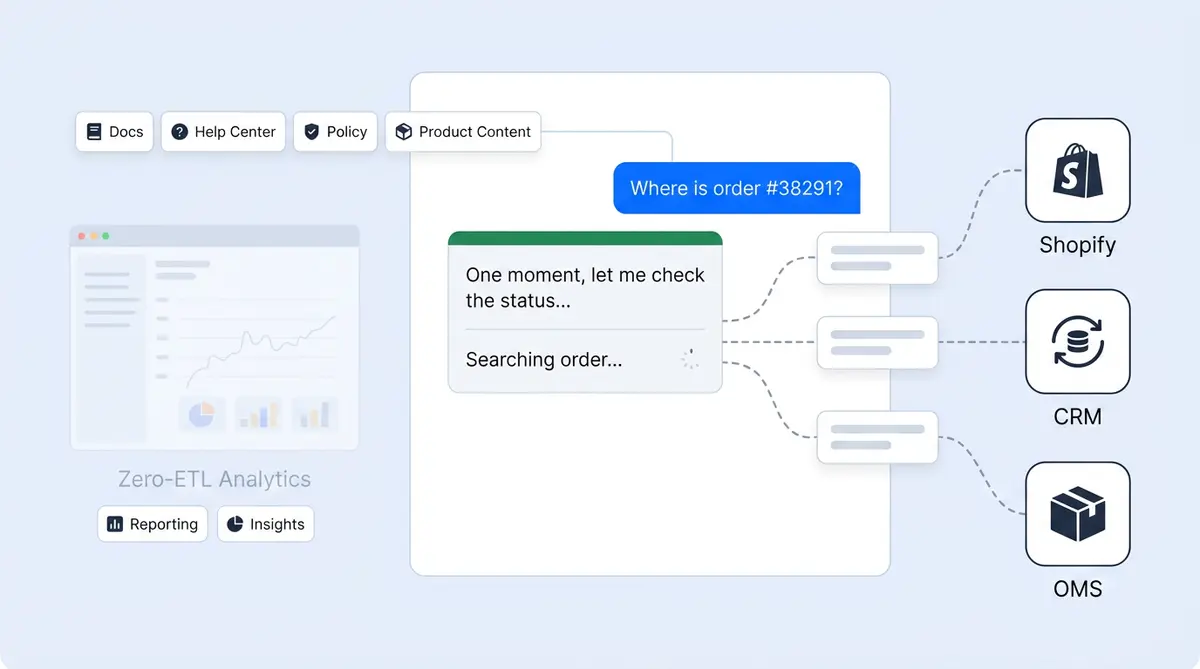
When a shopper asks "Where is my order?" your AI support agent doesn't need a data warehouse. It needs a live API call to Shopify right now, returning that specific order's tracking status. A warehouse replica that syncs every 15 minutes might show yesterday's shipping update. That's not good enough.
Ecommerce AI support needs two data modes working together:
- Broad knowledge covering your full product catalog, policies, and help articles. This data changes less frequently and benefits from scheduled data ingestion across multiple data sources. Batch or streaming data feeds keep it current.
- Live, per-query data answering customer-specific questions about orders, accounts, and availability. This must come as real-time data from the source system.
No single data pipeline pattern handles both. Traditional ETL processes add transformation lag. Zero-ETL integration removes the transformation step but still replicates ETL data into a warehouse. Pure API calls can't cover broad knowledge indexing. Organizations can get the best results with a hybrid approach.
How Alhena AI Solves This Without a Warehouse
Alhena AI pairs scheduled knowledge ingestion with live tool-calling at conversation time. No data warehouse, no ETL pipelines or ETL processes to create or maintain. This data architecture meets the requirements of e-commerce teams. Unlike traditional ETL tools that gate data access behind scheduled batch runs that need both broad knowledge and real-time answers with agility.
Alhena ingests helpdesk articles, product catalogs, and policy pages on a schedule. Our Knowledge Freshness Guide covers exactly how this works, including update cadence and verification.
For live queries, Alhena makes direct API calls to source systems during conversations. Order status from Shopify. Return eligibility from your OMS. Real-time data comes back in milliseconds. For teams that want to connect dozens of systems, Alhena supports MCP servers and API tools that give your AI agent access to thousands of platforms without writing code. As your operational requirements change, you add new data sources instantly.
What This Looks Like in Practice
A customer messages your store at 9 PM: "I ordered the Silk Serum three days ago and haven't got a shipping email."
- The AI identifies this as an order status query and triggers a live Shopify API call.
- SDK metadata from the website passes the customer's session context automatically.
- The API returns: shipped yesterday, tracking number available, and delivery in two days.
- The agent responds with the specific tracking link, grounded in live data.
No warehouse involved. No replication delay. No ETL processes. The answer reflects the order's status at that exact moment. Because every response traces back to a verified source, there's no risk of the AI hallucinating a shipping date. That's the grounded retrieval approach Alhena uses across every agentic conversation, delivering direct data insights with operational accuracy.
When Zero-ETL Still Makes Sense
Zero-ETL isn't wrong. It solves a different problem well. If your analytics team needs a unified view of customer behavior for BI dashboards, operational insights, and cohort analysis, zero-ETL integration into a data warehouse is the right call. The transformation, schema management, governance, and data quality controls that analytics and machine learning teams require are exactly what zero-ETL delivers.
But for the AI agent answering customer questions in real time? You need live tool-calling, not replicated tables. The two approaches complement each other. Your warehouse feeds dashboards, machine learning models, and real-time insights. Your AI agent calls APIs. Both are valid use cases for different data needs. You don't need to build additional infrastructure or copy SaaS data into yet another system.
Alhena fits as the AI layer that sits on top of your existing stack, connecting to source systems directly without complex data pipeline overhead. Our headless commerce architecture guide covers how this fits into composable stacks.
Key Takeaways
- Zero-ETL is a data warehouse and data integration pattern, not an AI agent pattern. It improves data movement between storage systems.
- Ecommerce AI needs two data modes: scheduled ingestion for broad knowledge and live API calls for per-customer queries.
- Alhena AI combines both without requiring a data warehouse, ETL pipelines, or data engineering resources.
- The result is grounded, real-time answers with strong data quality and real-time data accuracy that trace back to verified sources with zero hallucination risk.
Ready to simplify your data integration and see how Alhena handles your data stack? Book a demo or start for free with 25 conversations.
Frequently Asked Questions
What is Zero-ETL and how does it relate to ecommerce AI?
Zero-ETL is a data-warehouse replication pattern that moves data between systems without building ETL pipelines. Traditional ETL required dedicated data engineering teams. Amazon Web Services, including Amazon Aurora and Amazon Redshift, along with Salesforce, and Snowflake use it for cloud analytics workloads and simplified data access. For ecommerce AI agents, it solves part of the data freshness problem but doesn't handle live per-conversation queries.
How does Alhena AI access real-time customer data during conversations?
Alhena uses live API tool-calling during conversations. The agent makes a direct API call to Shopify or your CRM. Real time data responses return in milliseconds.
Does Alhena AI require a data warehouse to work?
No. Alhena combines scheduled knowledge ingestion for catalogs, policies, and help articles with live API calls for order-specific and account-specific queries. There's no data warehouse, no ETL pipeline, and no engineering team needed to maintain data flows.
What is the difference between Zero-ETL and live tool-calling?
Zero ETL replicates datasets between storage systems. Live tool-calling fetches specific data from source systems on demand. Zero ETL suits analytics dashboards. Live tool-calling suits AI agents needing real time data.
How does Alhena keep its knowledge base current without ETL?
Alhena ingests from helpdesks, catalogs, and policy pages on a schedule. Changes sync incrementally.
Can Alhena connect to systems beyond Shopify and helpdesks?
Yes. Alhena supports MCP servers and API tools connecting to thousands of platforms. No code or data pipelines needed.