The Risk No One Talks About: Unauthorized Order Lookups
A shopper types 'Where is order #1042?' into your AI chatbot widget. If your AI answers with a name, shipping address, line items, and tracking link to anyone who asks, you've just created a PII disclosure incident.
For Shopify merchants using AI chatbots, the risk is sharper than you'd think. Order numbers are often short, sequential, and guessable. An order tracking link can expose the carrier, ZIP code, and recipient name. That's enough for social engineering, porch piracy, or a chargeback scheme.
The question isn't whether your AI can look up orders. It's whether it knows who it's talking to before it shares anything.
How Alhena's Order Lookup Flow Works on Shopify
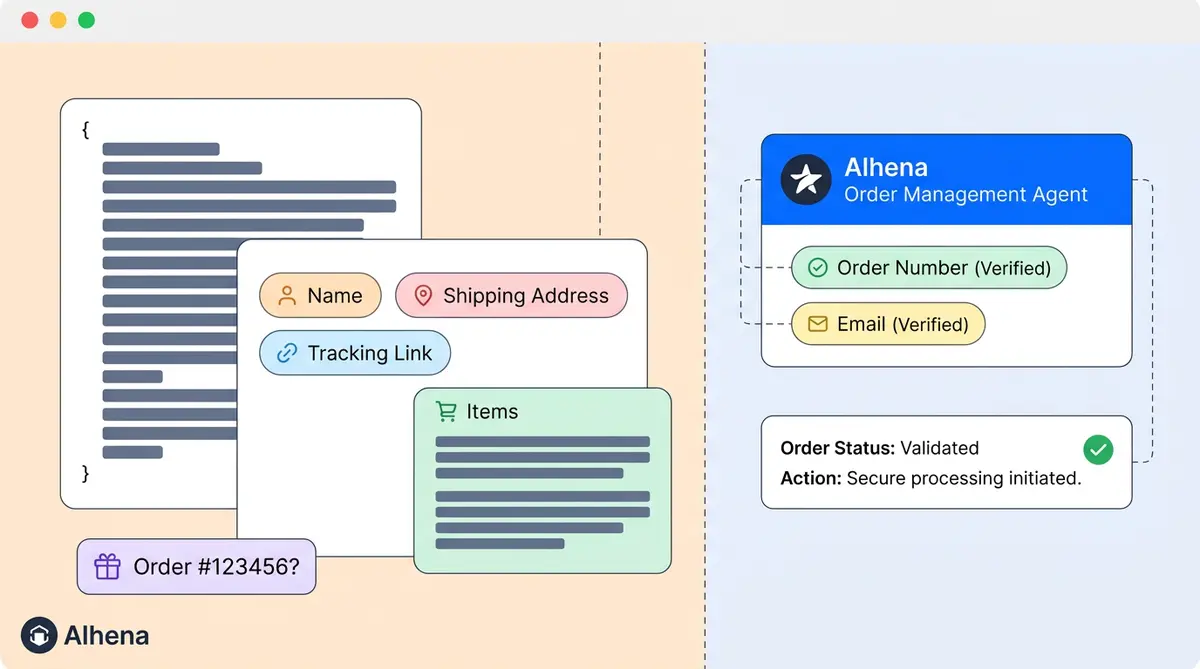
When you connect Shopify to Alhena AI, two specialized agents with distinct capabilities activate: the Order Management Agent and the Product Expert Agent. The order management agent is the one handling "Where is my order?" queries, and it follows a strict data-access workflow.
Here's the actual flow:
- A customer asks an order-related question in the chatbot.
- The Order Management Agent decides to invoke the order lookup tool.
- The tool requires an order number, an email address (customer emails are the binding key), or both. Without at least one identifier, it returns a prompt asking the customer to provide one. The AI can't fish for orders with no input.
- Alhena queries Shopify's API using the provided identifiers. If both are supplied but don't match jointly, it falls back to an email-only search, keeping email as the binding key.
- The agent returns relevant order details: order status, fulfilment status, order tracking info, and totals.
Product catalog data refreshes daily, but order and customer data is fetched on-demand, only when a customer query triggers the lookup. Nothing is cached or stored beyond the conversation.
This pattern means a random visitor can't just guess an order number and get results. The email requirement acts as an identity-binding layer, tying the lookup to something only the actual user knows. For a deeper look at the full AI order management workflow, we've covered that separately.
Identity Verification Patterns Every Merchant Should Know
Alhena's two-identifier approach fits into a broader set of identity-binding patterns. Understanding them helps you when building a framework to evaluate any AI chatbot or support systems you connect to live order data.
- Single-factor lookup (order number alone): High disclosure risk. If numbers are sequential or short, anyone can guess them. Not recommended for AI-facing tools.
- Two-factor binding (order number + email): The dominant pattern for self-service order lookup on the web. Raises the cost of a guessing attack significantly. This is how Alhena works.
- Authenticated context: The customer is already logged into your storefront before the chat loads. The strongest signal, because identity is asserted by Shopify itself.
- Out-of-band challenges (one-time codes via email/SMS): Used by some customer support systems for high-sensitivity disclosures like full payment details. A good option for specific scenarios, though it adds friction.
No single method is a silver bullet. Risk depends on which fields the AI is allowed to return, not just which fields it asks for. That brings us to the next layer: controlling what the AI actually says.
Data Minimization: What You Fetch vs. What You Say
Alhena's order tool fetches a full data set from Shopify: order number, fulfilment status, country code, totals, tax and shipping breakdowns, line items, tracking companies, numbers, and URLs.
But fetching data and disclosing data are two different things.
You can shape what Alhena's agent actually says in its response through agent guidelines and guardrails. For example, the agent can say "your package is shipped and out for delivery" without reading out the full street address. It can confirm the tracking carrier without exposing the recipient's name.
This is the response-layer control that most merchants overlook. The trust design patterns behind these choices matter as much as the verification step itself.
A Practical Security Checklist for Shopify Merchants
Before you connect any AI to your Shopify order data, run through this list:
- Require two identifiers for any order-data response. Order number plus email is the minimum bar.
- Constrain the agent's response to the smallest set of fields that answers the question. Don't expose addresses or payment details when all the customer asked was "Has it shipped?"
- Audit chat logs regularly. Have a human review what the agent is actually saying, not just what it has access to.
- Note: account for chat transcripts in your DSAR workflows. If a customer requests data deletion under GDPR or CCPA, chat history counts.
- Keep an off switch. In Alhena, one click in settings to disconnect Shopify revokes data access and disables the connected agents instantly.
- Review your vendor's compliance posture. Alhena is SOC 2 Type 2 compliant and runs GDPR-ready multi-region architecture.
Results When AI Order Management Is Done Right
When order lookups are both fast and secure, the results show up in your numbers. Puffy automated 63% of customer inquiries through AI automation with Alhena while maintaining 90% CSAT. Tatcha drove 11.4% of total site revenue and sales through AI, with 82% chat deflection through customer support automation.
These brands didn't compromise on security to get speed. They got both because the AI agent architecture was designed with identity verification and data minimization from the start, not bolted on after launch.
Alhena connects to Shopify, deploys in under 48 hours, and doesn't need dev resources. The unified memory layer carries customer context across channels so shoppers don't repeat themselves, while the identity-binding pattern ensures order data only goes to the right human.
The Bottom Line
Secure AI order tracking isn't a feature you toggle on. It's a set of choices: which identifiers you require, which fields you return, and how transcripts are governed. The merchants who get this right don't just avoid data incidents. They build the kind of trust that turns one-time buyers into repeat customers, building human trust at scale.
Ready to see how Alhena handles order lookups on your Shopify store? Book a demo or start free with 25 conversations.
Frequently Asked Questions
How does Alhena verify a customer's identity before sharing order details?
Alhena's Order Management Agent requires at least one identifier, either an order number or an email address (customer emails are the binding key), before returning any order data. When both are provided, email acts as the binding key. If they don't match jointly, the agent falls back to email-only search, so a random visitor can't guess an order number and get results.
What order data does Alhena pull from Shopify?
Alhena fetches order number, fulfillment status, country code, totals, tax and shipping breakdowns, line items, tracking companies, tracking numbers, and tracking URLs. You control which of these fields the agent actually shares with the customer through agent guidelines.
Can I limit what the AI says even though it has access to full order data?
Yes. Alhena separates data access from data disclosure. The agent fetches the full order record from Shopify, but you configure response-layer guardrails so it only shares the fields that answer the customer's question. For example, it can confirm a package is shipped and out for delivery without reading out the shipping address.
Is Alhena AI SOC 2 Type 2 compliant?
Yes. Alhena holds SOC 2 Type 2 certification and runs a GDPR-ready multi-region architecture with PII scrubbing for helpdesk imports. These controls cover data handling across all connected integrations, including Shopify order lookups.
How quickly can I connect Alhena to my Shopify store?
Alhena connects to Shopify and deploys in under 48 hours with no developer resources required. The Order Management Agent and Product Expert Agent activate automatically once the integration is live.
What happens if I disconnect Shopify from Alhena?
Disconnecting Shopify in Alhena's settings revokes data access and disables the connected agents instantly. No order or customer data persists after disconnection.
Does Alhena cache or store order data between conversations?
No. Product catalog data refreshes daily, but order and customer data is fetched on-demand from Shopify's API only when a customer query triggers a lookup. Nothing is cached or stored beyond the active conversation.