Every AI vendor claims their chatbot "remembers" customers. The word appears on landing pages, pitch decks, and feature lists. But when you ask a simple question, "Can I see exactly which memories the AI used in that response?", most vendors go quiet.
Recall without transparency is a black box. And black boxes don't build trust with merchants or shoppers. This post covers how to verify that your AI agent's memory is real, accurate, and working for you and your consumers.
What AI Memory Should Actually Do
A returning customer who told your AI last month that she has sensitive skin shouldn't be recommended a retinol serum today. A shopper who bought a king-size mattress in January shouldn't see twin-size sheet suggestions in March.
That's what real AI memory looks like in practice. The LLM extracts facts from conversations in real-time, ties them to a customer identity (email, user ID, or login), and recalls those facts in future sessions to shape better responses. This covers both episodic memory (what happened in a specific conversation) and semantic memory (general preferences learned over time).
But "better responses" only matters if the facts are correct. A recall system that stores wrong information, like noting "prefers size 8" when the customer said "size 9," does more harm than no memory at all. That's why transparency is the feature that separates real memory from marketing copy.
Answer Sources: The Transparency Layer Merchants Need
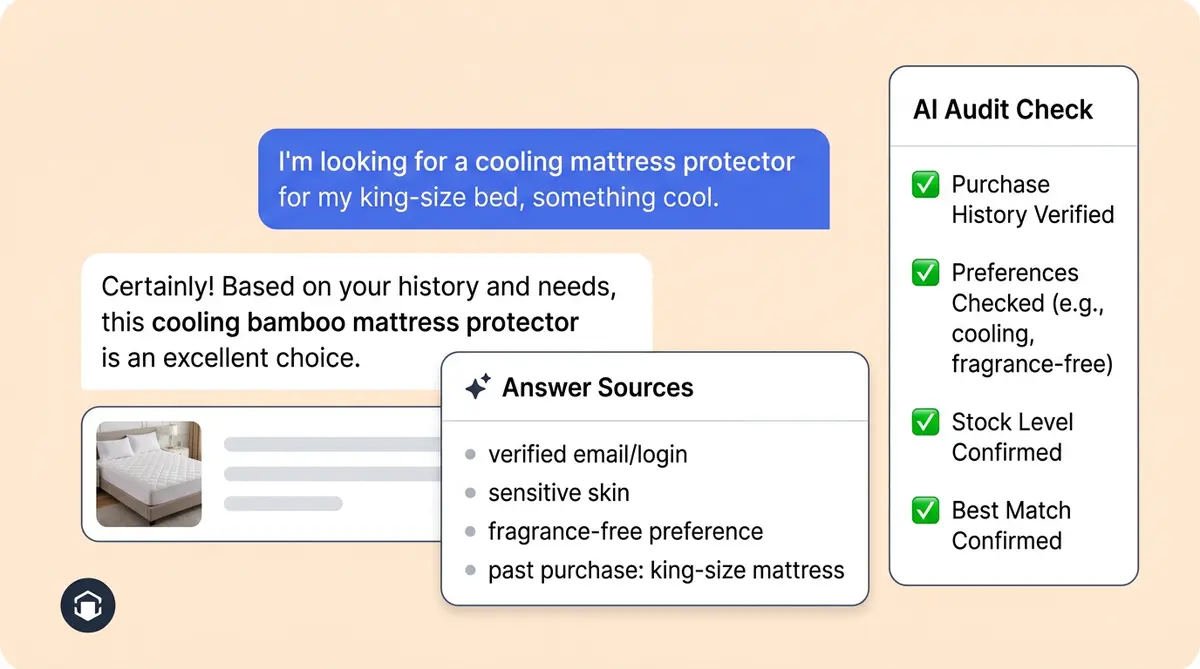
Alhena AI's User Memory system includes a built-in audit trail called 'Answer Sources'. For any AI response in a conversation, you can expand a dropdown and see exactly three things:
- Agent: which of the AI agents handled the message (Product Expert, Order Management, etc.)
- User memories recalled: the specific customer facts the AI pulled from different memory types for that response
- Knowledge used: the product data, knowledge base data, help docs, or policies referenced
This isn't a summary or a confidence score. It's the actual list of facts the AI used, displayed as bullet points. If the AI recommended a fragrance-free moisturizer, you can verify it recalled "customer has sensitive skin" from a conversation two weeks ago.
One important detail: user memories only appear in Answer Sources when the AI actually recalled and applied them. New visitors or customers without stored history won't show this section. That's honest behavior, not a bug.
Four Things to Check When Auditing AI Memory
Whether you're evaluating Alhena or any other AI tool, here's what to look for when testing memory claims.
1. Can you see which facts were used per response? Not a general "memory is active" indicator. You need per-response attribution showing the exact facts recalled. Alhena's Answer Sources provide this at the individual message level.
2. Do memories update when facts change? A customer who moved from New York to Austin should have their location updated, not appended. Alhena's memory architecture runs an ADD, UPDATE, or DELETE operation on every extracted fact, with evolution chains that preserve the history of changes. Unlike systems that rely on a vector database for fuzzy matching, Alhena uses LLM-ranked retrieval scoped to each tenant, avoiding the accuracy issues that come with vector database embeddings.
3. Does memory work across channels? If a customer shares their skin type on web chat, does the AI recall it when they send an Instagram DM next week? Cross-channel identity resolution is where most "memory" claims fall apart. Alhena ties memories to a unified customer identity across chat, email, social, and voice.
4. Is memory fed by more than just chat? Conversation-extracted preferences are valuable, but they're incomplete without order history. When your Shopify store is connected, Alhena also ingests purchase data, so the AI knows what customers bought, not just what they said.
Why This Matters for Revenue
Memory isn't a support feature. It's a sales feature. When the AI remembers a customer's preferences, it skips redundant questions and jumps straight to relevant product discovery and recommendations. That's fewer steps to checkout and higher conversion rates.
Tatcha saw a 3x conversion rate and 38% higher average order value after deploying Alhena's AI shopping assistant, which uses memory to build personalized skincare routines for returning visitors. The AI doesn't ask "what's your skin type?" if it already knows.
The psychology behind this is straightforward: consumers who feel recognized by a digital shopping assistant buy more confidently. Memory turns a generic digital chatbot into a shopping experience closer to a sales associate who knows your name. Shoppers come back when they feel understood.
The Bottom Line
AI memory is only as trustworthy as your ability to verify it. Before you commit to any AI shopping assistant, ask for a live demo where you can see the exact facts recalled per response. If the vendor can't show you that, their "memory" is a feature label, not a feature.
For a deeper look at how Alhena's memory system works under the hood, read the technical architecture breakdown or explore how it fits into your broader personalization stack.
Ready to see AI memory in action? Book a demo with Alhena AI or start for free with 25 conversations.
Frequently Asked Questions
What are Answer Sources in Alhena AI?
Answer Sources is a transparency feature that shows merchants exactly which customer memories, product data, and knowledge documents the AI used to generate each response. You can access it by clicking a dropdown on any AI message in the Conversations section.
How does AI memory work for ecommerce?
AI memory extracts facts from customer conversations (preferences, sizes, skin type, past concerns) and ties them to a customer identity like an email address. When that customer returns, the AI recalls those facts and uses them to give personalized responses instead of starting from scratch.
Can Alhena AI remember customers across different channels?
Yes. Alhena uses cross-channel identity resolution to maintain a single memory profile per customer across web chat, email, Instagram DMs, WhatsApp, and voice. A preference shared on one channel carries over to every other channel.
Does Alhena AI use purchase history from Shopify?
Yes. When connected to Shopify, Alhena ingests order history alongside conversation-extracted memories. This means the AI knows what a customer bought, not just what they said in chat, giving it a more complete picture for recommendations.
How do I know if the AI recalled the right customer facts?
Open any AI response in the Conversations dashboard and expand Answer Sources. The 'User memories recalled' section lists the exact facts used. If a fact is wrong or outdated, you can identify it immediately rather than guessing.
Does AI memory help increase conversion rates?
Yes. Memory lets the AI skip redundant questions and jump to relevant recommendations, which shortens the path to checkout. Tatcha saw a 3x conversion rate after deploying Alhena's memory-equipped AI shopping assistant.