Industry analysts project that 75% of enterprise buyers today expect AI agents to handle most routine commerce and retail tasks by 2027. Yet most e-commerce brands and businesses are still stuck on basic conversational AI chatbots that answer consumer and shopper FAQs and little else, leaving the entire shopping journey and shopping experience to static pages.
For a ranked comparison of the top platforms, see our guide to the best AI agents for ecommerce in 2026.
The gap isn't technology. It's sequencing. Businesses that try to jump straight from a scripted chatbot to fully autonomous AI commerce burn budget, confuse merchants, their teams, and partners, and end up pulling the plug. The ones that succeed follow a phased commerce approach, building trust, data foundations, commerce operations, and operational muscle while managing risk in the right order, creating a first-mover advantage.
This agentic commerce post maps out a practical agentic 12-month sequence for moving from chat to agentic execution. It's not a maturity model (we already published a detailed one here). It's a calendar you can actually follow, reshaping how your commerce team works with AI at each stage.
Days 1 to 90: Get Your Data House in Order
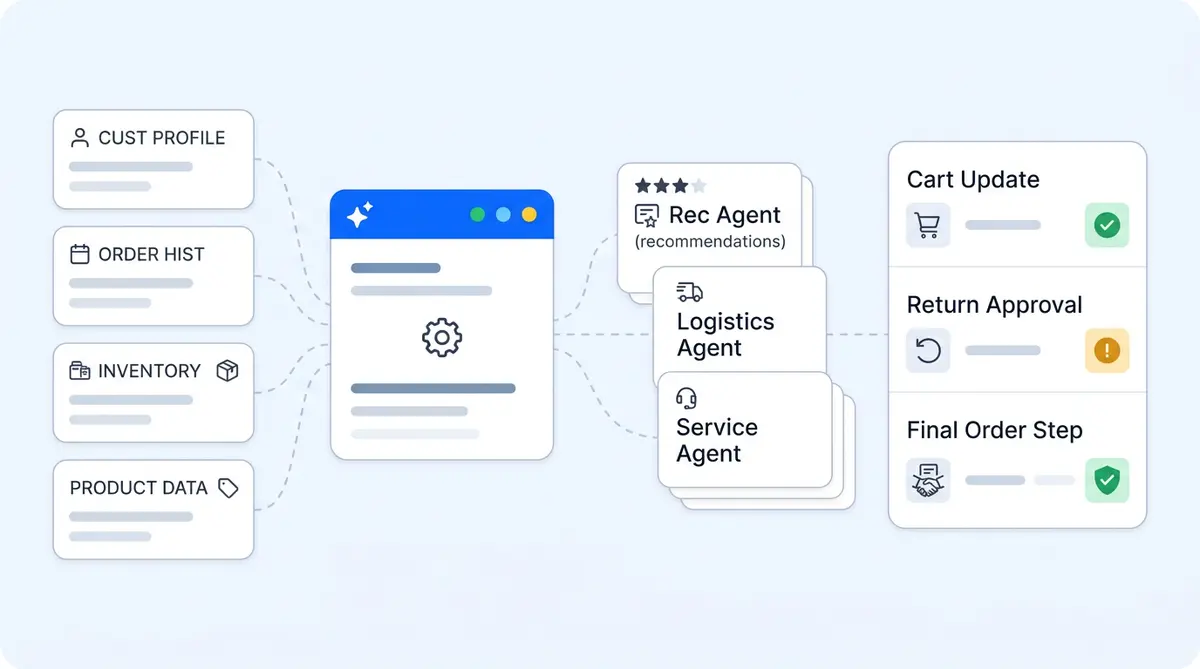
Nothing else matters if your AI can't access accurate, real-time data. In agentic commerce, the first 90 days should focus on connecting four data planes to your digital AI layer:
- Catalog and inventory so the AI never recommends out-of-stock products
- Order and fulfillment data so it can answer "where's my order?" with a real tracking number
- Customer identity and history across services so it knows who it's talking to across channels
- Policies and knowledge content so answers stay grounded in your actual return, shipping, and warranty rules in structured, machine-readable format
This is where most pilots stall. If your AI pulls stale inventory from a nightly sync into ai systems, shoppers get confident-sounding wrong answers. That's worse than no AI at all. Real-time connections to your commerce platform (whether that's Shopify, WooCommerce, or Salesforce Commerce Cloud and other commerce platforms) are non-negotiable.
Alhena connects via API to your store's live catalog, order system, and helpdesk knowledge base and can be deployed as a shopping assistant in under 48 hours without dev resources or custom tools. By day 90, you should be able to ask the AI "Do you have this in size M?" and "Where's order #1234?" and get verified, AI-powered, real-time answers on at least one channel.
Months 3 to 6: Deploy Task-Specific Agents
The instinct is to build one mega-agent that does everything. Resist it. In an agentic system, a single agent with broad scope is harder to evaluate, harder to guardrail, and fails in unpredictable ways.
Instead, deploy specialized AI agents with bounded agentic responsibilities and scoped tools. These AI-powered shopping tools form a strong first wave for e-commerce, covering:
- Product discovery, catalog search, and recommendations that guide shoppers to the right SKU with personalization, AI assistant recommendations, and tailored suggestions
- Order status and tracking with identity verification and checkout authentication before exposing shopper data
- Returns and exchanges initiation based on your actual policy
- Human handoff with full conversation context when the AI hits its limits
Start with an agent-assist setup where AI suggests replies to your human reps. This lets you gather supervised feedback and build confidence before graduating flows to fully automated handling. Alhena ships with an AI-powered Product Expert Agent and an Order Management Agent built in, so you're not building from scratch.
By month 6, you should have at least three task-specific agents live in production with weekly reviews of flagged conversations and measurable resolution rates through ongoing optimization. If you're unsure whether you're ready for this phase, this readiness checklist can help you assess.
Months 6 to 12: Graduate to Bounded Autonomous Execution
Notice the word "bounded". No honest vendor will tell merchants AI can run your entire digital commerce operation autonomously in 2026. What it can do autonomously for shoppers is execute specific write actions within transaction limits you define for your shoppers.
This phase is about graduating your AI agents from read-only to agent acting and action-taking, whether shoppers find you on your site, ChatGPT, or other AI surfaces:
- Execute refunds under a dollar threshold you set
- Updating shipping addresses and delivery preferences before fulfillment
- Pausing or modifying subscriptions
- Populating shopping carts, pre-filling the checkout flow, and confirming payment and processing transactions for shoppers
Every write-enabled agent needs three guardrails: explicit confirmation before executing, immutable action logs, and clear escalation triggers. Get legal and finance sign-off on action limits before you flip the switch.
This is also when you expand channels. The same agents, the same orchestration layer, and the same unified memory should work across web chat, email, Instagram and WhatsApp DMs, and voice. Brands like Tatcha reached 3x conversion rates and 11.4% of total site revenue from AI by following this kind of AI-mediated, A2A-capable, phased rollout rather than trying to do everything at once.
The Real Roadblock Isn't Technology
The pattern across stalled retail AI programs is consistent: missing data ownership, missing evaluation rigour in retail operations, or missing guardrail policy. The AI itself is rarely the bottleneck.
Before you start, assign a data owner for each of the four data planes. Define what "good" looks like with hard KPIs, not vibes. And document your guardrail policies before your agentic systems need them, not after something goes wrong.
If you want to see where your brand sits on the maturity curve right now, run through our AI maturity self-assessment. And for a deeper look at what agentic commerce actually means and the protocols driving it, our complete guide covers the full picture.
Ready to start your 12-month journey? Book a roadmap review with Alhena AI or start free with 25 conversations to see how the first 48 hours work.
Frequently Asked Questions
What is agentic ecommerce?
Agentic ecommerce is when AI agents don't just answer questions but act on behalf of shoppers, merchants, and brands. That includes populating carts, processing returns, updating orders, and completing full checkout steps. It goes beyond conversational AI by combining reasoning, tool use, and memory across sessions.
How long does it take to deploy an AI agent for ecommerce?
With Alhena AI, initial deployment takes under 48 hours. The AI connects to your commerce platform, ingests your structured catalog data and policies, and goes live on web chat. Expanding to additional channels and platforms and task-specific agents typically happens over the following weeks.
What's the difference between a chatbot and an agentic AI system?
A chatbot matches keywords to scripted responses. An agentic AI system reasons through complex, multi-step, multi-tool problems, calls APIs, tools, and API endpoints to fetch live data, remembers past interactions, and can take actions like issuing refunds or updating shipping addresses within defined guardrails.
Do I need developers to set up agentic commerce?
Not with Alhena. The platform connects to Shopify, WooCommerce, Magento, and Salesforce Commerce Cloud without custom code. You create and configure agents, policies, and guardrails through a dashboard with built-in tools. Most brands launch their first agent without any dev involvement.
What guardrails should AI agents have before taking actions?
Every action-taking agent needs three guardrails: explicit confirmation before executing high-impact actions, immutable logs of every action taken, and clear escalation triggers for edge cases. Dollar thresholds, fraud checks on payment transactions, policy boundaries, and human approval workflows should all be defined before go-live.
How do I measure ROI from agentic AI in ecommerce?
Track four metrics: AI-assisted conversion rate, average order value lift on AI-assisted sessions, support ticket deflection rate, and CSAT scores. Alhena's built-in revenue attribution dashboard tracks all of these. Tatcha saw 3x conversions and 11.4% of total site revenue from AI-assisted interactions.