TL;DR
An ecommerce store is ready for agentic commerce when shoppers hesitate before checkout, ask repeated product questions, and rely on support for buying decisions. These signals show the need for AI agents that guide product discovery, reduce confusion, and help customers choose with confidence across the shop journey.
Readiness Rarely Looks Like “Innovation”
Agentic commerce is projected to hit $1.7 trillion by 2030, and e-commerce brands are racing to adopt AI agents that handle product discovery, agentic checkout, and post-purchase support. But not every store is ready. This checklist covers 11 readiness signals that separate brands prepared for agentic e-commerce from those that aren't.
Most e-commerce teams don’t wake up thinking about AI power or autonomous systems.
They notice:
- Shoppers asking the same comparison questions
- Conversion dropping before checkout
- Support teams stepping in to guide decisions
- Product discovery becoming harder as catalogs grow
This is where agentic commerce naturally enters the picture.
Not as a shiny AI feature. But as a response to complexity in the modern shop journey.
Learn More here.
Here are 11 clear signs your e-commerce store is already there.
What Is Agentic Commerce?
Agentic commerce uses AI agents that operate autonomously to help shoppers make better decisions.
Unlike traditional chatbots or basic AI search, these agents:
- Understand intent across the shopper journey
- Reason through product complexity
- Guide discovery without overwhelming the shopper
- Act only when guidance is needed
Think of it as generative AI applied to decision-making, not just answers. Think of it as digital clienteling at scale.
11 Signs Your Ecommerce Store Is Ready for Agentic Commerce
1. Customers Ask the Same Decision Questions Every Day
Questions like:
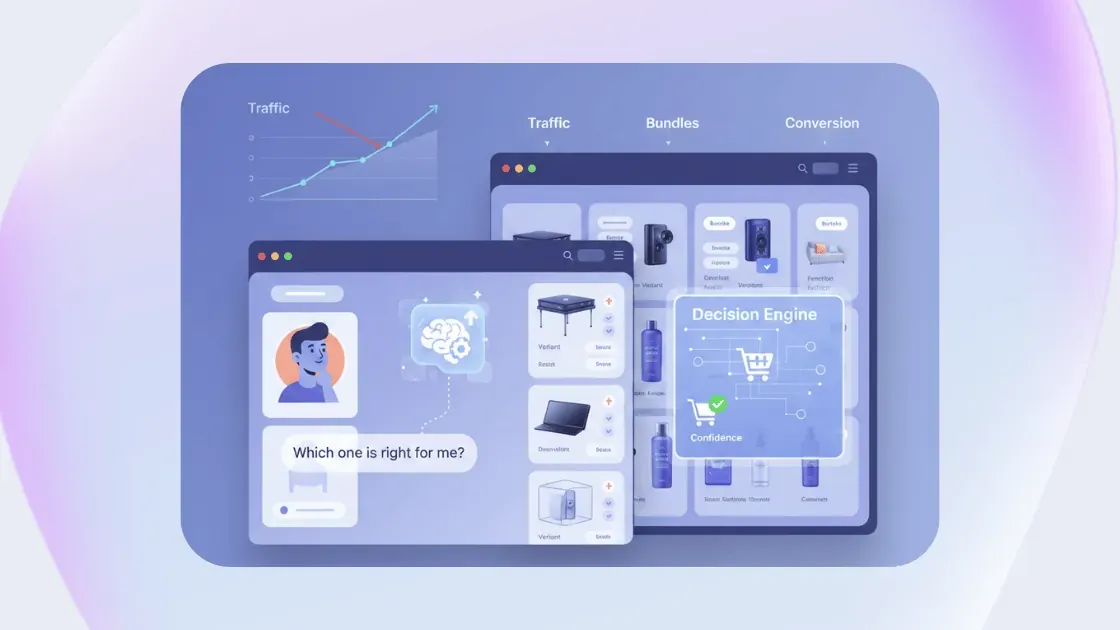
- “Which one is right for me?”
- “What’s the real difference between these?”
- “Is this better for my use case?”
This isn’t a support problem. It’s decision friction in product discovery.
When these questions repeat at scale, AI agents can resolve them autonomously.
2. Your Support Team Is Already Doing Pre-Sales
If your team:
- Recommends products
- Explains tradeoffs
- Helps shoppers compare options
They’re already doing agentic work manually.
Agentic commerce simply automates this process with consistency and scale.
3. Traffic Is Growing but Conversion Is Stuck
If:
- SEO and ads bring visitors
- Checkout performs fine
- Drop-offs happen earlier
The issue is usually not technical. It’s shopper hesitation caused by complexity and uncertainty.
This is where autonomous agents outperform static UX. It’s usually confidence loss before purchase where agentic systems perform best.
4. Your Product Catalog Has Real Complexity
Common signals:
- Multiple variants
- Bundles
- Compatibility rules
- Routines or use-case based buying
Search bars and filters break under complexity. AI agents reason through it.
5. You Use Multiple Tools That Don’t Connect the Journey
Support, search, merchandising, analytics. Each works in isolation, but customers experience them as one journey. Agentic commerce unifies context across systems instead of forcing shoppers to repeat themselves.
6. Accuracy Matters More Than “Cool AI”
If your biggest concern with AI is
- Wrong answers
- Hallucinations
- Loss of trust
You’re thinking correctly. Agentic commerce only works when accuracy is non-negotiable.
7. Brand Voice Is Part of Conversion
This is especially true for:
- Luxury
- Beauty
- Wellness
- Premium DTC
If tone and guidance matter, scripted bots damage trust. Agentic systems adapt to brand voice, not the other way around.
8. You Want to Know Which Conversations Drive Revenue
Modern ecommerce teams don’t just track deflection.
They ask:
- Which agent interaction influenced conversion?
- Which question unlocked AOV growth?
- Which discovery moment reduced perplexity for the shopper?
Agentic commerce treats conversations as measurable revenue drivers.
9. Peak Seasons Overwhelm Your CX Team
During BFCM or launches:
- Wait times increase
- Quality drops
- Teams burn out
Autonomous AI agents scale instantly without sacrificing decision quality.
10. Your Best Customers Ask the Best Questions
High-intent shoppers:
- Research deeply
- Compare thoughtfull
- Ask nuanced questions
Agentic commerce is built for thinking buyers, not impulse clicks.
11. You’re Optimizing for Fewer, Better Interactions
This is the strongest signal.
If your goal is:
- Less noise
- Less back-and-forth
- Faster confidence
You’re already aligned with an agentic mindset.
Agentic Commerce Readiness Checklist
Your store is likely ready if you see 3 or more of these:
- Repeated pre-purchase questions
- Support involved in selling
- Conversion drop before checkout
- Complex product decisions
- High concern for AI accuracy
- Brand-led buying experience
- Need to attribute revenue to conversations
An ecommerce AI agent is an intelligent agent that understands shopper intent, reasons over the catalog, and acts autonomously across the shop journey.
Instead of relying on basic AI search, it uses generative AI during product discovery, guiding shoppers toward confident decisions and removing hesitation before checkout.
For retail teams and merchants, it functions as a conversational assistant that makes products more discoverable and commerce more efficient.
Final Thought
Most e-commerce brands don’t need more automation. They need fewer moments where customers feel stuck.
Agentic commerce works because it knows:
- When to step in
- What to simplify
- When to step back
If these signs feel familiar. You’re ready. Try Alhena AI in Action by scheduling a Demo or starting a free trial
FAQ
How do I know if my ecommerce store is ready for agentic commerce?
Look for repeating pre-purchase questions, support agents doing product recommendations, and flat conversion despite growing traffic. If three or more of the 11 signs in this checklist apply, your store is a strong candidate. Alhena AI can deploy in under 48 hours so you can test readiness quickly.
What are the top agentic commerce use cases for online stores?
The biggest use cases are guided product discovery, automated size and fit recommendations, agentic checkout that populates carts for shoppers, and post-purchase order tracking. Alhena AI handles all four through its Product Expert Agent and Order Management Agent.
Is agentic commerce worth it for small ecommerce brands?
Yes. Small brands with complex catalogs or high-touch products see the fastest ROI because they can't afford to staff 24/7 support. Alhena AI starts with 25 free conversations and scales with your store, so there's no upfront risk.
How is agentic commerce different from an AI chatbot?
Traditional chatbots follow scripted decision trees and answer FAQs. Agentic commerce systems reason through product catalogs, compare options based on shopper intent, and take actions like populating carts. Alhena AI's Product Expert Agent operates as a digital sales associate, not a ticket deflector.
What does agentic checkout mean and how does it work?
Agentic checkout means the AI agent adds products to the shopper's cart and pre-fills checkout fields based on the conversation. Instead of the customer searching, selecting, and manually checking out, the agent handles it. Alhena AI's agentic checkout has contributed to a 3x conversion rate lift for brands like Tatcha.
Can agentic AI fully replace my customer support team?
Not entirely, and it shouldn't. Agentic commerce handles repetitive product questions and order inquiries automatically, freeing your team for complex cases. Puffy achieved 63% automated inquiry resolution with Alhena AI while maintaining 90% CSAT, showing the balance works.
What ecommerce platforms support agentic commerce in 2026?
Most major platforms support agentic commerce through integrations. Alhena AI connects natively with Shopify, WooCommerce, Magento, and Salesforce Commerce Cloud, plus helpdesks like Zendesk, Gorgias, and Intercom. Setup takes under 48 hours with no developer resources needed.
How does Alhena AI handle agentic commerce for e-commerce brands?
Alhena AI deploys two specialized agents: a Product Expert Agent for guided discovery and recommendations and an Order Management Agent for post-purchase support. Both are hallucination-free, grounded in your verified product data, and work across web chat, email, Instagram, WhatsApp, and voice. Brands like Victoria Beckham saw a 20% AOV increase after deploying Alhena.