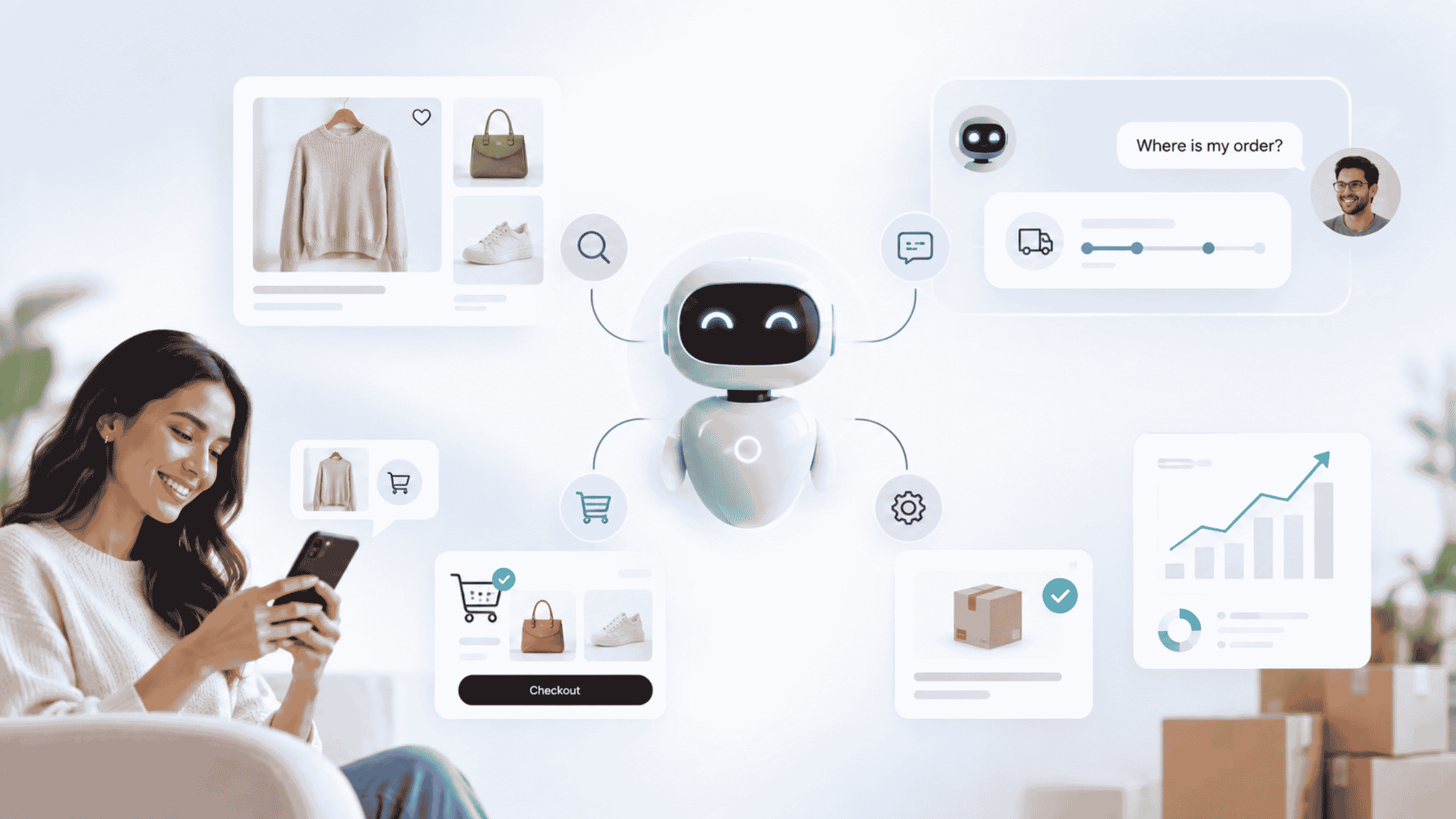
AI agents in ecommerce are autonomous systems that reason about shopper intent, read live commerce data, and complete multi-step actions across your stack. They fall into four role categories — discovery, support, post-purchase and operations — and cover nine distinct use cases in production today.
This page covers all nine, grouped by role, with what each one automates and where a human still has to step in. The distinction that runs through every section is the same one: whether a system can only answer, or can actually act.
What an ecommerce AI agent actually is
An ecommerce AI agent is an autonomous system that understands shopper intent, reads live business data — inventory, orders, ERP, CRM — and executes multi-step actions to resolve a need without a human.
The distinction from a chatbot is not conversation quality. It is whether the system can act. A chatbot tells a shopper where the returns policy lives. An agent verifies the order, checks the return window, generates the label, updates the ticket and notifies the customer inside one conversation.
Three capabilities define the category
- Reasoning toward a goal, rather than matching an intent to a scripted reply.
- Runtime data access. The agent calls your inventory API at the moment of the question, not from a training snapshot taken last quarter.
- Write access. It can change an order, not just describe one.
Remove any one of the three and you have a retrieval assistant with an agent label on it.
Which category the agent role falls into
Ecommerce AI agents fall into four role categories. Most brands deploy two to start, usually discovery and support, then expand into post-purchase and operations as the knowledge layer matures.
| Category | What the agent optimises | Primary metric | Use cases |
|---|---|---|---|
| Discovery & conversion | Turning intent into a cart | Conversion rate, AOV | 1, 2, 3 |
| Support | Resolving issues without a human | L1 containment, CSAT | 4, 5, 9 |
| Post-purchase | The gap between checkout and repeat purchase | Repeat rate, ticket volume | 6 |
| Operations & infrastructure | Feeding signals back to the business | Margin, sell-through | 7, 8 |
The most common evaluation mistake
Comparing agents across categories. A merchandising agent and a support agent solve different problems and share almost no requirements. Score them separately, or you will pick the wrong tool on the strength of an irrelevant feature.
Chatbot or commerce agent
A chatbot follows if-then scripts and returns one answer per question. An AI commerce agent reasons toward a goal, chains actions across live systems, and escalates only when it genuinely cannot resolve something.
Rule-based automation is predictable and brittle. It executes "if cart value under $50, show shipping upsell" reliably and fails the moment a scenario falls outside the rule set. Agentic systems observe, plan, act and reflect. If the first fulfilment centre is out of stock, the agent checks the next one without anyone writing a new rule.
| Capability | Traditional chatbot | AI agent |
|---|---|---|
| Logic | If-then scripts | Reasoning to a goal |
| Multi-step actions | One question, one answer | Chains 5 to 10 actions across tools |
| Real-time data access | Mostly no | Yes — inventory, ERP, CRM |
| Hallucination risk | High | Low with proper grounding |
| Typical L1 containment | 15 to 25% | 60 to 90% |
Containment ranges reflect deployed performance across Alhena and peer-vendor benchmarks for ecommerce L1 support.
How to judge a vendor
Ask whether the system maps rules or performs planning, tool use and runtime reflection. Agentic systems show a plan before executing and call live APIs as needed. Rule-only systems cannot, and no amount of conversational polish changes that.
Discovery and conversion
1. Autonomous shopping concierge
Search and filters fail when shoppers do not know the technical term for what they want. A concierge agent reads natural language and context instead.
A shopper says "I need an outfit for a rainy outdoor wedding in Scotland." The agent cross-references inventory, weather and style rules and returns a bundle. No filter combination produces that.
This is the use case with the clearest revenue line. Shoppers who engage a shopping agent convert at materially higher rates, because the agent removes the decision friction that causes abandonment. See AI Shopping Assistant.
2. Real-time personalisation and cart intervention
81% of shoppers prefer brands that personalise. Agents extend that past browsing history into live signals: sentiment, cart state, session behaviour, local events.
The highest-value application is the cart. An agent detects a shopper stalled on checkout with a high-value item and intervenes in the moment, answering the last-minute shipping question, confirming stock, or offering a time-sensitive incentive before they bounce.
The difference from a rule-based exit-intent popup is that the agent knows why the shopper stalled and responds to that reason.
3. Size, fit and compatibility guardian
The tactile gap drives bracket-buying and inflated returns. When shoppers cannot assess fit, uncertainty becomes a cost centre.
Vertical agents such as Fit Analyzer and Virtual Try-On let shoppers upload a full-body image, see realistic previews, and get colour recommendations matched to skin tone. Combined with purchase history, this replaces guesswork with visual certainty.
This is a returns-reduction use case disguised as a conversion one. Preventing the wrong-size purchase is cheaper than processing the return.
Support and escalation
4. Hallucination-free L1 automation
The early fear of AI in support was invented policy. Grounded architecture solves it: agents answer only from your live inventory, ERPs, carrier APIs and policy documents, and refuse when no source exists.
Deployments in ecommerce commonly report automated resolution in the 67–84% range, with outcome-based pricing around $0.99 per resolution. Use that as a planning figure against your current cost per ticket.
- Define resolution the way your vendor does. No human handoff, customer confirms resolved, or no follow-up ticket. Pick one and apply it consistently.
- Model economics with the full bill. Platform fees, minimums and add-ons sit on top of the per-resolution rate.
- Ramp with governance. Expect a 30/60/90 path: instrument intents, tune fallbacks, add deterministic rules, then widen scope.
See AI Support Concierge.
5. Continuous conversations across channels
Agents remember. A returning customer picks up where they left off regardless of whether the conversation started on WhatsApp, email or web chat, with relevant context pre-loaded: alternate sizes for a recently viewed item, the open ticket, the pending return.
The value is in what does not happen. The customer never repeats themselves, and that single friction point accounts for a large share of CSAT damage in multi-channel support.
9. Human-in-the-loop routing
A good agent knows its limits. When it detects frustration, ambiguity or a case outside policy, it hands off with a summary of the conversation, the customer's order context, and what it already tried.
Judge this behaviour as carefully as you judge the automation rate. An escalation that arrives without context is worse than no agent at all, because the customer has now spent five minutes before reaching a person.
Post-purchase and retention
6. Proactive post-purchase
The relationship does not end at checkout. Agents work the silent period between purchase and delivery: proactive status at each state change, delivery-exception handling before the customer notices, and a post-delivery success moment such as a setup guide that reduces early-life returns.
Returns and exchanges run end to end here too. The agent detects intent, verifies the order, checks eligibility against your policy, generates a prepaid label, schedules pickup, notifies the warehouse and closes the loop. Damage disputes and warranty claims escalate with full context.
Full breakdowns: how AI is transforming the post-purchase experience and how AI automates returns and refunds.
Operations and commerce infrastructure
7. Merchandising and pricing intelligence
Agents are the eyes on the digital floor. Every conversation is a signal about what shoppers want and cannot find.
An agent notices that 12% of shoppers today asked whether the summer collection comes in petite sizes, and pushes that to the merchandising dashboard the same day. That is demand data no analytics tool captures, because the shopper never searched for a product that does not exist.
The same signal layer feeds pricing. Agents surface where price objections cluster by SKU, region and segment, letting merchandising teams test adjustments against real hesitation rather than competitor scrapes.
8. Agent-to-agent checkout
As shoppers adopt their own AI assistants, brand agents have to talk to other agents. Google's AI Mode can add to a merchant cart and complete checkout with Google Pay on user confirmation. Amazon has tested a comparable flow.
What this requires from your stack: real-time inventory and delivery-slot availability exposed via API, tokenised payment with explicit user confirmation, auditable consent logs, and defined escalation rules for price disputes and unusual addresses.
Brands with documented checkout and order APIs will receive this traffic. Brands without will be bypassed silently. More: what are agentic storefronts and Alhena UCP onboarding.
What runs without a human
Agents handle tasks with a deterministic answer path and API access. They escalate anything requiring judgement about evidence, intent or goodwill.
| Runs autonomously | Escalates to a human |
|---|---|
| Product discovery and recommendation | Stolen-parcel claims |
| Stock and availability checks | Damage disputes needing photo assessment |
| Order status and tracking | Warranty edge cases |
| Address changes before dispatch | Goodwill decisions outside policy |
| Cancellations within policy | Pricing disputes |
| Size and variant swaps before dispatch | Emotionally charged complaints |
| Return eligibility and label generation | — |
| Exchange processing | — |
| Refund status | — |
| Cross-sell and replenishment prompts | — |
Illustrative: 1,000 monthly L1 tickets at 75% containment
Arithmetic on stated assumptions, not a benchmark. Substitute your own containment rate and handling time. The point is that the escalated 250 still need a context-rich handoff, and that half of the product is rarely priced or demoed.
The right target is not 100%. It is high containment on the deterministic set plus a clean handoff on everything else.
Scope: what agents can and cannot close
Can AI agents manage end-to-end ecommerce transactions autonomously?
Yes, within defined guardrails. An agent can guide discovery, build a cart, apply eligible promotions, complete checkout through a tokenised payment method, and handle the post-purchase lifecycle including returns, without a human at any step.
The limits are deliberate rather than technical. Agentic checkout requires explicit user confirmation and a verified payment method. High-risk orders, unusual shipping addresses and price disputes route to review by policy, not because the agent cannot proceed but because it should not. Full autonomy is available; constrained autonomy is what production deployments actually run.
What types of purchases can AI agents handle?
Agents perform best on considered purchases with a discovery problem, and on repeat purchases with a timing problem.
- Considered purchases — apparel, beauty, furniture, electronics. High decision friction, many variables, shoppers who do not know the right vocabulary. Largest agent lift.
- Consumables and subscriptions — the agent knows the purchase date and usage cycle and prompts reorder at the right moment rather than on a fixed schedule.
- Bundles and configurations — anything where compatibility matters and getting it wrong causes a return.
- Gift purchases — the buyer has constraints but no product knowledge, which is exactly the gap a concierge fills.
Agents add least on low-consideration commodity repurchases where the shopper already knows the SKU. There, speed matters more than guidance.
How do AI agents improve the shopping experience?
They remove the three friction points that cause abandonment: not finding the right product, not being sure it is right, and not getting an answer fast enough to stay in the session.
Search assumes the shopper can name what they want. Filters assume they know the attributes. Static product pages assume the question they have is one you anticipated. An agent handles the case where none of those hold, which is most first-time shoppers on an unfamiliar catalogue. The measurable effects are shorter time-to-cart, fewer sessions before purchase, and lower return rates where fit guidance is involved.
Small stores, and retail beyond ecommerce
What are good AI agent use cases for a small online store?
Start with two, not nine. Small catalogues and small teams get most of the value from support automation and guided discovery.
- Order status and returns automation. This is where a small team's hours actually go, so it delivers the highest hours-saved per unit of setup.
- Guided product discovery. Highest revenue impact, and it works better on small catalogues than large ones because the agent can hold the entire range in context.
Skip merchandising intelligence and agent-to-agent checkout until volume justifies them. Look for platforms that go live without developer resources and price from a low base rather than a platform fee. Cost structure matters more at this size than feature depth. See AI agent for Shopify: how to set one up.
Where do AI agents fit in retail beyond ecommerce?
The same four role categories apply, with different surfaces.
- Store operations — inventory queries, click-and-collect status, associate-facing product lookup.
- Contact centre — the support and post-purchase categories, unchanged.
- Merchandising and planning — the signal layer from use case 7, aggregated across online and in-store demand.
- Marketplace channels — Amazon, Walmart and TikTok Shop messaging, where SLA countdowns and channel policies constrain the reply.
The architecture does not change between online retail and ecommerce. The data sources do.
Why most AI implementations fail
Generic LLM wrappers hallucinate, cost more than expected, and have no commerce context. They demo on a curated catalogue and fail on a real one.
Alhena runs a shopping-first architecture instead. Agents follow your brand's logic and refuse when there is no source, connect directly to Shopify, WooCommerce and Salesforce Commerce Cloud alongside your existing helpdesk, and are measured on revenue lift rather than deflection alone.
Frequently Asked Questions
A chatbot answers questions; an AI agent completes tasks. A chatbot follows scripts and hands off the moment something gets complicated. An agent reasons toward a goal, takes actions across your stack, and escalates only when it genuinely cannot resolve something. In practice: a chatbot points a shopper to the returns policy, while an agent verifies the order, checks the window, generates the label, updates the ticket and notifies the customer in one conversation.
Four categories. Discovery and conversion agents handle guided selling, personalisation and fit. Support agents automate L1 resolution and routing. Post-purchase agents run tracking, returns and retention. Operations agents feed merchandising and pricing signals back to the business. Most brands deploy discovery and support first, then expand. Comparing agents across categories is the most common evaluation mistake, because they solve different problems and share almost no requirements.
Nine appear in almost every serious deployment: autonomous product discovery, real-time personalisation and cart recovery, size and fit guidance, hallucination-free L1 support, continuous cross-channel conversations, proactive post-purchase and returns, merchandising and pricing intelligence, agent-to-agent checkout, and human-in-the-loop routing.
Anything with a deterministic answer path and API access: product discovery, stock checks, order status, address changes before dispatch, in-policy cancellations, variant swaps, return eligibility and label generation, exchanges, refund status, and replenishment prompts. Tasks requiring judgement about evidence or goodwill, such as stolen-parcel claims, damage disputes and warranty edge cases, escalate to a human with full context.
Yes, within guardrails. An agent can guide discovery, build a cart, apply eligible promotions, complete checkout through a tokenised payment method, and handle the post-purchase lifecycle including returns. Agentic checkout requires explicit user confirmation and a verified payment method. High-risk orders, unusual addresses and price disputes route to human review by policy rather than by capability limit.
Yes, and integration depth matters more than the platform. Look for prebuilt connectors to Shopify, WooCommerce, Salesforce Commerce Cloud, BigCommerce and Magento that pull live inventory, order status and customer data without custom development, plus native helpdesk integrations. Enterprise-grade agents also meet SOC 2 Type II, GDPR and CCPA requirements with tokenised payment flows that keep card data out of the AI layer. If a vendor needs custom development just to read your product catalogue, that is a red flag.
See which of the nine your store actually needs
Run five real customer questions through Alhena and watch which ones it can act on rather than only reply to. Start free with 25 conversations, no call required.
Start free Book a demo