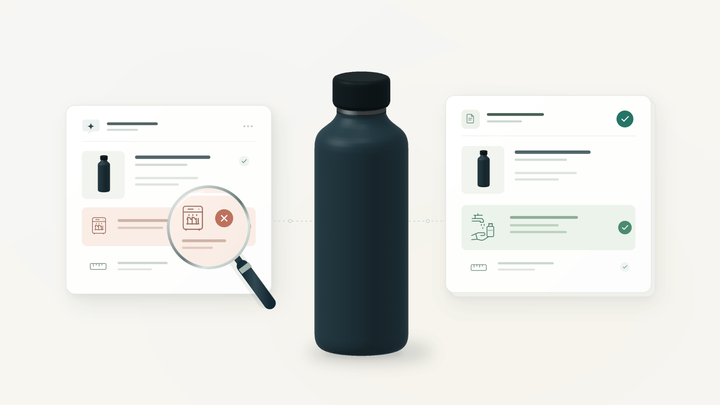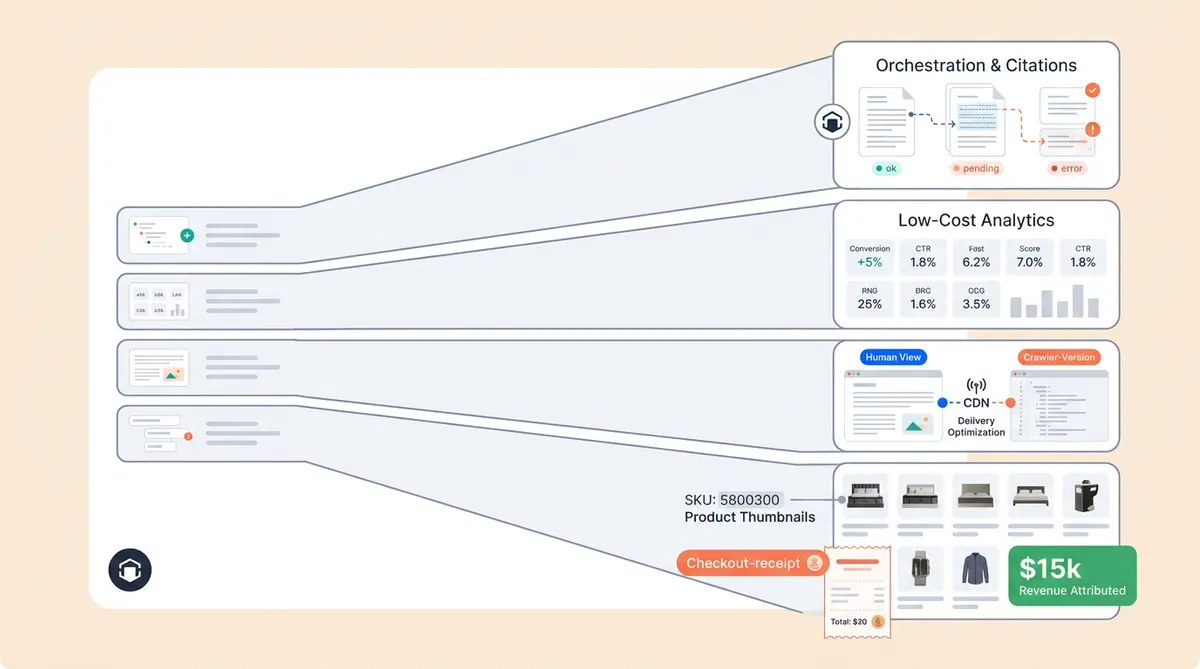
Profound, Peec AI, Scrunch AI, and Alhena are the four AI visibility platforms buyers shortlist most often in 2026, and they are built for four different jobs. Profound is the enterprise category leader with the broadest engine coverage. Peec AI is the best-value multi-engine analytics tool for mid-market teams and agencies. Scrunch AI, now part of Sitecore, is the delivery layer that rewrites pages for AI crawlers. Alhena is the e-commerce specialist that tracks visibility at the product level and traces AI answers to revenue.
This guide compares all four on monitoring depth, commerce capability, action layer, pricing, and fit, so you can shortlist in ten minutes instead of ten demos.
Last verified: July 2026. Alhena publishes this comparison and sells one of the products discussed. Competitor facts come from their public pricing pages, documentation, and announcements, linked at first use.
Key takeaways
- These four platforms compete in one category but solve four jobs: enterprise-scale monitoring plus automation (Profound), value analytics (Peec), crawler-side delivery (Scrunch), and commerce visibility tied to revenue (Alhena).
- Engine breadth is table stakes and diverging: Profound up to 10, Scrunch 8 claimed, Peec 6 with self-serve caps, Alhena 5 in every paid plan.
- Revenue attribution is the least-solved capability in the category: ruled out by Peec, partnered out by Profound, proxied by Scrunch, and native only in Alhena via first-party checkout joins.
- Scrunch's Sitecore acquisition (June 2026) makes it stronger for Sitecore accounts and raises roadmap questions standalone customers should ask at renewal.
- For e-commerce brands specifically, the full commerce stack (SKU tracking tied to a synced catalog, rendering analysis, checkout attribution) exists only in Alhena; Profound's and Peec's shopping modules are recent, analytics-only additions (Profound brand-level, Peec product-level since June 2026).
The four platforms at a glance
| Capability | Alhena | Profound | Peec AI | Scrunch AI (Sitecore) |
|---|---|---|---|---|
| Built for | E-commerce and DTC brands | Enterprise marketing orgs | Mid-market brands and agencies | Enterprise, now Sitecore customers |
| Core approach | Measure products in AI answers, fix content, attribute revenue | Monitor at scale, then act via agent workflows | Pure analytics, deliberately monitoring-only | Serve AI-optimized page versions to crawlers |
| AI engines | 5 in every paid plan: ChatGPT, Google AI Overviews, Gemini, Perplexity, Claude | Up to 10, including Copilot, Grok, Meta AI, DeepSeek | 6 core engines; some self-serve tiers cap tracking at 3 | 8 claimed |
| Prompt tracking | Topic-grouped prompts with relative AI demand signals and per-engine scores | Large-scale tracking plus Prompt Volumes panel data | Custom prompt sets, daily runs, extensive language coverage | Persona and topic views |
| Citation analysis | By domain and by page, with 0-100 Domain Rating and citation-gap detection | URL-level citations at very large scale | URL-level plus crawl-log correlation | Source attribution |
| Competitor benchmarking | Auto-discovers every brand in tracked answers; threat prompts, citation and fan-out advantage views | Strong benchmarking suite | Auto-detection with daily trend lines | Competitor views |
| SKU-level product tracking | Both levels: brand-level share of voice AND per-product SKU tracking, with invisible bestseller detection | Shopping Analysis module, brand-level focus | AI Shopping Analytics (launched June 2026) | Not offered |
| Answer rendering analysis | Yes: was a product card shown, with price, image, and carousel position captured | Not offered | Chat element tracking | Not offered |
| Revenue attribution | Native: AI-source traffic joined to checkout events, benchmarked against your sitewide baseline | Via Partnerize partnership | Out of scope by design | Via web analytics; no native purchase-event join |
| Live catalog sync | Shopify, WooCommerce, Magento, Salesforce Commerce Cloud | Shopify via Nostra partnership | Not offered | Not offered |
| Action layer | Content gap detection, AEO FAQ engine, PDP and blog fixes, citation analysis and outreach, plus an on-site AI agent acting on the same data | Agents workflows and Aim, publishing to Webflow, WordPress, Contentful | Recommendations only | Optimizer and Site Diagnostics; AXP serves rewritten content |
| API / MCP | Live MCP server (works inside ChatGPT and Claude) plus REST endpoints | API, cookbook, and MCP | API and MCP on enterprise tiers | Enterprise Data API |
| Entry pricing | Free tier; paid from $199/mo | From $99/mo; enterprise custom | From $95/mo, transparent tiers | From $250/mo billed annually |
| Ownership | Independent | Independent ($1B valuation, Feb 2026) | Independent | Acquired by Sitecore, June 2026 |
Sources: Profound pricing, Peec AI pricing, Scrunch pricing, Alhena pricing, and each vendor's product pages, all checked in July 2026. Packaging differs: Peec meters prompts by models and days, Profound adds agent credits, Alhena bundles visibility with its conversation-metered agent suite, so identical dollar figures do not buy identical things.
What is Profound best at?
Profound defined the AEO category and remains its reference point. The company raised a $96M Series C at a reported $1B valuation in February 2026 (Fortune), serves 1,800+ customers including Fortune 100 brands, and processes citation data at a scale no competitor matches. Its Agent Analytics product analyzes server logs to show which AI crawlers visit your site, with spoof verification. Its newest layer, Aim (July 2026), converts visibility findings into executed marketing projects through agent workflows that publish to Webflow, WordPress, and Contentful.
Where buyers push back, per recurring themes in G2 reviews: pricing that puts most mid-market teams out of reach, data volume that assumes a dedicated analyst, and agent features reviewers describe as promising but young. Commerce is a module rather than the design center: Shopping Analysis tracks at brand level, Shopify integration runs through a partner (Nostra), and revenue attribution runs through a partnership with Partnerize rather than first-party purchase data.
Choose Profound when you are an enterprise marketing org that needs maximum engine breadth, category-defining data scale, and workflow automation, with budget and staffing to match.
What is Peec AI best at?
Peec AI is the value benchmark of the category. Pricing is public and simple (from $95/mo, unlimited seats), setup is fast, and the product covers the analytics core exceptionally well: custom prompt sets run daily across engines with wide multi-language coverage, competitor detection is automatic, and citation analysis correlates with crawl logs. The company reported $10M ARR sixteen months after launch with 2,500+ customers, and its agency packaging is the strongest in the market.
Peec's scope is a deliberate choice, and the company says so: analytics only. There is no content generation, no site auditing, and no revenue attribution; its AI Shopping Analytics (June 2026) brought SKU-aware recommendation tracking, but it is weeks old and not connected to a catalog or purchase data. For a marketing team that wants clean numbers and will act on them elsewhere, that focus is a feature, not a gap.
Choose Peec AI when you are a mid-market brand or agency that wants the best multi-engine analytics per dollar and does not need the tool itself to act on the findings or prove revenue.
What is Scrunch AI best at?
Scrunch AI took a different bet: instead of only measuring what AI engines say, it changes what AI crawlers consume. Its Agent Experience Platform (AXP) serves compressed, JavaScript-free parallel versions of your pages to AI crawlers at the CDN level (Cloudflare, Akamai, Fastly, CloudFront, Vercel). Its published customer results are striking, including a vendor-published Akamai case study reporting a 364% increase in brand presence on non-branded prompts and 85% more total citations. In June 2026, Sitecore acquired Scrunch, in a deal Bloomberg reported at roughly $225M (unconfirmed by either company).
Two things belong on your diligence list. First, serving different content to bots than to humans draws cloaking-adjacent criticism from some practitioners; Scrunch positions it as optimization rather than deception, and buyers should form their own view. Second, the acquisition points the roadmap toward Sitecore's CMS and DAM suite. That is good news for Sitecore shops and an open question for standalone customers on Shopify or custom stacks, worth asking directly at renewal.
Choose Scrunch when you run an enterprise content estate (especially on Sitecore) and want the delivery-layer approach: rewriting what AI crawlers see without touching your human-facing site.
What is Alhena best at?
Alhena approaches AI visibility from the commerce side. It is built for a buyer whose question is not "was my brand mentioned?" but "which of my products do AI engines recommend, are they rendered correctly, and what did that traffic buy?"
Concretely, in every paid plan, Alhena AI Visibility tracks five engines (ChatGPT, Google AI Overviews, Gemini, Perplexity, and Claude) and runs a six-tab workspace: Overview, Prompts, Citations, Fan-out queries, Content AI visibility, and Competitors. Its differentiated capabilities are the commerce ones:
- SKU-level tracking. Per-topic product cards from AI shopping answers with your products flagged, plus invisible bestseller detection: top sellers with zero AI presence.
- Rendering analysis. Whether a full product card appeared, at what carousel position, with what price and image, not just whether text mentioned you.
- Fan-out query tracking. The web searches engines run under the hood before answering, with your organic position on each. On one live profile in July 2026, 98 tracked buyer prompts fanned out into more than 1,100 distinct searches where the brand did not rank in the top 10, each one a fixable gap.
- Native revenue attribution. Alhena classifies inbound traffic by AI source (ChatGPT, Perplexity, Gemini, Claude, Copilot) and joins it to actual checkout events, benchmarked against your sitewide baseline. Peec rules attribution out of scope, Profound routes it through Partnerize, and Scrunch leaves purchase reporting to your web analytics; Alhena computes it from first-party data because its shopping and support agents already sit on the site. Methodology is published in How Alhena measures AI visibility.
- Closing the loop with first-party data. Alhena operates on both sides of the customer journey: its AI Shopping Assistant and Support Concierge handle real conversations with shoppers across web chat, email, Instagram DMs, and WhatsApp, and that behavioral data (which products shoppers ask about, what questions they raise, what actually drives conversions) feeds the visibility layer, informing which prompts to track, which content gaps matter, and which fixes to prioritize. The other three platforms rely on external observation; Alhena also sees what happens on your storefront, and its on-site agent acts on the same catalog data, so visibility, action, and outcome live in one system.
Honest limits: Alhena covers 5 engines, not 10; if Grok, Meta AI, or DeepSeek tracking matters to you, Profound is the answer today. Alhena connects AI visibility to the commerce outcomes that determine where teams should act: product-level rendering, catalog accuracy, AI-referred conversion, and attributed revenue. And Alhena's visibility product ships bundled with its agent platform rather than as a standalone subscription, which fits brands consolidating their AI stack and frustrates buyers who want a pure tracker.
Choose Alhena when you run an online store and want product-level answers and revenue proof, not just brand mentions: which SKUs appear, how they render, what is broken, and what AI traffic actually bought. Alhena's free tier makes that testable in an afternoon.
How do the four differ on the question that matters: proving value?
Every platform in this comparison can tell you whether AI engines mention you. The fork in the road is what happens next.
Peec hands you clean dashboards and leaves action and proof to you. Profound automates content workflows but measures success in visibility metrics, with monetary outcomes delegated to a partner integration. Scrunch changes what crawlers read and leaves results to your web analytics. Alhena's published cohort research across 310 brands (LLM traffic study, 2026) found LLM referrals converting at 2.68% (October 2025 to April 2026 window), fourth-best of 13 channels, which is exactly why commerce buyers increasingly refuse to stop at mention counts.
Alhena is the only one of the four whose loop ends at a checkout event: visibility data, content fixes, and purchase outcomes in one system, benchmarked against your own site baseline.
The honest caveat: if your brand does not transact online (B2B SaaS, media, services), Alhena's biggest differentiators do not apply to you, and Profound or Peec will fit better. Category depth beats category breadth only when you are in the category.
Which platform fits which buyer?
| Your situation | Shortlist first | Why |
|---|---|---|
| Enterprise marketing org, multiple regions, needs maximum engine breadth | Profound | Widest engine coverage, biggest data scale, agent workflows, enterprise trust stack |
| Mid-market brand or agency, wants best analytics per dollar | Peec AI | Transparent pricing, unlimited seats, daily multi-engine tracking, agency packaging |
| Enterprise on Sitecore, wants crawler-delivery optimization | Scrunch AI | AXP rewrites pages for AI crawlers at CDN level; now integrated with Sitecore |
| Online store on Shopify, WooCommerce, Magento, or SFCC | Alhena | SKU-level tracking, rendering analysis, catalog sync, native revenue attribution |
| Ecommerce brand already running Alhena or another AI agent on-site | Alhena | Visibility bundles with the agent suite; one system from discovery to purchase |
| B2B SaaS with no transactional site | Peec AI or Profound | Commerce-native features will not apply; buy pure analytics or enterprise breadth |
About the publisher: Alhena AI, founded in 2022 by ex-LinkedIn and Meta engineers, is an Agentic commerce AI platform on a mission to make online shopping more fun, efficient and social. Alhena's product suite spans AI Shopping Agents, Support Concierge, Voice AI, and AI Visibility (AEO and GEO tracking).