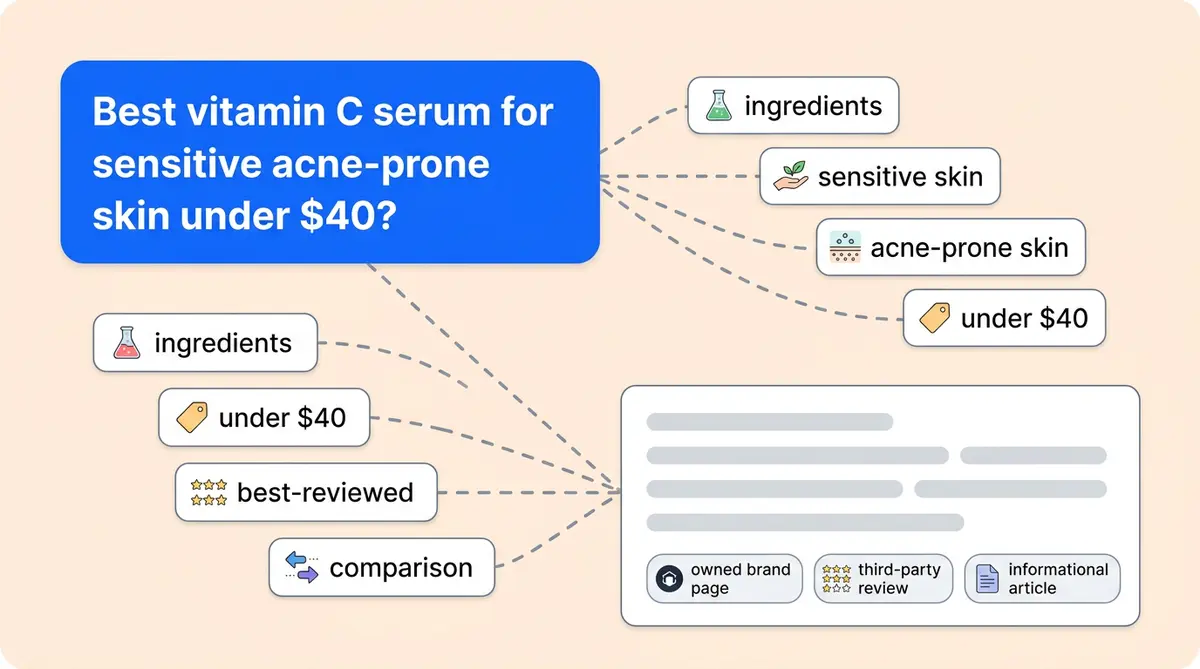
A fan-out query is one of the several background web searches an AI engine runs after you ask it a single question, before it writes a word of its answer. When you type one prompt into ChatGPT, Perplexity, or Google's AI Mode, the engine does not run your prompt as a single search. It breaks your question into subtopics, fires off a batch of narrower searches at the same time, reads the results, and synthesizes them into one answer. Google named this the "query fan-out" technique when it introduced AI Mode in March 2025, and every major answer engine now does a version of it.
For a brand, this quietly moves the contest for AI visibility. You are no longer competing only to rank on the shopper's original question. You are competing on the dozen or more fan-out searches the engine runs underneath it, most of which the shopper never sees and never typed. This guide explains how fan-out works, walks through a worked example, and lays out how to find and close the gaps where your pages are missing from those hidden searches.
Last verified: July 2026. Alhena publishes this guide and sells an AI visibility platform, one of the tools mentioned below. The description of query fan-out is drawn from Google's own product announcements, linked at first use.
Key takeaways
- A fan-out query is one of the several background searches an AI engine runs to gather evidence before answering a single prompt. Google calls it the "query fan-out" technique, and every major engine does a version of it.
- One buyer prompt commonly generates roughly a dozen fan-out searches. On the profile examined here it averaged about thirteen, and Google says its Deep Search mode "can issue hundreds of searches" for a single request (Google, May 2025). The exact count varies by engine, prompt complexity, and session.
- Your appearance in an AI answer is downstream of your organic rank on the fan-outs, so classical search ranking matters more in AI search, not less, just spread across many more specific queries.
- Brand-mention tracking hides the mechanism. Fan-out position tracking shows which underlying searches you are losing and can fix.
- The workflow is map, cluster, fix or create, and re-measure on positions, using the fan-out list itself as the content plan.
What is a fan-out query?
A fan-out query (also written as query fan-out) is a machine-generated search that an AI engine runs on your behalf to gather evidence before it answers. One user prompt produces many of them. Google describes the mechanism plainly: AI Mode "uses a 'query fan-out' technique, issuing multiple related searches concurrently across subtopics and multiple data sources and then brings those results together to provide an easy-to-understand response" (Google, March 2025).
Engines do this because of how retrieval works. A large language model on its own only knows what was in its training data, which is frozen and often out of date. To answer a live question such as "which vitamin C serum is best for sensitive skin in 2026," the engine has to go and fetch current pages, and a single broad search rarely surfaces everything it needs. Fanning the question out into several specific searches, by ingredient, by skin type, by price, by reviews, returns a wider and fresher evidence set, which the model then reads and summarizes into its reply.
The steps are consistent across engines even when the wording differs. The engine decomposes your prompt into sub-questions, runs those searches in parallel, pulls candidate pages from each, and assesses them at the passage level rather than judging whole documents. Classic search asked which single page best matches one query. Fan-out search asks which passages, across dozens of queries, best answer the parts of what a person wants. Whoever supplies those passages gets pulled into the answer.
What do fan-out queries look like? A worked example
Take a shopper who asks an AI assistant one natural question: "What is a good vitamin C serum for sensitive, acne-prone skin under $40?" That single prompt carries at least four constraints, the ingredient, skin sensitivity, acne, and price, and an engine will usually fan it out into several searches to cover them. The table below shows a plausible set, the buyer intent behind each, and the kind of page that tends to win it. The exact fan-outs vary by engine and by session, so treat this as illustrative rather than a fixed list.
| Fan-out search the engine runs | What the shopper is really trying to learn | Page type that tends to win it |
|---|---|---|
| best vitamin C serum for sensitive skin 2026 | Which products make the shortlist at all | Independent listicles and review roundups |
| is vitamin C good for acne-prone skin | Whether the ingredient is even right for them | Editorial and dermatologist explainer pages |
| vitamin C serum sensitive skin reviews | Social proof from real users | Review sites, forum threads, retailer ratings |
| best vitamin C serum under $40 | The price-filtered shortlist | Price-led roundups and retailer category pages |
| [brand name] vitamin C serum ingredients | Whether a specific product fits their needs | The brand's own product and FAQ pages |
| vitamin C vs niacinamide for acne | Which ingredient to choose in the first place | Comparison and educational content |
Notice what the table exposes. Your product detail page can be excellent and still lose most of this answer, because most of the fan-outs are informational, comparative, or third-party. The engine assembles its recommendation from all of them together. If your brand appears only on the one search that carries your name, you are a footnote in an answer built mostly from pages you do not own.
Why do fan-out queries matter for AI visibility?
Your presence in an AI answer is downstream of your organic ranking on the fan-out searches. The engine can only synthesize from pages it retrieved, and it only retrieves pages that ranked for the searches it ran. If you are not in the top results for the underlying fan-outs, you are not in the evidence set, so you cannot be in the answer, no matter how good your product is. AI visibility, put simply, is largely classical search ranking measured across a hidden and expanded set of queries.
This is the part that most "SEO is dead" takes get wrong. AI answers are not built by ignoring search. They are built by running more of it. Ranking did not stop mattering; it multiplied. Instead of optimizing for the one head query a buyer types, you now have to earn passages across the many long, specific, intent-split searches the engine generates from it. Answer engine optimization (AEO) and classical SEO are the same discipline pointed at a wider target, which is why the two are converging rather than replacing each other (more on AEO for agentic shopping).
It also explains why counting brand mentions alone is misleading. "Your brand was mentioned" can be true while you are absent from ten of the twelve searches that produced the answer, losing to competitors and review sites on the fan-outs that did the real work. Mention counts tell you the outcome. Fan-out positions tell you why, and where you can change it.
How do you find your fan-out gaps?
You can see fan-out behavior by hand. Perplexity lists the sources it consulted and often the sub-searches it ran. ChatGPT shows "searching the web" steps with the queries it fired, which is, concretely, how ChatGPT searches the web: one prompt, many visible sub-searches, one synthesized answer. Google's AI Mode and Gemini expose their reasoning and the sites they pulled from. Ask an engine one of your priority buyer questions, watch which searches it runs, and check whether your pages appear in the results for each. Do that across ten or twenty buyer prompts and the pattern of where you are missing starts to stand out.
Doing it at scale needs tooling. Alhena's Fan-out queries view does this automatically: for every buyer prompt you track, it lists the searches the engines run underneath (captured from the engines' own responses rather than simulated), your site's organic position on each, the current top-ranking results with your pages flagged, and which of your tracked prompts trigger which searches (product documentation). That turns an invisible layer into a ranked worklist of searches you can actually go and win, and the sampling method behind those positions is written up in how Alhena measures AI visibility.
The scale of the gap tends to surprise teams. On one profile we track, Alhena's own marketing site, a July 2026 snapshot showed 98 tracked buyer prompts expanding into 1,271 distinct fan-out searches. The site ranked in the top 10 organic results on 108 of them and did not appear in the results at all on 1,114. That is not a content-quality problem on the site itself; it is a coverage problem across the hidden searches, and every missing search is a specific, nameable page to write or improve.

A practical playbook for winning fan-out queries
The work is straightforward once you can see the searches. It comes down to four steps.
- Map the fan-outs. For your ten to twenty highest-value buyer prompts, list every search the engines run underneath, and record your position on each. Do it manually to start, or with a fan-out tracker once you want full coverage.
- Cluster by intent. Group the searches into informational ("is X good for Y"), comparative ("X vs Y"), review ("X reviews"), price ("best X under $N"), and branded ("your brand plus X"). Each cluster wants a different page, and treating them as one bucket is why generic content underperforms.
- Fix or create the page that best answers each cluster. Add FAQ and ingredient detail to product pages, publish the comparison and buying-guide content the informational fan-outs reward, and earn third-party citations for the review and roundup searches you cannot rank for directly. A content-gap analysis turns the unranked list into a concrete content plan.
- Re-measure on positions, not mentions. After the pages ship and get recrawled, check your rank on the same fan-outs again. Rising positions on the underlying searches are the leading indicator; more brand mentions in answers are the lagging result.
The order matters. Teams that jump straight to "publish more content" without mapping the fan-outs write pages that nobody's searches trigger. The fan-out list tells you exactly which pages will feed real AI answers, so you build the twenty that matter instead of two hundred that do not. For ChatGPT shopping specifically, the same fan-out logic decides which products get pulled into the product card, which is worth optimizing for on its own terms (ChatGPT shopping optimization).
The bottom line on fan-out queries
Fan-out queries settle the "is SEO dead" argument in an unexpected direction. AI answers are assembled from search results, so the brands that win them are the ones ranking on the hidden searches the engine runs, not the ones with the loudest name. That makes answer engine optimization less a new discipline than classical search ranking applied to a larger, machine-generated set of queries, measured in positions rather than blue links. The teams that will own AI answers in their category are the ones treating each unranked fan-out as a task to close, not each brand mention as a trophy to collect.
About the publisher: Alhena AI, founded in 2022 by ex-LinkedIn and Meta engineers, is an Agentic commerce AI platform on a mission to make online shopping more fun, efficient and social. Alhena's product suite spans AI Shopping Agents, Support Concierge, Voice AI, and AI Visibility (AEO and GEO tracking).