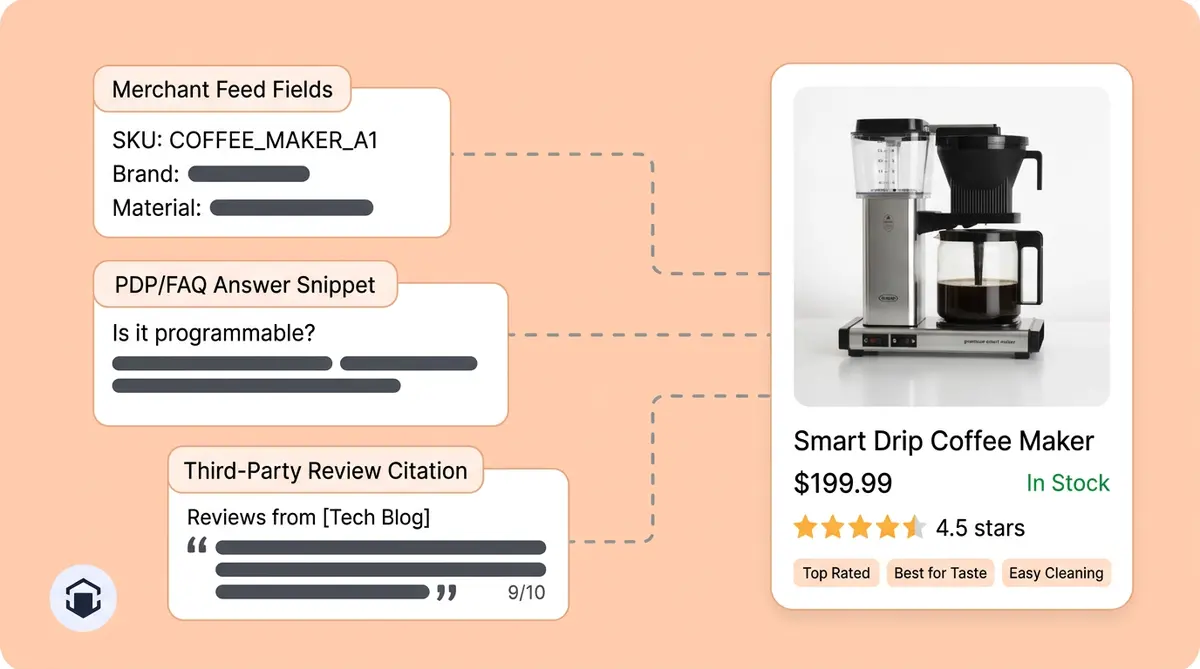
Google AI Overviews and Perplexity recommend products they can retrieve and verify. Get cited by keeping pages crawlable and indexed, enabling free listings in Google Merchant Center, matching price and stock across feed, page and schema, and earning independent third-party corroboration. Neither engine sells placement.
The mechanics are the point. Once you know what each engine retrieves before it writes a word, the work stops being guesswork and starts being a checklist.
Shoppers are already using these surfaces at scale. Adobe Analytics found traffic from generative AI sources to United States retail sites grew 693% year over year across the 2025 holiday season, and those visitors converted 31% more often than shoppers arriving from other sources.
Salesforce put a number on the commercial side: across Cyber Week 2025, AI and agents influenced 20% of global orders, worth roughly $67 billion. The channel is small in absolute terms and growing quickly, which is exactly when the cost of being invisible compounds.
Our own data points the same way. Alhena's Agentic Commerce Report, covering 329 ecommerce brands across nine traffic channels and eight verticals, found LLM and generative AI traffic converting at 2.47%, which ranked fourth among all acquisition channels and ahead of Google Ads at 1.82% and Meta Ads at 0.52%.
Key takeaways
- Google AI Overviews and AI Mode are grounded in Google's own Search index using retrieval-augmented generation, so a page must be indexed and snippet-eligible before it can ever be cited.
- Both Google surfaces run query fan-out, generating several related sub-queries behind a single shopper question, which means you compete for a cluster of searches rather than one keyword.
- Product data for AI Mode comes from the Shopping Graph, fed by Google Merchant Center. Free listings must be enabled; paid Shopping campaigns alone do not qualify you.
- Perplexity retrieves live per query and cites only a handful of sources, so extractable structure and independent corroboration matter more than domain size.
- Perplexity documents two separate agents: PerplexityBot follows robots.txt, while the user-initiated Perplexity-User fetcher generally does not. Blocking the wrong one removes you from citations.
- Mismatches between feed, product page and structured data are the most common self-inflicted cause of lost visibility, because both engines treat disagreement as a trust signal.
- How do Google AI Overviews decide which products to mention?
- How do products get into Google's Shopping Graph?
- How does Perplexity choose which sources to cite?
- Where do the two engines actually differ?
- What moves the needle: a six-point checklist
- Which edge cases quietly kill product visibility?
- How do you measure this without fooling yourself?
- What should you do in the next 30 days?
- Frequently asked questions
How do Google AI Overviews decide which products to mention?
Retrieval first, generation second.
Google states it plainly in its Search Central guidance on generative AI features: AI Overviews and AI Mode rely on Google's core Search ranking systems to retrieve relevant, current pages from the Search index, then review those pages to produce the answer with links. The industry term is retrieval-augmented generation, and Google calls it grounding.
The practical consequence is a hard gate. A page that is not indexed, or is blocked from showing a snippet, cannot be used. Everything else in this guide sits downstream of that one requirement.
What is query fan-out, and why does it break the one-keyword mindset?
Google defines query fan-out as a set of concurrent, related queries the model generates to fetch more information than the original question would return. Google's own worked example takes a lawn care question and fans it out into separate searches for herbicides, chemical-free weed removal, and prevention.
Applied to retail, "best running shoes for flat feet" quietly becomes a cluster: arch support, stability versus neutral, plantar fasciitis, sizing, and return policy. You are not competing for one query. You are competing for the shortlist that gets assembled from five.
Does a page need to rank first to get cited?
No. Ranking well helps because retrieval starts from the Search index, but the answer is assembled from passages across several fan-out results, not from the single top page. Topical coverage across the cluster is worth more than one hard-won position.
Google is also explicit that there is no special schema or markup requirement for AI features, and no ideal page length or chunking format. Advice that promises a secret AI-only tag is selling something Google says does not exist.
How do products get into Google's Shopping Graph?
Through Merchant Center, with free listings switched on.
The Shopping Graph is Google's live product dataset, and it is what AI Mode reaches into when a question turns transactional. Google described it in 2025 as more than 50 billion product listings with over 2 billion refreshed every hour, and put the figure above 60 billion at I/O 2026.
Your route in is a Google Merchant Center feed. Completeness matters: GTIN, brand, condition, price, availability, and variant attributes such as size, colour and material are what let Google match your item to the same product sold elsewhere.
Do Google Shopping ads put me in AI Mode?
Not on their own. Organic product surfacing draws on free product listings, which are a separate opt-in inside Merchant Center. Plenty of brands run paid Shopping campaigns for years without ever enabling the free listings that make them eligible organically.
Do my Amazon or marketplace listings count?
Generally not for the Shopping Graph. If your only storefront is a marketplace, you have no feed of your own to submit, and Google has no first-party record of your price, stock or policies. Brands that sell exclusively through resellers are effectively delegating their AI visibility to those resellers.
How does Perplexity choose which sources to cite?
Live retrieval, a small candidate pool, and a short citation list.
Perplexity does not answer from a static memory of the web. It searches at the moment you ask, pulls a modest set of candidate pages, reranks them, and typically cites a handful. Fewer slots means the bar for each one is higher.
Perplexity publishes no ranking formula, so treat any precise weighting you see quoted as an estimate. What is observable is consistent: pages that state an answer plainly, carry a recent date, and are corroborated elsewhere get picked more often than pages that bury the answer.
Which Perplexity crawlers matter, and what does each one do?
Perplexity documents two distinct agents, and they behave differently. Blocking them interchangeably is a common and expensive mistake.
| Agent | What it does | robots.txt | What to do |
|---|---|---|---|
| PerplexityBot | Indexes and links pages so they can be surfaced in Perplexity results. Perplexity states it is not used to crawl content for AI foundation models. | Respected | Allow it, and allowlist the published IP ranges at your WAF or CDN |
| Perplexity-User | Fetches a page because a user asked for it in that moment. | Generally ignored, because the fetch is user-initiated | Do not rely on robots.txt here; use access controls if a page must stay private |
| Googlebot | Feeds the Search index that grounds AI Overviews and AI Mode. | Respected | Never block. Blocking removes AI Overview eligibility entirely |
| Google-Extended | A robots.txt control token, not a crawler. Governs Gemini and Vertex use of your content. | Respected | Blocking it does not affect Search ranking or AI Overviews. Decide deliberately |
Should I block AI crawlers to protect my content?
Separate the two questions. Blocking a training crawler is a licensing decision, while blocking a search or retrieval crawler is a distribution decision that removes you from answers people are actively asking for.
For a commerce brand, the default that usually holds up is simple: allow the retrieval agents, keep private and account pages behind authentication rather than robots.txt, and make the Google-Extended call as a policy choice rather than an accident.
Where do the two engines actually differ?
Same foundations, different retrieval paths.
Treating "AI search" as one channel is the mistake that wastes the most effort. The two surfaces share prerequisites but reward different work once those prerequisites are met.
| Dimension | Google AI Overviews & AI Mode | Perplexity |
|---|---|---|
| Where product data comes from | Shopping Graph, supplied by Google Merchant Center | Live page retrieval, plus an optional merchant catalogue |
| Eligibility gate | Indexed and snippet-eligible in Google Search | Reachable by PerplexityBot and not blocked at the edge |
| Sources per answer | Many, drawn across fan-out results | Few, typically a short cited list |
| Biggest single lever | Feed completeness and free listings enabled | Extractable page structure and outside corroboration |
| Commerce layer | Product tiles, price tracking, agentic checkout | Product cards and assisted purchase in supported regions |
| Fastest fix if invisible | Audit Merchant Center for disapprovals and missing GTINs | Check robots.txt, WAF and bot rules for accidental blocks |
What moves the needle: a six-point checklist
In order. Later items are wasted effort if earlier ones fail.
- Confirm retrieval access. Verify indexation in Search Console, then check that robots.txt, your WAF and any bot manager allow Googlebot and PerplexityBot. Edge rules block more brands than robots.txt does.
- Turn on free listings and clean the feed. Fix Merchant Center disapprovals, fill GTIN and brand, and complete variant attributes. Disapprovals are silent until you go looking for them.
- Make feed, page and schema agree. Price, availability, condition and shipping must be identical in all three places, with structured data server-rendered rather than injected by JavaScript.
- Answer the fan-out, not the headline query. Build the comparison tables, spec lists, sizing guidance and returns detail that the sub-queries are actually asking for.
- Earn outside corroboration. Independent reviews, category roundups and genuine community discussion give both engines something to verify you against. No on-site change substitutes for it.
- Keep it current. Dated, maintained pages beat abandoned ones, and stale prices actively harm you now that agents transact against your feed.
None of this is exotic. It is the same discipline as good schema markup for AI search, applied with the knowledge that two different retrieval systems are reading it.
Which edge cases quietly kill product visibility?
The failures that never show up in a rankings report.
Price mismatch
Feed, page and JSON-LD disagree. Both engines read disagreement as unreliability and quietly deprioritise the listing.
Out of stock
An out-of-stock flag can remove an item from consideration entirely. Popular sizes selling out is a visibility event, not just an ops event.
Thin review footprint
Without independent reviews there is nothing to corroborate. This hits new brands hardest on "best of" and comparison prompts.
Marketplace-only presence
Selling only through resellers means no feed of your own and no first-party record. Your visibility becomes someone else's asset.
Locale gaps
Shopping and agentic checkout features roll out unevenly by country. A prompt tested from one market says nothing about another.
Run-to-run variance
Answers are personalised and non-reproducible. A single test proves nothing, which is why one-off screenshots mislead teams.
How do you measure this without fooling yourself?
Fixed prompt sets, tracked over time, joined to revenue.
Because answers vary by user and session, a screenshot proves nothing. The unit of measurement is citation share across a fixed set of prompts, sampled repeatedly, so you are reading a trend rather than a single roll of the dice.
Build that prompt set from real demand. The questions shoppers already ask your on-site assistant and support inbox are better raw material than a keyword tool, because they are phrased the way people actually talk to an AI.
- Fix the prompt set. Thirty to a hundred buyer questions per category, unchanged month to month so results are comparable.
- Track at SKU level. Brand mentions hide the products that never surface. Bestsellers that are invisible in AI answers are the highest-value gap you can find.
- Separate engines. Report Google AI Overviews, AI Mode and Perplexity apart, since a fix for one often does nothing for the other.
- Join it to revenue. Classify AI referral traffic in analytics and connect it to checkout, then compare against your sitewide baseline.
This is the loop Alhena AI Visibility was built to run: SKU-level tracking across ChatGPT, Google AI Overviews, Gemini, Perplexity and Claude, flagging where you are absent and joining what surfaces to what sells. Because Alhena also runs the on-site shopping agent and support concierge, the prompts shoppers ask you feed the prompts you track.
What should you do in the next 30 days?
Sequenced so nothing later is undermined by something earlier.
- Week 1: prove you are reachable. Confirm indexation, review robots.txt and edge rules for Googlebot and PerplexityBot, and clear every Merchant Center disapproval. Enable free listings if they are off.
- Week 2: make the three statements agree. Reconcile price, availability and condition across feed, product page and server-rendered JSON-LD, then fix the variant attributes and missing GTINs that block product matching.
- Weeks 3 and 4: answer the fan-out. Take your top twenty buyer prompts, list the sub-questions behind each, and add the comparison tables, sizing detail and returns clarity that answer them plainly on the page.
- Ongoing: corroborate and measure. Build genuine third-party review presence, then baseline your fixed prompt set and re-run it monthly, reporting citation share per engine and per SKU against revenue.
Neither Google nor Perplexity sells a spot in these organic answers, and neither publishes its full ranking function. What both have documented is the machinery: retrieval, corroboration, and a strong preference for data that agrees with itself.
That is a workable brief. Fix the plumbing, answer the questions people actually ask, earn the outside validation, and then measure in checkouts rather than screenshots.
See how AI engines describe your products
Baseline your SKUs across Google AI Overviews, Perplexity, ChatGPT and Gemini, and find the bestsellers that never show up.
Frequently asked questions
Make sure the page is indexed and snippet-eligible in Google Search, since AI Overviews are grounded in Google's Search index. Then submit a complete Google Merchant Center feed with free listings enabled, keep price and availability accurate, and make sure the feed, the page and your structured data all state the same thing. Finally, answer the sub-questions behind the buyer's query, not just the headline query.
Not in the organic product answers. Both platforms run paid formats elsewhere in their products, but the cited recommendations discussed here are earned rather than bought. Any tool promising guaranteed placement in these answers is describing something the platforms do not offer.
No. Google-Extended is a robots.txt control token that governs whether your content is used by Gemini and Vertex AI, not a crawler. AI Overviews are grounded in the Search index built by Googlebot, so blocking Google-Extended does not affect Search ranking or AI Overview eligibility. Blocking Googlebot, on the other hand, removes you entirely.
PerplexityBot indexes pages so they can be surfaced and linked in Perplexity results, and it follows robots.txt. Perplexity-User fetches a page because a user asked for it in that moment, and because the request is user-initiated it generally ignores robots.txt. Allow PerplexityBot if you want to be cited, and protect genuinely private pages with authentication rather than robots directives.
No. Google states there is no special markup required for its generative AI features and no ideal chunking or page length. Standard Product, Offer, AggregateRating and Organization schema is still worth implementing because it earns rich results and makes your data unambiguous, but it should be treated as good hygiene rather than a secret AI switch.
Generally not. Organic product surfacing in AI Mode draws on the Shopping Graph, which is fed by Google Merchant Center feeds from your own storefront. If you sell only through marketplaces or resellers, you have no first-party feed, and your AI visibility depends on how those third parties describe your products.
Both engines personalise and vary run to run, so two people asking the same question can get different products and different citations. This is why single screenshots are unreliable evidence. Use a fixed set of prompts sampled repeatedly and report citation share as a trend rather than treating any one answer as the truth.
It overlaps heavily but is not identical. Retrieval still starts from crawled, indexed pages, so technical SEO remains the entry ticket. What is added is feed accuracy through Merchant Center, agreement between feed, page and schema, coverage of fan-out sub-queries, third-party corroboration, and measurement at the level of citations rather than rankings.
Access and feed fixes can show up within days once crawling and feed refresh cycles catch up. Content and corroboration work is slower, usually measured across weeks to a few months, because it depends on pages being recrawled and on third-party sources accumulating. Re-baseline monthly rather than checking daily, since run-to-run variance will otherwise swamp the signal.