Most Schema Markup Advice Stops Too Early
If you've added Product, Offer, and AggregateRating schema to your ecommerce business, you're ahead of most brands. But ai-driven generative engines like ChatGPT, Perplexity, and Google AI Overviews don't just read your markup. They cross-reference it against digital knowledge graphs, external entity databases, and signals on third-party sites.
Having schema on the page is table stakes. Getting cited by generative engines requires a second layer of work that most technical guides skip. This post covers three patterns that close the gap: entity linking with sameAs, technical server-side rendering checks, and CI-level schema validation. If you need a refresher on foundational schema types, start with our schema markup for AI search guide. For a complete walkthrough of these tactics, see our AI search engine optimization guide.
Entity Linking With sameAs
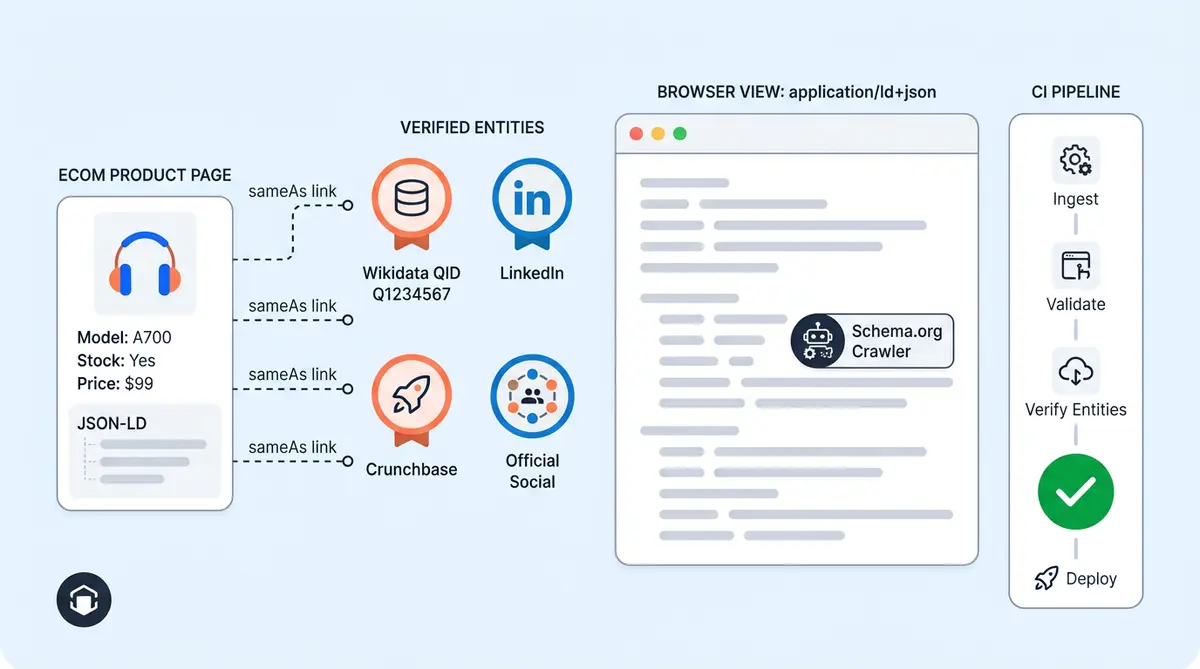
LLMs (large language models) match entities in your markup against knowledge graphs built from Wikipedia, Wikidata, and digital social profiles. The sameAs property makes that match explicit.
Without sameAs, an AI engine seeing your brand name has to guess which entity you are. With it, you point directly to your Wikidata entry (Q-ID), LinkedIn company page, and official social profiles. The engine can verify your identity instantly.
Where to Add sameAs
- Organization schema: Link to your Wikidata QID, LinkedIn company page, and official social accounts (X, Instagram, YouTube).
- Person schema (for authors): Link to LinkedIn and any Wikipedia or Wikidata entries. This strengthens E-E-A-T signals that generative engines weigh when selecting sources.
- Product schema: Link to the manufacturer's canonical product page and GS1 GTIN URIs. This helps AI shopping agents confirm product identity across retailers.
Search Wikidata for your brand name. If an entry exists, grab the Q-identifier and add it to your Organization schema. If no entry exists, focus on the professional and social profiles you control. Don't fabricate entity links to pages you don't own.
Testing Schema for AI Crawler Readability
Passing Google's Rich Results Test doesn't mean AI crawlers can see your high-quality structured data. Many AI crawlers don't execute JavaScript. If your schema is injected client-side during hydration, these crawlers never find it.
The Naive Crawl Test
Fetch your page with curl and grep for structured data blocks:
curl -s https://yourstore.com/product-page | grep -c "application/ld+json"
If the count is zero, your schema depends on JavaScript and is invisible to most AI crawlers. That's why you should move your structured data to server-side rendering so it's in the initial HTML response from your local server before any JS runs.
Cross-Check With Your llms.txt
If you publish an llms.txt file (the emerging standard for telling AI agents what to index), make sure every URL listed in it contains server-rendered structured data. A page in your llms.txt without parseable schema is a missed opportunity for generative engine optimization.
Adding Schema Validation to Your CI/CD Development Pipeline
Manual testing doesn't scale. If your store has hundreds of product pages, you need automated validation that catches schema errors before they hurt search performance.
A Lightweight CI Audit Pattern
- Fetch rendered HTML for 10-20 representative PDPs across categories.
- Extract all
application/ld+jsonblocks from the raw HTML (no browser rendering). - Validate each block against type definitions using a library like
schema-dts(TypeScript) orextruct(Python). - Check required fields: Does every Product have a
gtin,brand,offers? Does every Organization have at least twosameAsURLs? - Fail the build if any critical field is missing or any page returns zero JSON-LD blocks.
This catches regressions before they cost you AI visibility and performance. A theme or development update that accidentally strips your structured data won't make it to production.
The Weekly Prompt Test
No validator tells you whether AI engines actually cite your pages. For that, you need a manual feedback loop.
Pick five product queries your store should rank for. Ask them in ChatGPT, Perplexity, and Google AI Overviews once a week. Track which pages get cited and which don't. Compare: do cited pages have richer schema, more sameAs links, or server-rendered markup? Over a few weeks, clear patterns emerge. Our post on AI share of voice walks through tracking your citation rate across AI platforms systematically.
How This Connects to On-Site AI
Well-structured product data doesn't just help external AI engines cite you. It also improves what happens after visitors land on your site.
AI shopping assistants ingest your product catalog, reviews, and FAQs to answer customer questions in real time. The same structured, well-organized content that earns citations in generative search is what powers high-quality, hallucination-free answers in on-site chat. The work compounds: better visibility and traffic off-site, better traffic and experiences on-site.
Key Takeaways
- sameAs is your entity passport. Link your Organization, Person, and Product schema to Wikidata and social profiles so generative engines can verify who you are.
- Test without JavaScript. If
curlcan't find your JSON-LD, neither can most AI crawlers. - Automate validation in CI. Don't let a theme update silently strip your schema.
- Run weekly prompt tests. Ask AI engines your target queries and track which pages get cited.
Ready to turn your structured product data into on-site conversions? Book a demo with Alhena AI or start free with 25 conversations.
Frequently Asked Questions
What is generative engine optimization (GEO)?
Generative engine optimization is the practice of structuring your content, marketing assets, and data so AI search engines like ChatGPT, Perplexity, and Google AI Overviews cite your pages in their ai-driven responses and ai-generated answers. It goes beyond traditional SEO by focusing on the signals these AI systems use to select and attribute sources.
How does sameAs schema help with AI citations?
The sameAs property links your brand or product to verified external entities on Wikidata, LinkedIn, Crunchbase, and social profiles. This helps AI engines disambiguate your entity in their knowledge graphs. Entity-linked pages consistently rank higher in AI-generated answers because engines can verify and trust the source.
Do AI crawlers execute JavaScript to find schema markup?
Most AI crawlers, including OAI-SearchBot and PerplexityBot, do not reliably execute JavaScript. If your JSON-LD is injected client-side during hydration, these crawlers won't see it. Server-side rendering your structured data is the safest approach for AI discoverability.
What schema types matter most for ecommerce GEO?
Product, Offer, AggregateRating, and Review schema form the foundation. Beyond those, FAQPage schema helps AI engines cite your Q&A content directly, and Organization schema with sameAs links strengthens your brand entity across knowledge graphs. Our guide to schema markup for AI search covers the foundational types and implementation details.
How can I test if my schema is visible to AI search engines?
Run a curl command against your page and grep for application/ld+json blocks. If the count is zero, your schema depends on JavaScript and is invisible to most AI crawlers. Then validate the JSON-LD against Schema.org type definitions using tools like schema-dts or extruct.
How does structured data connect to on-site AI shopping assistants?
AI shopping assistants like Alhena AI ingest your product catalog, reviews, and FAQs to answer customer questions accurately. The same well-structured data that earns authority-driven citations in AI search also powers hallucination-free on-site answers. Brands using Alhena have seen significant conversion rate and average order value improvements.
Should I add schema validation to my CI/CD pipeline?
Yes. Automated validation catches schema regressions before they reach production. A theme update or code change can silently strip your structured data. Adding a pre-deploy development step that extracts and validates JSON-LD blocks across sample pages prevents organic visibility loss from undetected breakage.