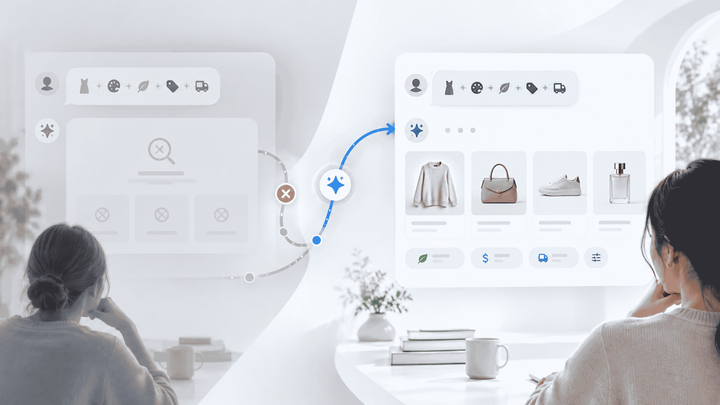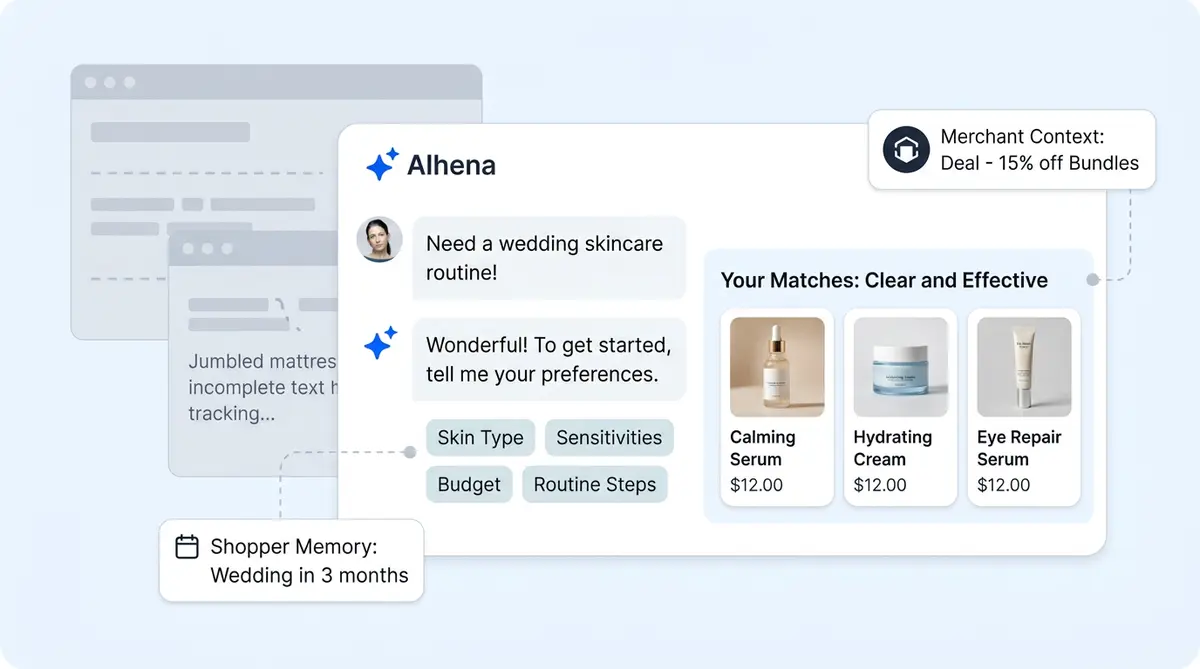
A shopper types "I need a lightweight moisturizer for oily skin, nothing too heavy, under $50." That single sentence contains four preference dimensions: product category, skin type, texture preference, and budget that customers share willingly. No quiz. No form. No polls or surveys. No tracking pixel. Just a conversation the shopper wanted to have. That's a smarter data strategy than anything cookie-based..
That's zero party data. For consumers and brands alike, it's a better deal than cookies ever were. This post explains why conversations collect it better than forms, how Alhena AI's Shopping Assistant turns those signals into recommendations, and what happens to the data after the chat ends.
Zero-Party Data in 30 Seconds
The term 'zero-party data' refers to one of the most valuable types of data: information a customer intentionally and proactively shares with a brand. Skin type, budget range, gift recipient's age, flavor preferences. It's distinct from first-party data (behavioral, inferred signals like clicks and page views) and third-party data (cross-site tracking via cookies).
We've covered the full breakdown of first-party vs. zero party data and cookie deprecation in a separate guide. The short version: Safari already blocks third-party cookies. Firefox partitions them. Chrome's Privacy Sandbox is dead. Marketers need a new way to understand their audience. The companies still relying on cross-site tracking are up to 51% inaccurate according to recent reports.
Zero-party data can solve that accuracy problem. The customer told you directly.
Why Conversations Capture Preferences Better Than Forms
Static quiz funnels ask shoppers to invest 5 to 7 clicks before delivering value. Drop-off rates climb with every question, and answers go stale fast.
Conversations flip that exchange. The customer gets value at every turn: an answer, a clarification, a product suggestion. Preference signals come out naturally from customers, embedded in the questions customers already want to ask.
One sentence in chat can carry five data points that a quiz would need five screens to extract.
The signals include customer context misses: urgency, uncertainty, and emotional framing.
How Alhena Turns Conversation Signals into Recommendations
Alhena's Shopping Assistant uses three data collection methods (beyond surveys and forms) to gather and act on zero-party data. These three ways to collect data don't require cookies or cross-site surveillance.
In-Chat Quiz Options
When the AI needs to narrow intent, it generates tappable, interactive multiple-choice buttons inside the chat. A shopper sees "What's your skin type?" with tappable options. One tap, no typing. Options come from the merchant's catalog, so they're always relevant to products in stock.
These aren't pre-built quiz funnels. They're AI-generated clarifying questions that appear only when they'd help. Icebreaker prompts and suggested follow-up questions work the same way, surfacing intent before the customer even types a word. For a deeper look at how this works, see our guide to AI product quizzes.
User Memory
When a customer shares a meaningful fact ("I have a nut allergy," "size 10 wide"), Alhena extracts it and stores it as a customer profile memory. On return visits, the AI recalls those facts and uses them to create personalized experiences from the conversation from the first message.
Memory is persistent only when the merchant identifies the visitor through login state or the custom data API. For anonymous visitors, memory is session-scoped. Alhena doesn't stitch identities across devices and doesn't use third party cookies. We've written an architectural deep dive on how Unified Memory works if you want the full picture.
Custom Data API
Merchants who already know the customer (loyalty programs tier, cart contents) can pass that context via setUserMetadata. The AI uses it immediately alongside conversation signals. Keys prefixed with _ 'stay private' to the merchant's own tools are hidden from the AI; it's useful for internal IDs that shouldn't influence recommendations.
From Signals to Product Cards
The AI merges all signals and matches them against the merchant's live product catalog. Results show as a product carousel with images, prices, ratings, and action buttons. Merchants can also boost specific products to raise their priority in recommendations.
Tatcha saw a 3x conversion rate and 38% higher AOV after deploying this approach. Victoria Beckham achieved a 20% AOV increase. The data shoppers share willingly converts better than the data brands scrape quietly, excels at engaging customers and boosting engagement, and fuels growth.
What Alhena Stores, What It Doesn't
This is where most "personalization" tools get vague. Here's what Alhena's solution actually does:
- No third party cookies. Sessions use a first-party fingerprint (a UUID scoped to the session) for conversation-to-checkout revenue attribution. Nothing crosses domains.
- Identification is opt-in. Persistent user memory only attaches to a stable identifier (email, customer ID) when the merchant chooses to pass one. Anonymous shoppers get session-scoped memory only.
- Consent controls are built in. Widget customization includes a GDPR-style consent toggle (see our full guide to widget-level privacy controls) that merchants can enable for their storefront.
- Lead sync is consent-gated. When lead generation is active, user attributes like email or first name can sync to HubSpot or Klaviyo, but only attributes the shopper gave in conversation. No behavioral tracking data can flow to your marketing strategy, tools, or campaigns.
- Private metadata stays private. Keys with the
_prefix are invisible to the AI and accessible only to the merchant's custom tools. - Redaction on request. This transparency builds trust and protects personal information. Alhena supports message redaction for GDPR and CCPA compliance for personal information when requested.
The data privacy model is simple because the data collection model is simple. Customers share information willingly. Alhena remembers it. That's it.
Start Collecting Zero-Party Data Today
You don't need a tracking pixel to know your customers. You need a conversation they want to have. Alhena's Shopping Assistant captures personalized preferences as customers state them, remembers what's relevant across channels and touchpoints, and gives merchants full control over what's stored and synced.
For more on building a cookieless personalization strategy, explore our first party data guide, Unified Memory overview, and definitive guide to AI shopping assistants.
Ready to see how conversational zero party data works for your store? Book a demo with Alhena AI or start for free with 25 conversations.

Frequently Asked Questions
What is zero party data in ecommerce?
Zero-party data is information a shopper intentionally shares with a brand, like skin type, budget range, or size preferences. Unlike first party data (behavioral signals from clicks and page views) or third party data (cross-site cookie tracking), zero party data comes directly from the customer. It's more accurate and it's fully consent-based.
How does Alhena AI collect zero party data without cookies?
Alhena's Shopping Assistant collects preferences through natural conversation for personalization. When a shopper asks about products, instead of static quizzes, the AI extracts customer signals like skin type, budget, and sizing from the chat. It can also present tappable Quiz Options to narrow intent. No third party cookies or cross-site tracking are involved. It is a privacy-first data strategy.
Does Alhena remember shopper preferences across visits?
Yes, through User Memory. When a merchant identifies a visitor (via login or the Custom Data API), Alhena stores relevant facts in a customer profile the customer shared and uses them to drive sales, increase engagement and conversion, boost purchase rates (including repeat purchase history), and recalls them on future visits. For anonymous visitors, memory is session-scoped only. There's no cross-device identity stitching.
How is conversational data collection different from a quiz funnel?
Quiz funnels require 5 to 7 clicks before delivering value, leading to high drop-off. Conversational AI delivers value at every turn while extracting preferences naturally. A single chat message like "I need trail running shoes for flat feet" contains more signals than several quiz screens.
What shopper data does Alhena store and what does it skip?
Alhena stores facts shoppers state directly in conversation (preferences, concerns, sizing). It uses a first party session fingerprint for revenue attribution. It does not use third party cookies, track browsing history outside of chat, or stitch identities across devices. Merchants control whether identification is enabled.
Can zero party data from Alhena sync to marketing tools?
When Lead Generation is enabled, attributes the shopper provides in conversation (email, name, consent) can sync to HubSpot or Klaviyo. Only data the shopper explicitly shared flows to marketing tools. No behavioral tracking data is included in the sync.
How is zero party data different from polls and surveys?
Polls and surveys collect zero party data, but they happen outside the shopping experience. Conversational data collection methods capture the same preference signals (skin type, budget, loyalty status) during the purchase journey itself. The data is more accurate because it reflects active purchase intent. This makes conversational personalization more effective for driving engagement and conversion.
What does a zero party data strategy look like for ecommerce?
A strong zero party data strategy starts with conversational data collection: deploy an AI shopping assistant that captures stated preferences, build personalized experiences from those preferences, and respect data privacy by only storing what the consumer explicitly shares. This replaces inferred behavior from third party cookies with direct, accurate signals that build trust and improve personalization over time.