The Cookie That Refused to Die (and Why It Doesn't Matter)
Google officially reversed its third-party cookie deprecation plans in July 2024, then killed its Privacy Sandbox replacement in October 2025 due to low adoption. Chrome still supports third-party cookies. Crisis averted, right?
Not even close. Safari blocks third-party cookies entirely. Firefox partitions them by default. Ad blockers strip them for millions more. Privacy regulations like GDPR in the EU and CCPA across 20+ U.S. states require consent before any tracking fires. The result: third-party data is inaccurate up to 51% of the time, according to a QR Code Chimp analysis of industry accuracy studies. If you're still building your personalization strategy on third-party cookie data, you're working with a foundation that's already crumbling under half the web.
For a deeper look at how CDPs power AI shopping experiences, see our guide on customer data platforms for ecommerce.
Meanwhile, 83% of consumers say they're willing to share personal data when they get clear personalization value in return, per Porch Group Media. The data gap isn't a supply problem. It's a collection problem. And in 2026, conversational AI is solving it.
Your data strategy needs to evolve. This post breaks down how first-party data AI in ecommerce replaces what cookies once provided, and the solutions that provide this data, why zero-party data from conversational AI is the highest-quality signal available, and how this single data asset connects your CX, marketing, and AI visibility teams around a shared competitive advantage.
Zero-Party Data and First-Party Data: A Quick Distinction
First-party data is behavioral. It's what customers do on your site: pages viewed, products clicked, time on page, cart activity. Your website analytics platform captures it passively.
Zero-party data is intentional. It's what customers tell you directly: "I have sensitive skin," "my budget is under $75," "I need a gift for my partner." This data comes from quizzes, preference centers, loyalty program profiles, and, increasingly, AI shopping assistants that collect it through natural conversation.
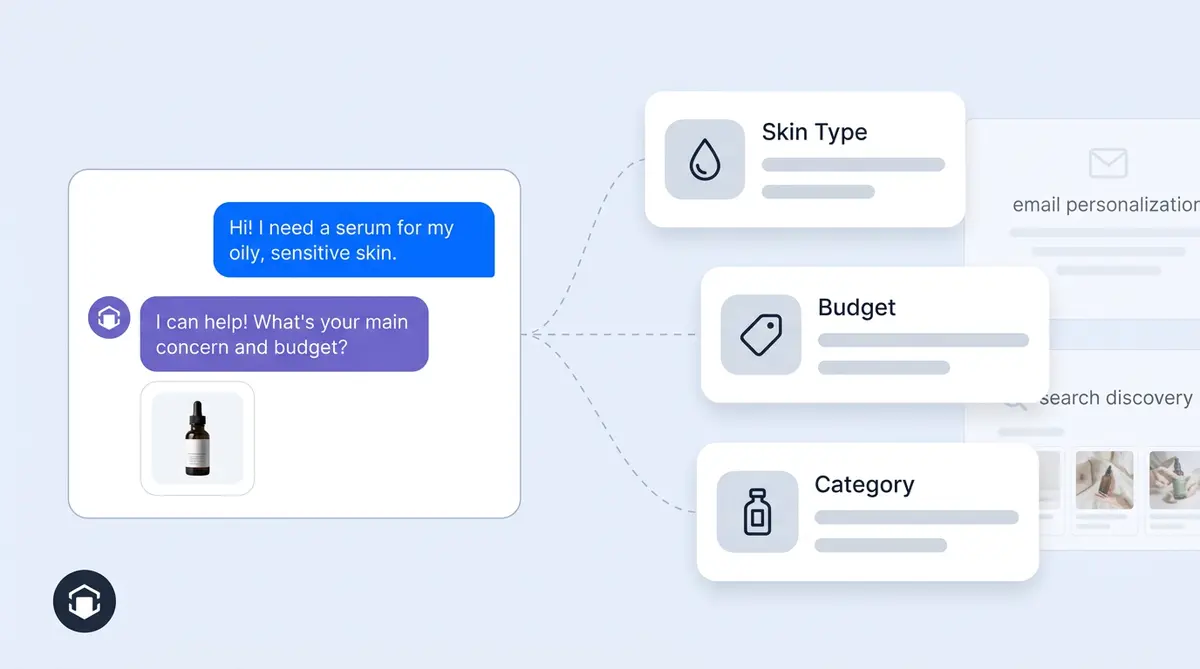
Third-party cookies used to stitch together a rough behavioral profile by following users across sites. That profile was always a guess. Zero-party data from a single AI conversation captures skin type, budget, product category, and purchase intent in 30 seconds, with the customer's full awareness and cooperation. It's not a proxy for preference. It is the preference.
Conversational AI: The Post-Cookie Data Collection Engine
When a shopper asks an AI assistant, "What's a good moisturizer for dry skin under $50?", that one sentence captures product category interest, skin concern, price sensitivity, and purchase readiness. No cookie trail required. No cross-site tracking. No consent banner gymnastics.
The numbers back this up. Shoppers who engage with AI assistants convert at 12.3% compared to 3.1% for unassisted visitors, a 4x lift, according to Rep AI's 2025 Shopper Behavior Report. They also complete purchases 47% faster. That's not just a conversion win. Every one of those AI conversations generates structured zero-party data your marketing team can activate immediately. Smart marketers treat each conversation as a first-party data event.
Alhena AI's Product Expert Agent captures this data across web chat, email, Instagram DMs, and WhatsApp, building persistent customer profiles enriched with purchase history, preferences, and browsing patterns that update with every interaction. Across every touchpoint in the customer journey, when a returning customer opens a new conversation, Alhena already knows their preferences, past purchases, and browsing patterns. That's conversational AI working as a data asset, not just a support tool.
From Conversations to Campaigns: Activating What You Collect
The real value of first-party data AI in ecommerce isn't collection. It's activation. Here's what you can optimize when your AI assistant feeds personalized marketing signals from structured preference data back to your marketing stack:
For a deeper look at how AI moves beyond broad segments to truly individualized experiences, see our guide on how AI makes ecommerce personalization actually personal.
- Personalized product recommendations based on stated preferences, not inferred ones. McKinsey reports that companies excelling at personalization generate 40% more revenue from those efforts than average performers.
- Smarter retargeting through first-party audience segments. Upload CRM data enriched with conversational preferences to run smarter advertising through Google Customer Match or Meta Custom Audiences. Your ad spend becomes more efficient because you\u2019re targeting based on declared intent, not inferred behavior. No third-party cookie dependency. Lower acquisition costs, better match rates. Build customer segments based on actual stated preferences, not guessed ones, for precise audience targeting and segmentation.
- Email and SMS flows triggered by conversation signals. A shopper who asked about running shoes for flat feet gets a follow-up with arch-support picks, not a generic "items you may like" blast.
- Reduced return rates. When customers buy products matched to their stated needs (not algorithmic guesses), they keep them. Brands using quiz-style data collection see return rates drop 46%, according to Digioh.
BCG and Google found that companies linking all their first-party data sources see 2x incremental revenue from ad placements and 1.5x better cost efficiency. Yet research shows only 1% of businesses actually deliver a fully cross-channel first-party data experience. Marketers know the gap is enormous, and the customer acquisition cost penalty is real, and it's a gap that conversational AI closes faster than any CDP implementation.
The AI Visibility Angle: Why Your CX Data Fuels Discovery
Here's where CX, marketing, and AI visibility teams converge on the same data asset.
Adobe reports that AI-sourced visits to retail sites surged 527% year over year through mid-2025. Gartner predicts traditional search volume will drop 25% by 2026 as AI chatbots and virtual agents absorb queries. This shift means The trend is clear: AI answer engines like ChatGPT, Perplexity, and Gemini are becoming how shoppers discover products.
What does this have to do with first-party data? Everything.
The conversations happening on your site through AI assistants reveal what real customers actually ask about your products: the exact language they use, the comparisons they make, the objections they raise. That conversational data is the richest source of answer engine optimization (AEO) intelligence available. It tells you which questions to answer on your product pages, which structured data to add, and which content gaps to fill so AI models recommend your products.
Alhena AI's AI Visibility tools connect this loop. The same conversational data that personalizes your customer experience also feeds your AEO and GEO strategy, helping your products surface in AI-generated recommendations. One data source. Three teams. A unique competitive moat.
What This Looks Like in Practice: Tatcha's Playbook
Tatcha, the luxury skincare brand, deployed Alhena AI's shopping assistant to guide customers through personalized skincare routines. The assistant asks about skin type, concerns, and routine preferences, collecting zero-party data through conversations that feel helpful, not intrusive.
The results: 3x conversion rate, 38% higher average order value, and 11.4% of total site revenue attributed to AI-assisted interactions. Setup took less than 48 hours with zero developer resources. The assistant also deflected 82% of support inquiries, freeing the CX team to focus on high-touch interactions.
The data collected through these conversations now informs Tatcha's product recommendations, email personalization, and content strategy. It's a textbook example of first-party data AI in ecommerce creating a flywheel: better conversations strengthen customer relationships and boost customer lifetime value through better data, which leads to better personalization, which leads to more conversions and richer data.
Building Your First-Party Data Strategy with Conversational AI
You don't need a multi-million dollar CDP to start. Here's a practical path to better ad performance and personalization:
- Deploy a conversational AI assistant that captures structured preference data. Alhena AI deploys in under 48 hours and integrates with Shopify, WooCommerce, Magento, and Salesforce Commerce Cloud without developer resources. These solutions collect structured preference data from day one.
- Connect conversation data to your marketing tools. Feed purchase history and preference signals into your email platform for personalized marketing campaigns, ad audiences, and recommendation engine. Alhena integrates with HubSpot, Zendesk, and other tools your team already uses.
- Use conversation insights for AEO. Mine your most common customer questions to optimize product pages for AI search. The questions your AI assistant answers today are the queries AI models will field tomorrow.
- Measure revenue attribution. Track which AI-assisted conversations lead to purchases with built-in analytics that show measurement of conversion rates, AOV lift, and revenue per conversation. Use predictive signals from conversations to identify high value customers early. Revenue attribution closes the loop between data collection and business outcomes.
- Iterate on the flywheel. Use what you learn from conversation data to improve recommendations, which improves conversion, reduces customer acquisition cost, and generates more data. BCG calls this the first-party data growth engine for retail.
Key Takeaways
- Third-party cookies are functionally degraded across 40%+ of browser traffic. Your loyalty program data, customer segments, and personalized marketing all suffer, regardless of Google's reversal. Building personalization on third-party data means building on inaccurate signals with declining performance.
- Conversational AI is the most effective zero-party data collection method available. A single AI chat captures what used to require cross-site cookie trails.
- First-party data from AI conversations drives 2x revenue and 1.5x cost efficiency when properly activated (BCG/Google).
- The same conversational data powers personalization, retargeting, and AI visibility, connecting CX, marketing, and AEO teams around one asset.
- Brands like Tatcha show this isn't theoretical: 3x conversion, 38% AOV lift, and 11.4% of site revenue from AI-assisted shopping.
Ready to turn your AI conversations into your most valuable data asset? Book a demo with Alhena AI to see how first-party data collection works in practice, or start free with 25 conversations and test the flywheel yourself.
Frequently Asked Questions
What is first-party data in ecommerce?
First-party data is behavioral information collected directly from your own website or app, including pages viewed, products clicked, cart activity, and time on page. Unlike third-party cookie data (which is inaccurate up to 51% of the time), first-party data reflects actual customer behavior on your properties. BCG and Google found that brands linking all first-party data sources see 2x incremental revenue from ad placements.
How does conversational AI collect zero-party data?
Conversational AI collects zero-party data by asking customers natural questions during shopping interactions. When a shopper tells an AI assistant their skin type, budget, size preference, or style, they voluntarily share structured preference data. This replaces the passive tracking that third-party cookies provided, with higher accuracy and full customer consent. Shoppers who engage with AI assistants convert at 12.3% vs. 3.1% for unassisted visitors.
Can first-party data replace third-party cookies for retargeting?
Yes. First-party data enables retargeting through Google Customer Match, Meta Custom Audiences, server-side tracking, and web push notifications, all without third-party cookies. CRM data enriched with conversational preferences creates more accurate audience segments than cookie-based lookalikes ever did. BCG research shows this approach delivers 1.5x better cost efficiency.
What is answer engine optimization (AEO) and how does first-party data help?
AEO is the practice of optimizing your content so AI answer engines (ChatGPT, Perplexity, Gemini) recommend your products. First-party conversational data helps because it reveals the exact questions, language, and comparisons real customers use. Mining this data lets you optimize product pages for the queries AI models field, giving you an AI visibility advantage. Adobe reports AI-sourced retail visits grew 527% year over year.
How long does it take to set up AI-powered first-party data collection?
With platforms like Alhena AI, deployment takes under 48 hours with zero developer resources. Alhena integrates with Shopify, WooCommerce, Magento, and Salesforce Commerce Cloud, and starts collecting structured conversation data from day one across web chat, email, Instagram DMs, and WhatsApp.
What results have ecommerce brands seen from first-party data AI strategies?
Tatcha saw a 3x conversion rate, 38% AOV uplift, and 11.4% of total site revenue from AI-assisted shopping. Victoria Beckham achieved a 20% AOV increase. Brands using zero-party data collection through quizzes and AI conversations report return rate drops of 46% because customers buy products matched to their stated needs rather than algorithmic guesses.
How does zero-party data conversational AI differ from traditional chatbots?
Traditional chatbots follow scripted decision trees and capture limited, structured fields. Zero-party data conversational AI uses natural language understanding to extract preferences, intent, and context from freeform conversations. Alhena AI's Product Expert Agent is grounded in your actual product catalog, so it collects preference data while actively guiding shoppers to relevant products, turning data collection into a revenue-generating interaction.
Is first-party data more valuable than third-party data?
Significantly. BCG and Google found that first-party data delivers 2.9x revenue uplift and 5-8x ROI on marketing spend compared to third-party approaches. First-party data is also more accurate: third-party data accuracy ranges from just 32-69%, while first-party behavioral and zero-party preference data reflects verified, consented customer signals.