Seventy-one percent of consumers expect personalized experiences, according to McKinsey. Only 35% of brands deliver them. The problem isn't a lack of data. Ecommerce brands drown in it: transaction records in Shopify, email engagement in Klaviyo, support tickets in Zendesk, browsing behavior in Google Analytics, social engagement across Instagram and WhatsApp. The real problem is that data lives in silos. It's a problem every growing e-commerce brand faces. A customer data platform for ecommerce solves this by collecting data from every source, stitching it into one profile per person, and making that unified profile available to every tool in your stack in real time.
What a Customer Data Platform Is (and What It Is Not)
A CDP is not a customer relationship management system, which stores sales team interactions for known contacts. Your personalization journey starts when you move beyond CRM limitations. It's not a DMP (data management platform), which handles anonymous ad audience data tied to cookies. And it's not a data warehouse, which stores everything but isn't built for real-time activation. A customer data platform is the customer truth layer that unifies identity across devices, channels, and touchpoints, then activates that unified profile in real time for any connected tool. For example, a cloud-based CDP gives every team a single view of each customer, from marketing teams to support teams to the AI layer. Whether you run Adobe Experience Platform, Salesforce Data Cloud, Tealium, Treasure Data, ActionIQ, or the Salesforce CDP (also known as Salesforce Data Cloud), the customer data platform sits at the center of your martech stack and feeds clean, unified profiles to every tool that needs them. Unlike a DMP that relies on anonymous cookie-based data, a CDP builds persistent, identified customer profiles that power cross-channel personalization at scale. This cross channel capability is what separates a modern customer data platform from legacy tools. For brands on Shopify, Commerce Cloud, or any major ecommerce platform, the right customer data platform is the foundation of a data-driven marketing strategy and genuine digital transformation. Every global organization benefits when all teams work from the same customer truth. Enterprise brands with integrated tech stacks see faster implementation timelines and stronger personalization outcomes. Real-time data flows mean your segmentation blueprint updates instantly. When a customer leaves feedback or ignores email promotions, the CDP adjusts their profile and the AI adjusts the conversation, all without manual intervention.
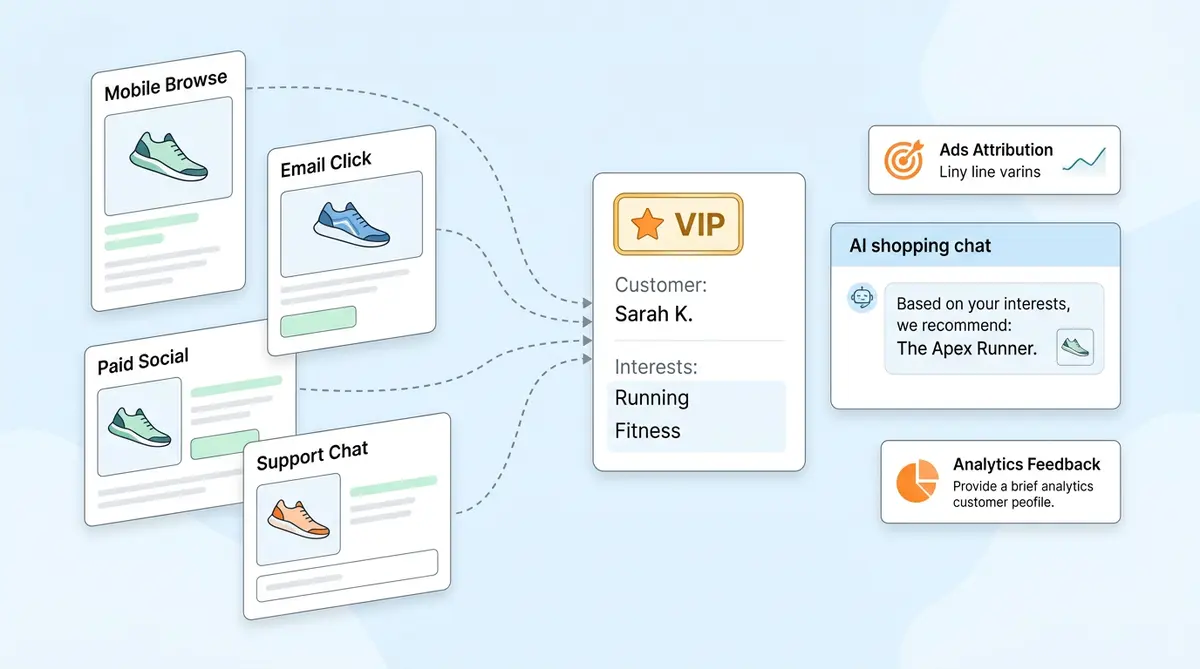
For ecommerce directors and marketers evaluating their stack, this distinction matters. The use cases are different. A CRM tracks known touchpoints. A CDP connects every segment of customer behavior, known and anonymous, into a single personalization layer. Your CRM strategy manages known relationships. Your CDP connects the dots between the anonymous browser who visited three product pages, the email subscriber who clicked a promotional link, and the customer who called support last week, recognizing them as the same person.
Why Ecommerce Brands Need a CDP Now
If you're running an e-commerce operation, consider this: four forces are converging. Customer data platforms have moved from nice-to-have to must-have, and the analysis behind that shift comes down to one insight. Every customer data platform vendor confirms it: brands that unify their data collection across hundreds of data points outperform those that don't. First, cookie deprecation is making third-party data unreliable. Safari and Firefox already block third-party cookies entirely. Unified first-party and zero-party data is now the only dependable path to personalization.
Second, omnichannel commerce creates data silos by default. Your commerce platform, helpdesk, email tool, social channels, and analytics suite each hold a fragment of every customer. A global report from MoEngage found that 47% of marketing executives cite siloed data as their biggest personalization barrier.
Third, AI needs unified data to work. An AI shopping assistant connected to fragmented data actually gives fragmented answers. Connected to a CDP, it gives answers informed by the full customer picture. The predictive capabilities of modern AI, whether powered by Adobe, Salesforce, or any other platform, depend on clean, unified customer insights. Without proper audience segmentation data feeding the model, optimization is impossible. AI can't personalize what it can't see. Your entire martech investment depends on segmentation accuracy, and segmentation accuracy depends on unified customer data platform infrastructure.
Fourth, privacy regulations now cover 43% of the U.S. population across 20 states. CDPs provide centralized consent management natively, with built-in data governance and data management controls that simplify GDPR and CCPA compliance. Data protection policies apply automatically, reducing compliance risk across every activation channel. These use cases show why governance and data management, whether in Adobe or any other platform, are not just IT concerns. They are core to every marketer's ability to segment audiences and deliver personalized customer experiences at every touchpoint. The more touchpoints your customer data platform captures, the smarter your AI becomes. For marketers running data-driven marketing programs, this means first-party data becomes your most valuable asset. Building a first-party data strategy around your customer data platform without the legal headaches. Every touchpoint generates governed, compliant first party data that feeds your customer data platform and improves segmentation over time.
Before and After: CDP-Connected AI
Without a CDP, your AI shopping assistant knows nothing about the customer except what they type in the current session. It treats a loyal VIP the same as a first-time visitor.
With a CDP, the AI knows their purchase history, loyalty tier, browsing patterns, email engagement, support history, and stated preferences before they type a single word. The data flow works like this: a customer visits your site, the CDP identifies them and sends their unified profile to the AI, and the AI personalizes the conversation using full customer context. Conversation data then flows back to the CDP, updates the profile, and every integrated downstream tool gets the enriched customer information. Your marketing campaigns, ad platforms, and analytics dashboards all work from the same updated profile. This feedback loop helps enhance future marketing campaigns and makes every customer interaction smarter than the last.
Three CDP-Powered AI Use Cases
Loyalty-Tier-Aware Shopping
VIP customers see exclusive product previews and dedicated offers surfaced by the AI because the CDP passes their loyalty status and segmentation data in real time. The same segmentation logic helps identify churn risk: if a previously active customer stops engaging, the AI can trigger a personalized win-back offer during their next visit. A brand running AI-powered loyalty programs can trigger tier-specific promotions inside the chat conversation itself, turning a support moment into a revenue moment.
Cross-Channel Context Continuity
A customer browses running shoes on mobile last night. Today on desktop, the AI greets them with "still thinking about those running shoes?" because the CDP connected both sessions to the same identity. This isn't hypothetical. It's worth knowing that identity resolution across devices is the core purpose of every customer data platform, and it's what makes social commerce and web chat feel like one continuous conversation.
Ad-to-Chat-to-Purchase Attribution
A customer clicks a paid social ad, engages the AI on site, and purchases. The CDP connects the ad impression to the chat conversation to the transaction, giving your marketing team full-funnel visibility that no siloed tool, not even Adobe Analytics alone, can provide. Companies excelling at this type of connected personalization generate 40% more revenue than average, according to McKinsey.
How Alhena AI Activates CDP Data in Real Time
Alhena AI is the conversational AI layer purpose-built for ecommerce that turns your CDP investment into real-time shopping experiences. Alhena integrates bidirectionally with mParticle, fetching unified customer profiles during live conversations and syncing conversation-derived attributes back for downstream activation across email, marketing campaigns, ads, analytics, cloud data warehouses, and Google-based tools. The integration handles all data mapping automatically.
For brands not yet on a full CDP, Alhena connects directly to HubSpot and Klaviyo to begin building the unified customer understanding that a CDP formalizes at scale. Alhena's unified memory layer maintains conversation context across web chat, email, Instagram DMs, WhatsApp, and voice, complementing the CDP's identity resolution with conversational continuity across every touchpoint.
Brands using Alhena have seen results like 3x conversion rates and 38% average order value uplift at Tatcha, and 80% inquiry automation at Manawa with response times dropping from 40 minutes to 1 minute. These outcomes come from connecting the right data to the right AI at the right moment. See the Tatcha case study for the full breakdown.
A CDP Without AI Is an Expensive Database
A customer data platform without AI activation is a well-organized filing cabinet. AI without CDP data is personalization without context. Together, they create the only stack that delivers true 1:1 shopping experiences at scale, where every interaction is informed by every previous interaction across every channel.
Ecommerce brands that get this right don't just improve support metrics. They turn every customer conversation into a revenue opportunity, reduce churn by catching at-risk customers before they leave, and improve customer retention across every stage of the lifecycle. Better customer experiences lead directly to stronger lifetime value. Both enterprise customers and mid-market customers benefit from this approach. Unlike batch-based systems that update overnight, a CDP feeds AI with live data, meaning customer feedback from a morning support ticket shapes the afternoon shopping conversation. Ready to see how CDP-connected AI works in practice? Book a demo with Alhena AI or start free with 25 conversations.
Frequently Asked Questions
What is the difference between a CDP and a CRM for ecommerce?
A CRM stores known customer contacts and sales interactions. A customer data platform for ecommerce goes further by unifying known and anonymous data across every channel, resolving identity across devices, and activating profiles in real time. Alhena AI connects to both, pulling CRM data from HubSpot and CDP data from mParticle to personalize every shopping conversation with the fullest possible customer context.
Why do AI chatbots need CDP data to personalize effectively?
Without CDP data, an AI chatbot only knows what the customer types in the current session. It treats a loyal VIP the same as a first-time visitor. With a CDP feeding real-time profiles, Alhena AI can greet returning customers by name, reference past purchases, surface loyalty-tier offers, and recommend products based on browsing history across every device and channel.
Can brands without a CDP still use AI personalization?
Yes. Alhena AI connects directly to platforms like HubSpot, Klaviyo, Shopify, and Zendesk to build a working customer profile even without a formal CDP. This gives brands a starting point for personalized AI conversations. As data complexity grows, adding a CDP like mParticle formalizes identity resolution and scales the personalization layer across your entire stack.
How does CDP-connected AI improve conversion rates compared to standalone AI?
Standalone AI personalizes based on session data alone. CDP-connected AI personalizes based on the full customer journey: purchase history, email engagement, support tickets, browsing behavior, and loyalty status. Alhena AI clients using unified customer data have seen up to 3x conversion rates and 38% average order value uplift because the AI recommends products the customer actually wants, not generic bestsellers.
Does connecting a CDP to AI require custom development?
Not with Alhena AI. The mParticle integration is bidirectional and preconfigured. The integration works out of the box, meaning customer profiles flow into Alhena during live conversations and conversation attributes sync back to the CDP automatically. Most brands complete implementation in under 48 hours with no developer resources required. Enterprise and mid-market ecommerce businesses get the same fast setup. The first step is connecting your commerce platform, and the rest of the implementation follows a guided process. Whether your martech stack includes Treasure Data, ActionIQ, Adobe, Salesforce Data Cloud, or another customer data platform, connecting through a CDP or directly through commerce and helpdesk integrations.
What customer data does a CDP send to AI during a live conversation?
A CDP can send purchase history, loyalty tier, lifetime value, browsing patterns, email engagement scores, support ticket history, stated preferences, and device or channel data. Alhena AI uses this real-time profile to tailor product recommendations, adjust tone and offers by customer segment, and maintain context continuity across web chat, email, Instagram DMs, WhatsApp, and voice.