Why AI Engines Skip Your Content (and How to Find Out)
A brand can rank on page one of Google Search with its website and still be invisible inside ChatGPT. That disconnect is the central problem with treating traditional SEO and AI engine optimization as the same discipline. Gartner predicts traditional Google Search volume will drop 25% by the end of 2026, while ChatGPT now handles over two billion queries a day. The traffic is moving. AI-referred traffic now accounts for a growing share of website visits, and the rules for earning visibility have changed.
AI engines don't rank pages. They cite sources. Generative search works differently from traditional search: AI models synthesize answers from multiple sources rather than returning a list of links. When a shopper asks Perplexity "best moisturizer for sensitive skin," the engine reads dozens of URLs, picks the most relevant ones, and weaves their claims into a single answer. If your product page wasn't useful enough to cite, you don't get a mention, a link, or a product card. You get nothing.
Alhena AEO's Content Gap Analysis was built to answer one question: why did the AI engine cite someone else instead of you, and what exactly should you fix? This guide walks through how the feature works, what it finds, and what ecommerce brands can learn from the process. You will also learn why it gives ecommerce brands a closed-loop path from "invisible" to "cited."
What Content Gap Analysis Means in AI Engine Optimization
In traditional SEO, a content gap is a keyword your competitors rank for that you don't. The fix is usually "write a new blog post." In answer engine optimization (AEO), the gap is different. It's not about missing keywords. It's about missing information that AI engines need to trust your page enough to cite it.
Think of it this way: when ChatGPT, Gemini, or Perplexity generates a shopping answer, each of these generative systems runs a retrieval step first. The AI agents powering these engines. It searches the web, pulls candidate pages, reads them, and decides which ones contain the most relevant claims worth referencing. These language models prioritize pages with high-quality, specific, evidence-backed information. Pages that earn citations share common traits: depth, specificity, structured evidence, and direct answers to the question asked.
A page that says "our moisturizer is great for sensitive skin" gets skipped. A page that explains which ingredients reduce irritation, cites clinical results, compares formulations, and addresses common follow-up questions gets cited. The gap between those two pages is a content gap for AI engines.
Alhena AEO identifies those gaps systematically, not by guessing what AI engines might want, but by analyzing what they actually cited and comparing it against what your content currently says.
How Alhena AEO Content Gap Analysis Works
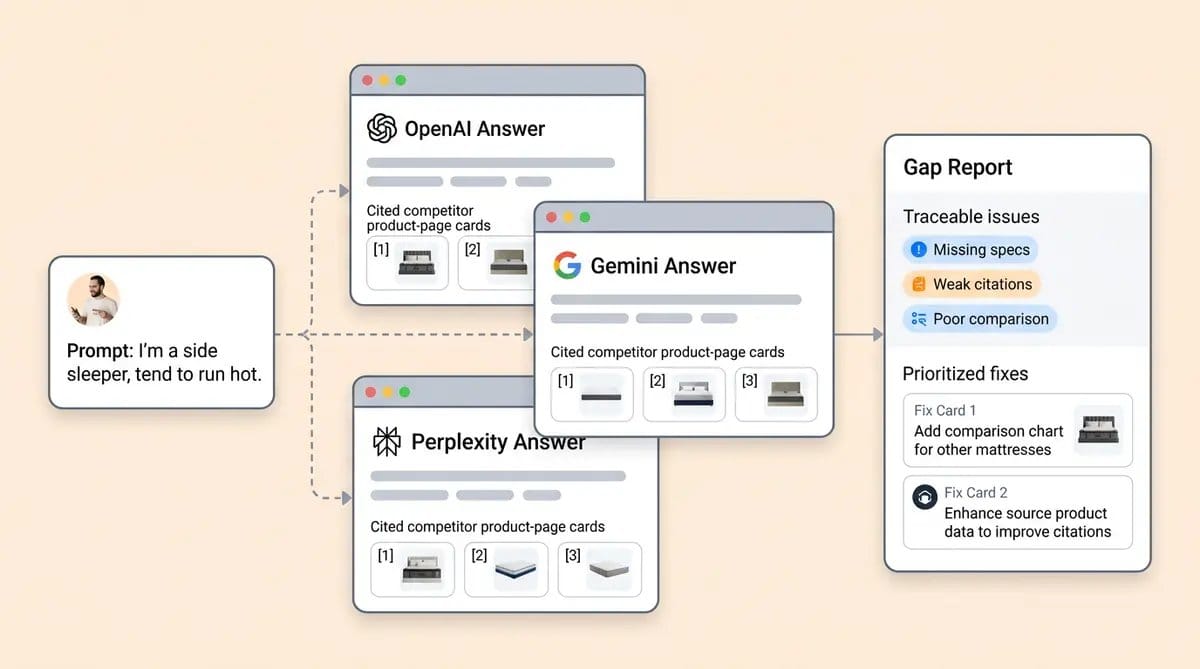
The system runs a six-step pipeline that starts with real AI prompts and ends with prioritized, traceable content fixes. Here's each step.
Step 1: Run the prompts shoppers actually ask
Every AEO configuration starts with a set of target queries, things like "best moisturizer for sensitive skin," "how to choose a standing desk," or "organic dog food for allergies." These aren't pulled from a keyword tool. They come from real shopping behavior: your customer conversations and marketing data, your category's most common pre-purchase questions, and the prompts your competitors already win on.
Alhena runs each query across multiple AI systems and providers (OpenAI, Gemini, and Perplexity) to capture how different engines answer the same question. This multi-provider approach matters because each generative engine uses different retrieval systems, ranking models, and citation logic.
Step 2: Capture the full AI answer and every citation
For each prompt and provider, Alhena records the complete output: the final answer text, every URL the engine searched, every URL it actually cited, the top cited domains, mentioned brand names, and any ecommerce product cards displayed. This goes well beyond simple "are we mentioned?" tracking. It captures the entire decision surface the AI engine used.
Step 3: Treat cited pages as the benchmark
This is the key insight that separates Alhena's approach from generic AI search engine optimization services. The pages an AI engine cites are, by definition, the pages it trusted. They passed the engine’s internal quality, relevance's internal relevance and quality filters. So instead of guessing what "good content" looks like, Alhena scrapes and analyzes those cited URLs to understand exactly what made them useful.
The analysis looks at depth of coverage, specificity of claims, supporting evidence, content structure, FAQ presence, comparison data, credibility signals, digital marketing best practices. In a digital marketing landscape shifting toward AI-powered search, and more. These cited pages become the benchmark your content is measured against.
Step 4: Compare against your own content
Alhena then pulls your brand's content from its knowledge base, including product pages, online documentation, and any target URLs that appeared in the AI engine's search results. It runs the same analysis on your pages and compares them, point by point, against the cited benchmark.
If a cited competitor page explains how ceramides repair the skin barrier and your product page only lists "ceramides" as an ingredient in its online product features without explanation, that's a gap. If a cited page includes a comparison table and yours doesn't, that's a gap. If a cited page answers five follow-up questions and yours answers none, that's a gap.
Step 5: Generate traceable, specific gaps
The output isn't a vague "improve your content" recommendation. Each gap is clear, specific, and traceable. For example:
- Gap: "Ingredient benefits: Lists ceramides but does not explain their role in skin barrier repair"
- Source: Cited URL from Dermatology Times explained ceramide function in 200 words
- Priority: High
- Impact: This claim appeared in 3 of 4 AI-generated answers for this prompt
Every gap includes where the issue exists on your page, which cited URLs had the missing information, the exact claims from those sources, a priority level, and a recommended fix. These references are fully traceable back to the original AI answer.
Step 6: Classify each gap by type
Alhena categorizes gaps into seven types so teams can triage and batch their fixes:
- Missing topic: An entire subject area your content doesn't address
- Insufficient depth: You mention the topic but don't go deep enough
- Missing data: No stats, clinical results, technical specifications, or quantitative evidence
- Outdated content: Your claims reference old studies or discontinued formulations
- Missing expertise: No expert quotes, certifications, or first-party testing
- Format gap: Missing comparison tables, structured FAQs, or schema markup
- FAQ gap: Common follow-up questions left unanswered
From Gaps to Fixes: Closing the Loop Automatically
Identifying a gap is only useful if you can close it. Most AI visibility tools stop at measurement. They count mentions but don't explain why those citations went to someone else. They leave the actual content work to you. Alhena closes the loop.
From any identified gap, Alhena can generate a proposed content fix. The fix pipeline works like this:
- Analyze brand voice: The system reads your existing content to match tone, terminology, and style
- Verify factual claims: Every claim in the proposed fix is cross-referenced against the cited source material
- Scrape the source page: The system pulls the specific section from the cited URL that contains the missing information
- Generate the fix: The output is either a new content section, an improvement to an existing section, or a batched FAQ section with schema markup ready to deploy
For ecommerce brands, this is where things get concrete. If a product is mentioned in AI-generated answers but not cited (or absent from product cards entirely), AEO identifies the missing FAQ content, spec details, ingredient explanations, or comparison data that could make that product page citable. The AEO FAQ Engine can then auto-generate schema-ready Q&A pairs for each SKU based on those gaps.
This is the core difference between Alhena's GEO and SEO/GEO services that run a standard content audit and rebrand it as "AI-ready." The fix isn't generic. It's grounded in what AI engines actually cited for the specific prompt your customers care about.
The Dashboard: Content AI Visibility View
Individual gaps are useful, but ecommerce catalogs can have thousands of product pages. The Content AI Visibility dashboard aggregates gaps by content page and product page so teams can see the full picture.
For every page in your catalog, the dashboard shows:
- Citation status: Is this page currently cited by any AI engine?
- Gap count: How many specific content gaps exist on this page?
- Prompt coverage: Which AEO prompts created opportunities for this page?
- Provider breakdown: Which AI engines (ChatGPT, Gemini, Perplexity) searched or cited this page?
- Estimated AI volume: How much AI-referred traffic and website traffic could this page capture?
- Fix priority: Which pages are most worth fixing based on gap count, volume, and competitive position?
This view turns content gap analysis from a one-off audit into an ongoing recurring competitive visibility audit. Teams can sort by estimated impact, track content performance over time, and monitor whether closed gaps result in new references on the next AEO run.
Why This Isn't a Generic SEO Audit
The online market is full of tools that call themselves "AI SEO" platforms. Most of them do one of two things: they track whether your brand gets mentioned in AI-generated answers, or they offer SEO/GEO services that repackage a standard content audit as "AI-ready." Alhena's content gap analysis is neither.
Here's what makes it different:
It's grounded in real AI behavior, not assumptions. The gaps come from actual AI engine runs across real shopping prompts. Alhena doesn't guess what ChatGPT might look for. It watches what ChatGPT actually searched, read, and cited.
Cited pages are the benchmark, not keyword competitors. Traditional gap analysis compares you against pages that rank for the same keywords. AEO gap analysis compares you against pages that AI engines already trusted enough to reference. Those are often different pages entirely.
Every gap is traceable. You can see exactly which cited URL had the information you're missing, what that information was, and which AI engine's answer included it. Nothing is a black box.
It's built for ecommerce. This isn't a digital marketing tool repurposed for product pages. The system understands SKU-level content, product attributes, ingredient lists, spec sheets, and the specific types of information that make a product page citable in AI shopping answers. These features matter when you're working with catalogs of hundreds or thousands of products.
It closes the loop. Measurement tools tell you the problem. They count citations but don't explain why those citations went to someone else. Alhena tells you the problem, shows you exactly what's missing, generates a fix, and lets you re-run AEO to measure whether the fix worked. The full cycle is: AI answer, cited competitor source, missing brand content, prioritized gap, generated fix, rerun to measure improvement.
What Ecommerce Brands Should Do First
If you're new to AI engine optimization, starting with content gap analysis is the most important part of the process and the highest-leverage move. Here's a practical path:
1. Identify your 10 most important shopping prompts. These are the questions your customers ask before buying. "Best [product] for [need]," "how to choose [category]," "[your brand] vs [competitor]." These become your AEO test queries.
2. Run those prompts across ChatGPT, Gemini, and Perplexity. Alhena AEO automates this, capturing answers, citations, and product cards for each generative engine.
3. Review your gap report. Focus on high-priority gaps first: missing topics and insufficient depth on your most valuable product pages. These are the changes most likely to flip a page from "invisible" to "cited."
4. Deploy fixes and re-measure. Use Alhena's generated fixes or write your own. Then rerun the same AEO prompts to see if your citation rate improves. This creates a measurable improvement loop that tightens with every cycle.
5. Expand to your full catalog. Once you've proven the approach on your top products, roll it out across your catalog using the Content AI Visibility dashboard to prioritize pages by estimated impact.
Brands using Alhena's full AI visibility suite have already seen results. Tatcha achieved a 3x conversion rate and 38% AOV uplift with Alhena's AI tools. Victoria Beckham saw a 20% increase in average order value. When your content is built to earn AI citations, the revenue and organic traffic follow. Whether you call it AEO, GEO, or AI engine optimization, this guide to making your content relevant to AI engines starts with knowing what you're missing.
Key Takeaways
- AI engines cite sources, not rank pages. Content gap analysis for AI is about missing information, not missing keywords.
- Alhena AEO runs real prompts across ChatGPT, Gemini, and Perplexity, then compares your content against the pages those engines actually cited.
- Every gap is traceable: you can see which cited URL had the missing information, what the claim was, and how it appeared in the AI-generated answer.
- Gaps are classified into seven types (missing topic, insufficient depth, missing data, outdated content, missing expertise, format gap, FAQ gap) for easy triage.
- Alhena doesn't just identify gaps. It generates content fixes matched to your brand voice and verifies factual accuracy against source material.
- The Content AI Visibility dashboard aggregates gaps by product page, showing citation status, gap count, provider coverage, and estimated AI volume.
- For ecommerce, AEO content gap analysis is the highest-leverage path from "invisible in AI search" to "cited and earning revenue."
Ready to find out why AI engines are citing your competitors instead of you? Book a demo with Alhena AI to see your content gaps in action, or start for free with 25 free conversations.
Alhena AI
Frequently Asked Questions
What is AEO content gap analysis?
AEO content gap analysis is a branch of answer engine optimization (AEO) and GEO (generative engine optimization) that identifies what your pages are missing so AI search engines can cite them. While traditional SEO audits focus on keyword rankings in Google search results, AEO gap analysis focuses on AI search visibility across generative AI platforms like ChatGPT, Gemini, and Perplexity. It gives you an overview of which content gaps prevent your brand from appearing in AI-generated answers and search results, then maps each gap to a specific optimization you can make.
How does Alhena AEO find content gaps?
Alhena sends real shopping queries across multiple AI systems (OpenAI, Gemini, Perplexity) and captures each AI answer along with every search result the AI model retrieved. It then scrapes the cited URLs to understand what made those pages authoritative enough to reference. By comparing that benchmark against your own content, Alhena's AI generates a list of specific, traceable gaps. Each gap shows what the LLM valued in a competitor's page that your page doesn't have, whether that's deeper ingredient detail, structured data, or missing FAQ sections.
What types of content gaps does Alhena identify?
Alhena classifies gaps into seven categories: missing topic, insufficient depth, missing data, outdated content, missing expertise, format gap, and FAQ gap. A format gap might mean your page lacks structured data, a comparison table, or conversational Q&A that platforms need to generate a useful answer. A missing expertise gap might mean your content lacks authoritative sources or backlinks to supporting evidence. Each gap type maps to a different optimization strategy so your team can batch similar fixes together.
Can Alhena generate content fixes automatically?
Yes. From any identified gap, Alhena can AI generate a proposed fix matched to your brand voice. The fix pipeline verifies claims against the cited source material and produces either a new section, an improvement to an existing one, or a complete FAQ section with schema markup ready to deploy. You can also generate summary recommendations across multiple gaps to prioritize your digital content strategy. Every fix is designed to optimize your pages for both SEO and GEO visibility at the same time.
How is AEO content gap analysis different from a traditional SEO content audit?
Traditional SEO audits compare your keyword rankings against competitors in search engine results. AEO and GEO content gap analysis compares your pages against what generative AI systems actually cited. The shift is fundamental: SEO asks 'do I rank for this query?' while AEO asks 'does the AI answer reference my content?' A page can rank on page one of Google and still have zero visibility in AI-generated answers. Alhena's approach focuses on relevance to the AI model's intent, not just keyword presence, and checks across every major platform.
Which AI engines does Alhena AEO track?
Alhena AEO tracks ChatGPT (which drives roughly 87% of all AI referral traffic), Google AI Overviews, Google Gemini, and Perplexity. The system also monitors AI search engines like Bing Copilot, which use large language model (LLM) technology to generate answers from web content. For each AI engine and search provider, Alhena captures the full AI answer, every search result URL, cited sources, mentioned brands, and product cards. This multi-platform coverage matters because each AI system uses different retrieval logic and ranks context differently.
How long does it take to see results from fixing content gaps?
Most brands see shifts in AI search visibility within 2 to 4 weeks of deploying fixes, depending on how quickly AI powered search engines re-crawl updated pages. Alhena's rerun capability lets you measure whether your optimization strategy is working by running the same queries again after updates go live. Pages that move from 'not cited' to 'cited' typically see increased referral traffic from generative AI platforms. GEO and SEO improvements often compound over time as AI models build a stronger relevance signal for your content.
Does AEO content gap analysis work for ecommerce product pages?
Yes, and product pages are where AEO gap analysis delivers the most value. The AI tool understands SKU-level content, product attributes, ingredient lists, and spec sheets. It identifies where you need to structure data properly, add FAQ content, comparison details, and technical specifications that could help a product page earn citations in AI-generated answers. For ecommerce, generative AI visibility directly impacts whether your products appear in AI search engine shopping cards, which is a growing share of digital commerce traffic.
How does GEO relate to AEO content gap analysis?
GEO (generative engine optimization) is the broader discipline of optimizing content for AI-powered search, while AEO (answer engine optimization) focuses specifically on earning citations in AI answers. Alhena's content gap analysis sits at the intersection of GEO and SEO: it uses GEO principles to analyze what generative AI models cite, then applies SEO best practices to help you optimize for both traditional search engines and AI search at the same time. Think of GEO as the strategy and AEO gap analysis as the tactical audit that tells you exactly where to optimize.
What context does Alhena use beyond just scraping competitor pages?
Alhena pulls context from multiple sources: your knowledge base, product catalog, AI answer outputs, and the full set of search results each AI platform retrieved for every query. This gives the AI tool a 360-degree view of the competitive landscape for each conversational query, not just a summary of one competitor's page. The system also considers structured data, schema markup, and digital content structure when evaluating gaps. This multi-context approach is what lets Alhena generate fixes that are specific to each AI search engine's ranking logic rather than offering generic SEO optimization advice.