Traditional search ranks pages in a list. AI search synthesises an answer. That one difference rewrites what optimisation means, because there is no position two in a sentence that names a single product.
AI-generated traffic to US retail sites rose 4,700% year over year as of July 2025. ChatGPT reaches over 900 million weekly active users, Google AI Overviews appear on roughly one in four results, and Perplexity processes 780 million queries a month. For ecommerce brands these platforms are a second storefront.
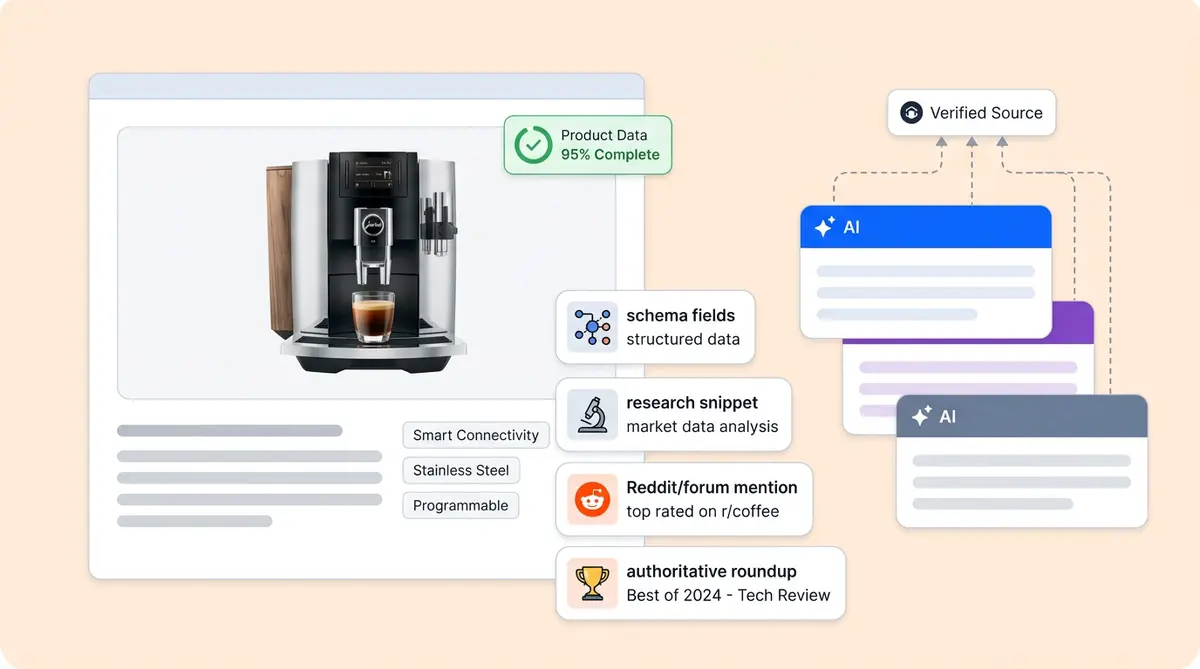
When a shopper asks for the best moisturiser for dry skin under $50, the model does not return ten blue links. It pulls from dozens of sources, weighs authority and trust, checks recency, and assembles one recommendation with citations. The brands that get named share a few traits: complete structured product data, content that answers specific questions directly, presence across third-party platforms, and freshness. Pages older than three months are over 3x more likely to lose AI visibility than recently updated ones.
What GEO actually means
Generative engine optimisation is the practice of structuring content so AI engines retrieve it, understand it, and cite it. If SEO gets you ranked, GEO gets you recommended. The two are layers of the same strategy, not opposites. Answer engine optimisation works the same way but focuses on direct-answer formats: featured snippets, AI Overviews, zero-click results.
Analysts project a 25% drop in traditional search volume by 2026 as users shift to AI systems. Early movers are locking in citation authority that compounds, which is the part that makes this urgent rather than merely interesting.
Seven tactics that earn citations
01Structure content for direct extraction
AI systems do not read your page like a human browsing a blog. They scan for clear, extractable statements they can quote or paraphrase. Content with structured formatting, meaning lists, tables, and concise definitions, is 28 to 40% more likely to earn a citation. Lead every section with a direct answer, use question-based headings that mirror how people ask, and break complex topics into short paragraphs. The goal is content clear enough that a model can pull a useful snippet without guessing what you meant.
02Build complete product data with schema markup
For ecommerce, your product data is the GEO asset that matters most. Complete, structured attributes are what let an engine describe your product confidently enough to cite it instead of a competitor's. When the choice is between your listing with missing specs and an identical competitor product with full data, the engine picks the one it can describe without hedging.
Implement Product schema in JSON-LD with every field filled: material, dimensions, colour, images, shipping details, pricing. Add FAQ schema to category and product pages, and layer in Review schema with aggregate ratings. Pages already surfacing as rich snippets in Google Search are more likely to be cited in AI summaries, so this is a two-for-one investment. Two companion pieces cover the detail: the six product data fields that drive AI recommendations for which fields to prioritise, and the schema markup guide for the JSON-LD implementation. The PDP checklist covers the on-page execution.
03Publish original research and first-party data
AI engines need sources to cite. Publish something no one else has, whether a benchmark study, a proprietary dataset, or survey results from your own customer base, and the model has a reason to reference you over a dozen competitors saying the same thing. Case studies work well here. A specific, attributable claim gives a model something citable. "AI improves conversions" earns nothing, because every site says it.
04Keep content fresh
AI engines show a documented recency bias. Guides published in 2024 without updates are already losing ground. Pages going more than three months without a refresh are significantly more likely to drop out of AI answers. Add a visible "last updated" timestamp to cornerstone content, refresh statistics annually, and swap outdated examples for current ones. This is maintenance, not a project.
05Show up on Reddit, forums, and UGC platforms
LLMs pull heavily from community platforms. When someone recommends your product by name in a genuine conversation, that feeds the retrieval data models use. You cannot fake this. Answer questions in subreddits where your customers actually are, and encourage real reviews on third-party sites. The brands recommended most often have organic mentions scattered across dozens of independent sources. Your own site is the anchor, but it cannot be the only signal.
06Get featured in authoritative roundups
The top five domains capture 38% of all AI citations for a given query. Inclusion in "best of" lists on high-authority sites raises your odds directly. Pitch products to journalists and creators writing comparison guides, and contribute expert quotes to industry reports. This cross-platform authority is weighted heavily when engines decide whom to cite.
07Test your visibility platform by platform
ChatGPT, Google AI Overviews, Perplexity, and Claude retrieve and rank sources differently. ChatGPT cited pages ranking in position 21 or worse almost 90% of the time, meaning traditional SERP position matters far less there. Google AI Overviews lean more on pages already in the top 10. Search your product categories on each platform and record where you appear and where you do not. Gap analysis by platform shows exactly where to spend effort.
What to measure weekly
- AI citation frequency. How often your brand appears in answers for target queries. Brands cited in AI answers see a 38% lift in organic clicks and a 39% boost in paid ad performance.
- Share of voice. Your mentions against competitors. If a rival appears in 7 of 10 "best moisturiser" answers and you appear in 2, you know the size of the gap.
- Content freshness score. How recently each key page was updated. Refresh cornerstone content every 90 days minimum.
- Schema coverage. What share of product pages carry complete JSON-LD. Aim for 100% of the active catalog.
- Conversion from AI referral traffic. Segment analytics by AI source. ChatGPT visitors convert 4.4x better than organic search, so this traffic is disproportionately valuable.
Start with a weekly check across those five. As the programme matures, build dashboards that flag drops in citation frequency or share of voice before they become problems.
Where an on-site assistant fits in
Most GEO guides stop at content optimisation. For ecommerce there is a layer beneath it: the quality and structure of your product data feeds directly into what AI engines can say about you.
Every conversation Alhena handles generates factual product content grounded in your verified catalog, with no invented specs. When crawlers find precise, consistent product information across your pages, your authority signal strengthens. Product data quality sets the accuracy ceiling for both your assistant and your GEO performance. Tatcha's AI concierge drove 3x conversion and a 38% AOV lift, and Victoria Beckham saw a 20% AOV increase. Higher conversion and engagement feed back into citation likelihood.
The Support Concierge extends this across web chat, email, Instagram DMs, WhatsApp, and voice, so every touchpoint produces consistent structured data. One integration covers your catalog, inventory, and pricing, and most brands are live inside 48 hours with no custom code.
Key takeaways
AI search is a revenue channel, not a trend. Orders are up 14x with 30% higher AOV. GEO builds on SEO rather than replacing it, so strong traditional rankings still feed citations. Product data quality is the foundation: complete schema and accurate attributes earn citations, vague marketing language does not. Freshness matters more than ever, with pages older than three months 3x more likely to lose visibility. Measure weekly, because citation frequency and share of voice move faster than SEO rankings ever did.
Turn your catalog into a citation magnet
See which of your products AI engines surface today, and which ones they cannot describe well enough to name.
Frequently asked questions
Traditional SEO focuses on ranking in a list of links. AI search optimisation focuses on getting your content selected as a source for a synthesised answer. The two work together: strong rankings still feed citations, but GEO adds schema completeness, content extractability, and cross-platform authority on top.
Search your core product categories and brand name in ChatGPT, Perplexity, Gemini, and Google AI Overviews. Ask the questions your customers would ask, across at least 10 to 15 queries. Record which platforms cite you, which do not, and which competitors appear instead. That manual audit is your baseline before any tooling.
Most brands see citation frequency shift within four to eight weeks of structured data and content improvements. Schema updates can move faster, two to four weeks, since product pages are re-crawled often. Third-party authority through Reddit, roundups, and original research takes longer, typically three to six months.
Yes, and it is the most controllable lever you have. Engines need specific, structured information to generate an accurate recommendation. Vague descriptions and missing schema fields leave nothing concrete to cite, so the engine recommends a competitor with better data. For which fields matter most, see the six product data fields that drive AI recommendations.
Product schema in JSON-LD on every product page with complete attributes, then FAQ schema on category and top product pages, then Review schema, then Organization and BreadcrumbList site-wide. The schema markup guide covers implementation order in detail.
Yes. An assistant generating structured, factual product answers creates crawlable content grounded in your catalog. When it answers specifically about materials, care, sizing, and comparisons, it produces exactly the citable precision engines reward. The requirement is that every response is grounded in verified data rather than generated.
Refresh cornerstone content every 90 days minimum. Pages older than three months are over 3x more likely to lose AI visibility. Product pages should update pricing, availability, and specifications in real time through your feed. For blog content, refresh statistics annually and add a visible "last updated" timestamp.
Yes. AI Overviews now appear on roughly 25% of searches, 60% of searches end without a click, and analysts project a 25% drop in traditional search volume by 2026. Strong Google rankings do help AI visibility because engines pull from top-ranking pages, but capturing the channel needs GEO-specific work on top.