In October 2025, Walmart became the first major retailer to let shoppers check out inside ChatGPT. Five months later, the retailer pulled the plug. Wrong item after wrong item kept landing in carts. Conversion rates dropped below what Walmart sees on its own app. So the company replaced OpenAI's checkout flow with Sparky, its own in-house chatbot and shopping agent, embedded directly into ChatGPT and Gemini.
That pivot tells you everything about where LLM commerce stands right now: the infrastructure is real, the ambition is massive, and the execution is still shaky and the fees unclear. If you run an independent e-commerce merchant, the question isn't whether AI-powered shopping matters. It's how you compete when the biggest retailers, Etsy sellers, and Shopify merchants are building storefronts inside someone else's chat window.
The Shift From Search to Transactions
Shopping is splitting into three layers that used to be one. Discovery, where LLMs recommend products to users. Decision, where LLMs compare options and handle objections. And transaction, where LLMs let users buy products and complete checkout. OpenAI and Google each chose to launch their commerce protocols (with Shopify, Etsy, and Stripe as payment processors and other partners) in late 2025 and early 2026 to power this shift. For a full breakdown of how these protocols work, see our agentic commerce playbook.
Most merchants still treat these as a single funnel on their own site. The platforms and their autonomous AI agents are unbundling them, and that changes the game for commerce as a whole.
What Walmart's Pivot Actually Means
Walmart's experience is the most instructive case study we have. After the launch, the initial OpenAI partnership promised frictionless checkout inside ChatGPT. In practice, the general-purpose model pushed inaccurate product results into carts based on availability, and users didn't convert.
The fix was telling: Walmart didn't abandon the channel. It took control. The launch of Sparky, the retailer's own purpose-built agent, now runs inside ChatGPT and Gemini. ChatGPT Plus users who access Sparky through ChatGPT complete a purchase at roughly 70% of the rate of those on Walmart.com, far better than the failed Instant Checkout conversion numbers.
The lesson is clear. Walmart decided it couldn't trust a general-purpose LLM to get product data right. It needed an agent grounded in its own product catalog. That's a lesson every e-commerce merchant should internalize.
The Two-Front Problem for Merchants and Independent Brands
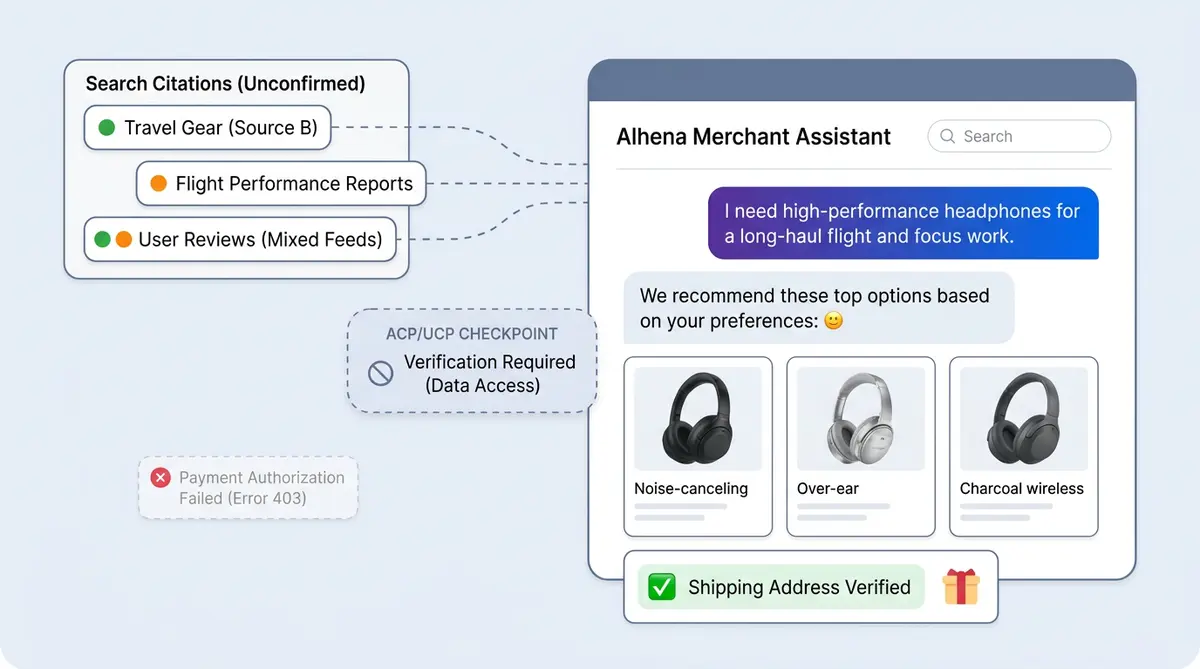
Here's the gap. Both commerce protocols (ACP and UCP) are currently invite-only and partner-driven, with platform fees (including Stripe fees) and terms set by each provider. Target, Gap, Best Buy, Etsy sellers, and Macy's are in. Your 500-SKU Shopify or WooCommerce store probably isn't.
That doesn't mean you're invisible in LLM results. When a shopper asks ChatGPT, "What's the best organic face serum?", your brand can still get cited by these agents. But getting cited and getting the purchase are two different things. The shopper might see your name, then check out with a competitor who has native checkout inside the chat window.
This creates a two-front problem. You need to show up in the LLM's answers (the discovery layer), and you need to convert on your own site when users click through (the transaction layer). Winning on just one of these channels isn't enough.
Front One: Get Cited in the LLM
AI visibility is the new SEO. When ChatGPT or Gemini recommends products, they pull from structured data, reviews, brand authority signals, and content quality. If your Shopify product pages lack schema markup for pricing and availability, if your reviews live behind JavaScript walls, or if your content doesn't answer the questions shoppers actually ask, you won't get mentioned.
Alhena's AI Visibility feature (currently in Beta) tracks exactly this: how often your brand appears in ChatGPT and Gemini answers, your citation share vs. competitors, and specific content gaps to close. It doesn't get you into these commerce protocols. What it does is show you where you're missing from AI-driven product recommendations and what to fix. For the full monitoring architecture, see our AI Visibility tech stack breakdown.
Practical first steps: run a competitive AI visibility audit against your top three competitors. Then build a weekly workflow to track and improve your citation share over time.
Front Two: Win the Conversion on Your Own Site
When users land on your site after an AI-driven recommendation, the experience needs to feel as capable as the chat window they just left. If they went from a conversational AI assistant that understood their preferences to a static product grid with a search bar, you've lost them.
This is where on-site AI shopping chatbot assistants earn their keep. Alhena's Shopping Assistant handles conversational product discovery and order fulfilment questions, answers pricing and sizing objections and surfaces options from your actual product catalog (not hallucinated specs) and tracks revenue attribution through Stripe-connected cart and checkout events. Every add-to-cart and completed order tied to an AI conversation gets recorded, so you know exactly what the assistant is worth.
Tatcha saw a 3x conversion rate and 38% AOV uplift from AI-assisted conversations. That's the kind of lift that matters when your site is competing with LLM-native checkout for shopper attention.
What We Don't Know Yet
Honest questions the industry hasn't answered:
- Will LLM-native checkout cannibalize brand sites, or will it expand the total addressable market by converting shoppers who would never have visited your site?
- Who owns the customer relationships and data when the transaction happens inside ChatGPT? Walmart kept control by embedding Sparky. Smaller merchants may not have that option.
- How do returns, fulfilment, loyalty programs, and post-purchase CSAT work when the buying moment is one company's API call to another?
These aren't rhetorical. They're open questions that will shape e-commerce strategy for the next two years. The merchants that will thrive are the ones defending both fronts now: building AI visibility so they get recommended and running AI-driven experiences on their own sites so they convert when shoppers arrive.
If you want to see where your brand stands in AI-generated shopping results, book a demo with Alhena AI to access AI visibility or start free with 25 conversations on your site.
Frequently Asked Questions
What is LLM-native checkout?
LLM-native checkout lets shoppers complete purchases directly inside AI chat interfaces like ChatGPT or Google Gemini, without visiting a retailer's website. Google's Universal Commerce Protocol and OpenAI's Agentic Commerce Protocol are the two main standards enabling this, with over 20 major retailers and payment providers participating as of early 2026.
Why did Walmart stop using OpenAI's Instant Checkout?
Walmart pulled Instant Checkout because the general-purpose LLM pushed inaccurate product results into shopper carts, and conversion rates fell below what Walmart sees on its own app. Walmart replaced it with Sparky, its own purpose-built shopping agent, which now runs inside ChatGPT and Gemini with roughly 70% of Walmart.com's conversion rate.
Can independent brands sell inside ChatGPT or Gemini?
Not easily, at least not yet. Both Google's UCP and OpenAI's Agentic Commerce Protocol are currently partner-driven, with platform fees (including Stripe fees) and terms set by each provider, with major retailers like Target, Gap, and Best Buy getting early access. Smaller brands can still get cited in LLM product recommendations through structured data, content quality, and AI visibility monitoring.
What is AI visibility for e-commerce?
AI visibility measures how often your brand appears in AI-generated answers when shoppers ask ChatGPT or Gemini product questions. Alhena's AI Visibility feature (Beta) tracks your citation share vs. competitors and surfaces content gaps to close. Pages with schema markup for pricing and availability receive up to 40% higher citation rates from AI models.
How does Alhena AI help brands compete with LLM shopping?
Alhena addresses both fronts: AI Visibility (Beta) monitors your brand's presence in ChatGPT and Gemini answers, while the on-site Shopping Assistant provides conversational product discovery grounded in your actual catalog. Cart and checkout events tie every AI-assisted sale to revenue attribution, so you can measure the impact directly.
Does Alhena AI enable checkout inside ChatGPT or Gemini?
No. Alhena does not plug into OpenAI's or Google's commerce protocols. It runs on your own site, providing AI-powered shopping assistance and tracking revenue from AI-assisted conversations. For LLM surfaces, Alhena's AI Visibility feature helps you monitor and improve how often your brand gets recommended.