Omnichannel customers spend 4% more in-store and 10% more online than single-channel buyers, according to Bloomreach research. Yet most retailers still treat each channel as a silo, creating separate contact center systems for chat, email, SMS, social media, and phone. The result? Customers repeat questions, customer support teams lose context, and revenue leaks through the gaps.
Here is what a true omnichannel customer experience looks like in 2026.
Why Channel-by-Channel CX Is Breaking
A customer asks a sizing question on Instagram, then visits your website. Two days later, they call about shipping. In a siloed system, each customer touchpoint starts from zero. No agent has context from the previous interaction.
A weak omnichannel strategy retains only 33% of customers, compared to 89% customer retention for brands with strong omnichannel customer engagement. That gap hits revenue directly: highly effective omnichannel strategies generate a 9.5% year-over-year increase in annual revenue, versus 3.4% for weaker strategies.
Most brands offer multiple communication channels and touchpoints. Those channels don't talk to each other.
What Omnichannel Customer Experience Really Means
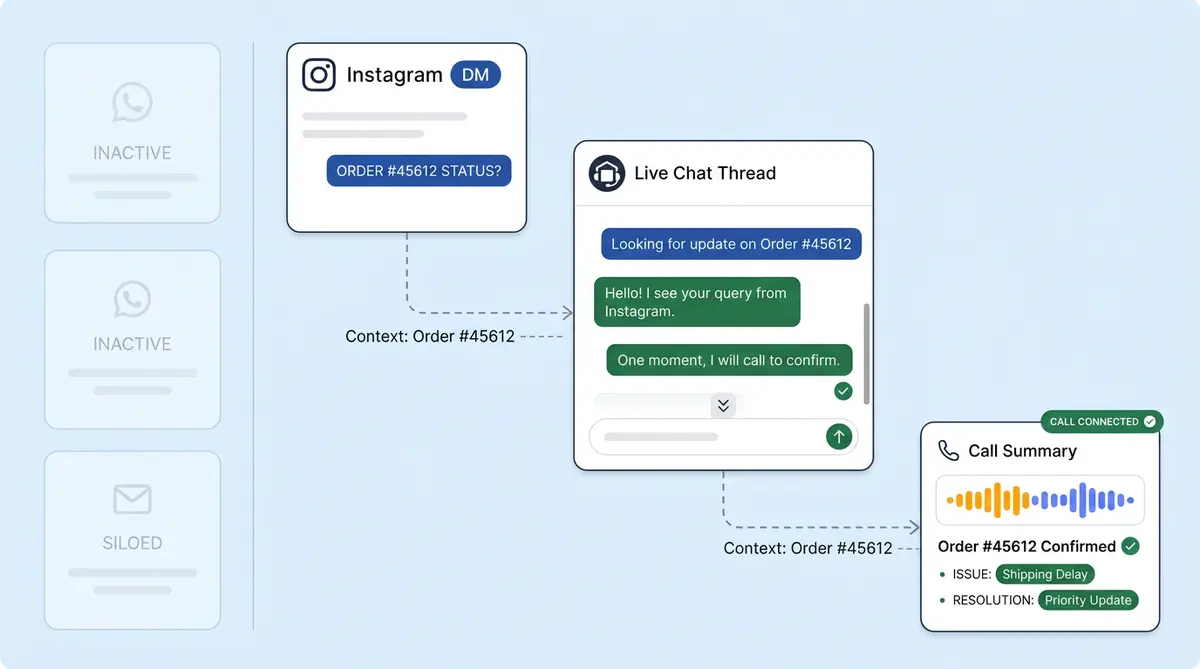
Omnichannel customer service isn't about being on multiple channels. It's about preserving customer context across all of them for a seamless, consistent, and personalized experience. When a shopper switches from WhatsApp to live chat, the conversation can continue without restarting. Escalations should carry the full customer journey thread.
In 2026, this means three things:
- Unified conversation history that follows the customer, not the channel
- Consistent omnichannel marketing messaging and brand voice aligned with your brand values, whether the reply comes via Instagram DM, email, or voice
- Shared analytics so you see your customer journey in one place, not seven disconnected journeys and data streams
You need a live view of conversations across every channel to act on customer behavior and improve outcomes in real time. See our complete omnichannel AI setup guide.
The Four Jobs Any CX Technology Must Do
Any omnichannel strategy platform needs to handle four things well:
- Ingest conversations from every channel into one queue. Web chat, email, voice, WhatsApp, Instagram, Facebook Messenger, and Slack. If your team toggles between five tabs, you don't have true omnichannel customer service.
- Preserve context when customers interact across channel switches. The AI should know what the shopper has already discussed on another channel.
- Surface live analytics, not weekly reports. Trending topics, customer feedback, and revenue analytics update in real time so your team can spot issues before they escalate.
- Route to humans cleanly when AI shouldn't answer. Omnichannel customer service and support fail when the AI can't hand off gracefully. Full transcript, customer history, and recommended next steps can be transferred with the conversation.
Our channel-specific AI guide covers adapting tone and personalization per channel. channel-specific AI guide.
How Alhena AI Handles Omnichannel CX Today
Alhena AI is a single AI assistant across chat, email, voice, and social with shared context. Here's what that looks like in practice.
Multi-channel ingestion. Alhena connects to web chat, phone and SIP lines, email, WhatsApp, Instagram, Facebook Messenger, Discord, Slack, and other communication channels. For marketing-centric engagement, brands can also use Web Push, mobile app push notifications, and RCS where carriers support it. Every conversation lands in one centralized, unified place, not scattered across platform-specific tools.
Unified Memory across channels. Alhena's Unified Memory layer tracks each customer's preferences, behavior, past purchases, and interaction history. When a shopper moves from an Instagram DM to your website, the AI picks up where it left off, no repetition needed.
Specialized agents with smart routing. Alhena uses specialized agents for product search, order management, and general support. Conversations route automatically to the right agent based on customer needs and intent, with escalations routed to human reps plus the full interaction transcript.
Social commerce is built in. On Instagram and WhatsApp, Alhena doesn't just answer questions. It guides shoppers from discovery to sales and checkout handling recommendations, size queries, and cart actions in 90+ languages. See our Facebook, Instagram, and WhatsApp AI breakdown.
Phone commerce, not just phone support. Alhena's Voice AI lets shoppers search products, get fit advice, and add to cart by voice.
Alhena's omnichannel approach delivers measurable results. Tatcha saw 3x conversions and 38% AOV uplift. Manawa cut response time from 40 minutes to 1 minute with 80% automation. Crocus hit an 86% automation and deflection rate with 84% customer satisfaction (CSAT).
What to Look for When Evaluating Omnichannel Platforms
Here's what to look for in a consistent, personalized omnichannel strategy in 2026:
- Channel coverage beyond chat and email. Modern omnichannel means more than chat and email. Look for native support for Instagram DMs, WhatsApp, phone, plus marketing-centric channels like Web Push, RCS, and mobile app push notifications. If you're stitching separate tools together for each channel, you don't have a true omnichannel platform.
- True context persistence. Ask vendors: "If a customer starts on WhatsApp and moves to web chat, does the AI remember the conversation?" If the answer involves manual processes like tagging or CRM lookups, it's not real omnichannel support.
- Live analytics, not batch reports. Trending topics, agent performance, and revenue analytics can all be accessed in real time.
- Clean human handoff. AI can and should know its limits. Look for built-in escalation with full conversation transfer, not a "please call us" dead end.
- No hallucinations. Grounded responses from verified product and customer data are non-negotiable.
Check our ROI calculator to see what this means for your numbers.
A strong omnichannel strategy breaks down silos with one omnichannel experience platform, driving better personalization across every customer interaction, higher customer engagement and retention, and fewer dropped conversations. Whether your CX focus is omnichannel marketing, customer service, or social commerce, interactions should feel seamless. CRM integration, real-time customer journey tracking, and customer satisfaction scoring all become possible when the omnichannel experience flows through a unified system.
One Conversation, Every Channel
The omnichannel customer experience isn't a feature to check off. It's the foundation that determines whether your AI investment drives revenue or just deflects tickets. In 2026, a consistent omnichannel customer experience means a single, seamless conversation with your brand, regardless of which channel they're on.
Brands that deliver this keep 89% of their customers and build customer loyalty. The rest fight over 33%.
Ready to unify your channels? Book a demo with Alhena AI or start for free with 25 conversations.
Frequently Asked Questions
What is omnichannel customer experience in ecommerce?
Omnichannel customer experience means giving shoppers a consistent, personalized interaction across every channel your brand uses, including web chat, email, phone, social media, Instagram, WhatsApp, and more. A strong omnichannel strategy ensures that customer interactions, context, and conversation history carry over when a shopper switches platforms, creating a seamless customer experience at every touchpoint.
How is omnichannel different from multichannel customer service?
Multichannel means your contact center is present on multiple channels. Omnichannel means those channels share data for a consistent customer experience. In a multichannel setup, a customer who chats on your website and then emails your customer service team starts two separate conversations. With an omnichannel strategy, both interactions share context and history, enabling consistent personalization across every touchpoint and channel.
What channels does Alhena AI support?
Alhena AI connects to web chat, email, phone (including SIP lines), WhatsApp, Instagram, Facebook Messenger, Discord, Slack, and other social media platforms. All conversations feed into one centralized contact center with shared customer context and analytics, giving you a true omnichannel customer experience across every communication channel.
How does Alhena AI preserve context when customers switch channels?
Alhena uses a Unified Memory layer that tracks each customer journey across every touchpoint. Preferences, behavior, past purchases, and interaction history persist regardless of which channel the shopper uses next. This consistent, personalized customer experience means no repeated questions, faster resolutions, and higher customer satisfaction.
Can omnichannel AI actually drive revenue, or is it just for support?
It drives revenue directly. An effective omnichannel strategy and personalized CX platform like Alhena AI handles product recommendations, guided selling, and cart actions inside social media DMs and voice calls, not just support tickets. Tatcha saw a 3x conversion rate and 38% AOV uplift. This approach improves customer satisfaction and customer experience while driving measurable sales.
How long does it take to set up omnichannel AI with Alhena?
Most brands go live in under 48 hours with no developer resources needed. Alhena integrates with Shopify, WooCommerce, Magento, Salesforce Commerce Cloud, and major customer service platforms like Zendesk, Freshdesk, and Gorgias. Your contact center gets a complete omnichannel customer experience platform out of the box.
Do omnichannel customers spend more than single-channel shoppers?
Yes. Industry research shows that omnichannel shoppers spend about 4% more in-store and 10% more online compared to single-channel buyers. Brands with highly effective omnichannel strategies also see a 9.5% year-over-year increase in annual revenue. These numbers show why unifying your channels isn't just a CX improvement, it's a direct revenue driver.
Does Alhena AI support marketing channels like Web Push, RCS, and mobile app notifications?
Alhena AI supports core commerce and support channels including web chat, email, phone, WhatsApp, Instagram, Facebook Messenger, Discord, and Slack. For marketing-driven engagement, brands can extend their omnichannel strategy with Web Push, mobile app push notifications, and RCS where carriers offer it. All interactions feed into a single conversation thread with shared context.
How much does an omnichannel AI platform typically cost?
Costs vary widely. Enterprise omnichannel commerce platforms can start at six-figure annual commitments (some cited around $150,000/year as a lower bound). Pricing models include flat subscriptions, usage-based credits, and an increasing trend toward revenue-share or outcome-based arrangements. Alhena AI offers flexible pricing with a free tier of 25 conversations to start. Check the pricing page at alhena.ai/pricing for current plans.