Where Each Platform Comes From
Alhena AI and Siena AI both target ecommerce brands, but they approach the problem from different angles. Both are AI platform solutions that aim to improve customer experience for ecommerce businesses, though they prioritize different outcomes.
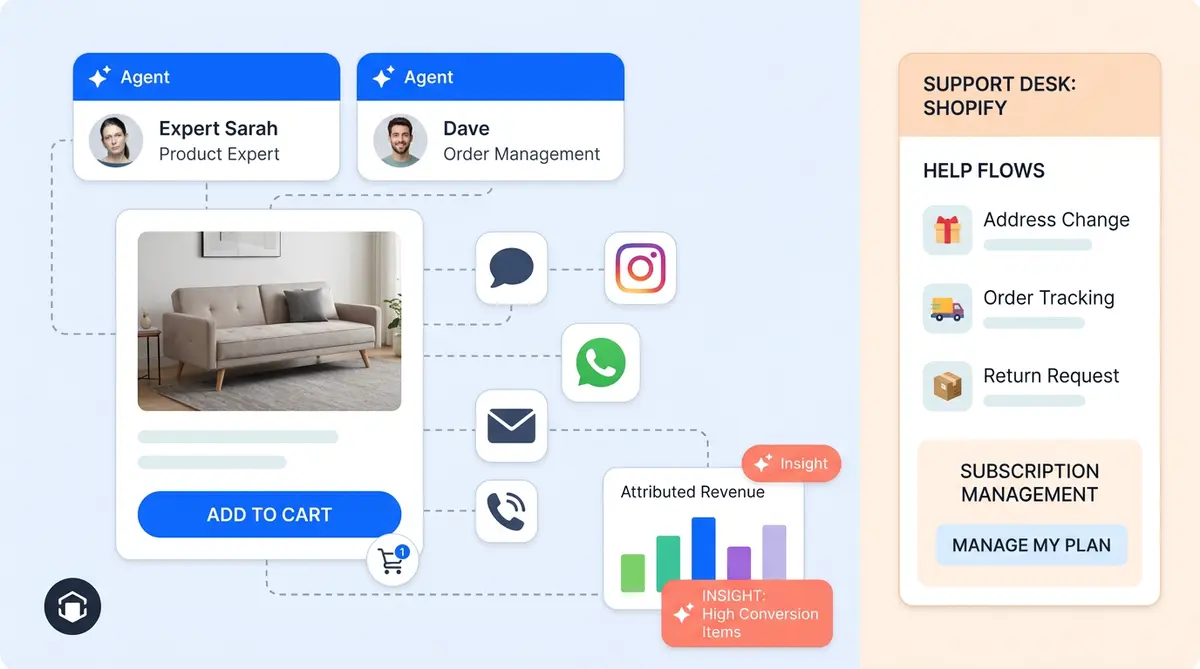
Alhena AI is a AI powered multi-agent platform built to help ecommerce businesses turn shopping conversations into conversion, revenue, and repeat purchases. It runs specialized AI agents: a Product Expert that recommends items and adds them to cart, an Order Management Agent that handles tracking, returns, and refunds, plus AI agents for lead capture, outfit builder, and other use cases. The system uses intelligent routing to send each conversation to the right specialist automatically, delivering hallucination-free responses with high accuracy, grounded in your actual product data. Alhena routes queries across multiple LLMs including Claude, GPT, and Gemini.
Siena AI, per its own site, AI positions itself as an autonomous "empathic agent" focused on AI automation for ecommerce. It focuses on automating CX with brand-voice consistency, built to automate and resolve common support ticket tasks like order status, returns, and address changes. Siena also offers product recommendations and subscription management features.
This comparison of Siena and Alhena comes down to one thing: Alhena treats every conversation as a chance to drive sales, guiding customers through the buying process. Siena autonomously treats every conversation as a support ticket to resolve.
Alhena AI vs Siena AI: At a Glance
| Alhena AI | Siena AI | |
|---|---|---|
| Core Focus | Revenue generation + support | Empathic support automation |
| Ecommerce Platforms | Shopify, WooCommerce, Magento, BigCommerce, SFCC, Solidus | Shopify, Fulfil |
| Helpdesk Integrations | 11 (Zendesk, Gorgias, Freshdesk, Gladly, HubSpot, Intercom, Kustomer + more) | 6 (Zendesk, Gorgias, Gladly, Intercom, Kustomer, Dixa) |
| In-Chat Cart Actions | Native Add-to-Cart on storefront | Recommendations via helpdesk |
| Revenue Attribution | Built-in, 24-hr first-touch window | Not documented |
| Voice AI | Phone + SIP, native | Not listed |
| Subscription Mgmt | Not native | 6 integrations (Recharge, Skio, etc.) |
Conversation Surfaces and Channels
Both platforms go beyond basic chat across multiple channels, but the range differs.
Alhena supports a chat widget, conversational search bar, product FAQs on product pages for self-service shopping, proactive nudges, voice AI (phone and SIP), email, Instagram DMs, Facebook Messenger (Meta Messenger), WhatsApp, Slack, and Discord. It also provides an Agent Assist layer for human reps so human agents get AI-suggested responses during live conversations.
Siena covers email, SMS, social DMs, WhatsApp, and comments, with multilingual support. If SMS is a primary support channel for your Shopify store, both platforms can handle it. It integrates through helpdesks like Zendesk, Gorgias, Gladly, Intercom, Kustomer, and Dixa to manage these channels.
If your brand relies on social commerce across Instagram and Facebook, or needs voice and visual AI support without a separate vendor, Alhena covers more ground natively.
In-Conversation Commerce Actions
This is where the two platforms diverge most clearly.
Alhena's Product Expert Agent surfaces product cards inside the chat with an Add-to-Cart button. On Shopify stores, this uses the native /cart/add.js endpoint to populate the cart drawer directly, with support for popular themes like Dawn, Horizon, Impulse, Prestige, and Turbo. For non-Shopify stores, Alhena provides SDK hooks and a backend HTTP API for the same flow. The Order Management Agent handles tracking lookups, returns guidance, and refund processing through Shopify, Narvar, and Ship24 connections.
Siena handles order-related actions (tracking, label generation, refunds, replacements) within automated workflows. Siena also handles return and exchange workflows) and offers product recommendations. Its commerce actions run primarily through helpdesk integrations rather than a native storefront widget.
The practical difference: Alhena acts inside your store. Siena acts inside your helpdesk.
Integration Ecosystem
Both platforms connect to the tools ecommerce teams already use, but the breadth differs significantly.
Alhena's verified integrations span six ecommerce platforms (Shopify, WooCommerce, Magento, BigCommerce, Salesforce Commerce Cloud, Solidus), eleven helpdesks (Zendesk, Gorgias, Freshdesk, Freshchat, Gladly, HubSpot, Kustomer, Re:amaze, Salesforce Service Cloud, Zoho Desk, Zoho SalesIQ), and marketing/CDP tools like Klaviyo, mParticle, Trustpilot, and Feefo.
Siena's published integrations include two ecommerce platforms (Shopify, Fulfil), six helpdesks (Zendesk, Gorgias, Gladly, Intercom, Kustomer, Dixa. Siena's native Intercom connection is a plus for Intercom users), six subscription tools (Recharge, Skio, Smartrr, Stay AI, Ordergroove, Prive), and connections to Klaviyo, Stripe, Loop Returns, Okendo, Yotpo, and Wonderment.
If you run WooCommerce, Magento, BigCommerce, or Salesforce Commerce Cloud, Siena doesn't list native support. That's a dealbreaker for brands off Shopify. Siena does have an edge in subscription management, with six dedicated integrations to Alhena's zero in that specific category.
Knowledge and Training Data
Alhena ingests from a wide range of sources: websites, helpdesk ticket history (Zendesk, Freshdesk, Gorgias), PDFs, Notion, Confluence, GitHub, Google Drive, Slack, Discord, YouTube transcripts, CSV/Excel files, and custom uploads up to 50MB. It handles messy, inconsistent data and runs daily product catalog syncs from your ecommerce platform. A built-in feedback loop auto-generates FAQs from real conversations, making the AI smarter with every interaction. The more data it processes, the better it can answer questions.
Siena pulls knowledge from Google Sheets, Google Docs, and custom API connections. Its training data is more limited in source variety, though its custom API option provides flexibility for custom integrations for teams with engineering resources.
For brands with knowledge scattered across help centers, PDFs, Notion wikis, and ticket archives, Alhena connects to more sources out of the box.
How Revenue Impact Is Measured
Alhena includes a documented revenue attribution model. It uses a 24-hour first-touch window across chat, FAQ, and nudge interactions. The dashboard breaks down attributed revenue by channel, with a "helpful answer" filter that only counts conversations where the AI actually influenced the purchase. A/B testing is built in so you can measure incremental lift.
Brands using Alhena have reported measurable results. Tatcha saw 11.4% of total site revenue attributed to AI interactions. Victoria Beckham measured a 20% AOV increase.
Siena positions itself as a tool that turns CX from a cost center into a revenue driver, citing a +94.7% CSAT improvement on average. Its site doesn't detail a specific revenue attribution methodology, so measuring direct sales impact may require your own analytics setup.
When Alhena Is the Right Fit
Choose Alhena if your team wants one platform that spans support automation, AI assisted product discovery, in-chat commerce actions, and revenue-attributable selling. It's a strong pick for brands on Shopify wanting zero-code revenue tracking, teams on WooCommerce or Magento, or Salesforce Commerce Cloud (where Siena doesn't have native support), and multi-agent and AI agents setups like outfit building or lead capture into Klaviyo, HubSpot, or mParticle.
If you're comparing other options too, our breakdowns of AI agents like Tidio, Zowie, and others in Alhena AI vs Tidio, Alhena vs Intercom Fin, and Alhena vs Zowie cover how those tools compare on similar criteria.
When to Evaluate Siena Instead
Siena is worth a look if your brand runs exclusively on Shopify, relies heavily on subscription management (Recharge, Skio, Smartrr), and your primary goal is reducing support volume through automation with empathic, brand-consistent responses to support tickets. Its six subscription integrations are a clear strength for DTC subscription brands that need to manage every interaction across recurring orders.
Enterprise teams already using Intercom or Dixa as their helpdesk will also find Siena's native Intercom and Dixa connections useful, since Alhena doesn't currently list either integration.
The Bottom Line
Both Alhena AI and Siena AI are built for ecommerce, not retrofitted from general-purpose support tools. The difference comes down to scope in AI customer service. Alhena covers more ecommerce platforms, more channels, more knowledge sources, and includes built-in revenue attribution. Siena specializes in empathic support automation with strong subscription-management integrations.
If you want AI that sells and supports across your full stack, Alhena is the broader service platform. If you're a Shopify-only subscription brand focused purely on CX automation, Siena deserves a demo.
Ready to see how Alhena fits your store? Check pricing at alhena.ai/pricing for plan details. Book a demo or start free with 25 conversations.
Frequently Asked Questions
What is the main difference between Alhena AI and Siena AI?
Alhena AI is a multi-agent platform that combines support automation with in-chat selling, revenue attribution, and product discovery across six ecommerce platforms. Siena AI focuses on empathic customer service automation, primarily on Shopify, with strong subscription-management integrations.
Does Alhena AI work with WooCommerce and Magento?
Yes. Alhena integrates natively with Shopify, WooCommerce, Magento, BigCommerce, Salesforce Commerce Cloud, and Solidus. Siena AI currently lists only Shopify and Fulfil as ecommerce platform integrations.
Can Siena AI add products to a customer's cart during a conversation?
Siena offers product recommendations through helpdesk integrations, but its commerce actions run through the helpdesk rather than directly on the storefront. Alhena provides native Add-to-Cart buttons inside the chat widget on Shopify stores using the /cart/add.js endpoint.
How does Alhena AI measure revenue from AI conversations?
Alhena uses a 24-hour first-touch attribution window across chat, FAQ, and nudge interactions. The dashboard breaks down attributed revenue by channel and includes a helpful-answer filter that only credits conversations where the AI influenced a purchase. A/B testing is built in.
Does Siena AI support voice calls?
Siena AI does not list voice or phone support on its integrations page. Alhena AI includes native voice AI with phone and SIP integration, letting brands handle calls through the same platform as chat and social channels.
Which platform is better for subscription-based ecommerce brands?
Siena AI has an edge here with six subscription integrations: Recharge, Skio, Smartrr, Stay AI, Ordergroove, and Prive. Alhena does not currently offer native subscription management integrations, so DTC subscription brands may find Siena more relevant for that specific use case.
How long does it take to set up Alhena AI vs Siena AI?
Alhena's documentation states setup takes days, not weeks. Installation requires a JavaScript snippet, and Shopify revenue tracking works via webhook with no custom code. Siena describes itself as plug-and-play with single-click helpdesk connections. Both platforms aim for fast setup and deployment.