Why Your AI Visibility Needs a Tech Stack, Not a Single Tool
Generative AI-driven referral traffic to U.S. retail sites rose 393% in Q1 2026, according to Adobe Analytics. That traffic now converts 42% better than traditional channels. Yet 70% of organizations still haven't started building their answer engine optimization strategy for commerce, per Acquia.
The gap creates a first-mover advantage for ecommerce brands willing to invest in a proper AI visibility infrastructure. But "invest" doesn't mean buying one monitoring tool and calling it done. It means assembling a tech stack where product data flows from your store, through structured data layers and content engines, into the generative AI systems that increasingly drive product discovery and shape the shopping experience.
This post maps the reference architecture for an ecommerce AI visibility tech stack: five layers, the data flows connecting them, and the specific integrations that make each layer work.
The Five-Layer AI Visibility Architecture
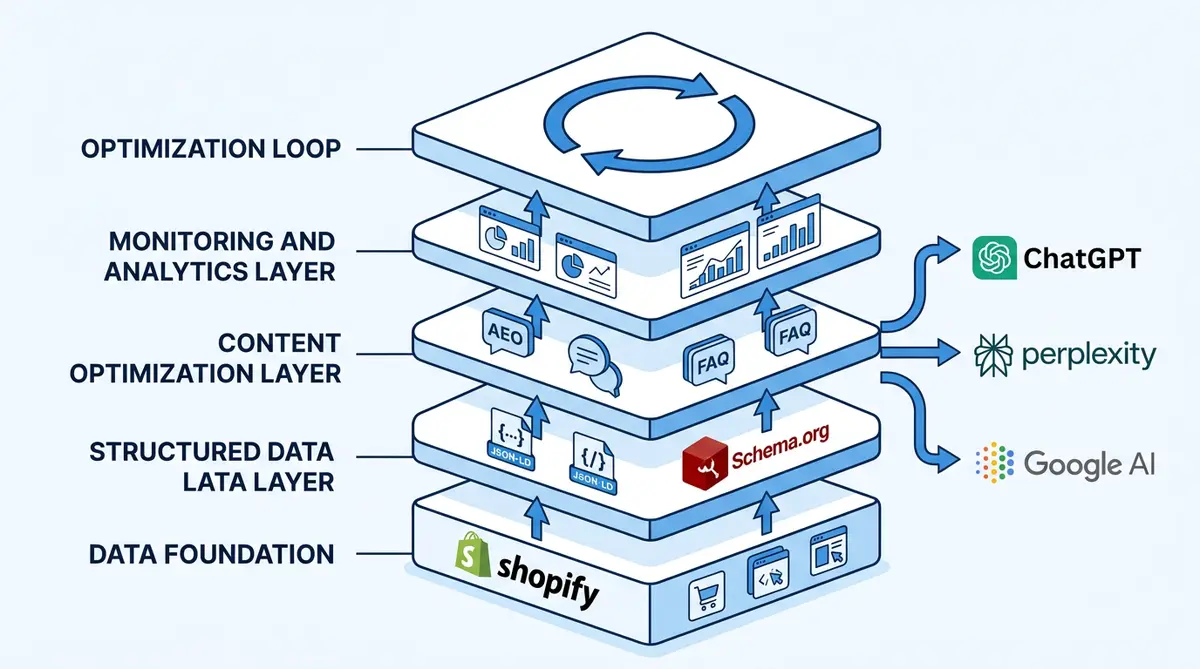
Think of your AI visibility infrastructure as five stacked layers, each feeding the next. Skip a layer and the entire pipeline breaks down. Here's how they fit together:
- Layer 1: Data Foundation (product data, feeds, catalog management)
- Layer 2: Structured Data and Machine Readability (Schema.org, JSON-LD, llms.txt)
- Layer 3: Content Optimization (AEO, on-site AI, FAQ engines)
- Layer 4: Monitoring and Analytics (AI citation tracking, share of voice)
- Layer 5: Intelligence and Optimization Loop (competitive benchmarks, content refresh cycles)
The data flows in one direction: from your product catalog at Layer 1, through transformation at Layers 2 and 3, out to AI crawlers and models, then back as visibility metrics at Layer 4. Layer 5 closes the loop by feeding insights back into Layers 1 through 3.
Let's walk through each layer with specific tools, integrations, and architecture decisions at every step.
Layer 1: The Data Foundation
Everything starts with your product data. If the data in your PIM or ecommerce platform is incomplete, inconsistent, or poorly structured, no amount of optimization downstream can fix it. AI models can't recommend products they don't understand.
Ecommerce Platform (Your Source of Truth)
Your Shopify, WooCommerce, BigCommerce, or Salesforce Commerce Cloud store holds your live catalog: titles, descriptions, pricing, availability, variants, and images. This is the origin point for every data flow in the stack.
The critical requirement here is completeness. Every product needs a filled-out title, detailed description, accurate pricing with currency, availability status, brand name, SKU, GTIN (if applicable), and aggregate ratings. Generative AI crawlers skip products with sparse data in favor of competitors with richer listings.
PIM Layer (Optional but Powerful)
For brands with 500+ SKUs, a Product Information Management system like Salsify, Akeneo, or Pimcore adds a crucial enrichment step. These platforms now include AI-powered content scoring and automated attribute enrichment that directly improve how products get represented in downstream structured data.
Salsify, for example, can auto-classify products, suggest missing attributes, and syndicate enriched feeds in real time. That enrichment flows directly into Layer 2.
Product Feed Management
Tools like Feedonomics and GoDataFeed sit between your catalog and the outside world, transforming raw product data into clean JSON and XML feeds. These feeds serve double duty: they power your Google Shopping campaigns and provide machine-readable product data that AI crawlers consume.
Layer 2: Structured Data and Machine Readability
This is the layer most ecommerce brands underinvest in, and it's the one with the highest ROI for AI visibility. Research from Passionfruit shows that 65% of pages cited by Google AI Mode and 71% cited by ChatGPT include structured data. Schema markup alone can increase AI citation probability by up to 40%.
Schema.org and JSON-LD Implementation
The essential schema types for ecommerce AI visibility are:
- Product and ProductGroup: complete product attributes including pricing, availability signals, brand identity, and customer ratings
- FAQPage: structured Q&A pairs that AI models can directly extract and cite
- Organization: establishes your brand entity in knowledge graphs
- BreadcrumbList: gives AI models your site's category hierarchy
- HowTo: for product usage guides and tutorials
A common misconception: Schema markup doesn't talk to LLMs directly. As ZipTie.dev explains, the pathway runs from Schema Markup to Google's Index to the Knowledge Graph Entity, and then to AI Overview citations. The structured data feeds the knowledge graph, which feeds the AI. Skip schema and you're invisible to the knowledge graph entirely.
Schema App's case study on entity linking showed a 19.72% increase in AI Overview visibility. Another case study found schema markup boosted AI visibility by 55% in under one business day.
The llms.txt Standard
Proposed by Jeremy Howard of Answer.AI, llms.txt is a companion to robots.txt. While robots.txt tells crawlers what to avoid, llms.txt tells AI models where your best content lives. For ecommerce, this means pointing to:
- Product feeds (JSON format with live pricing and availability)
- FAQ content and buying guides
- Shipping and returns policies (trust signals for AI recommendations)
- Support documentation
Dell's enterprise implementation is the current benchmark. The file sits at your domain root (/llms.txt) and uses Markdown format.
Crawler Access Configuration
AI crawlers now generate over 50% of all web traffic, according to Visalytica. Your robots.txt needs explicit rules for GPTBot, PerplexityBot, ClaudeBot, and Google's extended crawlers. Many AI crawlers operate with 1 to 5 second timeouts and can't process JavaScript-rendered content, so server-side rendering is critical for non-Google crawlers.
Layer 3: Content Optimization for AI Citability
Structured data makes your products machine-readable. Content optimization makes them citable to generative AI engines. There's a difference. A product page with perfect JSON-LD can still get ignored if the surrounding content doesn't give AI models enough context to build a confident recommendation.
AEO Content Strategy
Answer Engine Optimization goes beyond traditional SEO. HubSpot's AEO framework, outlined by Green Flag Digital, centers on three pillars: build consensus (corroborate claims across sources), provide information gain (share data competitors don't have), and use clear semantic structure (make claims easy to extract and cite).
For ecommerce, that translates to detailed buying guides, comparison content with specific product attributes, and FAQ pages structured around the shopping queries your customers actually ask.
On-Site AI Assistants as a Data Layer
This is where the architecture gets interesting. On-site AI shopping assistants like Alhena AI's Shopping Assistant serve a dual purpose in the AI visibility stack.
First, they drive direct revenue. Brands like Manawa cut agent workload by 43% and dropped response times from 40 minutes to under one minute with Alhena's hallucination-free product recommendations. Crocus reached 86% deflection rates with 84% CSAT.
Second, and this matters for the AI visibility stack, they generate structured interaction data. Every customer question, product recommendation, and attribute comparison creates machine-readable Q&A pairs. This interaction data feeds your AEO and GEO strategies by surfacing the exact queries shoppers use and the product attributes that drive purchase decisions.
Alhena's AI Visibility product takes this further by tracking which specific SKUs appear across ChatGPT, Gemini, and Perplexity, then attributing revenue back to each AI source. It also includes an AEO FAQ Engine that auto-generates structured Q&A pairs from your product catalog and a GEO Citation Strategy that identifies which publishers and review sites influence AI answers in your category.
Your tech stack is only as good as the citations it produces. Learn why in our analysis of AI search visibility beyond citations.
PDP Optimization
Your product detail pages are the atomic unit of AI visibility. From an architecture standpoint, the PDP is where your data foundation (Layer 1) and structured data (Layer 2) converge into a single crawlable page. The quality of that page determines whether AI crawlers extract enough signal to generate a confident product recommendation.
Our PDP optimization checklist for AI visibility covers the 15 specific on-page changes. From a tech stack perspective, the key question is whether your PIM or CMS can auto-populate these fields from your product database, or whether each PDP requires manual content work.
Layer 4: AI Visibility Monitoring and Analytics
You can't improve what you don't measure. The AI visibility and SEO tools landscape has exploded, with over 22 dedicated tools on the market as of early 2026. Here's how to think about the category.
Dedicated AI Visibility Trackers
These tools track your brand and product mentions across AI-generated answers:
- Budget tier ($20 to $50/mo): Rankscale AI, Keyword.com AI Tracker, Nightwatch LLM Monitor
- Mid-market ($100 to $500/mo): Peec AI, Otterly AI, Rankability, Profound
- Enterprise ($700+/mo): Semrush AI Toolkit, Ahrefs Brand Radar, seoClarity ArcAI, BrightEdge
- Free: HubSpot AI Share of Voice tool
We cover each of these tools in depth in our guide to the 10 best AI visibility tools for ecommerce.
For ecommerce specifically, though, generic AI visibility tools miss a critical dimension: they track brand mentions but not individual SKU performance. SKU-level tracking matters because a brand might appear in AI answers generically while specific high-margin products stay invisible. Alhena's AI Visibility product fills this gap with first-party behavioral intelligence from your actual storefront rather than scraped prompt simulations.
The tracking layer of your stack needs the right tool. See which ones we recommend in our list of the best AI brand visibility tracking tools.
First-Party Platform Analytics
Two major platforms launched AI-specific analytics in early 2026:
- Bing Webmaster Tools: AI Performance dashboard (public preview, February 2026), showing impressions and clicks from Copilot and Bing Chat
- Google Search Console: AI Contribution report (pilot, April 2026), tracking traffic from AI Overviews and AI Mode
Neither offers API access yet (Bing is CSV export only), so you can't automate this data into dashboards. But check both manually as part of your monthly review cycle.
GA4 AI Referral Attribution
Connect your monitoring layer to Google Analytics 4 to track AI referral traffic by source. Create custom channel groupings for chat.openai.com, perplexity.ai, gemini.google.com, and copilot.microsoft.com. This lets you measure not just visibility but the revenue each AI source drives.
Layer 5: The Optimization Loop
The final layer closes the feedback loop. Without it, your AI visibility stack is a one-way pipeline that never improves.
AI Share of Voice as Your Primary KPI
AI Share of Voice, the proportion of your brand mentions across AI-generated responses compared to competitors, is rapidly replacing traditional keyword rankings as the north star metric. BrightEdge calls it the most important ecommerce visibility metric of 2026.
Track it monthly across your top 20 to 50 product categories. Compare against your three closest competitors. When share of voice drops in a category, investigate whether the cause is a content gap, a structured data issue, or a competitor gaining ground with better review coverage.
Content Refresh Cycles
AI models update their knowledge at different cadences. ChatGPT's browsing feature pulls live web data, while its base training data updates quarterly. Perplexity indexes in near-real-time. Google AI Overviews reflect the latest crawl.
Set a 30-day review cycle for your top-performing product pages and a 90-day cycle for supporting content (buying guides, comparison pages). Prioritize updates to pages where AI visibility metrics have declined or where competitors have published fresher content.
Competitive Intelligence
Monitor which competitor products appear in AI answers for your target prompts and queries. When a competitor consistently outranks you in AI recommendations, reverse-engineer why: Do they have richer structured data? More third-party citations? Better review coverage?
Alhena's AI visibility toolset automates this competitive benchmarking at the SKU level, showing exactly where your products win and lose against specific competitors in AI-generated responses.
Once your stack is live, benchmark it against competitors with a competitive AI visibility audit.
The Data Flow: From Shopify to ChatGPT Citation
Let's trace a single product's journey through the full stack to make this concrete.
Step 1: A skincare brand adds a new serum to their Shopify store with complete product data: ingredients, skin type targets, pricing, customer reviews.
Step 2: JSON-LD Product schema fires on the PDP, encoding the product's name, price, availability, aggregate rating, and brand into structured markup. The brand's llms.txt file at the domain root points AI crawlers to the product feed.
Step 3: Alhena's AI Shopping Assistant begins recommending the serum to site visitors asking about their skin concerns. The interaction data generates structured Q&A content: "What's the best serum for dry skin?" maps to this product with specific attribute matches.
Step 4: AI engines and crawlers (GPTBot, PerplexityBot, ClaudeBot, Googlebot) discover the product through the JSON-LD, the llms.txt reference, and the FAQ content. The structured data enters Google's Knowledge Graph.
Step 5: A shopper asks ChatGPT "What's the best vitamin C serum under $60?" The generative model retrieves the product from its index, cites the brand page, and includes pricing and rating details pulled from the structured data.
Step 6: The click-through appears in GA4 under the AI referral channel. Alhena's AI Visibility dashboard shows the serum's mention alongside which competitors also appeared, how the product was positioned, and whether the citation included full product card details.
Step 7: The brand notices a competitor's serum appears more frequently. Investigation reveals the competitor has more recent third-party reviews. The brand updates their GEO citation strategy, targets the review sites Alhena identified as influential in their category, and monitors the impact in the next cycle.
That's the full loop. Data flows from catalog to structured markup to AI index to citation to analytics to optimization, and back again.
Getting Started: Priority Integration Order
You don't need to build all five layers at once. Here's the order that delivers the fastest ROI:
- Audit your structured data (Layer 2): Run Google's Rich Results Test on your top 20 PDPs. Fix missing Product schema properties first. This is the single highest-impact change you can make.
- Set up AI referral tracking tools (Layer 4): Create GA4 custom channel groupings for AI traffic sources. You need baseline data before you can measure improvement.
- Add an llms.txt file (Layer 2): Create a Markdown file at your domain root pointing to your product feed, FAQ pages, and key policies. This takes 30 minutes and immediately improves AI crawler access.
- Deploy an AI shopping assistant (Layer 3): Alhena connects to your store in under two days with no dev resources. You get both the direct revenue lift and the structured interaction data that feeds your AEO strategy.
- Choose a monitoring tool (Layer 4): Start with HubSpot's free AI Share of Voice tool. When you're ready for SKU-level tracking, Alhena's AI Visibility ties monitoring directly to revenue attribution.
Key Takeaways
- AI visibility requires a five-layer tech stack, not a single tool: data foundation, structured data, content optimization, monitoring, and an optimization loop.
- Structured data is the highest-ROI layer. Pages with JSON-LD schema are cited by AI models up to 40% more often than those without it.
- On-site AI assistants like Alhena serve dual roles: driving direct conversions and generating the structured interaction data that fuels your AEO strategy.
- SKU-level monitoring matters more than brand-level monitoring for ecommerce. Generic tools miss the product-specific visibility gaps that cost you sales.
- AI Share of Voice is the new primary KPI, replacing traditional keyword rankings as the metric that correlates most closely with AI-driven revenue.
- Start with structured data audits and AI referral tracking in GA4, then layer in content optimization and dedicated monitoring tools.
Ready to build your AI visibility infrastructure? Book a demo with Alhena AI to see the five-layer architecture in action and learn how your ecommerce stack connects to AI-driven product discovery. Or start for free with 25 conversations and explore the ROI calculator to estimate your potential lift.
Frequently Asked Questions
What is an AI visibility tech stack for ecommerce?
An AI visibility tech stack is the collection of tools, integrations, and data layers that help ecommerce brands appear in AI-generated product recommendations across ChatGPT, Perplexity, Google AI Overviews, and similar platforms. It typically includes five layers: a product data foundation, structured data markup, content optimization for answer engines, monitoring and analytics tools, and a feedback loop for continuous improvement.
How does product data flow from Shopify to a ChatGPT citation?
Product data starts in your Shopify catalog, gets encoded into JSON-LD structured markup on your product pages, and is discovered by AI crawlers like GPTBot and PerplexityBot. The structured data enters knowledge graphs and vector indices, which AI systems query when generating product recommendations in response to shopping prompts. The entire chain depends on complete product attributes and proper schema implementation at the markup layer.
What structured data types matter most for AI visibility?
For ecommerce, the essential schema types are Product (with full offers, brand, SKU, and aggregateRating properties), FAQPage for structured Q&A content, Organization for brand entity recognition, and BreadcrumbList for category hierarchy. Pages with structured data are cited by AI models up to 40% more often, according to Passionfruit research.
What is llms.txt and do ecommerce sites need it?
llms.txt is an emerging standard that tells AI models where to find your highest-quality content, similar to how robots.txt tells crawlers what to avoid. For ecommerce, it points to product feeds, FAQ content, shipping policies, and support docs. The file sits at your domain root in Markdown format. Adding one takes about 30 minutes and immediately improves AI crawler access to your product data.
Which AI visibility monitoring tools are best for ecommerce brands?
Budget options include Rankscale AI ($20/mo) and Nightwatch LLM Monitor. Mid-market tools like Peec AI ($99/mo) and Otterly AI ($29/mo) cover brand-level tracking well. For ecommerce specifically, SKU-level tracking from Alhena AI Visibility connects product mentions in AI answers directly to revenue, which generic tools can't do. HubSpot's free AI Share of Voice tool is a good starting point.
How does Alhena AI fit into the AI visibility tech stack?
Alhena operates at two layers of the stack. At Layer 3, its AI Shopping Assistant generates structured interaction data from real customer conversations, creating machine-readable Q&A pairs that feed your AEO strategy. At Layer 4, its AI Visibility product tracks SKU-level mentions across ChatGPT, Gemini, and Perplexity with revenue attribution. Brands like Tatcha have seen 3x conversion rates using Alhena's on-site assistant.
What is AI Share of Voice and why does it matter for ecommerce?
AI Share of Voice measures the proportion of your brand mentions in AI-generated responses compared to competitors. BrightEdge calls it the most important ecommerce visibility metric of 2026 because it directly correlates with AI-referred traffic and revenue. Track it monthly across your top product categories and benchmark against your three closest competitors.
How quickly can AI visibility improvements show results?
Some changes deliver near-immediate impact. One case study showed a 55% AI visibility increase within a single business day after fixing schema markup. GA4 AI referral tracking takes effect as soon as you configure custom channel groupings. Deploying an AI shopping assistant like Alhena takes under 48 hours. The full five-layer stack takes 2 to 4 weeks to build out, but you can start seeing ROI from Layer 2 structured data fixes within days.