Zendesk is the default customer service platform for a reason. It's a platform that handles complex workflows, scales to thousands of agents, and integrates with nearly everything. But in 2026, ecommerce brands and businesses and businesses are finding that Zendesk's platform strengths come with trade-offs and limitations: per-seat pricing that escalates fast, AI features that focus on tickets rather than sales, and a configuration and control overhead that many teams simply don't need.
Whether you're a 5-person DTC brand paying for enterprise features you'll never touch, or a mid-market retailer frustrated that Zendesk AI can deflect tickets but can't recommend products, there are better Zendesk alternatives available now. This guide compares the best options across two categories: traditional help desks that cost less, and cloud-based AI-first platforms that rethink customer service for ecommerce entirely.
Why Ecommerce Brands Are Looking for Zendesk Alternatives in 2026
Three forces are pushing ecommerce businesses and teams away from Zendesk.
Per-Seat Pricing Hits Ecommerce Hard
Zendesk's Suite Professional costs $115 per agent per month. For a 10-person support team, that's $13,800 per year on annual billing before any AI add-ons. Zendesk's AI features (Advanced AI) cost an additional $50 per agent per month. For growing ecommerce brands across various industries where support volume spikes during BFCM, holiday seasons, and flash sales, this model punishes growth.
Support-First, Not Sales-First
Zendesk was built to manage tickets. Its AI can auto-resolve common questions and route complex ones to agents. But it doesn't guide shoppers to products, populate carts, or track revenue from AI conversations. For ecommerce businesses, customer service and sales often happen in the same conversation. Zendesk treats them as separate worlds.
Configuration Overload
Setting up Zendesk properly takes weeks. Triggers, automations, views, macros, SLA policies, custom fields. It's powerful, but most ecommerce businesses don't use 80% of the features and spend time maintaining the other 80%. The best Zendesk alternatives for ecommerce simplify this without giving up control over what matters.
Two Paths Away from Zendesk
Ecommerce teams looking for Zendesk alternatives typically fall into two types:
- Path A: Lighter help desk. You want the same basic shape (shared inbox, ticket queue, agent assignments) with less bloat and better pricing. Help Scout, Gorgias, Freshdesk, Tidio, and Re:amaze fit here.
- Path B: AI-first platform. You want to deflect repetitive questions before they become tickets, drive revenue through AI-guided shopping, and keep a thin human layer for complex issues. Alhena AI fits here.
These aren't competing approaches. Path A asks: "Which ticket queue is cheaper?" Path B asks: "Do I even need a ticket queue for 80% of these customer interactions?"
Best Ticket-First Zendesk Alternatives for Ecommerce
If you want a traditional help desk that's lighter than Zendesk, here are five alternatives worth evaluating.
1. Freshdesk: Best Budget Zendesk Competitor
Freshdesk offers a free tier for up to 2 agents with email and social ticketing. Paid plans starting per agent at $15/month, making it significantly cheaper compared to Zendesk with more affordable pricing. The interface is cleaner and easier to configure. Its AI (Freddy) handles basic automation but lacks ecommerce-specific features like product recommendations or order management. It's good for: teams that need a functional help desk at a fraction of Zendesk's price.
2. Gorgias: Best for Shopify-Only Brands
Gorgias is purpose-built for Shopify ecommerce. Instead of per-seat pricing, it charges per ticket, which can save money for lower-volume stores. Its sidebar shows order data directly in the ticket view. The Gorgias AI Agent handles routine support and now includes a Shopping Assistant mode (Shopify only). Key limitation: full AI features don't work on Magento, WooCommerce, or BigCommerce. For a deeper comparison, see our Gorgias alternatives guide.
3. Help Scout: Best for Email-Heavy Teams
Help Scout provides a clean shared inbox with per-user pricing that undercuts Zendesk compared to its enterprise pricing. It's strongest for teams that handle most customer service over email and want simplicity over feature depth. No ecommerce-specific integrations, but the setup takes hours, not weeks. It's good for: small businesses prioritizing email workflows over omnichannel.
4. Tidio: Best for Small Stores on a Budget
Tidio provides live chat combined with a basic chatbot builder. It's affordable (free tier available) and quick to set up. Its AI (Lyro) handles FAQ responses but isn't built for complex ecommerce workflows like returns processing or product discovery. For more options, see our Tidio alternatives breakdown. It's good for: very small stores that need live chat with basic automation.
5. Re:amaze: Best for Predictable Pricing
Re:amaze bundles chat, email, and social into one dashboard with native Shopify integration. Re:amaze provides flat-rate pricing that's predictable, which budget-conscious teams appreciate. Its automation tools are rule-based, not AI-powered, so you don't get AI automation, so you'll handle more tickets manually. Good for: small ecommerce businesses wanting multi-channel support without surprises.
All five handle the basics well. Where they struggle is the same place Zendesk struggles: they measure success in tickets resolved, not revenue influenced.
The AI-First Zendesk Alternative: Alhena AI
Here's the question ticket-first tools don't answer: what if most of your "support" volume isn't really support at all?
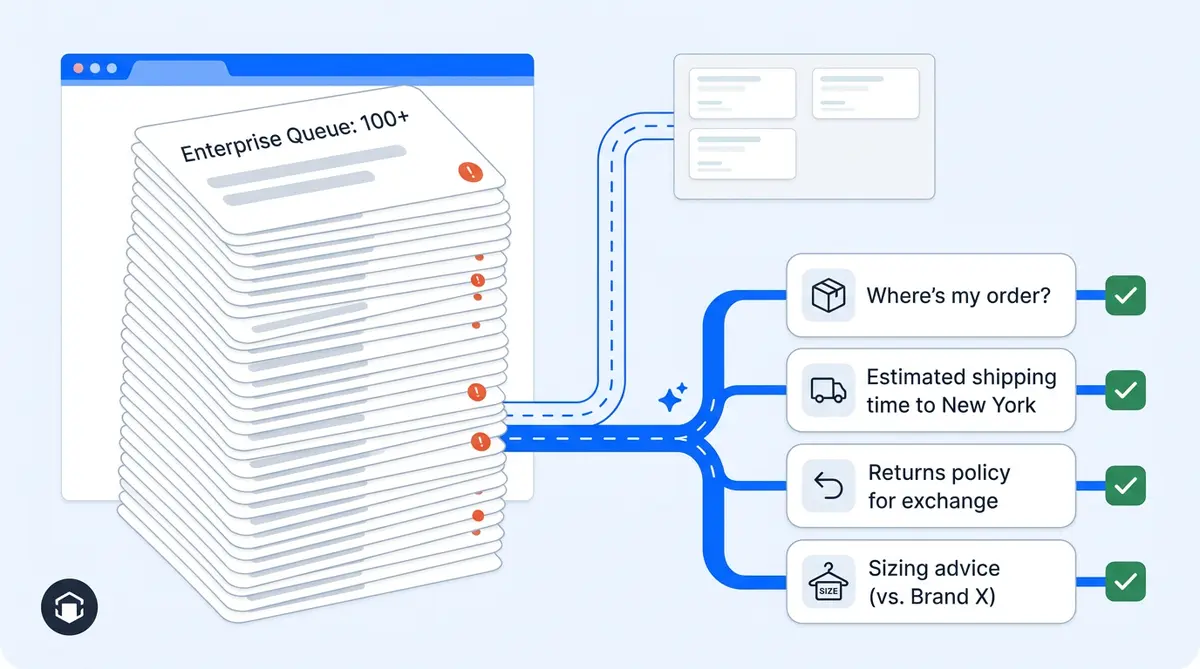
Order status checks, shipping timelines, return policies, product sizing questions, "which one should I buy?" conversations. These are repetitive, predictable, and perfectly suited for AI. When an AI agent handles them in real time, they never become tickets.
Alhena AI takes this approach. Instead of replacing your help desk, it sits in front of one, or replaces the need for one entirely for smaller teams.
How Alhena Differs from Zendesk and Traditional Helpdesks
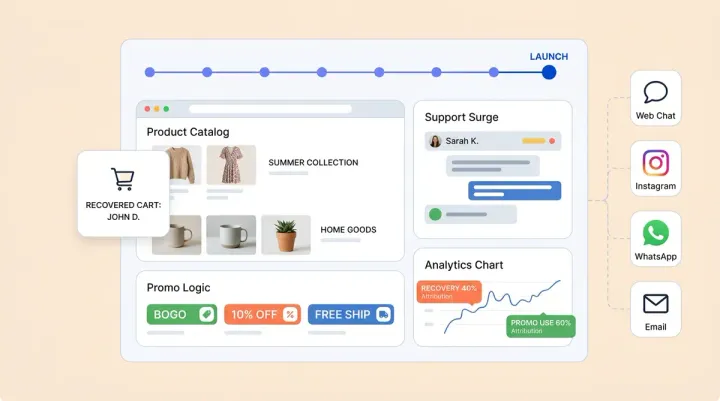
Alhena runs two specialized agents. The Product Expert Agent handles conversational product discovery, guided selling, and agentic checkout (populating carts and pre-filling checkout fields). The Order Management Agent processes returns, refunds, cancellations, and order tracking through automated workflows.
Unlike Zendesk AI, which resolves tickets, Alhena participates in the buying journey. It asks clarifying questions, recommends products based on shopper intent, and converts conversations into purchases. Brands like Tatcha saw a 3x conversion rate and 38% AOV uplift with 11.4% of total site revenue attributed to AI.
Works With or Without a Helpdesk
Alhena integrates with Zendesk, Freshdesk, Gorgias, Intercom, and Kustomer. You can layer it on top of your current stack or, for lean teams, use it as your primary customer-facing tool with only a lightweight ticketing layer behind it for escalations.
On the ecommerce side, it supports Shopify, WooCommerce, Magento, Salesforce Commerce Cloud, and BigCommerce. Channels include web chat, email, Instagram DMs, WhatsApp, and voice AI.
Real Results from Ecommerce Brands
- Tatcha: 3x conversion rate, 38% AOV uplift, 82% chat deflection
- Manawa: 43% lower workload, response time from 40 minutes to 1 minute
- Puffy: 63% automated inquiry resolution, 90% CSAT
- Crocus: 86% deflection rate, 84% CSAT
- Victoria Beckham Beauty: 20% AOV increase
Zendesk vs Alhena AI vs Ticket-First Alternatives
| Alhena AI | Zendesk | Ticket-First Alternatives | |
|---|---|---|---|
| Approach | AI-first: deflect + sell | Ticket-first: manage + resolve | Ticket-first: lighter + cheaper |
| Ecommerce Sales | Product discovery, guided selling, agentic checkout | None | Gorgias Shopping Assistant (Shopify only) |
| Pricing | Credit-based, predictable | $115+/agent/mo + AI add-ons | $0-$25/agent/mo (varies) |
| Setup Time | Under 48 hours | Weeks to months | Hours to days |
| Revenue Tracking | Built-in AI revenue attribution | No | No (Gorgias has basic) |
| Best For | Brands wanting AI sales + support | Large teams, complex workflows | Budget-conscious small businesses |
Five Questions to Pick the Right Zendesk Alternative
Use these questions to narrow your decision:
- Is your primary goal cost reduction or revenue growth? If cost, compare ticket-first alternatives. If revenue, evaluate AI-first platforms like Alhena.
- What percentage of your support volume is repetitive? If over 60%, an AI-first approach will save more than a cheaper helpdesk ever could.
- Do you sell on multiple platforms? Gorgias locks you into Shopify for AI features. Alhena and Freshdesk work across Shopify, WooCommerce, Magento, and more.
- Do you need AI that sells, or just AI that deflects? Zendesk AI and most ticket-first alternatives deflect. Alhena deflects and drives revenue through guided selling and checkout.
- How fast do you need to go live? If you need results this week, Alhena (48 hours) or Tidio (same day) beat Zendesk's multi-week implementation.
The Bottom Line
Zendesk is still a strong platform for large, complex support operations. But for ecommerce brands in 2026, the best Zendesk alternatives depend on what you're trying to solve.
If you want a cheaper helpdesk, Freshdesk, Help Scout, or Re:amaze get the job done for less money with less complexity.
If you want to rethink professional customer service as a revenue channel, Alhena AI provides hallucination-free product recommendations, agentic checkout, omnichannel coverage including voice and social, and built-in analytics tools that tie AI conversations to purchases. It deploys in under 48 hours and works with your existing ecommerce platform and helpdesk.
Ready to move beyond ticket-first support? Book a demo with Alhena AI or start for free with 25 conversations. Use the ROI calculator to see what AI-first support could save your team.

Alhena AI
Frequently Asked Questions
What is the best free Zendesk alternative for ecommerce?
Freshdesk provides a free tier for up to 2 agents with email and social ticketing. Tidio also has a free plan with live chat and a basic chatbot. For AI-powered support, Alhena AI offers 25 free conversations to test before committing, which allows you to see actual, real deflection and sales results before paying.
Can I use Alhena AI with Zendesk instead of replacing it?
Yes. Alhena allows direct integration with Zendesk. Many brands keep Zendesk for CRM-connected ticket management while using Alhena to handle the 60-80% of conversations that are repetitive (order status, sizing, returns) and to drive product sales through AI-guided shopping.
How much does Zendesk cost per month for ecommerce?
Zendesk Suite Professional costs $115 per agent per month. Adding Zendesk Advanced AI is another $50 per agent per month. A 10-person team pays roughly $19,800 per year. Many Zendesk alternatives offer per-ticket pricing or flat-rate plans that cost significantly less.
Which Zendesk alternative works best for Shopify stores?
Gorgias is built specifically for Shopify with deep CRM and order-level integration. However, its AI features are Shopify-only. Alhena AI supports Shopify plus WooCommerce, Magento, BigCommerce, and Salesforce Commerce Cloud with consistent AI capabilities across all platforms.
Does switching from Zendesk to another platform take long?
It depends on the alternative. Ticket-first tools like Freshdesk or Help Scout take days to set up. Alhena AI deploys in under 48 hours with without developer resources needed. Zendesk itself typically takes weeks to months for full configuration and control.
Can AI replace a helpdesk entirely for ecommerce?
For smaller teams, yes. When AI handles 60-80% of customer conversations (order tracking, returns, product questions, sizing), you may only need a lightweight ticketing layer for escalations. Crocus achieved 86% deflection and Manawa automated 80% of inquiries with Alhena AI.
What's the difference between AI-first and ticket-first support?
Ticket-first tools (Zendesk, Freshdesk, Gorgias) organize customer conversations into queues for agents to resolve. AI-first tools (Alhena AI) resolve most conversations before they become tickets and add a sales layer that recommends products and drives checkout. The difference shows up in both cost savings and revenue impact.