Agentic Commerce Has Arrived: A Brand’s Playbook for ChatGPT and Gemini
An AI agent can help someone choose a product without completing the payment. It can also complete an approved transaction without taking responsibility for every question that follows. That distinction is now central to agentic commerce.
On March 24, 2026, OpenAI described a shift toward merchant-owned buying experiences after finding its initial Instant Checkout approach too restrictive. Google’s agentic commerce initiative sets out a different route: purchases within its own surfaces for eligible products and participating businesses. There is no single destination for every sale.12
For an ecommerce brand, the question is not just whether an agent can sell your products. It is whether your business is ready to help the customer before, during, and after that sale.
Agentic commerce is shopping in which an AI agent interprets a customer’s goal and carries out authorized tasks on their behalf. Those tasks can include product discovery, evaluating alternatives, building a cart, and completing an approved purchase. Agentic does not mean unrestricted: the customer’s permissions and the available integrations determine how far the agent can go.23
This playbook focuses on what that shift means for your catalog, your online shop, and the customer relationship you still need to earn.
Three Eras, One Trend: The Conversion Surface Keeps Moving
A useful way to understand the change is to distinguish three experiences, rather than assume one has completely replaced another.
Traditional ecommerce: the customer does the navigating. A visitor searches, opens product pages, checks details, and builds a cart. A basic bot might answer a question or supply a link, but the customer coordinates the journey.
Conversational shopping: the assistant helps narrow the choice. Generative AI makes natural-language questions more useful. Alhena AI’s Shopping Assistant, for example, provides conversational search, guided questions, and product-specific answers on a brand’s site. The customer can shop by describing a need rather than translating it into filters.4
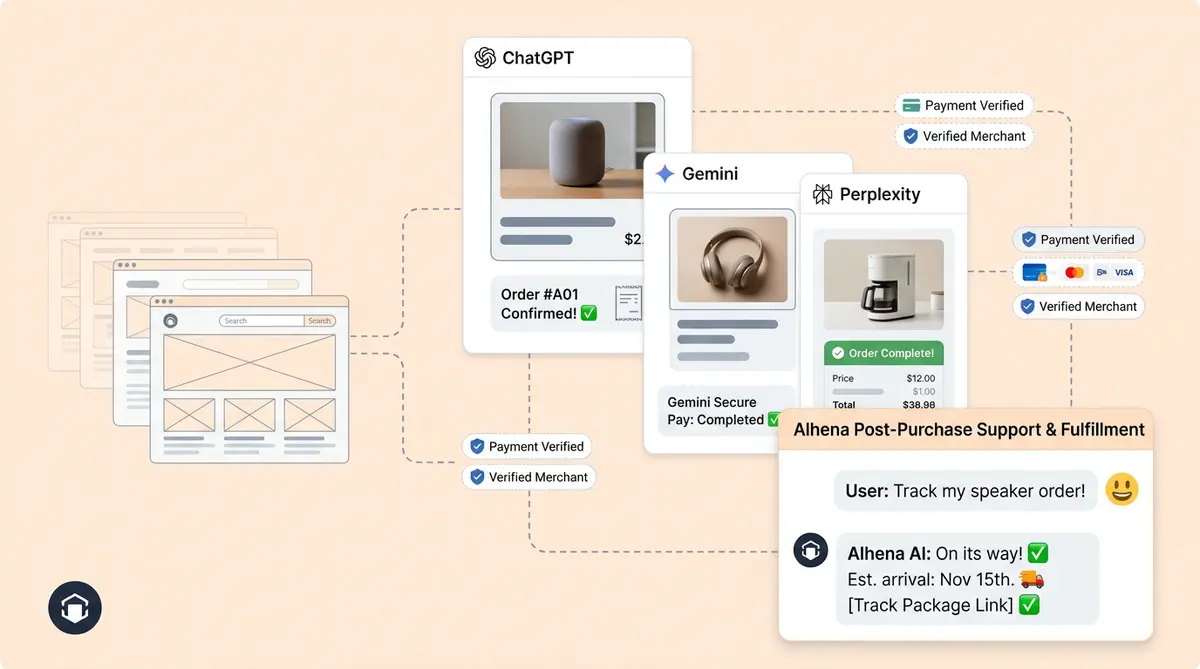
Agentic shopping: the assistant can carry out approved steps. An AI agent goes beyond explaining an option when it uses connected tools to perform a task. The original ACP announcement described passing an approved order to the seller’s existing systems, which retain responsibility for payment processing and fulfillment.3
These experiences can coexist in the same journey. Someone might ask an agent to narrow a shortlist, visit your site to check sizing, and return later with an order question. Build your agentic commerce strategy around those transitions, not a prediction that every product page will disappear.
Where Each Platform Fits Your Catalog
Start by separating where a customer researches from where they complete checkout. The table below describes documented approaches, not universal availability for every account or country.
| Platform | Shopping approach | Documented buying path | Practical priority for your brand |
|---|---|---|---|
| ChatGPT | Conversational product research and selection. | The March 2026 update emphasizes sellers’ own buying experiences, with native apps available for deeper integrations.1 | Prepare accurate product information and a useful landing experience. |
| Gemini and Google’s shopping surfaces | Product research connected to Google’s shopping ecosystem. | UCP supports embedded buying for eligible listings and participating sellers.2 | Check eligibility and keep your Merchant Center data consistent with your site. |
| Perplexity | Research-led shopping with product suggestions. | Instant Buy supports eligible products through participating sellers, including PayPal-enabled flows.5 | Confirm supported markets and products before planning around an embedded sale. |
For your own testing, use the same shopper questions across AI platforms. Does an agent find the correct variant? Does it explain a product limitation accurately? Does the destination preserve the item the customer selected?
A useful agentic commerce audit follows the whole journey. A mention without a usable destination is not the same outcome as a completed sale.
Amazon, Open-Web Assistants, and Your Store: Different Models of Agentic Commerce
Amazon’s Marketplace-Led Model
Amazon renamed Rufus Alexa for Shopping on May 13, 2026. Its assistant combines Amazon catalog information, customer activity, reviews, and other sources; it is not limited to marketplace data alone. Amazon’s 2025 update reported more than 250 million customers had used Rufus that year and that users were over 60% more likely to buy during a shopping trip. That is an observed association, not proof of incremental lift.6
The external-store model also needs a distinction. Shop Direct can send someone to a seller’s website. For eligible Buy for Me items, Amazon can complete an approved purchase from that external store. The merchant receives customer name and address information and manages delivery, returns, exchanges, and service.7
For your retail strategy, evaluate marketplace sales and external-store referrals separately. The agent may introduce the customer in both cases, but that does not make the data access, economics, or service responsibilities identical.
Open Standards and Seller-Controlled Systems
OpenAI’s Agentic Commerce Protocol (ACP) and Google’s Universal Commerce Protocol (UCP) provide ways for an agent to interact with business systems. They are not interchangeable guarantees that every retailer can immediately offer every payment experience. The published designs preserve the seller’s role in the transaction, while the customer-facing experience depends on the implementation.23
For a retailer, the useful question is operational: can the agent identify the right product, obtain current information, submit only an authorized action, and return a clear result?
The Relationship Depends on the Actual Handoff
Avoid building a strategy around the claim that external assistants never provide support. Amazon documents order-status help and guidance on returns, for example.6
Instead, map the responsibilities in each channel. Which service identifies the customer? Which system holds the order? Who resolves an exception? Which conversations reach your team?
Agentic commerce does not remove your responsibility to make those answers clear. An agent that helps someone buy should not leave them guessing who can help when the item arrives damaged.
From Announcement to Implementation: Gemini’s Retail Rollout
Google introduced UCP on January 11, 2026, alongside partners including Shopify, Etsy, Wayfair, Target, and Walmart. Its announcement described a common standard spanning shopping and after-sale support, with businesses remaining the seller of record.2
On March 24, 2026, Gap announced support for buying through Google’s search and Gemini experiences alongside predictive sizing technology. The announcement used forward-looking availability language, so it should not be treated as proof that every customer could use the complete experience that day.8
The practical lesson for an apparel retailer is broader than payment placement. An agentic journey needs dependable size, variant, and availability information as well as a working transaction path. A customer asking for a jacket that fits a specific occasion needs more than an attractive image.
Treat that as a readiness test for your own catalog: could an agent explain the differences between two sizes or fabrics using information you actually publish?
The Real Shift: Your Site Becomes the Hub
Plan for a customer who arrives with some research already done, but not every concern resolved.
Imagine a shopper who asks an external assistant for a sofa that fits a narrow apartment. The agent supplies a shortlist. The customer then reaches your site to check whether the packaging fits through a stairwell and whether delivery includes assembly.
Your online shop needs to answer those questions without making the person restart the search. Put dimensions, delivery conditions, and relevant product answers where the visitor can find them. Give the on-site agent access to approved information rather than asking it to improvise.
The same principle applies after the sale. An order-status question should lead to the actual order, not a generic shipping paragraph. A return request should reflect the item’s eligibility, not a promise your team cannot honor.
For ecommerce teams, agentic commerce is therefore both an acquisition challenge and a continuity challenge. Treat the transition between an external agent and your own service as part of the product experience.
Owning the Conversation with Alhena
Alhena AI helps ecommerce brands manage the on-site conversation before and after a sale. Its Shopping Assistant supports product guidance; its Support Concierge handles connected service tasks such as tracking, returns, and cancellations, with escalation when a human agent is needed.49
That gives the two products distinct roles in an agentic commerce journey. Use product guidance to help someone validate a choice. Use service automation to resolve an order issue through the appropriate business system. Configure both around the information and actions your team approves.
Alhena documents grounding responses in company knowledge and approved policies, plus passing conversation history during human escalation. Do not assume that means an external platform’s private conversation automatically transfers into your store.9
The published customer results illustrate the opportunity. Alhena’s Tatcha case study reports 3× the site-average conversion rate and 82% chat deflection. Its Manawa case study reports 80% of chat inquiries resolved and response times falling from 40 minutes to under one minute. These are customer-specific results, not promised outcomes for every deployment.1011
For an agentic commerce program, use those examples to define your own measurement plan: successful assistance, completed orders, resolved issues, and customer satisfaction—not conversation volume alone.
How Does an AI Agent Work? From Intent to an Approved Purchase
Here is a practical workflow to use when designing or evaluating an agentic shopping experience. It separates understanding a request from having permission to carry it out.
1. Understand What the Customer Actually Wants
Consider the request: “Help me shop for a waterproof jacket under $150 that can arrive before Friday.”
The AI agent needs to identify the customer’s intent, budget, deadline, size, and any stated preference. Ask only for details that materially change the answer. Someone who needs rain protection for a commute may not need the same garment as a mountaineer.
This is where generative AI can make the interaction easier to follow. But useful language is only the start: the agent still needs reliable evidence for every material product claim.
2. Check the Facts Before Offering a Choice
Require the agent to check stock, delivery constraints, and current pricing against an approved source. An API connection may provide that information in real time; cached product copy should not be presented as a live inventory check.
Have the agent compare suitable options against the customer’s criteria. The best price is not necessarily the lowest displayed amount if delivery charges or an unusable arrival date change the value.
A good recommendation explains why an item fits and what remains uncertain. An intelligent-sounding answer is not enough when the underlying product facts are missing.
3. Separate Assistance from Permission to Spend
Make decision ownership explicit: the consumer sets the goal and permissions; the agent operates within them.
An autonomous workflow should have defined limits for spending, substitutions, timing, and approved sellers. Let an agent act autonomously only within that scope. A request to research a jacket is not permission to place an order, and access to a saved payment method is not blanket authorization.
Before an AI agent can act on a customer’s behalf, decide when it must ask them to confirm the exact item and total. Also define what happens when stock changes, the amount rises, or the requested variant is unavailable.
4. Confirm the Transaction, Not Just the Attempt
After an approved purchase, require the agent to verify the result in the connected system. A submitted request and a confirmed order are different states.
The retailer should provide an order reference, the final amount, and fulfillment details. When an operation fails or times out, the AI system should avoid blind retries that might create duplicates. Give the customer an intelligible status and an escalation route.
This is where agentic commerce needs operational discipline, not just persuasive conversation.
5. Support Repeat Needs Without Removing Control
A customer might ask an agent to reorder a household item within a set budget. Design the rule around product identity, quantity, frequency, and cancellation—not an assumption that past behavior authorizes future spending.
For a consumer who prefers to review each basket, a copilot experience may be more appropriate than automatic buying. Both can be useful ways to shop.
The trust test is simple: can the customer understand what the agent will do, stop it, and resolve a mistake? That is a better design target than maximum autonomy.
A Four-Step Playbook for Agentic Commerce
1. Enable Supported Connections in Proportion to the Opportunity
Start with the channels and integrations your business can actually use. Ask your platform and payments partners which capabilities are supported for your market, product categories, and account.
Do not equate a small payment-code change with a production-ready agentic commerce deployment. The original ACP launch described a minimal integration for certain existing payment setups, not a universal implementation timeline.3
For your pilot, document what the agent can read, what it can change, and when it must request approval. Test an unavailable item, a rejected payment, and an interrupted session before expanding access.
2. Optimize Product Data for AI Search and People
Keep identifiers, variant details, materials, dimensions, price, stock, and delivery information consistent across your site and feeds. Google recommends using product structured data and Merchant Center feeds together to help it understand and verify product information.12
For the retailer, the objective is not a paragraph that repeats every category keyword. It is a product record an agent can use without guessing. Publish accurate answers to the questions customers ask when they shop, including compatibility, limitations, and care requirements.
Make product discovery useful even when the customer’s wording differs from your category labels. “Fits a small hallway” deserves dimensions and access guidance, not only a collection name.
3. Check AI Crawler Access Without Abandoning Security
Review crawling permissions, your content delivery network, and hosting rules. Google’s guidance explicitly includes making important information available as text and ensuring infrastructure does not prevent intended crawling.13
Distinguish a public product lookup from an authenticated order action. An agent reading a size chart does not need the same permissions as an agent requesting a cancellation. Keep customer records and privileged operations protected.
Treat agentic access as a scoped integration. Do not remove protections simply because a visitor identifies itself as an agent.
4. Own the Experience at Both Ends
Design an arrival experience for someone referred by an external agent. Keep the selected item visible, make policy answers easy to find, and give the customer a clear next step.
Then connect the service journey. Alhena AI’s Support Concierge documents integrations with order and customer systems, task execution, and escalation to a human agent with context.9
For your agentic commerce pilot, track where assistance succeeds and where it breaks. Review incorrect product answers, failed handoffs, unresolved requests, and repeat contacts. Use that evidence to improve the experience before increasing traffic or permissions.
Key Takeaways
- Agentic commerce is a set of connected tasks, not one universal buying screen. Plan for embedded experiences, seller-site visits, and mixed journeys rather than assuming a single model will win.
- A trustworthy agentic experience needs accurate data and explicit authority. A fluent AI answer is not evidence that an agent checked inventory or received permission to spend.
- Keep the customer relationship operational. Make it easy to complete the purchase, find the order, and resolve the next question. A completed sale is the beginning of the service relationship, not its end.
Frequently Asked Questions
What Is Agentic Commerce?
Agentic commerce lets an AI agent perform authorized shopping tasks for a customer, rather than only display information. The agent might find suitable products, build a cart, or help complete payment. Its scope depends on the available tools and the customer’s permission; it does not imply unrestricted spending.23
How Is an AI Agent Different from a Traditional Shopping Bot?
A traditional bot may follow a script or return a predefined answer. An AI agent can use connected tools to carry out a task and respond to the result. Generative AI can support both experiences; the distinction is whether the system can take authorized action, not how natural its language sounds.14
Can Customers Still Buy Directly Inside ChatGPT?
The answer depends on the integration. The March 24, 2026 update shifted emphasis toward sellers’ own buying experiences while retaining native apps as an option for deeper integration. Check the actual retailer experience rather than assuming every product can be bought in the same chat interface.1
How Does Agentic Checkout Change a Brand’s Website?
Build the site to support both customers who are just exploring and those who arrive with a shortlist. For the second group, prioritize the exact product, unanswered questions, and a clear route to payment. For an agentic commerce pilot, also test order tracking and returns so the handoff does not end at the sale.
Which Agentic Commerce Platforms Should a Retailer Prioritize?
Start with eligibility, catalog fit, and measurable customer demand. A retailer with established Google product feeds can investigate that ecosystem first; a specialist brand can test research-oriented channels such as Perplexity. Use a small set of representative questions to compare results, then invest where the customer journey works—not simply where an announcement attracts attention.
How Can an AI Agent Shop Autonomously Without Undermining Trust?
Define the tasks it may perform, require appropriate authorization, and make the limits visible. An agent should not turn a research request into a transaction without permission. For autonomous routines, specify spending caps, acceptable substitutions, and cancellation controls. Give the consumer a record of what happened and a way to challenge it.
How Does AI Power a Better Shopping Decision?
Use it to reduce the work required to find and evaluate relevant information. An assistant should explain product differences, ask useful questions, and surface constraints. Keep the decision with the customer unless a clearly authorized routine applies. In agentic commerce, convenience should come from less effort—not from hiding choices or uncertainty.
How Can a Retailer Prepare Product Data for an AI Agent?
Use complete identifiers, explicit variant attributes, and current pricing and availability. Align visible content with product structured data and relevant feeds. Google recommends these complementary sources to improve its understanding of products.12 Where an agent checks stock in real time, make sure the answer comes from the live system rather than an old description.
What Happens to Support After an Agentic Sale?
It depends on the channel. In Amazon’s external-store Buy for Me flow, the seller manages delivery, returns, exchanges, and customer service.7 Map those responsibilities before launch. An on-site service layer can then help the customer reach the correct order and complete an allowed request instead of repeating the original buying journey.
How Quickly Can a Brand Enable Agentic Commerce?
Separate catalog preparation from transactional integration. For your rollout, check eligibility, data quality, payment support, and approval requirements before setting a date. Alhena describes supported Shopping Assistant integrations as mostly self-serve and Support Concierge deployment in days; confirm your particular systems and workflows rather than treating “under 48 hours” as universal.49
How Does Alhena AI Help Brands in the Agentic Commerce Era?
Alhena connects on-site product assistance with customer service. Its Shopping Assistant helps customers navigate products, while Support Concierge can automate connected support tasks and escalate to a human agent when needed.49 For an agentic commerce program, position Alhena around the brand-controlled experience rather than assuming it replaces every external shopping platform.
How Should Brands Measure Agentic Commerce Adoption?
Define the outcome before counting usage. Measure qualified referrals, AI-assisted orders, successful task completion, unresolved issues, and repeat business. Separate association from incremental impact by using a suitable control or holdout where practical. Review trust and loyalty alongside revenue so a faster transaction does not conceal a worse customer experience.
Ready to Own the Conversation?
Your next customer may arrive from an agent, a search result, or a direct visit. Give each person a useful path from product questions to dependable service.
Explore Alhena’s Shopping Assistant and Support Concierge, then choose one journey to improve before expanding your agentic commerce program.