Why Voice Commerce UX Patterns Matter
Only 2% of Amazon Alexa owners ever bought something by voice. Google Assistant, Amazon Alexa, and Apple Siri fared no better for online shopping. Amazon Alexa, Google, and Apple Siri all missed the mark. Smart home assistants like Siri, Alexa, and Google Home were built for smart home general queries and simple tasks, not commerce. Google Assistant fared no better for online shopping, and 90% never did it again, according to The Information. Amazon spent $10 billion a year on Alexa and smart speaker voice shopping still failed. Smart voice search through Alexa and these smart devices never caught on. Consumer behavior studies showed that e-commerce businesses learned that smart devices and shopping list features alone don't drive commerce because it treated voice as a standalone channel with no connection to the traditional e-commerce storefront.
The new model is different: voice-activated AI agents on real phone calls and web voice widgets, grounded in your actual product catalog, wired into your actual cart through smart, real-time interactions. Voice search, voice technology, and virtual assistants have matured past simple NLP keyword matching into next-generation generative AI conversational agents that use natural language processing and conversational interface design to interpret natural language voice commands. Unlike a text chatbot, the voice agent handles spoken intent with real-time responses and execute real actions against your store's APIs.
This post breaks down three voice commerce UX patterns for conversational AI voice that Alhena's AI-powered Voice AI runs in production. You'll learn how voice search, voice assistants, add-to-cart, handoff, and checkout actually work end-to-end.
Pattern 1: Voice Add-to-Cart
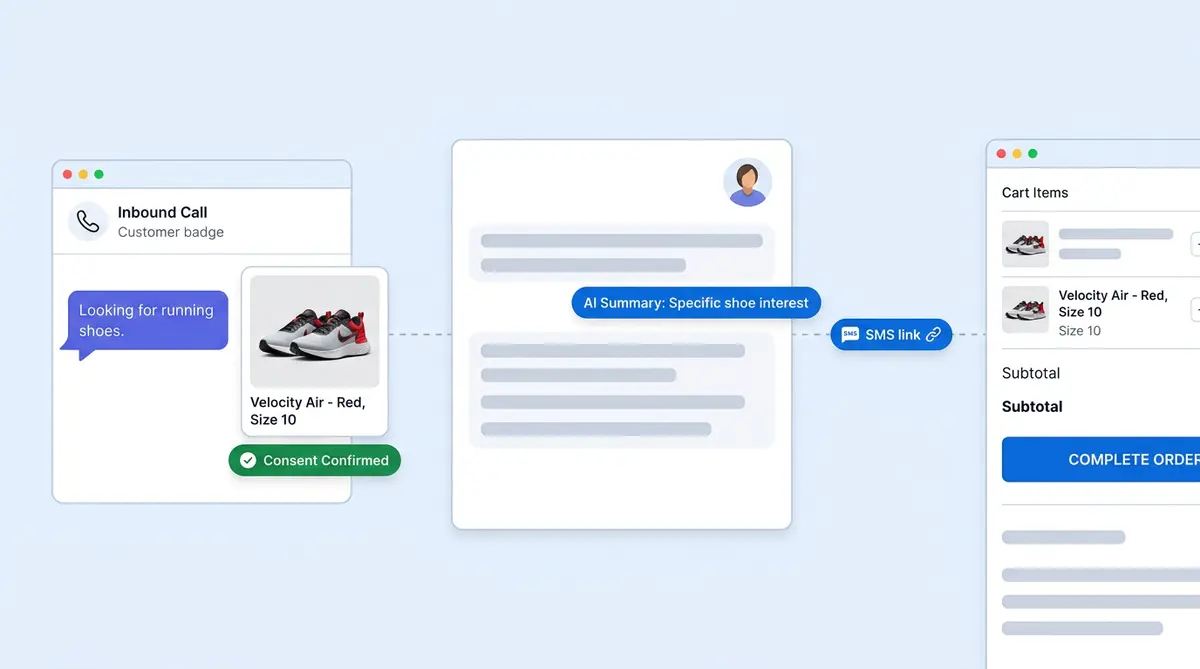
A customer says "add two of those running shoes to my cart." Between that sentence and a product appearing in their cart, four things happen in this ecommerce voice commands sequence.
Product Grounding, Then Consent
The voice agent doesn't guess which product the customer means. It handles product discovery by retrieving the product through Alhena's knowledge and render_product tools, using natural language understanding for voice search product discovery to resolve "those running shoes" to valid variant IDs with real prices, sizes, and detailed product availability. No hallucinated SKUs. This is the same hallucination-free grounding pipeline that powers Alhena's text-based Shopping Assistant.
The AI model literally cannot call add_product_to_cart without first confirming. The tool description tells the model: "Requires explicit user consent before use. Ask 'Shall I add this product to the cart?' and only call this function after the user affirms." The model must obey its tool contract. The tool accepts an array of products with variant IDs and quantities, so multi-item requests like "add a size 9 and a size 10" reorder requests, reorder confirmations, or voice commerce requests resolve in a single turn.
Same Cart Path, Dual-Channel Confirmation
On confirmation from this voice-activated, AI-powered interaction, the voice server pushes a JSON frame down the live WebSocket: { "kind": "add_product_to_cart", "products": [...] }. The voice-activated storefront widget waits for the agent to finish speaking, hydrates the product through the rendering API, then calls the exact same add-to-cart function that clicking the button would call. For Shopify stores, that's /cart/add.js with the native cart drawer. For non-Shopify stores, it fires the products:added_to_cart SDK event. AI-powered revenue attribution via _alhena_fingerprint is preserved. A built-in throttle prevents double-adds when the model fires the same call twice.
The customer hears "I'm adding it now" while the cart drawer opens on screen. 46% of consumers don't trust voice commerce and virtual assistants to process orders correctly, per AppNova research. Dual-channel confirmation drives user engagement and in this voice-assisted, AI-powered shopping experience (voice narration plus visual cart update) closes that gap. For voice-activated phone callers with no browser, Alhena's server POSTs the product list directly to the cart endpoint, builds the cart server-side, and sends a checkout link by SMS mid-call. See our breakdown of the sub-second voice AI call stack for the audio pipeline details.
Pattern 2: Voice Handoff to a Human Agent
Every voice AI needs an escape hatch. The question is whether voice commerce agents drop context or preserve it. Unlike a text chatbot or basic voice search tools, good voice commerce tools maintain full conversation history through a conversational interface. Our guide to human escalation covers when customer service handoffs trigger. This section covers the telephony mechanics.
Detection and Gate
There's no separate ML classifier or speech recognition trigger. Speech recognition accuracy has improved dramatically. The AI assistant's realtime voice model itself decides when to escalate based on its system prompt, then invokes transfer_to_human with a reason parameter. Before any transfer executes, three checks run: Is phone handoff enabled? Are we inside business hours (timezone-aware)? Is a transfer target configured? If it's after hours, the AI pivots to a callback ticket: collects the caller's info, creates a ticket with the full transcript, and tells the customer someone will call back.
Two Transfer Modes
Direct phone/SIP transfer: The voice server updates the call through the Twilio REST API with a Dial TwiML verb pointing to the target number or SIP endpoint. Original caller ID is preserved for PSTN calls, so voice commerce systems hand off cleanly. The AI drops off once the dial starts.
Freshcaller bot action transfer: For brands running Freshcaller, the call originates in Freshcaller's IVR, gets handled by Alhena, and when escalation happens, Alhena hands it back through Freshcaller's bot action API with a transfer_call action. The caller re-enters the contact center's queues, skill-based routing, and agent availability logic.
Context Before Pickup
Before the human picks up, Alhena's transcript summarizer generates a full transcript, a brief summary (~200 characters), and an outcome classification (DEFLECTED, TRANSFERRED, CUSTOMER_DISCONNECTED). For helpdesk integrations (Freshdesk, Zendesk, Gorgias), the transcript attaches as a private note with an "AI Voice Call Transcript" header. The ticket flips to needs_human_response and gets tagged for reporting. No "can you repeat what you told the bot?"
Pattern 3: Voice Checkout
Voice is great for browsing and deciding in e-commerce. The user experience with voice commerce is terrible for entering a credit card number. Voice search works for finding products, not for payment. The voice checkout pattern splits the ecommerce shopping experience: voice handles conversation, a visual checkout page handles the transaction.
Throughout the call, Alhena builds the cart across ecommerce platforms and commerce sites (client-side via widget or server-side for phone calls). When it's time to buy, the checkout URL includes every item, quantity, and applied discount. Browser open? Alhena pushes checkout directly over the WebSocket. Phone only? SMS with the link.
This voice commerce design avoids PCI scope entirely, solving the biggest security concern (no voice authentication or card data touches the system) in e-commerce voice commerce. No card data touches the voice system. Payment happens in the browser through a secure, familiar flow. Alhena's own results with Tatcha: 3x conversion rate, 38% AOV uplift. See the full case study.
What This Means for Your Store
These three patterns cover the full arc of a voice commerce interaction, running in production across e-commerce retailers and businesses and ecommerce retailers today with smart devices and phone lines. Built on the same voice commerce, conversational commerce, and commerce uses infrastructure described in our complete guide.
Consent-gated tool contracts in this AI-powered, conversational voice system mean the AI can't go rogue. Smart RAG grounding means no phantom products. Dual-channel confirmation drives user engagement and, across all interactions, builds trust. Context-rich handoffs from AI voice to customer service agents mean humans pick up where AI left off. Customers can buy products through voice and get customer service help on the same call. Whether handling voice commands for tracking orders or answering product questions, the user experience stays consistent. Splitting voice from checkout means PCI compliance without friction. These voice commerce strategies boost sales. Marketing, sales, and e-commerce teams can finally attribute voice interactions and customer interactions to revenue and grow their voice shopping strategy with real data.
McKinsey projects agentic commerce could reach $3 to $5 trillion globally by 2030. Voice shopping, voice search, and natural language voice commands are the primary market interface for that shift. Voice assistants and voice-activated commerce are here to stay. The best voice commerce solutions combine voice search with real cart actions and automation.
Ready to see how voice commerce works on your store? Book a demo with Alhena AI or get started free with 25 conversations.
Frequently Asked Questions
How do voice assistants and voice search differ from smart speaker shopping?
Voice commerce is any transaction initiated or assisted through spoken conversation with an AI agent. Unlike Amazon Alexa or Amazon Echo smart speaker shopping (where only 2% of users ever purchased), modern voice shopping uses AI-powered, voice-activated agents on real phone calls. These conversational AI voice assistants process voice commands and voice search queries on web voice widgets connected to your actual product catalog and cart. Voice commerce and AI chatbot adoption drive this shift. The global voice commerce market worldwide is projected to reach $186 billion by 2030.
How do voice assistants handle add-to-cart without hallucinating products?
The AI assistant uses speech recognition, natural language processing, and conversational interface technology with retrieval tools to match spoken natural language product references against the merchant's actual catalog, resolving requests to valid variant IDs before calling any cart API. The tool accepts an array of products with variant IDs and quantities, so multi-item voice commands work in a single turn. Voice search and retrieval work together. If confidence is too low, voice assistants ask a clarifying question instead of guessing.
Does voice search and voice add-to-cart require new Shopify integration work?
No. The voice agent sends a WebSocket frame to the widget, which calls the same add-to-cart function that fires when a customer clicks the button. For Shopify stores, that means /cart/add.js and the native cart drawer. For non-Shopify stores, it fires the products:added_to_cart SDK event. Voice commerce ensures revenue attribution, conversion tracking, and cart scripts apply exactly as they would for any manual add-to-cart event.
What happens during a voice-to-human handoff?
The AI assistant's AI-powered, voice-activated conversational model decides to escalate based on voice commands by calling a transfer_to_human function. Alhena checks business hours and routes via direct Twilio Dial transfer (with caller ID preserved) or Freshcaller bot-action transfer back into the contact center queue. Before the human picks up, a full transcript, AI summary, and outcome classification are attached to the helpdesk ticket.
How does voice checkout handle payment securely?
Voice checkout splits the experience: the AI handles conversation and cart building, then generates a pre-filled checkout URL. Payment happens in the browser through the ecommerce platform's native checkout flow. It’s secure: no card data ever touches the voice system, which avoids PCI scope entirely. Smart voice commerce interactions across ecommerce platforms stay secure throughout.
What happens if the voice AI can't understand the customer?
Alhena uses consistent error recovery: for misheard product names, it offers the closest catalog matches and asks follow-up questions. For failed cart additions (out of stock), it suggests personalized recommendations and alternatives. A built-in throttle prevents double-adds. For dropped transfers, it falls back to creating a callback ticket. Every error path ends with a clear next step. Check our FAQ section below for more details on common voice commerce questions. Unlike Amazon Alexa, Google Assistant, and other voice assistants that gave up on complex requests, Alhena's voice assistants recover gracefully. Where other voice assistants fail silently, Alhena's voice search and voice assistants offer clear alternatives.
How long does it take to set up Alhena Voice AI?
Alhena deploys in under 48 hours with no dev resources needed. The voice-activated AI assistant connects to your ecommerce platform (Shopify, WooCommerce, Magento) and helpdesk (Zendesk, Freshdesk, Gorgias) through pre-built integrations. Configure your phone number or SIP line, set the voice and greeting, and the AI-powered voice search and natural language agent is live. If your text-based Add to Cart works with Alhena, voice works automatically.