For twenty years, the Product Detail Page was the centre of e-commerce. SEO landed shoppers there. They read specs, compared variants, scrolled through reviews, and clicked "Add to Cart." Every optimization dollar flowed toward making that page convert better.
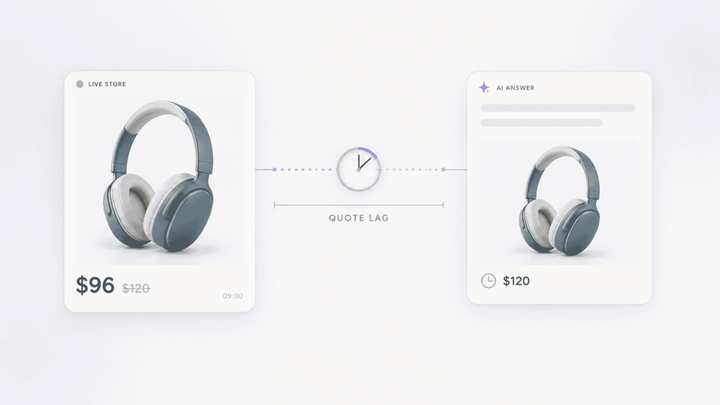
Two shifts are pulling the PDP apart. On-site, shoppers don't want to read five product pages and compare. They want to ask and be told. Off-site, shoppers are researching on ChatGPT, Gemini, and Perplexity instead of clicking through Google to your PDP. The page that once handled discovery, evaluation, and conversion is becoming a fulfillment artifact: a URL for compliance, price-of-record, and structured data that AI crawlers ingest.
With agentic commerce now live in ChatGPT and Gemini, this shift is accelerating. Read our brand playbook for selling inside AI chatbots.
This post maps which e-commerce pages lose their human audience, which ones transform, and which ones survive. If you're deciding where to spend your next redesign budget, this is the framework.
On-Site: How AI Shopping Absorbs the PDP's Job
Everything the PDP historically did, an AI shopping assistant now does inline. Shoppers who engage with AI during sessions convert at 12.3% vs. 3.1% without (a 4x lift), according to Neuwark. The unbundling is already happening across five functions.
Discovery Moves Into the Conversation
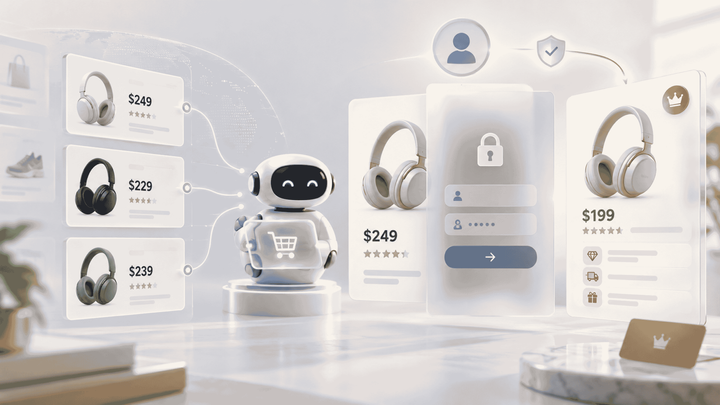
When a shopper asks, "what moisturizer works for dry skin under $50?", the AI searches the merchant's product catalog and returns personalized product cards directly in chat: image, title, price (including sale price), star rating, review count, and CTAs. No SERP. No PDP click-through. Multiple results appear as a horizontally scrollable carousel, the new product listing page, inside the conversation. Conversational commerce collapses the browse-filter-compare flow into a single exchange.
Amazon's Rufus already proves this at scale: 300 million users, 60% higher conversion rates and stronger engagement among active users. The category page didn't vanish, but its role as a discovery surface is hollowing out fast.
Add to Cart Without the Page
The "Add to Cart" button sits on the product card itself. On Shopify it calls the native cart API directly. On other platforms, merchants wire a handler to the SDK event. Shoppers never leave the chat to transact. Events like product:added_to_cart power revenue attribution back to the conversation, replacing the old page-based "did they land on the PDP?" metric.
Q&A Gets Answered in Context
The PDP's other job, does it run small? Is it machine-washable? what's the return window? gets handled by Product FAQs that the AI retrieves per-SKU and answers in context. FAQ pages have lost 60 to 80% of their traffic since 2022. The content still matters as training data, but the page as a human destination is fading.
Merchandising Moves to AI Policy
Merchants used to influence buying decisions through hand-tuned PDP copy. Now they influence AI recommendations through boost rules (prioritize specific SKUs) and natural language guidelines ("always recommend the newest collection first"). For fashion brands, outfit builders compose complete looks as a single card with combined pricing, replacing the "Complete the Look" widget that lived on the PDP.
Conversational Search Replaces the Funnel
Conversational search drops in as the site search itself, turning every query into a conversational answer with product cards. The funnel that used to be search, PLP, PDP, cart becomes ask, cards, and cart in a single surface.
Net result: on-site, the PDP has been unbundled. Discovery moved to the carousel. Merchandising moved to AI policy. Q&A moved to contextual answers. The CTA moved to in-chat Add to Cart. And attribution, once a "did they land on the PDP?" story, becomes conversation-level revenue tracking via SDK events and the revenue impact dashboard.
Off-Site: AEO Absorbs the PDP's SEO Role
The PDP's other reason to exist was SEO: it was the landing page Google sent buyers to. That traditional search traffic source is eroding. Zero-click commerce is accelerating: roughly 60 to 65% of Google searches now end without a click, and queries with AI overviews show 83% zero-click rates. Traffic from generative AI sources to retail sites surged 4,700% year-over-year in 2025 (Adobe), but that traffic bypasses PDPs entirely.
Product research increasingly starts and ends inside ChatGPT, Gemini, Claude, and Perplexity. Those engines synthesize answers and cite a handful of sources. Most PDPs never get cited. Only 0.3% of AI Overviews even include e-commerce sources, according to ALM Corp. The bar for earning a citation is high, and traditional PDP copy doesn't clear it.
This is where AI Visibility (AEO) replaces the PDP's old SEO work. As Jorrit Steinz, CEO of ChannelEngine, put it: "If product data isn't structured for machines, it won't surface where shopping now begins." Instead of optimizing a product page for Google rankings, brands now need to ensure AI engines mention and cite them. The process looks different:
- Prompt monitoring: Track the customer-style questions you want to be cited for ("best running shoes for wide feet") across ChatGPT, Gemini, and other engines in an omnichannel landscape.
- Visibility scoring: Measure what percentage of those prompts return your brand, your citation share vs. competitors, and which engines mention you.
- Content gap analysis: For every prompt where competitors get cited and you don't, identify what's missing and what content to create.
The work that used to be "optimize the PDP for this keyword" becomes "create the content that makes ChatGPT cite you for this query." Brands cited in AI Overviews earn 35% more organic clicks. The PDP optimization checklist still matters, but now it's about making the page machine-readable, not human-persuasive.
Under the hood, modern AEO tools run domain profiling, e-commerce context extraction, query expansion with AI volume estimation, per-provider search agents across OpenAI, Anthropic, Google, and Perplexity, plus citation extraction and brand-position tracking. It's a full answer-engine intelligence pipeline. The PDP's SEO job didn't disappear. It moved to a different system entirely.
The Pages That Survive (For Now)
Not every page gets absorbed. McKinsey's automation curve framework shows that AI delegation scales with trust and low regret risk. High-stakes, identity-signalling, or physical-world pages resist absorption. Three categories hold.
Checkout stays human. OpenAI launched Instant Checkout inside ChatGPT in September 2025, serving 900 million weekly users. By April 2026, Forrester confirmed it was pulled back due to poor performance; only a handful of merchants ever went live. Legal frameworks for AI-initiated payments remain unresolved, with open questions around consent, liability, and chargebacks for regulated goods. 77% of shoppers still prefer clicking through to a website to complete purchases. Agentic checkout can populate carts and pre-fill forms, but the final confirmation stays human. Checkout is the one page where friction is a feature.
Account and loyalty dashboards persist. These are personalized, stateful, and action-heavy. AI can summarize your points balance in chat, but the full management interface for redemptions, tier tracking, and preferences remains a page. Personalization at this depth requires authenticated sessions and real-time data feeds that conversational interfaces don't yet handle well.
AR and fit tools grow. The virtual try-on market is projected to reach $38 to $48 billion by 2030, with 30% higher conversions and 30% fewer returns for retailers that offer it. 43% of US smartphone shoppers in beauty and apparel now expect AR features. You can't replace "does this jacket fit my shoulders?" with a text response. These pages don't just survive the AI shift; they become a competitive moat that conversational AI can't replicate.
Where to Redirect Your Budget
The mismatch is clear: 40% of e-commerce businesses are still standardizing product pages for AI agents, and 33% haven't started at all, according to Digital Applied. Meanwhile, teams spend months on PLP visual redesigns and FAQ page rewrites for pages that fewer customers visit each quarter. McKinsey projects $3 to $5 trillion in AI-mediated retail by 2030. The customers using these AI channels need your data to be machine-readable. They don't need your PLP to have a prettier grid.
As BCG warned: "Retailers risk being reduced to background utilities in agent-controlled marketplaces." Flip the investment:
- Deprioritize: PLP grid redesigns, static comparison page template, FAQ page UX refreshes.
- Invest in: Structured product data quality. AI shopping assistants that absorb browse/compare/Q&A into chat. AI visibility audits that track your brand across answer engines. Checkout trust optimization. AR and fit tools.
Conversational commerce spending hit $290 billion in 2025, up from $41 billion in 2021 (a 7x increase in four years). One in five Cyber Week 2025 orders involved an AI agent. AI-referred shoppers convert 31% more and are 33% less likely to bounce.
The PDP isn't dying overnight, but its job description has changed. The sooner you stop optimizing it as a decision surface and start treating it as a data source, the sooner your store architecture matches the future e-commerce companies are building toward.
Ready to see how AI shopping and AI visibility work together? Book a demo with Alhena AI or start free with 25 conversations.
Frequently Asked Questions
Which ecommerce page types are most affected by AI shopping agents?
Product listing pages (PLPs), FAQ pages, and static comparison pages face the biggest disruption. Their core functions (browse, filter, answer, compare) are being absorbed into conversational AI interfaces. FAQ pages have already lost 60-80% of traffic since 2022, and category page browsing is being replaced by AI shopping assistants that handle discovery in a single conversation.
Are product detail pages still important in an AI-driven ecommerce world?
PDPs are more important than ever, but for a different reason. They're shifting from human decision surfaces to structured data artifacts that AI engines read, verify, and cite. Brands cited in AI Overviews earn 35% more organic clicks. The PDP becomes the source of truth that ChatGPT, Perplexity, and Google reference when recommending products.
How does conversational AI replace category page browsing?
Instead of scrolling through a grid of 48 products and toggling filters, shoppers tell an AI assistant their exact needs (budget, skin type, use case). The AI searches, filters, and ranks in one response. Amazon Rufus demonstrates this at scale with 300 million users and 60% higher conversion rates among active users.
Will AI checkout replace human-facing checkout pages?
Not in the near term. OpenAI's Instant Checkout was pulled back in April 2026 due to poor performance. Legal frameworks for AI-initiated payments remain unresolved (consent, liability, chargebacks), and 77% of shoppers still prefer clicking through to a website to complete purchases. Agentic checkout helps populate carts and pre-fill forms, but the final confirmation stays human.
What should ecommerce teams invest in instead of PLP redesigns?
Redirect budget toward structured product data quality (complete attributes, consistent schemas), conversational AI deployment, checkout trust optimization, and AR/fit tools. Currently 40% of ecommerce businesses are still standardizing product pages for AI agents, and 33% haven't started at all. Closing that gap delivers more ROI than any category page visual refresh.
How do AI engines like ChatGPT and Perplexity use ecommerce product pages?
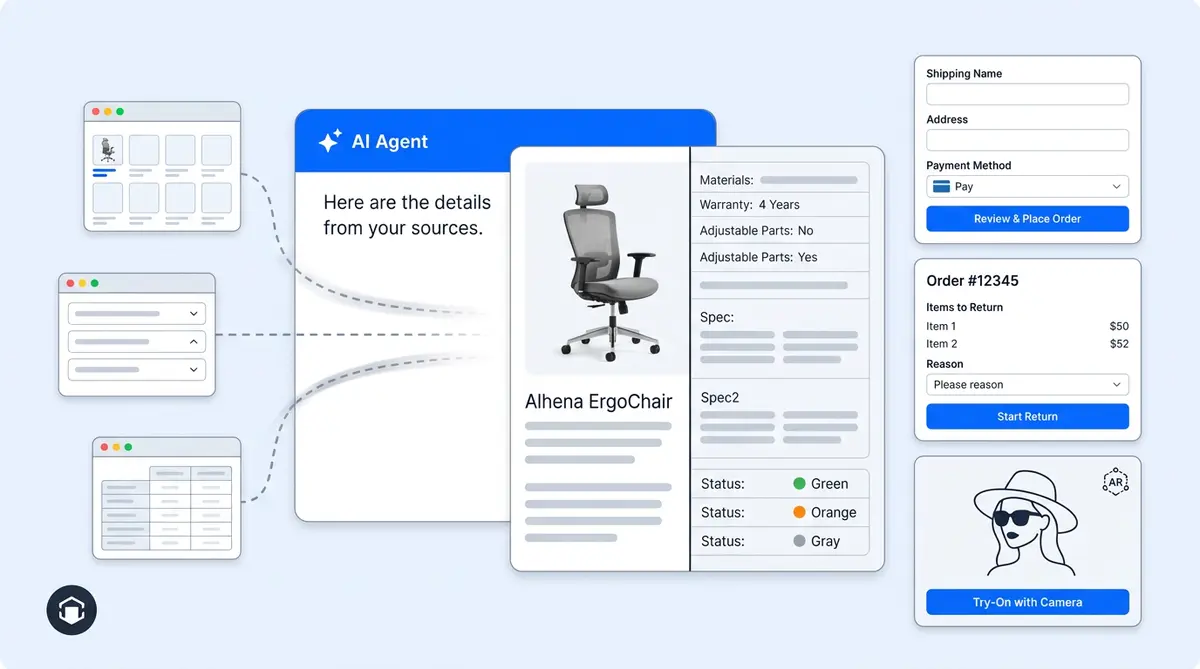
AI engines read your product pages for structured data (schema markup, attributes, descriptions) to verify facts before recommending products. They pull pricing, availability, specifications, and reviews. The page's most important visitor is now a machine, not a human browser. Making pages AI-readable through proper structured data directly increases your chances of being cited and recommended.
What is the difference between absorbed pages and transformed pages in ecommerce?
Absorbed pages lose their human-facing function entirely to AI (PLPs become unnecessary as browsing surfaces, FAQ pages lose visitors to AI answers). Transformed pages still exist but serve a different audience: PDPs shift from persuading humans to providing data for machines, and homepages shift from discovery hubs to brand trust signals that AI engines verify.
How fast is the shift from traditional ecommerce pages to AI-mediated shopping?
The shift is accelerating rapidly. Conversational commerce spending grew from $41 billion in 2021 to $290 billion in 2025 (7x in four years). One in five Cyber Week 2025 orders involved an AI agent. AI referral traffic to retail sites grew 693% during the 2025 holiday season. Teams that reallocate design budgets in 2026 gain 12-18 months of compounding advantage.
Do AR and virtual try-on pages survive the AI shift in ecommerce?
Yes. AR try-on and visual search tools are interactive and body-dependent, making them impossible for text-based AI to replace. The virtual try-on market is projected to reach $38-48 billion by 2030. Retailers with AR features report 30% higher conversions and 30% fewer returns. These pages grow in importance as competitive differentiators that AI discovery cannot replicate.